
chap04_5.
- 格式:ppt
- 大小:1.28 MB
- 文档页数:31

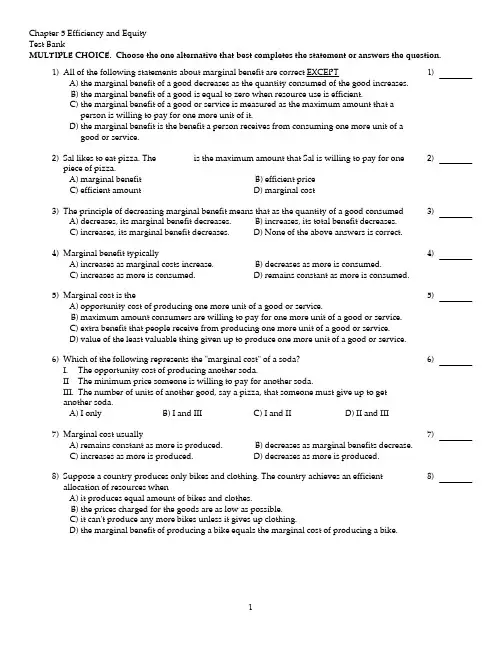
Chapter 5 Efficiency and Equity
Test Bank
MULTIPLE CHOICE. Choose the one alternative that best completes the statement or answers the question.
1)All of the following statements about marginal benefit are correct EXCEPT
A)the marginal benefit of a good decreases as the quantity consumed of the good increases.
B)the marginal benefit of a good is equal to zero when resource use is efficient.
C)the marginal benefit of a good or service is measured as the maximum amount that a
person is willing to pay for one more unit of it.
D)the marginal benefit is the benefit a person receives from consuming one more unit of a
good or service.1)
2)Sal likes to eat pizza. The ________ is the maximum amount that Sal is willing to pay for one
piece of pizza.
A)marginal benefitB)efficient price
C)efficient amountD)marginal cost2)
3)The principle of decreasing marginal benefit means that as the quantity of a good consumed

Notes for Chapter 5
The focus of this chapter is on nonwage labor costs, those costs that do not directly vary with the
number of hours worked by the worker. These nonwage labor costs include hiring costs, training
costs, and employee benefits.
Hiring costs
Hiring costs include all of the costs associated with the hiring process. These costs include the
costs associated with:
• placing advertisements,
• selecting candidates for interviews,
• interviewing candidates,
• selecting candidates for job offers,
• negotiating job offers, and
• processing the worker's employment (filling out W4 forms, I9 forms, and adding the
worker to the company's insurance and pension plans) in the human resources department
of the firm.
In the secondary labor market, hiring costs are generally relatively low. Hiring costs in the primary
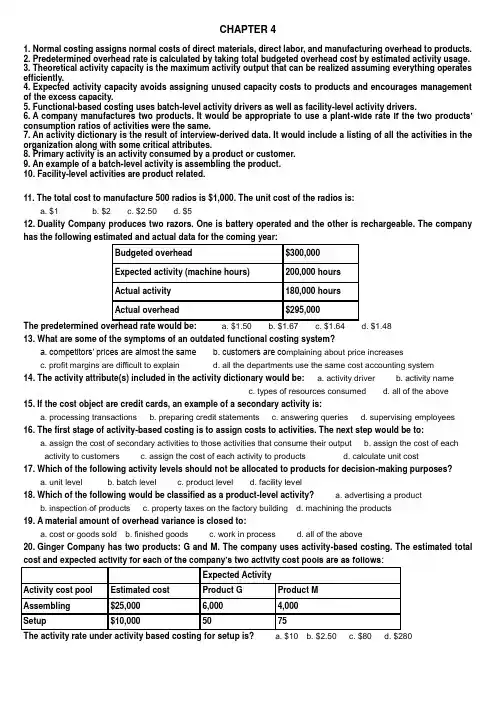
CHAPTER 4
1. Normal costing assigns normal costs of direct materials, direct labor, and manufacturing overhead to products.
2. Predetermined overhead rate is calculated by taking total budgeted overhead cost by estimated activity usage.
3. Theoretical activity capacity is the maximum activity output that can be realized assuming everything operates
efficiently.
4. Expected activity capacity avoids assigning unused capacity costs to products and encourages management
of the excess capacity.
5. Functional-based costing uses batch-level activity drivers as well as facility-level activity drivers.
6. A company manufactures two products. It would be appropriate to use a plant-wide rate if the two products’
consumption ratios of activities were the same.
7. An activity dictionary is the result of interview-derived data. It would include a listing of all the activities in the
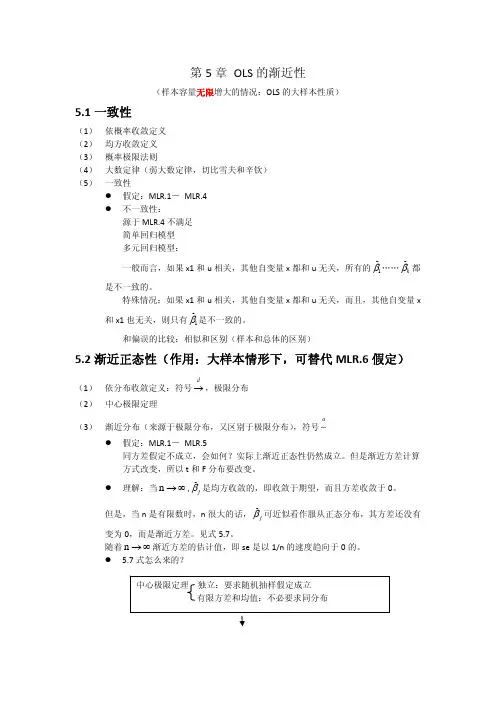
第5章 OLS的渐近性
(样本容量无限增大的情况:OLS的大样本性质)
5.1一致性
(1) 依概率收敛定义
(2) 均方收敛定义
(3) 概率极限法则
(4) 大数定律(弱大数定律,切比雪夫和辛钦)
(5) 一致性
z 假定:MLR.1- MLR.4
z 不一致性:
源于MLR.4不满足
简单回归模型
多元回归模型:
一般而言,如果x1和u相关,其他自变量x都和u无关,所有的1ˆβ……ˆkβ都
是不一致的。
特殊情况:如果x1和u相关,其他自变量x都和u无关,而且,其他自变量x
和x1也无关,则只有1ˆβ是不一致的。
和偏误的比较:相似和区别(样本和总体的区别)
5.2渐近正态性(作用:大样本情形下,可替代MLR.6假定)
(1) 依分布收敛定义:符号d→,极限分布
(2) 中心极限定理
(3) 渐近分布(来源于极限分布,又区别于极限分布),符号a∼
z 假定:MLR.1- MLR.5
同方差假定不成立,会如何?实际上渐近正态性仍然成立。但是渐近方差计算
方式改变,所以t和F分布要改变。
z 理解:当n→∞,ˆjβ是均方收敛的,即收敛于期望,而且方差收敛于0。
但是,当n是有限数时,n很大的话,ˆjβ可近似看作服从正态分布,其方差还没有
变为0,而是渐近方差。见式5.7。
随着n→∞渐近方差的估计值,即se是以1/n的速度趋向于0的。
z 5.7式怎么来的?
中心极限定理 独立:要求随机抽样假定成立
有限方差和均值:不必要求同分布
怎么估计渐近方差呢?一般用有限的12ˆijnnr−×∑代替()12ˆnplimijnr−×∑来
估计
2σ未知怎么办?用2σ代替
5.3渐近有效性
z 渐近有效性定义:“致,且渐近正态”的估计量,其渐近协方差阵小于等于任何
一个一致且渐近正态的估计量的协方差阵,则它是渐近有效的。
z 格林P76:我们还没有在大样本中证明OLS按照“任何”一种标准都是最优的。
定理5.3也不过是告诉我们:在某一类估计量中,OLS是最优的,即渐近有效的 极限分布:()()()212ˆˆNormal0,plim,djjijnnrββσ−−→∑