
新概念英语第一册L55 56
- 格式:ppt
- 大小:4.86 MB
- 文档页数:65


笔试部分(100分)
一、补全单词。(20分)
1. l__ve(住 ) 2.__s u__ lly( 通常) 3.h__m__w__rk(作业) 4. h__m__(家)
5. l__n__h (午饭) 6. m__m __nt ( 现在) 7.st__m__ch a__he (胃疼) 8.s__z
__( 尺码) 9.p__d(信笺簿) 10.__nv__lo__e (信封) 11.m__s__(必须)
12.m__ __ th(嘴) 13.d__ct__r(医生) f__ __l (感觉)
15.t__l__ph__ne(电话) 16.h__ __da__he(头疼) 17.d__nt__st(牙医)
18.m__d__c__ne(药) 19.__sp__ri__(阿司匹林) 20. sh__p (商店)
二、按要求完成下列各词。(10分)
1.make (现在分词) 2. do(单三) 3. eat(单三)
4. 去上学________________________ 5. 在早上_______________________
6. go(单三) 7. 在正午____________ 8. 在夜晚_______________
9. does not(缩写) 10. tomato (复数)____________
三、单项选择。(20分)
( ) 1. What’s the matter your hand?
A. of B. on C. like D. with
( ) 2. Show your hand me. A. to B. on C. at D. of
1
新概念英语第一册
姓名:
2 课文1对不起!
课文3对不起,先生。
课文5很高兴见到你。
课文7你是教师吗?
课文9今天好吗?
3 Lesson 1 Excuse me! 对不起!
Listen to the tape then answer this question. Whose handbag is it?
听录音,然后回答问题,这是谁的手袋?
A: Excuse me!
B: Yes?
A: Is this your handbag?
B:Pardon?
A: Is this your handbag?
B:Yes, it is.
A: Thank you very much.
New Word and expressions生词和短语
excusev.原谅mepron.我(宾格)
yesadv.是的is v. be动词现在时第三人称单数
thispron.这 yourpossessive adjective你的,你们的
handbag n.女用手提包pardon int. 请再说一遍
it pron.它thank you感谢你(们)
very much 非常地
参考译文
对不起
什么事?
这是您的手提包吗?
对不起,请再说一遍。
这是您的手提包吗?
是的,是我的。
非常感谢!
4 Lesson 2
A About you
Copy this dialogue. Add your own name at the end. 抄写这段对话,. 在结尾处加上你的名字。
Sue: Excuse me. _ _____
John: Yes? _ _____
Sue: What's your name? _
_____
John: Pardon? _
_____
Sue: What's your name? _
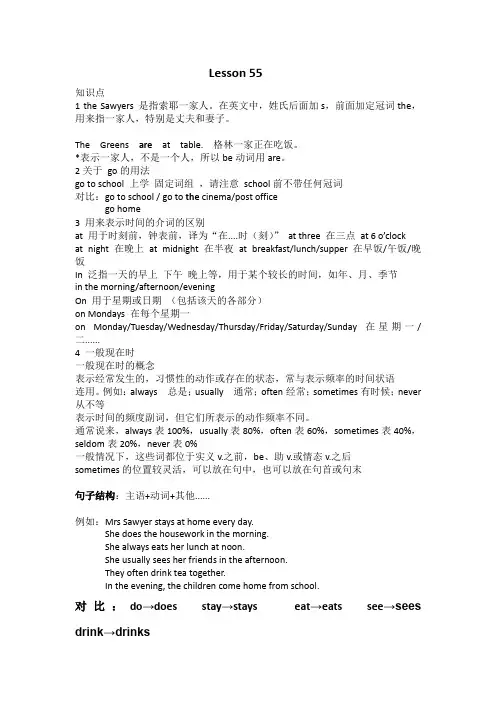
Lesson 55
知识点
1 the Sawyers 是指索耶一家人。在英文中,姓氏后面加s,前面加定冠词the,用来指一家人,特别是丈夫和妻子。
The Greens are at table. 格林一家正在吃饭。
*表示一家人,不是一个人,所以be动词用are。
2关于 go的用法
go to school 上学 固定词组 ,请注意 school前不带任何冠词
对比:go to school / go to the cinema/post office
go home
3 用来表示时间的介词的区别
at 用于时刻前,钟表前,译为“在....时(刻)” at three 在三点 at 6 o’clock
at night 在晚上 at midnight 在半夜 at breakfast/lunch/supper 在早饭/午饭/晚饭
In 泛指一天的早上 下午 晚上等,用于某个较长的时间,如年、月、季节
in the morning/afternoon/evening
On 用于星期或日期 (包括该天的各部分)
on Mondays 在每个星期一
on Monday/Tuesday/Wednesday/Thursday/Friday/Saturday/Sunday 在星期一/二......
4 一般现在时
一般现在时的概念
表示经常发生的,习惯性的动作或存在的状态,常与表示频率的时间状语
连用。例如:always 总是;usually 通常;often经常;sometimes有时候;never从不等
表示时间的频度副词,但它们所表示的动作频率不同。
通常说来,always表100%,usually表80%,often表60%,sometimes表40%,seldom表20%,never表0%
一般情况下,这些词都位于实义v.之前,be、助v.或情态v.之后
sometimes的位置较灵活,可以放在句中,也可以放在句首或句末

《新概念英语》第一册第73课 The way to King Street 到国王街的走法
【课文+译文】
Last week Mrs. Mills went to London. She does not know London very well, and she lost her
way. 上星期米尔斯夫人去了伦敦。她对伦敦不很熟悉,因此迷了路。
Suddenly, she saw a man near a bus stop. 'I can ask him the way.' She said to herself. 突然,她在公共汽车站附近看到一个男人。“我可以向他问路,”她想
'Excuse me,' she said. 'Can you tell me the way to King Street, please?'“对不起,您能告诉我到国王街怎么走吗?”她说。
The man smiled pleasantly. He did not understand English! He spoke German. He was a
tourist. 这人友好地笑了笑。他不懂英语!他讲德语。他是个旅游者。
Then he put his hand into his pocket, and took out a phrasebook. 然后他把手伸进了衣袋,掏出了一本常用语手册。
He opened the book and found a phrase. He read the phrase slowly. 他翻开书找到了一条短语。他缓慢地读着短语。
'I am sorry,' he said. 'I do not speak English.'“很抱歉,” 他说,“我不会讲英语。”
Word and expatiations
week [wik] n. 周;工作日,上课日,普通日