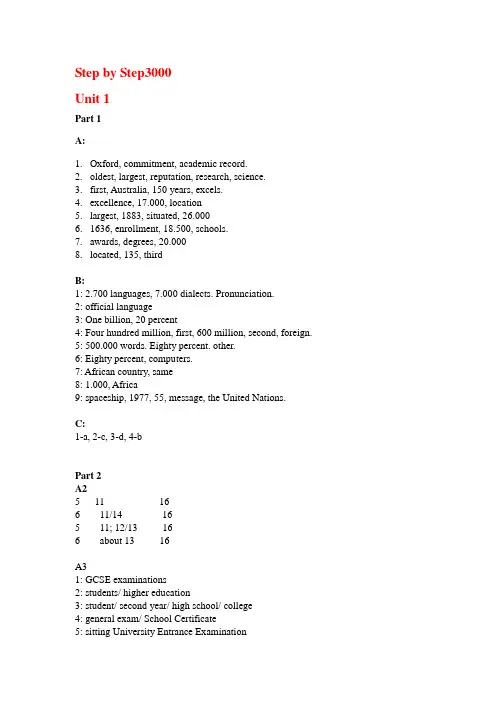
Step by Step3000Unit 1Part 1A:1.Oxford, commitment, academic record.2.oldest, largest, reputation, research, science.3.first, Australia, 150 years, excels.4.excellence, 17.000, locationrgest, 1883, situated, 26.0006.1636, enrollment, 18.500, schools.7.awards, degrees, 20.0008.located, 135, thirdB:1: 2.700 languages, 7.000 dialects. Pronunciation.2: official language3: One billion, 20 percent4: Four hundred million, first, 600 million, second, foreign. 5: 500.000 words. Eighty percent. other.6: Eighty percent, computers.7: African country, same8: 1.000, Africa9: spaceship, 1977, 55, message, the United Nations.C:1-a, 2-c, 3-d, 4-bPart 2A25 11 166 11/14 165 11; 12/13 166 about 13 16A31: GCSE examinations2: students/ higher education3: student/ second year/ high school/ college4: general exam/ School Certificate5: sitting University Entrance Examination6: bachelor’s degree: 3/4 yearsMaster’s degree: another year or twoDoctorate: a further 3-7 yearsB:B1: Idioms, largest vocabularyFrenchIn Spelling £pronunciationB2: FTFPart ⅢA1:ⅠA: AgeD Foreign student populationⅡA: 2: 15 hrs (+2 or 3 for lab)3: a: +100b: Discussion group 15-20c: much smaller4: informal, friendly6: 2-3 hrs: 1 hrA2:ⅡB: 2: Examination4: QuizzesC: regular attendanceⅢGraduate schoolC: SeminarsD: some area of interestE: a research paperB:B2:A good student: make mistakes, every new thing, the language. Working outside the classroom.A bad student: Passive, the teacher. Stick his neck out, more likely to be right than himself.Part ⅣA:1 gate2 the History Department3 the Psychology Department4 he Library5 the Education Department6 the Philosophy Department7 the Geography Department8 the Sports Ground 9 the Foreign Language Department10 the Chinese Department 11 the Physics Department12 the Mathematics Department 13 the Chemistry Department14 the Clinic 15 the Auditorium16 the Administration BuildingB:Robert MartinBiology, next fall, six years in a public school in the hometown; two years in a military school; high school in the hometown.Science( biology in particular), sports.Unit 2Part Ⅰ16.998.00064.186.300840.0001.000.0003.320.000143.24432.4832.966.0005.105.70029.028ˉ1.3125.31536.1984.145B1.243.738.000955.220.000267.901.000199.867.000159.884.000147.105.000138.150.000125.638.000122.013.000118.369.00096.400.00082.071.000C1 .Chinese 1.300 million2. Spanish 332 million3. English 322 million4. 189 million5. 182 million6 170 million7. Russian 170 million8 Japanese 125 million9 Germon 98 million10. 75.5 million11. Korean 75 million12. French. 72 million13. Vietnamese. 67 million14. 66 million15. 64 million16. 63 million17. Turkish 59 million18 58 million19. 44 million20. Polish 44 million21. Arabic 42.5 million22. 41 millionPart ⅡA:1. A baby boy2.social, ecological, populations3.longer, healthierB:1: b 2:c 3:aPart ⅢA: water, 70%, red or brown, plant cover, snow, continents, islands, arms of the ocean, connecting, a channel, valleys, plains.B: in 1950:New York, 12 millionLondon: 2, 10 millionCalcutta: 10,Tokyo: 3In 2000:New York: 6Calcutta: 4, 16millionTokyo: 18 million1.Mexico City2. Sao Paulo3. Rio de Janeiro4.Bombay5.Delhi6.Shanghai7.SeoulPart ⅣSkills, the main idea, what, recognize, central, important, direction, purpose, inform, compare, answer, stated, a topic sentence, first, details, difficult, persuade, end, implied, hinted at, a whole.Unit 3A: BA912, 11:20 17BA877 11:20 14BA292 11:25 19TW695 11:30 164EA831 11:35 24BA838 9IB290 11:35 15LH039 11:40 9BA666 11:40 18AI 141 6BA560 22B:Drinks: Tea Soft drinks CoffeeFood: Egg and tomato; Ham and tomato; Roast chicken ; CheeseburgersPart Ⅱ9:15 10:3010:30 13:30Advantages: by plane: Quick/beautiful viewBy train: frequent service (hourly)/modern/ comfortable/ lovely view from dining car Disadvantages: by plane: have to get Gatwick Airport/ expensiveBy train: quite crowed/ quite expensivePart ⅢCuster 1 customer 2Sep. 4-Sep. 17 Aug.5- Aug.182 doble and 1 single 1 double and 1 big bedroom with 2 singlebeds and a sofa3 1 full bathroom3( kitchen, dining room, sitting room) 2(kitchen, living-sitting room) √ ×√( six days a we ek) ×£80 for a Fiesta £98 for a Fiesta√ √£570 £270B: b; dUnit 4Part ⅠA1.Argentina: A tie is too personal(1)2. . Roses mean love(2)3, Even numbers(2.4.6,rtc ) are unlucky.(2)4. Japanese people usually don’t give four of anything as a gift.(2)B1.Japan,Korea2.Brazil, Russia3.Canada, the U.S4.Egypt, MexicoC1. February 14 ,European, North American2. March 2, Japan3. May 5, Japan4, May 5 China5. August 15 China6. April 1,European, North American7. July 14, France8. December 26,Britain, Canada9. May 1, European, Canal, Philipine, Latin American10 November 25, France11. March 17 Ireland12.the 2nd Sunday in May, England, France, India, ChinaPart ⅡA1: 1. changed, few, bored, rainy2.museum directors, what they are seeing.3.provide fun, feel at homeA2: electricity/pass/body17th century instruments/musicput on costumes/ the Stockholm Operabone-by-boneA3:Ⅰnew audiencesA: the youngC: the less educated membersⅡ: A. rebuiltB. 1. modern2. a. lighting, color and soundb. fewer objectsⅢA: guidedB: touch, listen, operate and experiment; scientific principles Ⅳ. educational; departmentA: filmB: danceB:squid; his nameC:C1: a. vendorsb. fortunec. eatinga.street performersb.portrait paintingC2: 1.a. special powers/ attract menb. objects/ for snake bites2. shells/ on a cloth/ the way they land3. round cakes/ bean flour/hot spices/ fried4. a. folk singers/ guitarsb. classical musiciansc. actors5. practice drawing and paintingPart ⅢA. A2. 1. much busi er; Monday …Saturday2. humid and hot4. much colder, _30℃5. much flatter; beautiful6. mountainous7. higher; rocky8. more crowed9. smaller10. tallerB.Gestures of approval:1.Thumbs up in France, latin American2.Two thumbs: Kenya3.Tunisia4.Greece5.Lebanon, Iran6.Tonga7.Italy8.Europe Latin America9.Mexico, Costa Rica, Japan10.Bolivia, Honduras, Lebanon11.Barbados12.Bangladesh13.Greece, Iran. ItalyPart ⅣB: 1-g; 2-f; 3-j; 4-I; 5-e; 6-b; 7-h; 8-a; 9-d; 10-c FFTTFUnit 5Part IA]1.Octorber 1969 / first email message2.March 1972 / addresses3.February 1976 / head of state4.fall 1976 / Jimmy Carter / US $45.September 1983 / higher education / accounts6.December 1994 / erase / destroy7.December 1998B:One feature of the information superhigha is that the traffic travles fast, and techies use their own special shorthand to keep mesages zooming along. Today we’l help you decode tach talk by answering soome not so frequently asked questions about abbreviations on the Internet.What does it mean when a message includes the letters AISI or IMHO? AISI stands for “as I see it” and IMHO is shorthand for “in my humble opinion”.Some modest folks will also add FWIW before sharing their opinion, which stand for “for what it’s worth”. Others express their disapproval with the letters CMIIW. That is “correct me if I’m wrong”The lsit of commonly abbreviated phrases on teh Net is neaerly endless. As a matter of fact, AAMOF stands for “as a matter of fact” and “believe it or not” gets posted as BION.Are there any pre-Information-Age abbreviations still making tteh rounds in this high-tech era? You bet. The old stadnbys FYI, MYOB, and SOP which stand for “for your information”, “ mind your own business,” and “standard operating procedure” are still frequently used today even in email.Since time is getting short, ahs the Net given us truly short and clear ways to say good-bye? Try TAFN (That’s all for now) and BCNU (be seein’ you).C:1.Tim Berners-Lee is the man who wrote the software program that led to thefoundation of the World Wide Web2.In the 1980s scientists were already communicating using a primitive version ofemail.3.in 1990 Tim Berners-Lee wrote programs which from the basis of the World WideWeb4.in 1991 his programs were placed on the Internet.5.between 1991 and 1994 the number of web pages rose from 10 to 100,000.6.right now the world is focused on e-commerce.7.The invention for the web brings rapid rewards to people wit imagination and newideas.Part IIA1Connected / system / connection / work together / stations / peopleA2Connection of railroads or other vehiclesConnected system of radio stationsSystem linking a number of computers together.原文:Few things in this world change as fast as languages. Every day, new words are created to deal with new ideas or new technologies. New meanging also are added to exisitng words. A dictionary published years ago may show one or two meanign for a word; a dictionary published today may list several more meaning for the same word. Network is one such word. It combines two words. The first is “net”, it means materials that are connected; the second is “work”. One meaning of “work” is a system. Network means a connection of systems that work together. The systems that networks connect can be very different. For example ,radio and television stations can be connected in the network, so can computers and even people.Word expert Milford Matthew found written uses of the word “network” in the late 1980s. The word then was used as a verb, a word that show action. At that time network meant the connection of railroads or other vehicles used for travel. One publication said it is only a question of time when the railroads will network an area of the American west called the “Pan Handle”. Another publication of the time said complete areas are networked by trolley cars , which are a kind of electric train.Now we often hear network used in connections with broadcasting. The Barnhart Dictionary of New English says that as early as 1914, people used it to mean a connected system of radio stations. This meaning continues to be popular. A more modern use of the word “network” is linked to computers. A network is a system that links a number of computers together. Networks make it possible for people who use computers to share information in costly equipment. Many companies and government agencies share the same computer network. The computers are linked through a main computer or through special lines. Some people are able to do their jobs from their home computers.Computers networks also permit an exchange of unofficial information and discussion between computer users. By linking their computers to telephones, people can buy goods through their computers. They can send messages to friends in many countries.Another modern use of the word “network” concerns relations between people. Ideas and information are exchanged by people who network to share interests and goals. Many Americans network to get better jobs or to meet new friends. Meeting new friends by networking is not work though is fun.BB1b. Getting assignments and research papersc.Attending professors’ “virtual office hours”d.Course lectures.Entertainment b. online gamesCommunications b. toll-free phone callse-commerce orders.原文:The proposed merger of America Online and Time Warner anticipates an age when high-speed Internet access is everything. It will be pipeline for almost all the entertainment, communications and information that people consume.It is an era so distant to most Americans that they can hardly envious it. And yet is already exists. In fact, it is the only world that today’s college students know. Colleges across the United Sates have spent hundreds of millions of dollars in recent years wiring dormitories for high-speed Internet access.When admissions people go out and talk to students these days, the students always asks, “Do you have a high-speed network?” indeed, fro today’s students, having high-speed Internet access is a top priority. They base their housing decisions on it, and restructure their meager student budgets to afford it.College administrators acknowledge that academic pursuits are just a fraction of the activity on their campus networks. The bulk of the traffic consists of data containing music files, instant messages, toll-free phones calls, e-commerce orders, online games and just about anything.Ata a high-rise dorm at the University of Southern California, walking down the hallway on the eighth floor almost any time of dya, you’re likely to hear students in separate rooms shouting at each other --- “You killed me!” as they mow each other down in online games played over the network. Friends from opposite ends of the floor simultaneously make for the elevators. They’ve just messaged each other by computer that it’s time to head off to the dining commons. To them, knocking on someone’s door is an antiquated 20th century tradition.Today’s students regis ter for classes, get their homework assignments, research papers and attend professors’ “virtual office hours” online. Some universities even post course lectures on the Net, so that students can review them any time they wish.Just as one the students p ut it “We live our lives over the Internet.”Part IIIA1.The desktop into our everyday life.2.Experimenting anarchy3.Disappear4.EconmoniesA: we’re gonna take a closer look tonight again at the future of the Internet. Not that we have anything but the va guest idea where it’s going in the long run. One of the truly fascinating and somewhat unsettling aspects of the Internet revolution is howmany technologists and scientists say that the future may hold any number of surprises. So we’re going to inch our w ay into the future.P: At the Internet World Trade Show in New York, they see a future when the web is everywhere.St: Technology is moving from the desktop into our everyday life.P: Imagine work, society, economics, relationships, all transformed, when anyone, anytime can get any message or knowledge or amusement they want, anywhere on the planet without so much as a wire.S2: in many ways, the Internet is the world’s largest experimenting anarchy, because all of a sudden, the citizens of the world are in charge, and no single government or governing body is in charge of what they do.P: Keep in mind that the web, transmitting by satellites, cellphone, cable, goes through no one central location that anyone controls. So many of the boundaries that exist today, political and economic, will be strained as never before. Some scientists say three quarters of the world’s languages will disappear as the net connects isolated places. Already English is what you find on most web pages, blending cultures, no matter how much people try to save them. Economies are changing too. As distance becomes meaningless, white-collar clerical, accounting or administrative jobs are being exported to Asia, just as blue-collar factory jobs were years ago.S3: Imagine, there are 40 or 50 million Indians, not to mention the Chinese, who could deliver office work to the rich countries of the world for two dollars an hour. P: So this massive web of information is both an asset and a threat, changing cultures, economies, and governments, in ways no one can imagine or control.BB1Person to person / real many more real / friends1.Relatives 1. Careers2. 2. Medical cries3.Neighbors4.Colleagues5.By phone 4. Choosing a school or collegeThere’s a professor at the University of Toronto in Canada who has come up witha term to describe the way a lot of us North Americans interact these days. Andnow a big research study confirms it.Barry Wellman’s term is “network individualism”. It’s not the easiest concept to grasp. In fact, the words seems to contradict each other. How can we be individualistic and networked at the same time? You need other people for networks.Here’s what he means. Until the Internet and email came along, our social networks involved flesh-and-blood relatives, friends, neighbors, and colleagues atwork. Some of the interaction was by phone, but it was still voice to voice, person to person, in real time.But the latest study by the Pew Int4rnet and American Life Project confirms that for a lot of people, electronic interaction through the computer has replaced a great deal of social interchange. A lot of folks Pew talked with say that’s a good thing, because of concerns that the Internet was turning us into hermits who shut out other people in favor of a make-believe world on flickering computer screens.To the contrary, the Pew study discovered. The Internet has put us in touch with many more real people than we’d have ever imagined. Helpful people, too. We’re turning to an ever-growing list of cyber friends for advice on career, medical crises, child-rearing, and choosing a school or college. About 60 million Americans told Pew that the Internet plays an important or critical role in helping them deal with major life decisions.So we networked individuals are pretty tricky: We’re keeping more to ourselves, while at the same reaching out to more people, all with just the click of a computer mouse.Part IVDaily communication / broadcast programs / in print / listeningFailure / digit / losses / ignoreRead / Intensive training / regularCommas / sensitivity to numbersUnit 6Part IA:1.Paris3.19324.Berlin6. Tokyo7. 19721—d 2---a 3----g 4----b 5----f 6----e 7-----c听力原文Women competed in Olympic events for the first time in Paris in 1900.In 1924, the first Winter Games were held in Chamois.In 1932, the first Olympic village was built to accommodate athletes in Los Angeles. In 1936 in Berlin TV cameras broadcast Olympic events for the first time.The 1956 Olympic in Melbourne were the first Olympic Games to be held in the southern hemisphere.Tokyo hosted the first Asian Olympics in 1964.In 1972 for the first time, over one billion TV viewers watched the Munich Olympic opening ceremony.B.BaseballWatch games on television or listen on the radio American footballPlay the sport soccer听力原文:What is the most popular sport in the United States? That might be an impossible question to answer. There are different meanings of the words “most popular”.One way to measure the popularity of a sport is by the number of people who pay to watch it played by professional teams. Experts say the most popular American sport by that measure is baseball. Each professional baseball team plays 162 games every season.Or the popularity of a sport can be measured by the number of people who watch games on television or listen on the radio. Then the answer might be American football.And the popularity of a sport could be measured by the number of people who play the sport instead of just watch it. The answer, in this case, is the game people in the United States call soccer. It says more than 18 million people play soccer in the United States.C1—d 2--- h 3---a 4---e 5---i6---c 7---g 8--- b 9---j 10---f听力原文:Right, everybody. Stand up straight. Now bend forward and down to touch your toes ----- and up ---- and down ---- and up. Arms by your sides. Raise your right knee as high as you can. Hold your leg with both hands and pull your knee back against your body. Keep your backs straight. Now lower your leg and do the same with your left knee ------ up ---- pull towards you -----and down. Move your feet further apart, bend your elbows, and raise your arms to shoulder level. Squeeze your fists tightly in front of your chest. Now push your elbows back ------ keep your head up! And relax…. Feet together, and put your hands on your hips. Now bend your knees and stretch your arms out in front of you. Hold that position ---- now up. Stretch your arms out to the sides at shoulders height, palms up. Rotate your arms in small circles --- that’s right ---- and now the other way. Now stand with your hands clasped behind your neck and your legs apart. Bend over to the left, slowly, but as far as you can. And slowly up. And down to the right. And up. OK ---- if we’re all warmed up now, let’s begin!Part IIAa.friendly / warm / affectionateb.drunk / aggressive / scream / shout / push people around / smash glasses /monsters2.He finds it difficult to understand why normal, nice people behave so badly atfootball matches.3.enjoy themselves / no aggressive or violence4.rugby / tennis5.They sit there silently throughout.听力原文:M: I have neighbors who, who are very nice, friendly, warm, affectionate people, and live near a football ground. Tottenham, and on Saturday I avoid them, because they come back from the match about 6 o’clock, 7 o’clock, drunk, aggressive --- they scream, they shout, and ….. After the World Cup Fi-, after the World Cup when England got knocked out. I was in my local pub and they came in and they started pushing people around and smashing glasses, and I was really frightened and I walked out, and I don’t understand, I really don’t understand what it is about a football match that can turn ordinary, friendly people into monsters.Section 2JE: but do you think that’s so of a lot of football fans? I mean, I’ve heard other people say they’ve gone to football matches and there’s been absolutely no trouble in the terraces at all, and people have been…. Sat there, you know, quite happily, opposing teams next to each other.J: Oh but it obviously does happen a lot. I mean, you see it on the news. What happens when British fans go to Europe? There’s always trouble, isn’t there ?M: Well, but it’s, it’s not ….it’s… In Brazil, for example, where I’ve also been to football matches, people go to enjoy themselves, and there’ s no aggression or violence, or … there’s nothing like that. It seems peculiarly, it seems particular to England and a few other countries that football provides people with the opportunity to show their most violent, aggressive natures.Section 3A: But perhaps it’s just a function of people getting together in crowds, large groups of people getting into enclosed spaces together.J: But large crowds go to other kinds of matches ---- go to rugby matches, go to Wimbledon to watch tennis…M: Go to pop concerts…J: If they go to Wimbledon to watch tennis, they sit there silently throughout.A: Yes, but it’s interesting that one of the solutions that the police have, think might work is to have all-seater matches, for example, where everybody’s seated…..BI am always amazed when I hear people saying that sport creates goodwill between the nations, and that if only the common people of the world could meet one another at football or cricket, they would have on inclination to meet on the battlefield. Even if one didn’t know from concrete exam ples (1936 Olympic Games, for instance) that international sporting contests led to orgies of hatred, one could deduce it from general principles.Nearly all the sports practiced nowadays are competitive. You play to win, and the game has little meaning unless you do your utmost to win. On the village green, where you pick up sides and no feeling of local patriotism is involved, its it possible to play simply for the fun and exercise: but as soon as the question of prestige arises, as soon as you feel you and some larger unit will be disgraced if you lose, the most savage combative instincts are aroused. Anyone who has played even in a school football match knows this. At the international level, sport is frankly mimic warfare. But the significant thing is not the behavior of the players but the attitude of the spectators: and, behind the spectators, of the nations who work themselves into furies over these absurd contests, and seriously believe ---- at any rate for short periods --- that running, jumping and kicking a ball are tests of national virtue.Part IIIA1.since 19882.in 20013.in 19844.in 19605.by 2004B:1.wheelchair tennis and basketball2. a. teach all kinds of sports to disabled peopleb. for the Paralympics3. the ability to move his legs4. his body and mind again5. a. wireless earphonesb. visual interpreters听力原文:The Olympics and the Paralympics are separate movements. But they have always been held in the same year. And since 1988, they have also been held in the same city. The International Olympic Committee and the International Paralympics Committee signed an agreement in 2001 to secure this connection.The Paralympics Games grew out of a sports competition held in 1948 in England.A doctor named Lowing Guttmann organized it for men who suffered spinal cord injuries in World War Two. Four years late, it became an international event as competitors from the Netherlands took part.Then, in 1960, the first Paralympics were held in Rome. Four hundred athletes from 23 countries competed. By 2004, the Paralympics Games in Athens has almost 4,000 athletes from 136 countries.BThe Olympics and the Paralympics are separate movements. But they have always been held in the same year. And since 1988, they have also been held in the same city.The International Olympic Committee and the International Paralympics Committee signed an agreement in 2001 to secure this connection.The Paralympics Games grew out of a sports competition held in 1948 in England.A doctor named Ludwing Guttmann organized it for men who suffered spinal cord injuries in World War Two. Four years late, it became an international event as competitors from the Netherlands took part.Then, in 1960, the first Paralympics were held in Rome. Four hundred athletes from 23 countries competed. By 2004, the Paralympics Games in Athens has almost 4,000 athletes from 136 countries.Athletes may have physical or mental limitations; they may be blind or in wheelchairs. Yet sometimes they perform better than athletes without disabilities. Wheelchair tennis is a popular sport. So is basketball. In fact, there more than 100 professional teams playing wheelchair basketball.Special wheelchairs for athletes are lightweight and designed for quick moves. For people who want to go really fast in their chairs, there is a Power Wheelchair Racing Association.In the State of Utah there is a place called the National Ability Center. It teaches all kinds of sports to people with all kinds of physical and metal disabilities. It even gives friends and family members a chance to try a sport as if they were disabled.A report from The Washington Post wanted to know what it could be like for a blind person to use a climbing wall. So, protected by a safety-line, the newspaper reporter closed his eyes and started to feel for places to put his hands and feet. Trainers on the ground urged him on: “Take your time. You can do it.” Finally he reached the top.At the National Ability Center people can learn to ride horses and mountain bikes. They can try winter mountain sports, and learn scuba diving and other water activities. The center also prepares athletes for the Paralympics.For disabled people intered in yoga, there special stretching exercises. Mattew Sanford knows about these. He has been in a wheelchair ever since a car accident when he lost the ability to move his legs. He was thirteen years old at the time. That was almost thirty years ago.Mattew Sanford says he has had two lives: one before he was thirteen and the other after. He had to learn to live with a new reality. For many years, he was told to build up the strength in his arms and forget about his legs.But he says yoga enabled him to reconnect with thirteen-year-cold boy who lived his body. He says the exercises and special breathing of yoga let him connect his body and mind again.Now Matthew Sanford teaches yoga at his studio in the State of Minnesota. He also travels to talk to people about living with a disability. He says feeling connected to our body is a powerful part of living ---- whether we have a disability or not. Today there are more and more choices of entertainment for people with disabilities. Theaters may offer wireless earphones to make the sound louder for people with limited hearing. Some provide a visual interpreter to describe a performance or a play for a person who is blind or has limited sight.。