研究生英语写作文章范文
- 格式:docx
- 大小:37.16 KB
- 文档页数:2
研究生英语写作文章范文
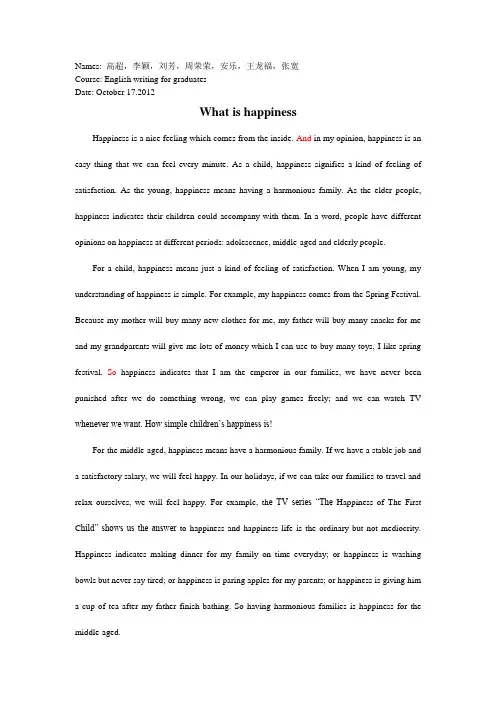
In recent years, the topic of artificial intelligence (AI) has drawn
substantial attention worldwide. With advancements in technology,
AI has gradually become an integral part of our daily lives.
However, while AI may bring numerous benefits, it also poses
significant challenges. This essay aims to explore the pros and
cons of AI and offer some suggestions on managing its potential
negative consequences.
To begin with, AI has demonstrated immense potential in various
sectors. One of its key advantages lies in its ability to enhance
efficiency and accuracy. For instance, in the healthcare industry,
AI technology such as machine learning algorithms can analyze
big data, aiding in the early diagnosis of diseases and improving
treatment outcomes. Moreover, AI has also accelerated the
development of autonomous vehicles, leading to safer and more
efficient transportation systems. These advancements highlight the
positive impact AI can have on society.
Additionally, AI has the potential to revolutionize the job market.
By automating repetitive tasks, it allows workers to focus on more
creative and intellectually challenging work. This can lead to
increased productivity and overall job satisfaction. Moreover, AI
can also assist in improving workplace safety by taking over
hazardous tasks. For instance, robots can be deployed in industries
such as mining or construction to reduce the risk of accidents and
injuries.
Nonetheless, AI also brings about significant concerns. One major
issue is the potential displacement of human workers. As AI technology advances, many routine jobs are at risk of being
replaced by automation. This can result in job losses and increased
unemployment rates. To mitigate this issue, governments and
educational institutions should prioritize retraining programs,
equipping workers with the necessary skills to adapt to the
changing job market.
Another concern is the ethical implications of AI. The
development of autonomous machines raises questions regarding
their decision-making capabilities and accountability. For example,
in the field of self-driving cars, the challenge lies in determining
who should be held responsible in the event of an accident caused
by an AI-powered vehicle. Addressing these ethical concerns
requires ethical guidelines and regulations as well as transparent
decision-making processes.
In conclusion, AI holds great promise in various domains, bringing
about efficiency improvements and job market transformations.
However, it is essential to carefully manage its potential negative
consequences. Governments, educational institutions, and
industries must work together to ensure proper workforce
adaptation and implement ethical guidelines to navigate the future
of AI. By doing so, we can harness the benefits of AI while
minimizing its drawbacks.