
朗文英语听说教程3答案
- 格式:pdf
- 大小:3.37 MB
- 文档页数:5

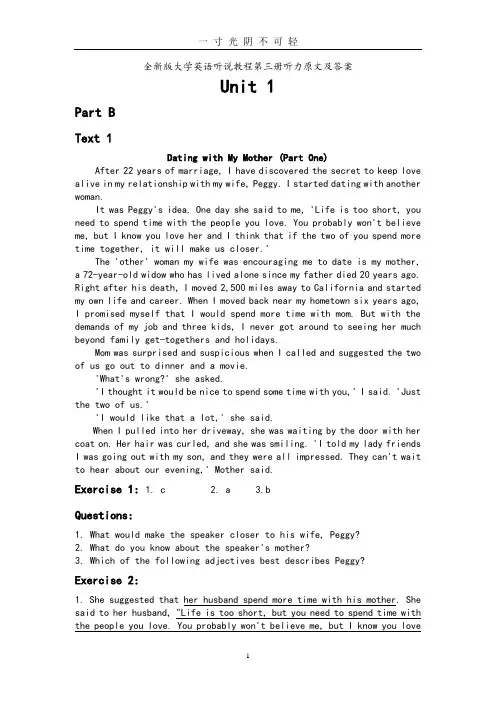
全新版大学英语听说教程第三册听力原文及答案Unit 1Part BText 1Dating with My Mother (Part One)After 22 years of marriage, I have discovered the secret to keep love alive in my relationship with my wife, Peggy. I started dating with another woman.It was Peggy's idea. One day she said to me, 'Life is too short, you need to spend time with the people you love. You probably won't believe me, but I know you love her and I think that if the two of you spend more time together, it will make us closer.'The 'other' woman my wife was encouraging me to date is my mother, a 72-year-old widow who has lived alone since my father died 20 years ago. Right after his death, I moved 2,500 miles away to California and started my own life and career. When I moved back near my hometown six years ago, I promised myself that I would spend more time with mom. But with the demands of my job and three kids, I never got around to seeing her much beyond family get-togethers and holidays.Mom was surprised and suspicious when I called and suggested the two of us go out to dinner and a movie.'What's wrong?' she asked.'I thought it would be nice to spend some time with you,' I said. 'Just the two of us.''I would like that a lot,' she said.When I pulled into her driveway, she was waiting by the door with her coat on. Her hair was curled, and she was smiling. 'I told my lady friends I was going out with my son, and they were all impressed. They can't wait to hear about our evening,' Mother said.Exercise 1: 1. c 2. a 3.bQuestions:1. What would make the speaker closer to his wife, Peggy?2. What do you know about the speaker's mother?3. Which of the following adjectives best describes Peggy?Exercise 2:1. She suggested that her husband spend more time with his mother. She said to her husband, "Life is too short, but you need to spend time with the people you love. You probably won't believe me, but I know you loveher and I think that if the two of you spend more time together , it will make us closer."2. 1) ...she was waiting by the door with her coat on and she had her hair curled.2) She had told her lady friends about this.Text 2Dating with My Mother (Part Two)We didn't go anywhere fancy, just a neighborhood place where we could talk. Since her eyes now see only large shapes and shadows, I had to read the menu for both of us.'I used to be the reader when you were little,' she said.'Then it is time for you to relax and let me return the favor,' I said.We had a nice talk over dinner, just catching up on each other's lives. We talked for so long that we missed the movie.'I'll go out with you again,' my mother said as I dropped her off, 'but only if you let me buy dinner next time.'I agreed.'How was your date?' my wife asked when I got home that evening. 'Nice...nicer than I thought it would be,' I said.Mom and I get out for dinner a couple of times a month. Sometimes we take in a movie, but mostly we talk. I tell her about my trails at work and brag about the kids and Peggy. Mom fills me in on family gossip and tells me about her past. Now I know what it was like for her to work in a factory during the Second World War. I know how she met my father there, and know how they went through the difficult times. I can't get enough of these stories. They are important to me, a part of my history. We also talk about the future. Because of health problems, my mother worries about the days ahead.Spending time with my mom has taught me the importance of slowing down. Peggy was right. Dating another woman has helped my marriage.Exercise 1: 1. c 2. d 3. dQuestions:1. What does the story mainly tell us?2. Which of the following is true?3. What can you learn from the story?Exercise 2: 1. F 2. T 3. F 4. T 5. FQuestions:1.It can be inferred that the speaker’s mother often took him out todinner when he was small.2.The mother has poor eyesight now.3.On their first date the speaker took his mother out to dinner and amovie.4.The speaker’s parents worked in the same factory during the SecondWorld War.5.The speaker and his mother now meet once every month.Part CConversation 1:W: You know, many American parents are now wondering why they can't keep their teenage children from drinking.M: I'm aware of that. To my mind, it's the permissive attitude of the parents that is to blame.Q: What can you learn from the man's response?Conversation 2:M: Don't you think it's good to give our children a monthly allowance? W: I think so. It can teach them the value of money. With a monthly allowance they can learn to budget their expenses wisely.Q: What are they talking about?Conversation 3:M: Mom, I've got a part-time job at a supermarket. Three hours a day weekdays and all day Saturday.W: Congratulations, Tom. But are you sure you can handle it? What about your homework and your piano lessons?Q: How does the mother feel about Tom's part-time job at the supermarket? Conversation 4:M: Hey, Mary. You look so upset. What happened?W: My father had an accident the other day. He is now in hospital and will have an operation tomorrow. You see, his heart is rather weak. I really don't know whether he can survive it.Q: What's the woman worried about?Conversation 5:W : Mother's Day is coming soon. Could you tell me what sons and daughters do in your country on that day?M: Well, they send their mothers flowers and cards to celebrate theoccasion. Besides, it is a common practice for them to wear pink carnations on that day.Q: Which of the following is true of the customs of Mother's Day in the man's country?1. b2. c3. b4. d5. dPart DMy First JobMy parents ran a small restaurant. It was open twenty-four hours a day, seven days a week. My first job was shining shoes for customers when I was six years old. My duties increased as I grew older. By age ten I was clearing tables and washing plates. My father made it clear that I had to meet certain standards. I had to be on time, hard-working and polite to the customers. I was never paid for any work I did. One day I made the mistake of telling Dad I thought he should give me ten pounds a week. He said, "OK, then how about you paying me for the three meals a day when you eat here and for the times you bring your friends here for free drinks?" He figured I owed him about 40 pounds a week. This taught me quite a lot.Statements:1. The speaker had more than one responsibility at his parents' restaurant.2. The speaker's parents kept their business open around the clock.3. It can be inferred that the speaker's family lived in the United States.4. It seems that the speaker's father was very strict with him but quite kind to his friends.5. The father finally agreed to pay his child for his work but would deduct the cost of his meals.6. This story shows that the speaker has very unhappy memories of his childhood.Unit 2Part BText1What a Coincidence! (Part One)Andrew had always wanted to be a doctor. But the tuition for a medical school in 1984 was 15,000 dollars a year, which was more than his family could afford. To help him realize his dream, his father, Mr. Stewart, a real estate agent, began searching the house-for-sale ads in newspapers in order to find extra business. One advertisement that he noted down wasfor the sale of a house in a nearby town. Mr. Stewart called the owner, trying to persuade him to let him be his agent. Somehow he succeeded and the owner promised that he would come to him if he failed to get a good deal with his present agent. Then they made an appointment to meet and discuss the thing.As good things are never easy to acquire, the time for the appointment had to be changed almost ten times. On the day when they were supposed to meet at 3 o'clock in the afternoon, Mr. Stewart received another call from the owner. His heart sank as he feared there would be another change of time. And so it was. The owner told him that he couldn't make it at three but if he would come right then, they could talk it over. Mr. Stewart was overjoyed. Leaving everything aside, he immediately set out to drive to the house.As he approached the area, he had a strange feeling of having been there before. The streets, the trees, the neighborhood, all looked familiar to him. And when he finally reached the house, something clicked in his mind. It used to be the house of his father-in-law! The old man had died fifteen years ago but when he was alive, he had often visited him with his wife and children. He remembered that, like his son Andrew, his father-in-law had also wanted to study medicine and, failing to do so, had always hoped that one of his two daughters or his grandchildren could someday become a doctor.Exercise 1:1. b 2. a 3. d 4. cQuestions:1. Who are the two main characters in the story you have just heard?2. How did Mr. Stewart get to know the owner of the house?3. What problem did Mr. Stewart have?4. What is the coincidence in the story you have just heard?Exercise 2:1984 / son / medical school / tuition / afford it / realize / newspaper ads / extra business / advertisement / succeeded / agent / changed / phone call / put aside / doing / immediately / familiar / father-in-law's / visited / his father-in-law alive / coincidenceText2What a Coincidence! (Part Two)When he entered the house, Mr. Stewart was even more amazed to find that the house was decorated exactly as he had remembered it. He told the owner about this and the latter became intrigued too. However, they were in for even greater surprises. It so happened that in the middle of their discussion, a postman came to deliver a letter. And the letter wasaddressed to Mr. Stewart's father-in-law! Were it not for Mr. Stewart's presence there and then, the letter would be returned as no person of that name lived in the house any longer. As the postman demanded a signature on the receipt slip, Mr. Stewart signed for his long-deceased father-in-law. Mystified, the owner urged Mr. Stewart to open the letter and see what it contained. The letter was from a bank. When he opened it, two words immediately met his eye -- 'For education'. It was a bank statement of an amount his father-in-law had put in years ago for his grandchildren's education needs. With the interest it had earned over the years, the standing value of the amount came to a little over $15,000, just enough money to cover the tuition of Andrew's first year at a medical college!Another thing that is worth mentioning is about the postman. The original postman, who had worked in this neighborhood, called in sick that day. So the postman, who was new to the area, came to deliver mail in his place. Had it been the old postman, the letter would undoubtedly be returned to the sender as he knew full well that no person bearing that name lived in that house any longer.The miracle was a blessing for Andrew. With the money given to him by his grandfather he was able to study medicine. Now he is a doctor in Illinois.Exercise 1: 1. T 2. F 3. F 4. F 5. F Statements:1. Several coincidences happened in the story.2. The coincidences made it possible for the owner to sell his house ata good price.3. No one actually benefited from the coincidences.4. It can be inferred that Mr. Stewart did not have to seek extra work from then on.5. With the extra money Mr. Stewart had earned, Andrew's dream finally came true.Exercise 2:1. He was intrigued.2. A bank statement.3. his father-in-law had put an amount of money in the bank for his grandchildren's education.4. A little over $15,000.5. He could use the money to cover the tuition of his first year at a medical college.6. He is a doctor in Illinois.Part CDad Stops for Gas, Finds Lost SonNueng Garcia was the son of an American serviceman stationed in Thailand in 1969. But his father went back to the States when Nueng was only three months old. When he grew up Nueng immigrated to the United States and worked as a gas station clerk in Pueblo, Colorado. His dream was to find his father John Garcia. Year after year, he tried in vain to search for information about the whereabouts of his father.It was a fine day in Pueblo. There was not a cloud in the blue sky. But for him, it was just another day on the job. Suddenly he noticed the name of one customer who paid with a check. The man, who was in his fifties, had the same surname as his own. Nueng raised his head from the check and looked at the man. Could this be his father?"Are you John Garcia?" he asked."Yes," came the answer."Were you ever in the Air Force?""Yes.""Were you ever in Thailand?""What's that to do with you?" answered the man, who became suspicious by then."Were you or were you not?" Nueng persisted."Yes.""Did you ever have a son?"At this truth dawned on the man. They stared at each other and realized at the same moment that they were father and son who were separated 27 years ago and half a world away.John Garcia hadn't seen his son since 1969. He lost touch with Nueng's mother when she started seeing another man. He moved to Pueblo nine years ago. He said he never went to that gas station, wasn't even low on gas that day and hardly ever paid with a check.Exercise: 1. F 2. T 3. F 4. F 5. T 6. T 7. F 8. T Statements:1. Nueng's parents divorced when he was only 3 months old.2. After moving to the U.S.A., Nueng worked at a gas station in Colorado.3. Nueng never gave up his efforts to find his father, but John Garcia had never looked for his son.4. One day while at work Nueng's eyes fell on the photo of a customer's driver's license, and the man in the photo looked like his father.5. John Garcia was once in the U.S. Air Force stationed in Thailand.6. John Garcia and his son didn't meet each other again until 1996.7. Nueng's father said he often went to that gas station but never paid with a check.8. It was by coincidence that John Garcia and his son were reunited aftermany years of separation.Part DUnexplained ParallelsOne of the best-known collections of parallels is between the careers of Abraham Lincoln and John F. Kennedy. Both were shot on a Friday, in the presence of their wives; both were succeeded by a Southerner named Johnson; both their killers were themselves killed before they could be brought to justice. Lincoln had a secretary called Kennedy; Kennedy a secretary called Lincoln. Lincoln was killed in the Ford Theater; Kennedy met his death while riding in a Lincoln convertible made by the Ford Motor Company -- and so on.Similar coincidences often occur between twins. A news story from Finland reported of two 70-year-old twin brothers dying two hours apart in separate accidents, with both being hit by trucks while crossing the same road on bicycles. According to the police, the second victim could not have known about his brother's death, as officers had only managed to identify the first victim minutes before the second accident.Connections are also found between identical twins who have been separated at birth. Dorothy Lowe and Bridget Harrison were separated in 1945, and did not meet until 1979, when they were flown over from Britain for an investigation by a psychologist at the University of Minnesota. They found that when they met they were both wearing seven rings on their hands, two bracelets on one wrist, a watch and a bracelet on the other. They married on the same day, had worn identical wedding dresses and carried the same flowers. Dorothy had named her son Richard Andrew and her daughter Catherine Louise; Bridget had named her son Andrew Richard and her daughter Karen Louise. In fact, she had wanted to call her Catherine. Both had a cat called Tiger. They also had a string of similar mannerisms when they were nervous.How can we explain the above similarities?Exercise:1)Shot, Friday, wives2)Succeeded, Johnson3)killers, brought, justice4)secretaries5)Ford theater, Lincoln6)Died, accidents7)trucks, same road8)met, 34, seven rings, wrist, watch9)Married, wedding dresses, same flowers10) similar, children11) cat, TigerStatements:1. Both Abraham Lincoln and John F. Kennedy were killed by a Southerner.2. John F. Kennedy's secretary was named after Abraham Lincoln.3. The news story told about the traffic accidents that killed two twin brothers.4. It can be inferred from the passage that more parallel phenomena are studied in the United States than in any other country.5. Coincidences occurring in three nations are described in the passage.6. Some psychologists' interest is the research on coincidences between twins.7. According to the speaker, coincidences occur much more often between twins than between people who are not related.8. The speaker does not mention his/her own opinion on whether these parallels can be explained.Unit 3Part BText 1A Marriage Agreement (Part One)(Tom and Linda have signed a marriage agreement. Both agree not to break the rules outlined in the agreement. John, a reporter, is talking to them about the agreement.)John: Tom, Linda, first I'd like to ask you why you decided to write this unusual agreement.Tom: We found that many problems are caused when a person has different expectations from his or her spouse. We wanted to talk about everything openly and honestly before we started living together.Linda: Also we both know how important it is to respect each other's pet peeves. Like, I can get very annoyed if others leave stuff -- clothing, papers, everything! -- lying around on the floor. It really bugged me, so we put that in the agreement.John: This is mentioned in Article 1: Cleaning Up, isn't it? It says, "Nothing will be left on the floor overnight. Everything must be cleaned up and put away before going to bed."Tom: Then I'll know clearly what Linda's expectations are.John: I see. What about Article 2: Sleeping? It says, "We will go to bed at 11 p.m. and get up at 6:30 a.m. except on weekends." I'm sure some people hearing this will think that this agreement isn't very romantic. Tom: Well, we disagree. We think it's very romantic. This agreement shows that we sat down and talked, and really tried to understand the other person. A lot of problems occur in a marriage when people don't talk aboutwhat they want.Linda: That's right. When we disagreed about something, we worked out a solution that was good for both of us. I would much rather have Tom really listen to me and understand my needs than give me a bunch of flowers or a box of candy.Exercise 1: 1. b 2. c 3.aQuestions:1. Which statement best summarizes the marriage agreement between Tom and Linda?2. According to Tom, what will give rise to problems in a marriage?3. What can be inferred about Linda from the conversation?Exercise 2:1. Because she wanted to understand each other's expectations so that potential problems could be avoided and they could live happily together.2. Cleaning up. Everything must be cleaned up and put away before going to bed.3. Sleeping. Time for bed: 11pm; time to get up: 6:30am except on weekends.Text 2A Marriage Agreement (Part Two)John: Linda, do you spend a lot of time checking to see if the other person is following the rules? Arguing?Linda: No, not at all.Tom: A lot of couples argue because they don't understand each other's expectations. I think we spend less time arguing than most couples because we both know what the other person expects.John: What happens if one of you breaks a rule?Tom: Well, that's in Article 13 of our agreement.John: Is it? Oh yes, Article 13: Breaking Rules. "If you break a rule, you must apologize and do something nice for the other person to make it up."Linda: Yeah, like last time Tom broke the rule of driving.John: What's the rule?Linda: The rule is we must ask for directions if we are driving and get lost for more than five minutes.John: What happened?Tom: We were driving to a friend's wedding, and we got lost. Linda wanted to stop at a gas station to ask for directions, but I thought I could figure it out.Linda: Then we drove forty miles in the wrong direction and ended up being late for the wedding.Tom: So I took her out to dinner. I knew what I should do to apologize. John: That's very important, I think, knowing how to apologize. By the way, do you plan to update your agreement at all? What if things change in your life and a rule doesn't work anymore?Linda: We've thought about that too. Article 14 states that we must review this agreement once a year and make necessary changes.John: Well, it was really nice talking to you both. Thank you very much for your time.Tom & Linda: Thank you.Exercise 1: 1. F 2.F 3.T 4.TStatements:1. Tom and Linda never argue because they both know what the other person expects.2. Once Tom broke Article 14 and apologized to Linda by taking her out to dinner.3. If some of the rules in the marriage agreement become outdated, changes will be made to update them.4. It seems that both Tom and Linda are satisfied with their marriage agreement.Exercise 2:1. One rule says that if they get lost for more than five minutes when they are driving, they must stop and ask for directions.2. Once Tom and Linda got lost when they were driving to a friend's wedding.3. Linda wanted to stop at a gas station to ask the way, but Tom thought he could figure it out.4. As a result, they were late for the wedding because they went in the wrong direction for forty miles.Part CA Perfect MatchAre you looking for a good relationship with someone special? What type of person is the best person for you? Is it the person with the highest IQ? Is it the most beautiful or most handsome person? How about the richest person or the most ambitious? Is your ideal partner the most traditional or the most modern person? Is he or she the person most like you, or most unlike you?The answer, psychologists say, is none of the above. Why? Because they are all extremes. In a number of research studies, psychologists asked couples these questions. The answers were clear. Most people are happy with moderation -- with partners who are not the most or the best (or the least or the worst). People are more comfortable with partnerswho are not so special.The research showed several other important things. In a love relationship, two things can cause trouble. First, trouble happens when both people get angry quickly. This is not surprising. Second, trouble happens when people don't expect to change themselves in a relationship. Do you stay calm when you disagree with someone? Are you ready to change yourself? If you can tolerate disagreement and are willing to change, maybe you are ready for a serious relationship.Exercise:1. ...not so special/not extremes2. a. ...get angry quicklyb. ...change themselves...Statements: 1. F 2. T 3. T 4. F 5. T 6. T1. The passage implies that the perfect match for you is a person who is most unlike you.2. The author argues that the most beautiful or most handsome person may not be your perfect partner.3. Moderate person, that is, the partners who are not the most or the best can be your perfect match.4. The research showed that an extreme love relationship between the two can cause trouble.5. The passage states that the anger is one of the causes that lead to the breakup of a love relationship.6. The perfect match lies in the people's attitudes to tolerate disagreement and be willing to change in a relationship.Part DHusbands and Wives Don't See Things AlikeLet's face it -- husbands and wives just don't see things alike. Take TV remote controls, for example. I'm a channel-grazer. When I watch the news, I flip back and forth through four different networks."It drives me crazy when you do that," my wife complains. I don't understand why she has no interest in other channels. After all, she is a woman who wants to know everything going on in the neighborhood and among all the relatives. Just one button away might be an interesting program on How to Lose Fifty Pounds by Eating Chocolate Sundaes or How to Understand Weird Husbands. But, no, she won't change channels, not even if she dislikes the program she's watching."This talk show host makes me so angry!" she cried one evening. "Then why don't you change the channel?" I asked."Because I can't stand people who are always changing channels." Differences. No right or wrong, just differences."The first law of civilization," said an old philosopher, "is to let people be different."I don't need to convert my wife to my ways, and she doesn't try to make me be like her. We simply take turns monitoring the remote control.Exercise:1.He frequently changes channels.2.No. It makes her very angry.3.She sticks to one channel even if she doesn’t like it.4.They take turns monitoring the remote control.5.How everything is going on in the neighborhood and among all theirrelatives.6.No. Because, as one philosopher puts it, “The first law ofcivilization is to let people be different.”Statements:1. The major difference between the speaker and his wife is their TV viewing habits.2. According to the speaker, he is more interested in talk shows while his wife is more interested in news programs.3. The wife seems to be more weird than the husband is.4. The speaker and his wife usually take turns working the remote control when they watch television.5. It can be inferred that women are generally more tolerant than men of their spouse's differences.6. The speaker and his wife maintain peace not by changing each other but by tolerance.Unit 4Part BText 1Being a Police Officer Is a Stressful JobInterviewer: Welcome to our program, Sam.Sam: Thank you.Interviewer: Sam, how long have you been a police officer?Sam: I've been a police officer for thirty years.Interviewer: Thirty years. And you've had different types of assignments on the police force, I guess.Sam: Yeah, I've done everything from patrol to undercover work to detective work, and now I'm supervising investigations.Interviewer: Sam, I think most people would say that being a police officer is a very stressful job. Would you agree?Sam: Yes, it's definitely a stressful job. But it depends on your assignment.Interviewer: So, what's probably the most stressful assignment you can have?Sam: I'd say patrol is the most stressful assignment.Interviewer: That's interesting! In what way?Sam: Well, I guess the biggest part of the stress is the fear factor -- the fear of the unknown.Interviewer: What do you mean, Sam?Sam: Well, in patrol work, you don't know from moment to moment who you are talking to or what their reaction is going to be to justify your presence. Let's say, for example, a patrol officer stops someone for a traffic violation. It seems as though that would be a very low-stress situation.Interviewer: Yes, it is a very low-stress situation.Sam: But the truth is, there are more police officers injured during a routine stop.Interviewer: Really?Sam: Really! That's why all police officers are taught from the very beginning to be aware of their surroundings. People back over policemen, people shoot policemen, people jump out at policemen -- different kinds of things. So that's probably the most stressful time.Interviewer: I see. Let's take a break and then we'll move on to our next topic.Sam: All right.Exercise 1: 1. d 2. c 3.aQuestions:1. What's the relationship between the two speakers?2. What does Sam mainly talk about?3. What do you know about Sam?Exercise 2:Sam has been a police officer for 30 years. He has done everything from patrol to undercover work. He has also done detective work and now he is supervising investigations.Sam thinks being a police officer is a very stressful job, but it depends on the assignment one has. In his opinion the biggest pert of the stress is the fear of the unknown and patrol is the most stressful assignment.Text 2Stress Reducers。

全新版大学英语听说教程3答案完整版全新版大学英语听说教程答案第三册UINT1Part BText 1Exercise 1: 1. c 2. a 3.bExercise 2:1. She suggested that her husband spend more time with his mother. She said to her husband, "Life is too short, you need to spend time with the people you love. You probably won't believe me, but I know you love her and I think that if the two of you spend more time together , it will make us closer."2. 1) ...she was waiting by the door with her coat on and she had her hair curled.2) She had told her lady friends about this.Text 2Exercise 1: 1. c 2. d 3. dExercise 2: 1. F 2. T 3. F 4. T 5. F Part C1. b2. c3. b4. d5. dPART DMy First JobMy parents ran a small restaurant. It was open twenty-four hours a day, seven days a week. My first job was shining shoes for customers when I was six years old. My duties increased as I grew older. By age ten I was clearing tables and washing plates.My father made it clear that I had to meet certain standards. I had to be on time, hard-working and polite to the customers. I was never paid for any work I did. One day I made the mistake of telling Dad I thought he should give me ten pounds a week. He said, "OK, then how about you paying me for the three meals a day when you eat here and for the times you bring your friends here for free drinks?" He figured I owed him about 40 pounds a week. This taught me quite a lot.Unit 2Part BText 1Exercise 1: 1. b 2. a 3. d 4. cExercise 2:1984 / son / medical school / tuition / afford it / realize / newspaper ads / extra business / advertisement / succeeded / agent / changed / phone call / put aside / doing / immediately / familiar / father-in-law's / visited / his father-in-law alive / coincidence.Text 2Exercise 1: 1. T 2. F 3. F 4. F 5. FExercise 2:1. He was intrigued.2. A bank statement.3. his father-in-law had put an amount of money in the bank for his grandchildren's education.4. A little over $15,000.5. He could use the money to cover the tuition of his first year at a medical college.6. He is a doctor in Illinois.Part C1. F2. T3. F4. F5. T6. T7. F8. TPART DUnexplained ParallelsOne of the best-known collections of parallels is between the careers of Abraham Lincoln and John F. Kennedy. Both were shot on a Friday, in the presence of their wives; both were succeeded by a Southerner named Johnson; both their killers were themselves killed before they could be brought to justice. Lincoln had a secretary called Kennedy; Kennedy a secretary called Lincoln. Lincoln was killed in the Ford Theater; Kennedy met his death while riding in a Lincoln convertible made by the Ford Motor Company -- and so on.Similar coincidences often occur between twins. A news story from Finland reported of two 70-year-old twin brothers dying two hours apart in separate accidents, with both being hit by trucks while crossing the same road on bicycles. According to the police, the second victim could not have known about his brother's death, as officers had only managed to identify the first victim minutes before the second accident.Connections are also found between identical twins who have been separated at birth. Dorothy Lowe and Bridget Harrison were separated in 1945, and did not meet until 1979, when they were flown over from Britain for an investigation by apsychologist at the University of Minnesota. (8处答案为met,34)They found that when they met they were both wearing seven rings on their hands, two bracelets on one wrist, a watch and a bracelet on the other. They married on the same day, had worn identical wedding dresses and carried the same flowers. Dorothy had named her son Richard Andrew and her daughter Catherine Louise; Bridget had named herson Andrew Richard and her daughter Karen Louise.(10处答案similar自己看下这个不一定, children) In fact, she had wanted to call her Catherine. Both had a cat called Tiger. They also had a string of similar mannerisms when they were nervous.How can we explain the above similarities?Unit 3Part BText 1Exercise 1: 1. b 2. c 3.aExercise 2:1. Because she wanted to understand each other's expectations so that potential problems could be avoided and they could live happily together.2. Cleaning up. Everything must be cleaned up and put away before going to bed.3. Sleeping. Time for bed: 11pm; time to get up: 6:30am except on weekends.Text 2Exercise 1: 1. F 2.F 3.T 4.TExercise 2:1. One rule says that if they get lost for more than five minutes when they are driving, they must stop and ask for directions.2. Once Tom and Linda got lost when they were driving to a friend's wedding.3. Linda wanted to stop at a gas station to ask the way, but Tom thought he could figure it out.4. As a result, they were late for the wedding because they went in the wrong direction for forty miles.Part C1. ...not so special/not extremes2. a. ...get angry quickly b. ...change themselves... PART D原文Husbands and Wives Don't See Things AlikeLet's face it -- husbands and wives just don't see things alike. Take TV remote controls, for example. I'm a channel-grazer. When I watch the news, I flip back and forth through four different networks."It drives me crazy when you do that," my wife complains. I don't understand why she has no interest in other channels. After all, she is a woman who wants to know everything going on in the neighborhood and among all the relatives. Just one button away might be an interesting program on How to Lose Fifty Pounds by Eating Chocolate Sundaes or How toUnderstand Weird Husbands. But, no, she won't change channels, not even if she dislikes the program she's watching."This talk show host makes me so angry!" she cried one evening."Then why don't you change the channel?" I asked."Because I can't stand people who are always changing channels."Differences. No right or wrong, just differences."The first law of civilization," said an old philosopher, "is tolet people be different."I don't need to convert my wife to my ways, and she doesn't try to make me be like her. We simply take turns monitoring the remote control.1. The major difference between the speaker and his wife is their TV viewing habits.2. According to the speaker, he is more interested in talk shows while his wife is more interested in news programs.3. The wife seems to be more weird than the husband is.4. The speaker and his wife usually take turns working the remote control when they watch television.5. It can be inferred that women are generally more tolerant than men of their spouse's differences.6. The speaker and his wife maintain peace not by changing each other but by tolerance.Unit 4Part BText 1Exercise 1: 1. d 2. c 3.aExercise 2:Sam has been a police officer for 30 years. He has done everything from patrol to undercover work. He has also done detective work and now he is supervising investigations.Sam thinks being a police officer is a very stressful job, but it depends on the assignment one has. In his opinion the biggest pert of the stress is the fear of the unknown and patrol is the most stressful assignment.Text 2Exercise 1: 1. T 2. F 3. T 4. F 5. TExercise 2:1. ... One is an exercise program, another is a psychological program with counseling for officers. And there are several discussion groups as well for officers to sit down and talk about their stress with other officers.2. 2)...He tries to get some sort of exercise every day.3)...his personal relationships, especially his relationships with his wife.Part C1. d2. d3. d4. b5. cPART DFinding Creative Outlets for Very Stressful TimesBeautifying your home is a fun and practical pastime that can offer a wonderful sense of accomplishment. Few people may realize, however, that painting the walls, knitting bedspreads or sewing pillows can help relieve the life pressures we all experience.Studies indicate that engaging in creative endeavors such as sewing and crafting can lower one's risk of stroke, kidney damage and heart disease.These calming, repetitive activities relax the mind and can lower blood pressure. Sharing such activities can also be a way to spend time with loved ones, which increases our sense of belonging and further reduces stress.People have always turned to working with their hands in times of stress. Handicraft works, with their symbols of hope, have a far greater impact when created by groups.Keep in mind the following tips to increase the stress-relieving benefits of your craft projects:1. Work with materials that stimulate the senses; work in a comfortable area without distractions; play your favorite music.2.(4处答案framing) Make a family project of selecting your favorite photos, and frame them so they can be enjoyed every day. In stressful times, the photos can lift your spirits as you recall happy moments.3. If your schedule is hectic, choose a practical project that will make the most of crafting time. If a simple kitchen curtain needs to be replaced, start there.Change sometimes compels us to see things in new ways.Unit 5Part BText 1Exercise 1: 1. D 2. DExercise 2: 1.F 2.T 3.F 4.T 5.T 6.F 7.T 8.F 9.F 10.TText 2Exercise 1:1. Reaching Everybody by Exposing Lies2. They launched an advertising campaign to call on youth to fight against tobacco companies by starting the "Not fro Sale" commercial on television and radio.3. They intend to spread the message that teenagers no longer want to be targeted by tobacco companies in their advertisements.Exercise 2: 1. c 2.a 3.c 4.c 5.bPart CSkatescooter· Mostly made in Switzerland· In 1999· Not until it was popular in Japan·For sport; for transportation from h ome to the underground or from a bus stop to the office· a variety of people, from students to business executives· Can be folded up without difficulty and is easy to carry aboutPART D答案(仅供参考)16 years old,go to college, clothes and boys, her grades slipped, a scholarship, wealthy, afford, tuition,normal,fashion and dating,a talk,think about ,putting college off,wait, 未知,push ,take her education, seriously 原文She Doesn't Seem Ready for CollegeHi, Jenny, you don't look happy. What's wrong?Jenny: Well, Roger, I've got a problem.Roger: What is it?Jenny: You know my daughter Jane is 16 years old now. And we've begun talking about college. She says she wants to go, but she's let her grades slip and no matter how I urge her to study, all she seems interested in are clothes and boys. We're not wealthy, you know. And it won't be easy for us to afford the tuition if she can't get a scholarship. Is going to college the best choice for her right now?Roger: Do you mean that she doesn't seem ready for college?Jenny: You're right.Roger: Then you'd better have a serious talk with Jane about college. Jenny: A serious talk with her?Roger: Yes, to my mind it's quite normal for girls her age to be wrapped up in fashion and dating, but as a mother you havea right to expect her to pay attention to her studies too.Jenny: Yes, but how?。

Unit 3Section One Tactics for listeningPart 1 Spot DictationWildlifeEvery ten minutes, one kind of animal, plant or insect (1) dies out for ever. If nothing is done about it, one million species that are alive today will have become (2) extinct twenty years from now.The seas are in danger. They are being filled with (3) poison: industrial and nuclear waste, chemical fertilizers and (4) pesticides, sewage. If nothing is done about it, one day soon nothing will be able to (5) live in the seas.The tropical rain (6) forests, which are the home of half the earth's living things are (7) being destroyed. If nothing is done about it, they will have (8) nearly disappeared in twenty years. The effect on the world's (9) climate - and on our agriculture and food (10) supplies - will be disastrous.(11) Fortunately, somebody is trying to do something about it. In 1961, the (12) World Wildlife Fund was founded - a small group of people who wanted to (13) raise money to save animals and plants (14) from extinction. T oday, the World Wildlife Fund is a large (15) international organizati on. It has raised over (16) £35 million for (17) conservation projects, and has created or given support to the National Parks in (1 8) five continents.It has helped 30 (19) mammals and birds - including the tiger - to (20) survive.Part 2 Listening for GistMrs. Bates: Hullo. Is that Reception? .Reception: Yes, madamMrs. Bates: This is Mrs. Bates. Room 504. I sent some clothes to the laundry this morning, two of my husband's shirts and three of my blouses. But they're not back yet. You see, we're leaving early tomorrow morning.Reception: Just a moment, madam. I'll put you through to the housekeeper. Housekeeper: Hullo. Housekeeper.Mrs. Bates: Oh, hullo. This is ... I'm phoning from Room 504. It's about some clothes I sent to the laundry this morning. They're not back yet and you see ...Housekeeper: They are, madam. You'll find them in your wardrobe. They're in the top drawer on the left.Mrs. Bates: Oh, I didn't look in the wardrobe. Thank you very much.Sorry to trouble you.Housekeeper: That's quite all right. Goodbye.Mrs. Bates: Goodbye.ExerciseDirections: Listen to the dialogue and write down the gist and the key words that help you decide.This dialogue is about making an inquiry about the laundry.The key words are reception. laundry. shirts. blouses. wardrobe.Section Two Listening ComprehensionPart 1 DialogueA UN InterpreterInterviewer: ... so perhaps you could tell us how exactly you became so proficient at languagelearning, Suzanne.Suzanne: Well, I think it all started with a really fortunate accident of birth. You know I was born in Lausanne*, Switzerland; my father was Swiss-French Swiss and my mother was American, so, of course, we spoke both languages at home and I grew up bilingual. Then, of course, I learnt German at school - in Switzerland that's normal. And because I was already fluent in English, my second language at school was Italian. So I had a real head start*!Interviewer: So that's ... one, two, three, four - you had learnt four languages by the time you left school? How fluent were you?Suzanne: Urn, I was native speaker standard in French and English, but I'd become a bit rusty* in German and my Italian was only school standard. I decided the best option was to study in the UK, and I did Hispanic Studies at university, studying Spanish and Portuguese, with some Italian, and living in Manchester. Then I went to live in Brazil for two years, teaching English.Interviewer: So by this time you must have been fluent in six languages? Suzanne: Nearly. My Italian wasn't perfect, but I had a boyfriend from Uruguay* while I was there, so my Spanish also became pretty good!Interviewer: And then what did you do?Suzanne: When I was 25 I came back to Switzerland, went to an interpreters' school and then got a job in the United Nations when I was 28.Interviewer: And you've been there ever since?Suzanne: Not quite. In the first few months I met Jan, a Czech interpreter, who became my husband. We went to live in Prague in 1987 and that was where I learnt Czech. Interviewer: And the eighth language?Suzanne: Well, unfortunately the marriage didn't last; I was very upset and I decided to take a long break. I went to Japan on holiday, got a job and stayed for two years, which was when I learnt Japanese.Interviewer: That's amazing! And now you're back at the United Nations? Suzanne: Yes. Well, I never really left. I carried on doing work for them when I was in Prague - some in Prague, some in Austria and Switzerland, and I took a "sabbatical*" to work in Japan. They need people who can understand Japanese. But, yes, I've been back with them full-time for two years now.Interviewer: And your plans for the future?Suzanne: I'm going to learn more Oriental languages. It was such a challenge learning Japanese - it's so different from all the others. So I'll spend another two or three years here with the UN full-time, during which time I hope to get a substantial promotion, then I think I'll go back and learn Korean, or perhaps Chinese, and Thai - I'd love to learn Thai. And then, perhaps an Indian language. Whatever, I want to be fluent in another three or four languages before 45.ExerciseDirections: Listen to the dialogue and decide whether the following statements are true (T) or false (F).l.T 2.F 3.F 4.F 5.T 6.F 7.T 8.T 9. T 10. FPart 2 PassageThe Clyde RiverSalmon are very sensitive to environmental conditions and require cool, well-oxygenated water to thrive.The closure of factories that had poured toxins and other pollutants into the river boosted water quality significantly and modern sewage processing plants helped eliminate some of the foul smells.The river's depth and navigability helped make Glasgow an important center for importing tobacco, sugar and cotton from the Americas starting in the 1600s.The mills and factories that lined the Clyde made steel, textiles and chemicals, tanned leather and even produced candy and brewed alcohol.When the factories began to close in the second half of the 20th century, working-class Glasgow, Scotland's largest city, gained a reputation for social deprivation and rough streets.Running through one of Britain's biggest manufacturing centers, Glasgow, the Clyde River* was poisoned for more than a century by the fetid* byproducts of industry. The waterway bore the brunt of Glasgow's economic success during the IndustrialRevolution and beyond, as pollution and chemicals destroyed its fish and wildlife populations and brewed smells whose memory still makes residents wince*. Now, with heavy industry gone and Glasgow reconceived as a center for culture and tourism, the Clyde is coming back to life.For the first time since the late 1800s, its native salmon have returned in sizable numbers, reflecting the new cleanliness of a river that was once one of Britain's filthiest.The Clyde River Foundation surveyed fish populations last autumn at 69 sites in the Clyde and its tributaries, and found salmon in seven of the nine major tributaries. The migratory fish, which vanished from the Clyde around 1880 after a long decline, first reappeared in the 1980s, but last year's survey was the first to show they've come back in healthy numbers.Although commercial salmon fishing was never widespread on the Clyde, the fish's return is symbolically important for Glasgow, where salmon were once so important to the city's identity that two are pictured on its official coat of arms.The salmon's comeback is also a sign of big improvements to water quality. Like sea trout, which have also reappeared in the Clyde system in recent years, salmon are very sensitive to environmental conditions and require cool, well-oxygenated* water to thrive. The decline of Glasgow's main industries helped boost the fortunes of a river that was essentially fishless for decades during the worst periods of pollution.The closure of factories that had poured toxins* and other pollutants into the river boosted water quality significantly. Environmental regulators also lightened dumping rules, and modern sewage processing plants helped eliminate some of the foul* smellsthat once tainted* the air.With worries rising about the environmental impact of enormous fish farms elsewhere in Scotland and severely depleted fish stocks in the North Sea and North Atlantic, the Clyde comeback is a rare bit of good news for Scotland's fish lovers.Since the area that is now Glasgow was first settled around the year 550, the Clyde has been central to its history.The river's depth and navigability helped make Glasgow an important center for importing tobacco, sugar and cotton from the Americas starting in the 1600s. Later, during the Industrial Revolution that began in the late 1700s, Glasgow became a center of British shipbuilding and one of the country's great manufacturing centers.The mills and factories that lined the Clyde made steel, textiles and chemicals, tanned leather and even produced candy and brewed alcohol.When the factories began to close in the second half of the 20th century, working-class Glasgow, Scotland's largest city, gained a reputation for social deprivation* and rough streets. More recently, its art museums and nightlife have helped drive an economic comeback that has turned the city into a popular tourist destination.Exercise A Pre-listening QuestionRivers are important to humans because they supply fresh drinking water, serve as home for important fishes, and provide transportation routes.Exercise B Sentence DictationDirections: Listen to some sentences and write them down. You will hear each sentence three times.(Refer to Typescript)Exercise C Detailed ListeningDirections: Listen to the passage and choose the best answer to complete each of the following sentences.l.A 2. C 3. C 4. B 5. D 6. C 7. B 8. AExercise D After-listening DiscussionDirections: Listen to the passage again and discuss the following questions.The Clyde's depth and navigability helped make Glasgow an important center for importing tobacco, sugar and cotton from the Americas starting in the 1600s. And the city became a center of British shipbuilding and one of the country's great manufacturing centers during the Industrial Revolution. More recently, its art museums and nightlife have helped drive an economic comeback that has turned the city into a popular tourist destination.(Open)Section Three :NewsNews Item1NATO ExpansionSeven countries are expected to become members of the Transatlantic Alliance at the Prague Summit: Bulgaria*, Estonia*, Latvia*, Lithuania*, Romania, Slovakia* and Slovenia*. For most people in these countries, formally joining the West represents the fulfillment of lifelong dreams.Eastward expansion is not the only issue to be discussed at the Prague Summit. Manypeople believe the political and military alliance, created after World War II to provide a collective security system for the ten West European countries and the United States and Canada, lost its purpose with the collapse of the Soviet Union - for many years its only threat.NATO expansion and its post-Cold War role have been the subject of endless debate on both sides of the Atlantic, especially after the terrorist attacks on the United States.A possible war in Iraq is also high on the Prague agenda. Critics in the United States note few of the current candidates for membership have military forces that can contribute significantly to the new form of conflict. Some observers cite the importance of even minimal contributions, such as participating in NATO border defense, surveillance* or peace-keeping operations.Exercise ADirections: Listen to the news item and complete the summary.This news item is about the NATO eastward expansion and its military contribution. Exercise BDirections: Listen to the news again and complete the following passage.At the Prague Summit many people believe the political and military alliance, created after World War II to provide a collective security system for the ten West European countries and the United States and Canada, lost its purpose with the collapse of the Soviet Union - for many years its only threat.Another item on the Prague agenda is a possible war in Iraq. Critics in the United Statesnote that the new comers have no military forces that can /contribute significantly to the new form of conflict. Some observers cite the importance of even minimal contributions, such as participating in NATO border defense. surveillance or peace-keeping operations. News Item2NATO SummitOne month and one day before the Prague summit, President Bush met with the NATO Secretary General George Robertson and praised the alliance. At the time, Mr. Robertson described the Prague meeting as "a transformational summit", perhaps the most important in the history of the alliance.It is a transformation that began with the end of the Cold War, and gained momentum with the September 11th terrorist attacks on the United States.Just days after hijacked planes rammed into the World Trade Center and the Pentagon, NATO voted to invoke its charter and help defend the United States. The Bush administration thanked the alliance, asked for NATO help with surveillance flights over the east coast, and then proceeded to launch a war on terrorism outside the structure of the alliance.At the Prague meeting - the first NATO summit since the terrorist attacks on America - the alliance will take up the creation of a rapid deployment force which could be deployed outside Europe. Members will be asked to commit units with specialty skills that can be used in unique situations such as forces trained in dealing with chemical weapons or the special challenges of fighting in rugged* mountains.Exercise ADirections: Listen to the news item and complete the summary.This news item is about NATO's Prague Summit and its help to the USA.Exercise BDirections: Listen to the news again and answer the following questions.One month and one day before the Prague summit, President Bush met with the NATO Secretary General.When meeting with President Bush, the NATO Secretary General described the Prague summit as "a transformational summit", perhaps the most important in the history of the alliance.Because just days after September 11 th terrorist attacks, NATO voted to invoke its charter and help defend the United States.They are the skills that can deal with chemical weapons or fight in rugged mountains and the like.News Item3Putin-Bush SummitPresidents Bush and Putin ended their talks with a joint statement in which they said Iraq must comply with UN demands to disarm or face major consequences.They stressed Iraqi leader Saddam Hussein must comply fully and unconditionally with the latest Security Council disarmament resolution, and they expressed concern about the proliferation* of weapons of mass destruction.Russia backed the UN resolution as one of the five permanent members of the SecurityCouncil.But Moscow does not support the use of force against Iraq.At the end of their meeting in an 18th-century castle near the St. Petersburg airport, Mr. Putin said he still hopes diplomatic pressure will produce results. And he urged President Bush to continue to work through the UN.Their statement on Iraq bears a striking resemblance to the language approved by the 19 NATO member countries at the Prague summit. Mr. Bush told reporters that it is important to assure Russia that it has nothing to fear from NATO expansion. Exercise ADirections: Listen to the news item and complete the summary.This news item is about the talks between the US president and the Russian president. Exercise BDirections: Listen to the news again and decide whether the following statements are true (T) or false (F).l. .F 2. T 3. T 4.F 5. TSection Four Supplementary ExercisesPart 1Feature ReportBush’s Arrival in EuropeAir Force One touched down on a cool, rainy summer's night at a military base outside London. Mr. Bush said nothing to reporters during the more than seven-hour flight from Washington, and he left the air base without making any remarks.But before he left the White House, the president said he will stand firm on his positionson global warming and missile defense. They are issues that have divided America and its European allies. And the prospects for a quick resolution are as gloomy as the skies that greeted his arrival on European soil.These are issues sure to be discussed at length on the sidelines of the Genoa* summit meeting. The leaders of the world's seven largest industrialized countries plus Russia have put the plight* of the world's poorest nations at the top of their formal agenda. But no one expects to avoid the controversiesGenerated by President Bush's opposition to the Kyoto* climate treaty, and his plan to develop a missile defense system. iIn an interview with foreign journalists prior to his departure for London, Mr. Bush talked about the dispute over the Kyoto protocol. He said some leaders have been more sympathetic to his view than others. And he said he will seek to reassure critics that the United States is seeking viable* alternatives to the agreement, which calls for mandatory* controls on emissions of certain gases, such as carbon dioxide.His talks Thursday with British Prime Minister Tony Blair could provide a clue of what lies ahead. The two will meet at Chequers, Mr. Blair's official residence in the British countryside. A spokesman for the Prime Minister indicates on global warming and missile defense the two leaders may simply agree to disagree.It will be a serene* spot for a meeting. All indications at the reception awaiting the G-8 summit participants in Genoa will be quite the opposite.About a hundred thousand protestors are expected and elaborate security measures are in place in the Italian port city. President Bush says he can't quite understand whatmotivates the demonstrators. In his interview with foreign reporters, he said their aggressive protest tactics do more harm than good. He added their anti-trade stance* would lock people into* poverty.Exercise ADirections: Listen to the news report and complete the summary.This news report is about the attitudes of President Bush and the US government towards the issues of global warming and missile defense.Exercise BDirections: Listen to the news again and complete the following passage.Mr. Bush arrived in London for a short visit before the G-8 summit in Genoa.But before he left the White House, the president said he will stand firm on his positions on global warming and missile defense, the issues that have divided America and its European allies and are sure to be discussed at length at the Genoa summit meeting. The leaders of the world's seven largest industrialized countries plus Russia have put the plight of the world's poorest nations at the top of their formal agenda. But no one expects to avoid the controversies generated by President Bush's opposition to the Kyoto climate treaty; and his plan to develop a missile defense system.Mr. Bush defended his stance by saying that the United States is seeking viable alternatives to the agreement, which calls for mandatory controls on emissions of certain gases, such as carbon dioxide.About a hundred thousand protestors are expected and elaborate security measures are in place in the Italian port city.Part 2 PassageCorn PlasticsThe sugar is fermented and distilled to extract the carbon, a basic building block for commercial-grade plastics and fibers.Perhaps the greatest appeal of corn plastics is their green credentials. They go back to nature in 40 days.The biggest demand for corn plastics has been outside the United States, where packing components are developed for many products exported to America.Corn-based plates are about 5 percent more expensive than traditional plastic, and the cups can be 25 percent more costly.5) A billion pounds of PLA can be harvested annually within a decade, which would mean 10 percen t of America’s corn supply would be into plastics and fiber.sCorn plastic are being developed by Cargill Dpw LLC at its plant outside Blair,where refined corn suger is converted into a substance called polyactide or PLA . . The sugar is fermented* and distilled* to extract the carbon, a basic building block for commercial-grade plastics and fibers.PLA, in pellets* the size of 0.46 centimeters in diameter, is being pressed into packaging for food, plastic wrap, foam and dinner ware. It is spun into fabrics at plants in North Carolina, Hong Kong and several cities in Japan, and marketed under the Ingeo* brand of clothing and blankets. Cargill Dow, a joint venture between privately held food giant Cargill Inc. and Dow Chemical Co., says Ingeo means "ingredients from the Earth". DuPont Co. is in the early stages of developing a similar product, but it still includessome petroleum. The company is part of a consortium* that received US$19 million from the US Department of Energy to develop a way to turn com stocks, stems and leaves into a polymer* from which plastic can be made.Perhaps the greatest appeal of com plastics is their green credentials. It takes about a month for plastic bags made from com to degrade in a compost. A similar oil-based plastic bag could take centuries to decompose.Coca~Cola Co. used 500,000 cups made from com plastics at the Winter Olympics in Salt Lake City last year. Instead of creating a large trash problem, used cups were simply composted and quickly turned into dirt."The product performed beautifully. They go back to nature in 40 days," said Frederic Scheer, president of Los Angeles-based Biocorp North America, which supplied the cups. The biggest demand for com plastics has been outside the United States, including China's T aiwan island, where packing components are developed for many products exported to America. T aiwan bans petroleum-based plastic shopping bags and disposable plastic tableware. Electronics giant Sony Corp was involved in the early development of com plastics and has wrapped its mini discs in a com-based film made by Cargill Dow for two years. Cargill Dow also reached an agreement with T aiwan-based Wei Mon Industry to distribute com-plastic packaging materials.IPER, one of Italy's largest supermarket chains, has been working with the natural-based packaging from Cargill Dow for nearly a year for film containers and heat-sealable film overlays.The com-based plastic is more costly now. Biocorp North America*'s com-based platesare about 5 percent more expensive than traditional plastic, and the cups can be 25 percent more costly. But Scheer said the price will decline as production goes up with demand - which he expects to see within five years. That could amount to a highly productive and new use of America's com supply, which is so abundant that it is widely converted into com-based sweeteners and animal feed.Cargill Dow believes a billion pounds of PLA can be harvested annually within a decade. That would mean 10 percent of America's com supply would be converted into plastics and fibers.Exercise A Pre-listening QuestionCom starch is used primarily as a thickener. Sweeteners generated in the com-refining process are used as sugar substitutes. Refined com oil is used as cooking oil and producers of margarine, salad dressings, shortening, mayonnaise and other foods. The second major refined corn product is ethanol, which is gaining increasing acceptance as a cleaner burning option for motor fuels. The latest development in this field is the making of corn-based bio-chemical products like corn plastic and fiber.Exercise B Sentence DictationDirections: Listen to some sentences and write them down. You will hear each sentence three times.Exercise C Detailed ListeningDirections: Listen to the passage and answer the following questions.Corn plastics are being developed by Cargill Dow LLC at its plant outside Blair.The substance is called polylactide or PLA."Ingeo" is a brand of plastic fabrics made from corn sugar and it means "ingredients from the Earth".It takes about a month for plastic bags made from corn to degrade in a compost. A similar oil-based plastic bag could take centuries to decompose.Coca-Cola Co. used 500,000 cups made from corn plastics at the Winter Olympics in Salt Lake City.Many corn-plastic products are mentioned, such as cups and plates, shopping bags, packing components and packaging materials, film containers and heat-sealable film overlays.Probably because the production is still low now and the price will decline as production goes up with demand - possibly within five years.Cargill Dow believes a billion pounds of PLA can be harvested annually within a decade. Exercise D After-listening DiscussionDirections: Listen to the passage again and discuss the following questions..Frederic Scheer said the price will decline as production goes up with demand - which heexpects to see within five years. That could amount to a highly productive and new use of America's corn supply, which is so abundant that it is widely converted into corn-based sweeteners and animal feed.(Open)。
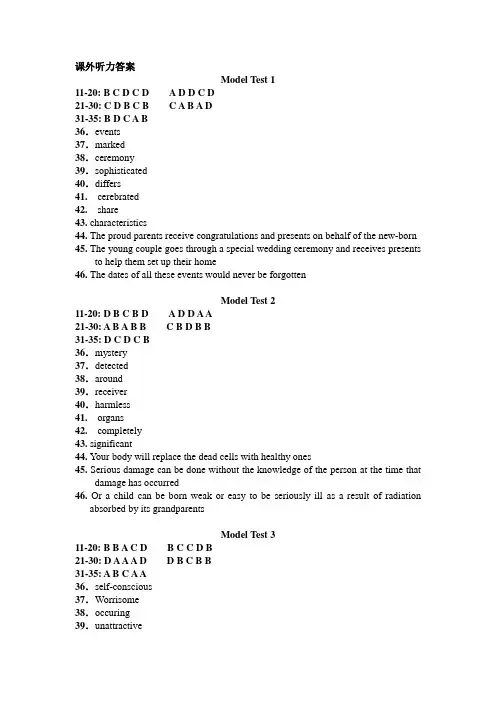
课外听力答案Model Test 111-20: B C D C D A D D C D21-30: C D B C B C A B A D31-35: B D C A B36.events37.marked38.ceremony39.sophisticated40.differs41. cerebrated42. share43. characteristics44. The proud parents receive congratulations and presents on behalf of the new-born45. The young couple goes through a special wedding ceremony and receives presentsto help them set up their home46. The dates of all these events would never be forgottenModel Test 211-20: D B C B D A D D A A21-30: A B A B B C B D B B31-35: D C D C B36.mystery37.detected38.around39.receiver40.harmless41. organs42. completely43. significant44. Y our body will replace the dead cells with healthy ones45. Serious damage can be done without the knowledge of the person at the time thatdamage has occurred46. Or a child can be born weak or easy to be seriously ill as a result of radiationabsorbed by its grandparentsModel Test 311-20: B B A C D B C C D B21-30: D A A A D D B C B B31-35: A B C A A36.self-conscious37.Worrisome38.occuring39.unattractive40.adversely41. reflected42. reactions43. profound44. They also find it difficult to be pleased by compliments because they believethey are unworthy of praise45. It is clear that, while self-awareness is a healthy quality, overdoing it is harmful46. Since shyness goes hand in hand with lack of self-esteem, it is important forpeople to accept their weakness as well as their strengthsModel Test 411-20: D A A C B B A C C D21-30: D B C A A D A C A C31-35: B B D B C36.advertisements37.urging38.marketing39.combat40.teenagers41. overweight42. raises43. pressure44. Unhealthy lifestyles including high-calorie diets, poor exercise and hours spentin front of the television or computer45. junk food ads mainly featuring fast food and high-fat dairy foods increased duringtimes young people were most likely to be watching46. it is clear marketing plays a big role in the kinds of food children preferModel Test 511-20: A B A B C B D B A C21-30: A C C C D A C B D C31-35: B D C C B36.However37.produce38.escaping39.Although40.strapped41. bound42. instant43. accused44. This time he wore no clothes and there were chains round his neck, waist, wrists,and legs; but he again escaped in a few minutes45. As he went past, he stepped on it so that it stuck to the bottom of his foot46. He was heavily chained up and enclosed in an empty wooden chest, the lid ofwhich was nailed downModel Test 611-20: D A A A D D A B C C21-30: C B C C C A D B C A31-35: D C C A D36.designed37.vigorous38.indoors39.education40.activities41. adapt42. bruised43. common44. because it was soft and large enough that it required no equipment, such as a bator a racket to hit it45. The basic idea of the game was to throw the ball into the basket46. The students taught it to their friends and the new sport quickly took onModel Test 711-20: B C B A B C D C D B21-30: A C D D C C B B D C31-35: B D D C D36.records37.consisted38.battle39.messenger40.exhaustion41. abolished42. influences43. re-establish44. the aim of the Olympic Movement is to promote peace, friendship andunderstanding between different nations through sports45. Winners received a silver medal, a certificate and a crown of olive leaves46. The Olympic Games are held every four years with one country being responsiblefor the organization of the eventModel Test 811-20: C B D B C D B B A C21-30: B D D C D B C D A B31-35: A A C B D36.sunny37.activities38.recreational39.venturing40.trip41. around42. surprisingly43. diving44. The beaches on the east coast are spectacular with gentle waves where is good fordancing45. The coastal waters are also great for various boating options46. Back on dry land, there’s golf and some good hiking rou tes at Hawaii NatureCenter。