
时间状语从句PPT-课件
- 格式:ppt
- 大小:4.37 MB
- 文档页数:23

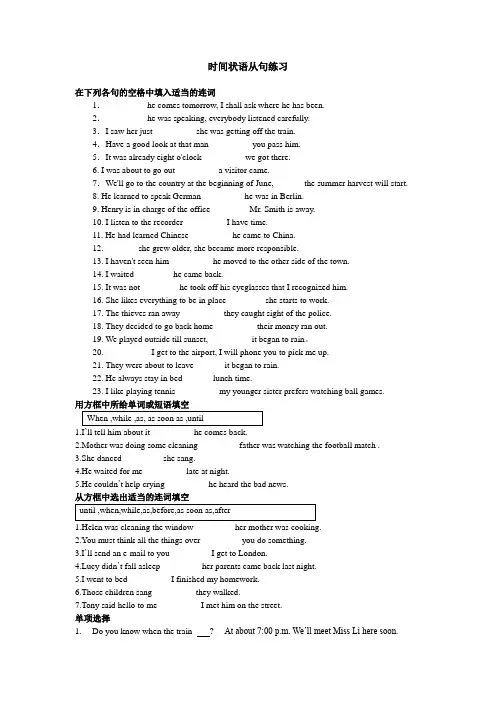
时间状语从句练习
在下列各句的空格中填入适当的连词
1._________ he comes tomorrow, I shall ask where he has been.
2._________ he was speaking, everybody listened carefully.
3.I saw her just _________ she was getting off the train.
4.Have a good look at that man _________ you pass him.
5.It was already eight o'clock _________ we got there.
6. I was about to go out _________ a visitor came.
7.We'll go to the country at the beginning of June, ______ the summer harvest will start.
8. He learned to speak German _________ he was in Berlin.
9. Henry is in charge of the office ________ Mr. Smith is away.
10. I listen to the recorder _________ I have time.
11. He had learned Chinese _________ he came to China.
12. _______ she grew older, she became more responsible.
13. I haven't seen him _________ he moved to the other side of the town.
时间状语从句
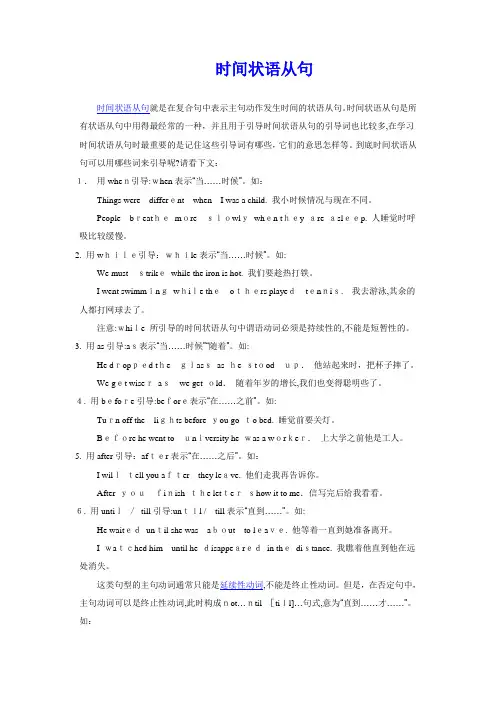
时间状语从句就是在复合句中表示主句动作发生时间的状语从句。时间状语从句是所有状语从句中用得最经常的一种,并且用于引导时间状语从句的引导词也比较多,在学习时间状语从句时最重要的是记住这些引导词有哪些,它们的意思怎样等。到底时间状语从句可以用哪些词来引导呢?请看下文:
1. 用when引导:when表示“当……时候”。如:
Things were different when I was a child. 我小时候情况与现在不同。
People breathe more slowly when they are asleep. 人睡觉时呼吸比较缓慢。
2. 用while引导:while表示“当……时候”。如:
We must strike while the iron is hot. 我们要趁热打铁。
I went swimming while the others played tennis. 我去游泳,其余的人都打网球去了。
注意:while 所引导的时间状语从句中谓语动词必须是持续性的,不能是短暂性的。
3. 用as引导:as表示“当……时候”“随着”。如:
He dropped the glass as he stood up. 他站起来时,把杯子摔了。
We get wiser as we get old. 随着年岁的增长,我们也变得聪明些了。
4. 用before引导:before表示“在……之前”。如:
Turn off the lights before you go to bed. 睡觉前要关灯。
Before he went to university he was a worker. 上大学之前他是工人。
5. 用after引导:after表示“在……之后”。如:
I will tell you after they leave. 他们走我再告诉你。
After you finish the letter show it to me.信写完后给我看看。

状语从句
(一)状语从句概述
定义 状语从句用作状语,是起副词作用的句子。
位置 状语从句可以放在主句之前,也可以放在主句之后,时间、条件、原因和让步状语从句放在句首时需要用逗号和主句隔开。
分类 根据其作用可以分为时间、地点、原因、条件、目的、让步、方式和比较等状语从句。
作用 它可以修饰谓语、非谓语动词、定语、状语和整个句子。
(二)状语从句详解
1. 时间状语从句
引导词 用法 示例
when 意为“当…的时候”。When引导从句的谓语动词可以是延续性动词,也可以是瞬间动词。并且when有时表示“就在那时” A liar is not believed when he
speaks the truth.说谎者讲真话时也没有人相信。
When he arrives, I’ll call you.
When you laugh and smile,
your body relaxes.
while 意为“在…的时候,在…的同时”。While引导从句的谓语动词必须是延续性的,发生时间较长,并强调主句和从句的动作同时发生(或者相对应)。While有时还可以表示对比。 While I was standing at the
window, I saw several boys
running along the street.
While John was watching TV,
his wife was cooking.
as 意为“一边…一边…”。The writer was angry as he was As引导的动作是延续性的,发生时间较短,一般用于主句和从句动作同时发生;as也可以强调一前一后。 travelling on a train to London
because someone had invaded
his “space”.
He smiled as he stood up.
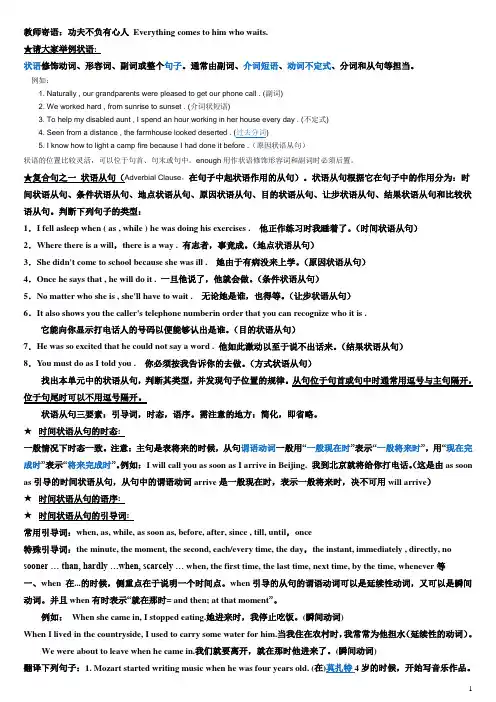
1 教师寄语:功夫不负有心人 Everything comes to him who waits.
★请大家举例状语:
状语修饰动词、形容词、副词或整个句子。通常由副词、介词短语、动词不定式、分词和从句等担当。
例如:
1. Naturally , our grandparents were pleased to get our phone call . (副词)
2. We worked hard , from sunrise to sunset . (介词状短语)
3. To help my disabled aunt , I spend an hour working in her house every day . (不定式)
4. Seen from a distance , the farmhouse looked deserted . (过去分词)
5. I know how to light a camp fire because I had done it before .(原因状语从句)
状语的位置比较灵活,可以位于句首、句末或句中。enough用作状语修饰形容词和副词时必须后置。
★复合句之一 状语从句(Adverbial Clause,在句子中起状语作用的从句)。状语从句根据它在句子中的作用分为:时间状语从句、条件状语从句、地点状语从句、原因状语从句、目的状语从句、让步状语从句、结果状语从句和比较状语从句。判断下列句子的类型:
1.I fell asleep when ( as , while ) he was doing his exercises . 他正作练习时我睡着了。(时间状语从句)
2.Where there is a will,there is a way . 有志者,事竟成。(地点状语从句)
3.She didn't come to school because she was ill . 她由于有病没来上学。(原因状语从句)