
动词时态(一般过,一般将
- 格式:ppt
- 大小:795.50 KB
- 文档页数:23

1 / 2
be动词的一般过去时态教学方法
在教be动词的一般过去时态时,我是这样设计的:
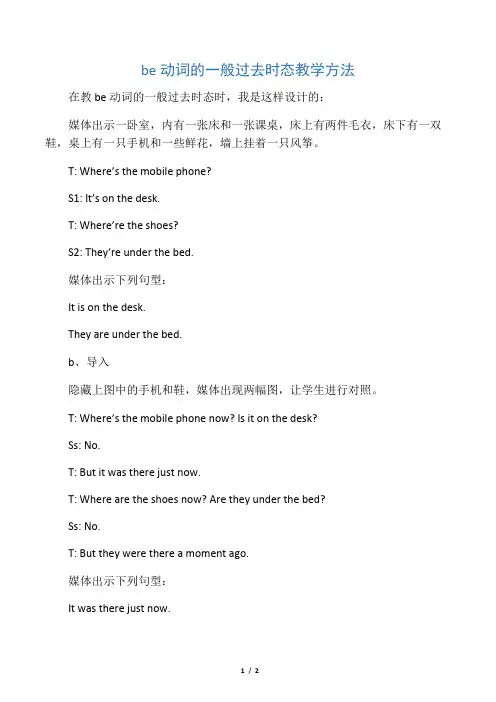
媒体出示一卧室,内有一张床和一张课桌,床上有两件毛衣,床下有一双鞋,桌上有一只手机和一些鲜花,墙上挂着一只风筝。
T: Where’s the mobile phone?
S1: It’s on the desk.
T: Where’re the shoes?
S2: They’re under the bed.
媒体出示下列句型:
It is on the desk.
They are under the bed.
b、导入
隐藏上图中的手机和鞋,媒体出现两幅图,让学生进行对照。
T: Where’s the mobile phone now? Is it on the desk?
Ss: No.
T: But it was there just now.
T: Where are the shoes now? Are they under the bed?
Ss: No.
T: But they were there a moment ago.
媒体出示下列句型:
It was there just now.
2 / 2
They were there a moment ago.
由学生已知的一般现在时作铺垫,引出be动词的一般过去时,两种时态对比使用,教师作适当解释。
这样,借助媒体创设的语法情景,学生深切感知并能归纳这一语法现象,还可以活用知识进行实践等一系列活动,有效地帮助学生掌握了be动词一般过去时的用法。

页脚内容 一、一般现在时:
概念:经常、反复发生的动作或行为及现在的某种状况。
基本结构:①be动词;②行为动词
时间状语:always, usually, often, sometimes, every week (day, year, month…), once
a week, on Sundays, etc.
eg: I usually get up at seven o’clock every morning
我通常每天7点起床
表述客观真理、客观存在及自然现象
eg: Knowledge is power 知识就是力量
Time and tide wait for no man 岁月不等人
China lies in the east of Asia 中国位于亚洲的东部
在时间、条件、让步状语从句中,代替一般将来时
eg: If it doesn’t rain, we will go on a picnic as planned.
如果不下雨,我们将按计划去野餐。
某些动词如:come, go, leave, arrive,stop, start,take place等,用于一般现在时表示按时间表拟定或将来肯定会发生的动作。
eg: The final exam takes place next week.
期末考试在下周举行。
The train leaves Beijing at six and arrives at shanghai at eleven.
火车六点离开北京,11点到达上海。
否定形式:①am/is/are+not;②此时态的谓语动词若为行为动词,则在其前加don't,如主语为第三人称单数,则用doesn't,同时还原行为动词。
页脚内容 一般疑问句:①把be动词放于句首;②用助动词do提问,如主语为第三人称单数,则用does,同时,还原行为动词。

第1页 版权所有 不得复制 1 初三英语通用版动词时态和语态课后练习
(答题时间:45分钟)
动词的时态
一、单项选择
*1. I like this silk dress, and it so soft and comfortable.
A. is feeling B. feels C. has felt D. is felt
2. —How was your weekend on the farm?
—Great! We with the farmers.
A. enjoy ourselves B. went fishing C. will work D. make friends
3. You to the meeting this afternoon if you have something important to do.
A.
needn’t to come B. don’t need come
C. don’t need coming D. needn’t come
4. The geography teacher told us yesterday that the earth
around the sun.
A. moves B. moved C. has moved D. was moving
*5. If he harder, he will catch up with us soon.
A. study B. studies C. will study
D. studied
6. —Shall we go shopping now?
小学英语四种时态及口诀
一提到时态,就必然用到动词。首先要明确两个概念:
动词有五种形式,即:原形(形式),第三人称单数(形式),过去式(形
式),现在分词(形式),过去分词(形式)。
小学阶段,句子有以下四种常见时态,即:一般现在时态;一般过去时态;
一般将来时态;现在进行时态。
式,意思就是各种不同的形式,是对应着动词来说的;
时态,意思就是表达各种不同的时间的事情,是对应着句子来说的。式与时,
先搞懂区别。
一、 一般现在时态
一般现在时用法口诀
一般现在时,every, usually, often, sometimes.
第一、二人称和复数,动词原形不变换。
除了I, you,复数外,动词后加s(es)别忘怀。
要变一般疑问句,be动词提前很容易。
若是没有be动词,Do和Does开头要注意。
否定句,很简单,not 在be 动词后面站。
若是没有be动词,do, does加not 要牢记。
请把这些规律记,一般现在时没问题。
一般现在时态,可能是两种意思。
第一,表示经常性的动作,
常与often, sometimes, usually, every day, every week, every month, every
year等表示频率的副词连用。
例如:He often goes swimming in summer.
I usually go to work by bike.
Sam visits China every year.
第二,表示现在的状态。
如:My mother is a worker.
There is a computer in our classroom.
注意问题:
be (am, is, are) 动词就是独立的谓语动词,一个句子中有了be(am, is, are) 就
有了谓语动词了。句子中不能同时出现两个谓语动词。
不少同学经常出这样的错误:
The boy is often eats hamburgers.(错)