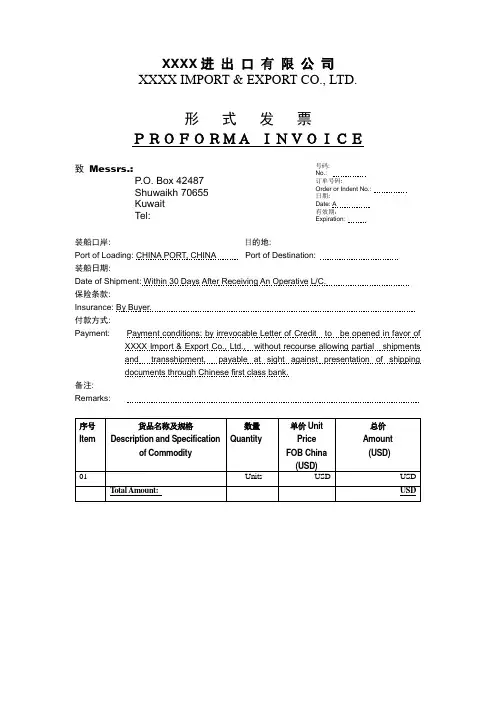
形式发票英文
- 格式:docx
- 大小:11.30 KB
- 文档页数:3
形式发票英文
1. Introduction
In the business world, a formal invoice plays a crucial role in facilitating the
transaction process. An invoice serves as a legal document, providing a detailed
breakdown of goods or services rendered, their prices, and the terms of payment.
This document is especially important for international transactions, where
communication may be conducted in different languages. In this article, we will
explore the format and terminology commonly used in English-language formal invoices.
2. Header Information
The header section of a formal invoice typically includes the following
information:
• Company Name and Logo: The name and logo of the company
issuing the invoice should be clearly displayed at the top.
• Company Address: The full address of the company, including street
name, city, state, and country.
• Contact Information: Contact details, such as telephone number,
email address, and website, should be provided for communication purposes.
• Invoice Number: A unique identifier for each invoice is assigned to
keep track of the transaction.
• Invoice Date: The date when the invoice is issued should be clearly
stated.
3. Billing and Shipping Information
In this section, the invoice should include details of the customer or client,
including:
• Customer Name: The legal name of the individual or business entity
being billed.
• Customer Address: The complete billing address, including street
name, city, state, and country.
• Shipping Address: If the shipment is made to a different address, it should be clearly specified.
4. Description of Goods or Services
The main body of the invoice contains a detailed breakdown of the goods or
services provided. Each item should include the following information: • Item Description: A clear, concise description of the goods or
services rendered should be provided.
• Quantity: The quantity of each item or the number of hours of service
provided should be clearly mentioned.
• Unit Price: The individual price per unit/item should be stated.
• Total Price: The total price for each item, calculated as the quantity
multiplied by the unit price, should be shown.
5. Subtotal, Discounts, and Taxes
The subtotal section displays the total cost before applying any discounts or
taxes. If any discounts or taxes apply, they should be clearly stated, with a
breakdown of the calculation.
6. Terms of Payment
The terms of payment outline the agreed-upon method and timeline for
payment. Commonly used terms include:
• Payment Method: The preferred method of payment, such as bank
transfer, credit card, or check.
• Payment Due Date: The date by which payment should be received.
• Late Payment Policy: If there are penalties or fees for late payment,
they should be clearly stated.
• Bank Account Information: If payment is to be made via bank
transfer, the relevant bank account details should be provided.
7. Footer
The footer section of a formal invoice usually contains additional information,
including:
• Terms and Conditions: Any specific terms and conditions associated
with the transaction should be mentioned here.
• Tax Identification Number: The company’s tax identification
number or VAT number, if applicable.
• Total Amount Due: The final amount due should be clearly stated.
• Notes or Additional Information: Any additional information or
special instructions can be mentioned in this section.
8. Conclusion
Writing a formal invoice in English requires following a standardized format and
terminology. In this article, we have covered the essential sections of an invoice,
including header information, billing and shipping details, itemized descriptions,
subtotal calculations, payment terms, and footer information. By adhering to these guidelines, businesses can effectively communicate their financial transactions to
international clients or customers.