BEAM4 Element
- 格式:doc
- 大小:704.00 KB
- 文档页数:21
BEAM4 Element DescriptionBEAM4 is a uniaxial element with tension, compression, torsion, and bending capabilities. The element has six degrees of freedom at each node: translations in the nodal x, y, and z directions and rotations about the nodal x, y, and z axes. Stress stiffening and large deflection capabilities are included. A consistent tangent stiffness matrix option is available for use in large deflection (finite rotation) analyses. See BEAM4 in the ANSYS, Inc. Theory Reference for more details about this element. A tapered unsymmetrical elastic beam is described in BEAM44and a 3-D plastic beam in BEAM24.Beam4单元是一个单轴单元,可以分析拉、压、扭和弯。
单元的每个节点有六个自由度:沿x、y、z轴方向的平动和绕x、y、z轴的转动。
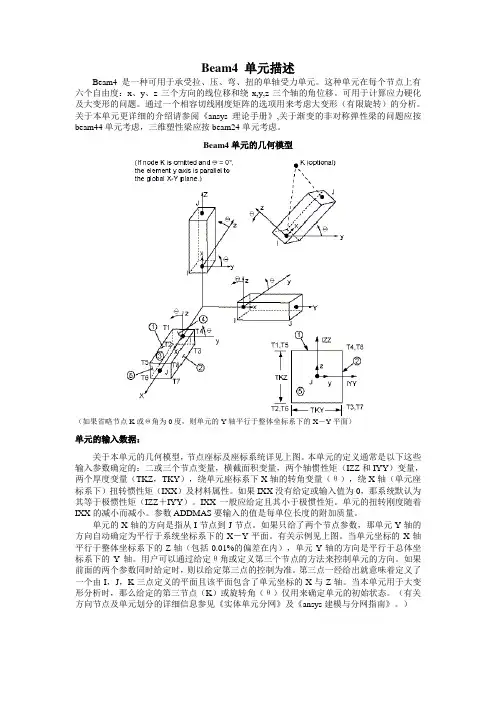
Figure 4.1 BEAM4 GeometryBEAM4 Input DataThe geometry, node locations, and coordinate systems for this element are shown in Figure 4.1: "BEAM4 Geometry". The element is defined by two or three nodes, the cross-sectional area, two area moments of inertia (IZZ and IYY), two thicknesses (TKY and TKZ), an angle of orientation (θ) about the element x-axis, the torsional moment of inertia (IXX), and the material properties. If IXX is not specified or is equal to 0.0, it is assumed equal to the polar moment of inertia (IYY + IZZ). IXX should be positive and is usually less than the polar moment of inertia. The element torsional stiffness decreases with decreasing values of IXX. An added mass per unit length may be input with the ADDMAS value.这个单元的几何形状,节点位置,和坐标系如Figure 4.1: "BEAM4 Geometry"所示。
该单元由两或三个节点、截面面积、两个转动惯量(IZZ and IYY)、两个边长(TKY and TKZ)、与单元x轴所成的偏斜角和材料特性、扭转惯性矩(IXX)和材料特性。
如果IXX没有特别指定或等于0,那么,它等于极惯性矩(IYY + IZZ)。
IXX必须为正但小于极惯性矩。
单元的扭转刚度随IXX减小而减小。
每单位长度附加质量通过ADDMAS参数输入。
The element x-axis is oriented from node I toward node J. For the two-node option, the default (θ = 0°) orientation of the element y-axis is automatically calculated to be parallel to the global X-Y plane. Several orientations are shown in Figure 4.1: "BEAM4 Geometry". For the case where the element is parallel to the global Z axis (or within a 0.01 percent slope of it), the element y axis is oriented parallel to the global Y axis (as shown). For user control of the element orientation about the element x-axis, use the θ angle (THETA) or the third node option. If both are defined, the third node option takes precedence. The third node (K), if used, defines a plane (with I and J) containing the element x and z axes (as shown). If this element is used in a large deflection analysis, it should be noted that the location of the third node (K), or the angle (THETA), is used only to initially orient the element. (For information about orientation nodes and beam meshing, see Meshing Your Solid Model in the ANSYS Modeling and Meshing Guide.)单元的x轴方向为节点I到节点J的方向。
在确定两节点的情况下,y轴的默认方向则自动地平行于全球坐标系的x-y平面。
几个方向如图Figure 4.1: "BEAM4 Geometry"所示。
特殊地,当单元平行于全局坐标系的z轴时,单元的y轴平行于全局坐标系的y轴。
用户可以用单元的x轴、θ角或第三节点来控制单元的方向。
如果两者都定义了,则第三节点的定义优先。
如果定义了第三个节点,那么则定义了单元的x-z平面。
如果单元呈很大的的角度时,则需要第三个节点或θ角来定义单元的初始方向。
(节点的方向和两单元划分单元,参见ANSYS Modeling and Meshing Guide的Meshing Your Solid Model)The initial strain in the element (ISTRN) is given by Δ/L, where Δ is the difference between the element length, L, (as defined by the I andJ node locations) and the zero strain length. The shear deflection constants (SHEARZ and SHEARY) are used only if shear deflection is to be included. A zero value of SHEAR_ may be used to neglect shear deflection in a particular direction. See Shear Deflection for details.单元的预应力(ISTRN)由Δ/L给定,这里Δ是单元的长度L(由节点I和J的位置确定)和0应力时的长度的差值。
剪应力的大小(SHEARZ and SHEARY)只有在要考虑剪应力时才用到。
在忽略某个方向的剪应力时则设为0,细节参见Shear Deflection。
KEYOPT(2) is used to activate the consistent tangent stiffness matrix (i.e., a matrix composed of the main tangent stiffness matrix plus the consistent stress stiffness matrix) in large deflection analyses [NLGEOM,ON]. You can often obtain more rapid convergence in a geometrically nonlinear analysis, such as a nonlinear buckling or postbuckling analysis, by activating this option. However, you should not use this option if you are using the element to simulate a rigid link or a group of coupled nodes. The resulting abrupt changes in stiffness within the structure make the consistent tangent stiffness matrix unsuitable for such applications.主要参数(2)用于定义大角度分析时的确定切线刚度矩阵组集的,你通常可以得到几何非线性分析的更快的收敛路径,比如,用这个参数分析屈曲或后屈曲分析。
但是,不能用于仿真刚性杆或节点集的耦合。
这是因为这种结构中,切线刚度矩阵组集不再适合着用应用。
KEYOPT(7) is used to compute an unsymmetric gyroscopic damping matrix (often used for rotordynamic analyses). The rotational frequency is input with the SPIN real constant (radians/time, positive in the positive element x direction). The element must be symmetric with this option (e.g., IYY = IZZ and SHEARY = SHEARZ).主要参数(7)用于计算不对称转动阻尼矩阵(常用于转子动力学分析)。