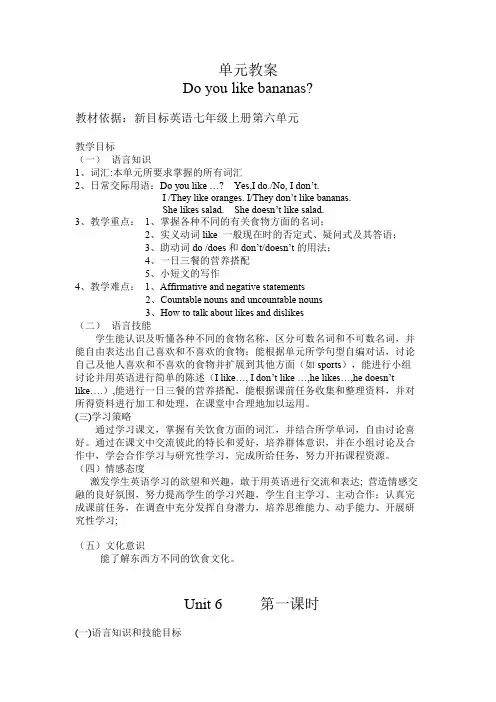
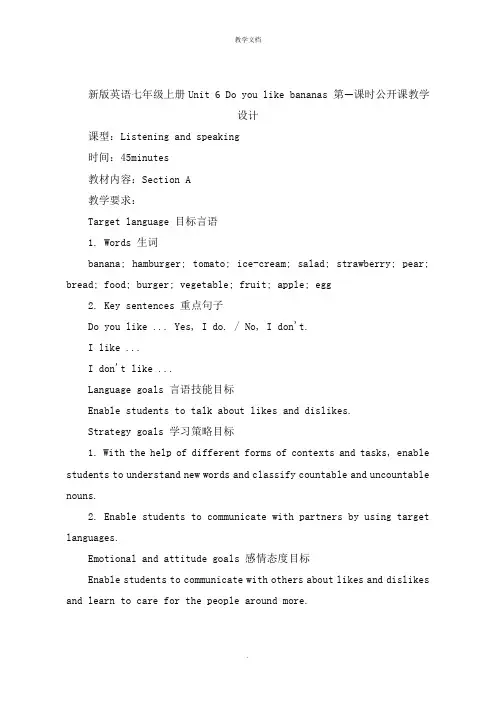
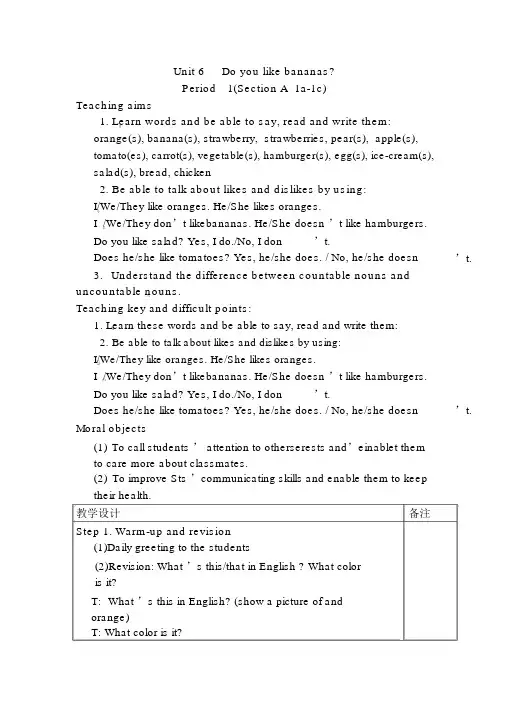
Unit 6Do you like bananas?Period 1(Section A 1a-1c)Teaching aims1. Learn words and be able to say, read and write them:orange(s), banana(s), strawberry, strawberries, pear(s), apple(s),tomato(es), carrot(s), vegetable(s), hamburger(s), egg(s), ice-cream(s),salad(s), bread, chicken2. Be able to talk about likes and dislikes by using:I/We/They like oranges. He/She likes oranges.I /We/They don’t likebananas. He/She doesn’t like hamburgers.Do you like salad? Yes, I do./No, I don’t.Does he/she like tomatoes? Yes, he/she does. / No, he/she doesn’t.3.Understand the difference between countable nouns and uncountable nouns.Teaching key and difficult points:1.Learn these words and be able to say, read and write them:2.Be able to talk about likes and dislikes by using:I/We/They like oranges. He/She likes oranges.I /We/They don’t likebananas. He/She doesn’t like hamburgers.Do you like salad? Yes, I do./No, I don’t.Does he/she like tomatoes? Yes, he/she does. / No, he/she doesn’t. Moral objects(1)To call students ’ attention to otherserests and’ei n ablet themto care more about classmates.(2)To improve Sts ’communicating skills and enable them to keeptheir health.教学设计备注Step 1. Warm-up and revision(1)Daily greeting to the students(2)Revision: What ’s this/that in English ? What coloris it?T:What ’s this in English? (show a picture of andorange)T:What color is it?Step 2. Presentation –New words.(1)Go on asking: What ’s this/that in English ? Whatcolor is it?T:What ’s this in English? (show a picture of anapple and if the student don’t know it, show thephonetic symbol of the word.)T: Spell it, please.S: A-P-P-L-E.T: What color is it?S: It ’s red.(Present the other three words as above: pear,strawberry, banana )T:We can call all of these things fruit . (Teach the newword “fruit ”.)Show pictures and ask the Ss “What arethese/those? ”and ask the SS to spell the pluralforms of these words: oranges, apples, pears,strawberries, bananas.(2)Repeat step (1) to present: carrot, carrots,tomato, tomatoes and vegetable, vegetables.(3)Present some more words by showing pictures. Get theSs to make an effort to pro nounce and spell the new words.Bread, hamburger ,hamburgers, milk, ice-cream,ice-creams, salad, chicken ,an egg, eggsWe can call all of these things food:食物3.Memory Challenge: Who has the best eyes?(1)Show the pictures, and say the plural forms of the nouns andsome uncountable noun.(2)Summarize. 可数名词有复数形式 , 不可数名词一般没有复数形式Step 3Presentation Target language 11. Show the pictures and say:I like tomatoes, but I don’ t like bread.2.Let students say:I like, but I don’t like ....3. Show the pictures and say:She likes bread, but she doesn’t like milk.He likes chicken, but he doesn’t like eggs.4.Let students say: He/She likes , but he/she doesn’tlike ....According Ss’answers and say:5. Sing a chant:Bananas, bananas, I like bananas! Salad, salad, I like salad!Strawberries, strawberries,I don ’t like strawberries!Pears, pears, he likes pears!Milk , milk, he likes milk!Tomatoes, tomatoes,He doesn ’t like tomatoes! Step 4 Work 1a .1. Read the words.2.T: Look at the pictures and fill in the chart .Fruit Food Vegetable3.Match the words with the things in the picture.4.Check the answers .Step 5 Present the new language 1 .1. T: Oh, we have lots of delicious fruits . I like apples best.Do you like apples ?S1 :Yes , I do. I like apples.S2: No, I don't . I like salad.T: Do you like salad ? S3: Yes , I do. I like salad./ No, I don't . I don’tlike salad.Step 6 Pairwork .1. T: Work in pairs .Ask and answer with your partners .(Before class the students have draw some pictures of the food )2. Get the Ss to ask and answer in pairs, using the sentences:’t.A: Do you like ?B: Yes, I do./ No, I don 3. When you ask andanswer, please fill in the chart. Name Like DislikeStep 7 Present the new language 2 .1.Show pictures and ask and answer questionsDoes she/he like ?Yes, she/he does. She/He likes/ No, she/he doesn ’t. She/He doesn ’tlike .Step 8 Pairwork .1. T: Work in pairs .Ask and answer with your partners .2.Get the Ss to ask and answer in pairs, using the sentences:Does she/he like ?Yes, she/he does. She/He likes/ No, she/he doesn ’t. She/He doesn ’tlike .3.According Ss’answers and ask “Do they like ? Yes, they do./ No, they don’t.”Step 9 Work on 1b.1.T: 1b. List en and number the conversations.2.Listen.3.Check the answers.4.Read after the tape.Step 10 work on 1c.1.First, practice the conversations in 1b.Then, make a survey and fill in the chart below.2. Report: I like milk and tomatoes, but I don’t like ice-cream. Mary likes oranges, but she doesn’liket milk orice-cream. Tom likes tomatoes and strawberries, but hedoesn ’ t like bread.Step 11 . HomeworkWrite down the report.Blackboard design:New Words Unit 6 Do you like bananas?Do you like?Yes , I do. I likeNo ,I don ’t. I don ’tlikeDoes she/he like ?Yes, she/he does. She/He likes/No, she/he doesn ’t. She/He doesn ’tlike.Period 2(Section A 2a-2d)Teaching aims:1. Words & expressionsBirthday, dinner, week, think about, food, sure, how/whatabout ? Burger, vegetable, fruit, apple, then2. Target languageI like strawberries, they’re delicious. Let’s have them.--Yes, I like them ,too./ No, I don’tlike them.I like salad, it ’s delicious. Do you like it?-- Yes, I do./No, I don’t but I likeice cream.Let ’ s have Let ’s think about the food.Ability goalsEnable students to talk about likes and dislikes.Learning ability goalsHelp students learn how to talk about likes and dislikes.2. Listening and speaking skills.Moral object:Learn to keep healthy.Teaching important / difficult pointsHow to talk about likes and dislikes with the target language.教学设计备注Step1 Warm up and revision.1.Everyday greeting.2.Review.Show the pictures and say the singularforms and the plural forms of the countable nouns.3.Show some pictures of the uncountable nouns.4.Summarize.(1).当可数名词复数再次出现时,用“They( 主语)或 them(宾语)”替代。