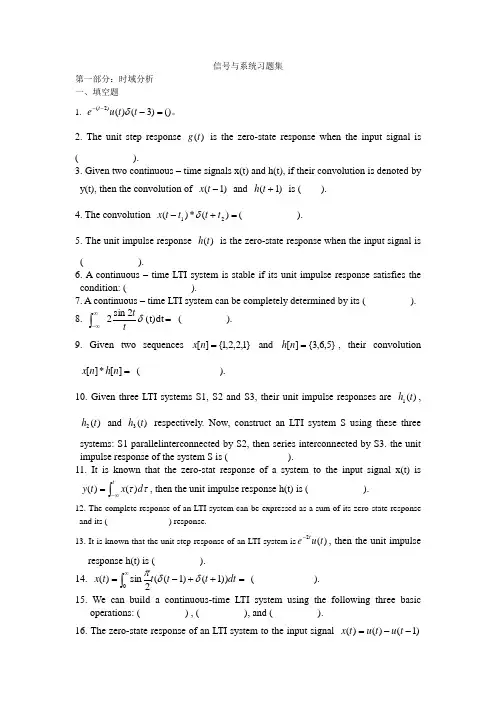
信号与系统signal and system英文版往年考试题1
- 格式:doc
- 大小:244.50 KB
- 文档页数:5
Test (Chapter 1,2,3,4)
参考答案
I. Blank filling (Total scores 60, each scores 5. ) 1、
)0(1
f a
(70%) 2、
2/1-(96%)
3、
)()(t t u e t δ+--(92%)
4、Piecewise function can be comprised by rectangular window functions(可以用矩形窗函数构造分段函数). Consider a signal )]1()([)(--=t u t u t t f ,the even component of )(t f is )(t f e = ,the odd component of )(t f is
)(t f o =
)]1()1()(2[2
+---t u t u t u t
(46%) )]1()1([2
--+t u t u t
(92%) 5、Consider a signal )]1()([)(--=t u t u t t e ,and
)]1()([)(--=-t u t u e t h t ,so =)(*)(t h t e 。
(Express your answer by rectangular window function like
I.4) 先做微分
⎪⎩
⎪
⎨⎧<<-<<+-=--其他,02
1),2(10,1)(1t t e t e t t y t
(76%)
6、Necessary and sufficient conditions for stability of the system
is
its
impulse
response
)
(t h should be
【int(f(x),-inf,inf)=dx x f ⎰∞
∞-)(】
∞<⎰
∞
∞
-dt t h )((37%)
7、consider a signal )1()()(--=t u t u t e ,则=)(*)(t e t e (Express your answer by rectangular window function like I.4)
)]2()1()[2()]1()([----+--t u t u t t u t u t (87%)
,01
2,120,t t t t others <<⎧⎪
-<<⎨⎪⎩
8、Known Fourier transform of f(t) is )(ωj F ,so the Fourier transform of )4(t f - is 。
)(4ωωj F e j --(71%)
9、The Fourier transform of )('2t e t j δ is
)
2()(')('1)(2-↔↔↔ωδω
δδj t e j t t t j (83%)
10、A system S with input ][n x and output ][n y related by
]}2[][]{[][++=n g n g n x n y is time invariant while
][n g = .
Constant (6%)
11、ττδδd x t y T t T t t x t
⎰∞-=--+=)()(),()()(, then E ∞ of
)(t y is
2T (73%)
II. Single choice(Total scores 24, each scores 6. ) 1.The equivalent expression of )4(2-t δ is ( D )
A :)2(2
1
-t δ
B :)]2()2([2
1
+-t t δδ+ C :)2(41
-t δ
D :)]2()2([4
1+-t t δδ+
⎪⎩⎪⎨
⎧≠==⎰+∞∞-)
0(0)(1
)(t t dt t δδ 2. Refer to the Fourier transform of )()(t u e t x at
-=, to
determine
)(t f when the Fourier transform of )(t f is
)
2(51
++ωj , then
)(t f is ( B )
A :)()25(t u e t j --
B :)()25(t u e t j +-
C :t j e )25(--
D :t j e )25(+-
ω
j a t u e at
+↔-1
)(
3.The input e(t) and output r(t) of a continuous system is
regulated by r(t)=e(t+2), then the system is ( D ) A :causal, time-variant, linear, stable
B :causal, time-invariant, nonlinear, unstable
C :non-causal, time-variant, linear, stable
D :non-causal, time-invariant, linear, stable
4.The input f(t) and output r(t) of a system is governed by
⎰=τττd e f t r )()(, then the system is ( B )
A: Linear and time-invariant system
B: Linear and time-variant system C: Nonlinear and time-invariant system D: Nonlinear and time-variant system
III. True or False. (Total score 16, each scores 2.) 1.If system input is )(t x , then the system )()(t tx t y = is
linear.
T
2.If k n h <][(for any n), and k is a known constant, then the LTI system with unit impulse response h[n] is stable.
F
3.The Fourier transform of real even signal is also a real even function.
T
4.For any system, the impulse response completely describes
its behavior.
F 5.If h(t) is the unit impulse response of a LTI system, and h(t) is periodic and non-zero, then the system is unstable.
T 6.The summation of two periodic signals is also a periodic signal.
F 7.LTI system must be causal.
F 8. The Fourier transform of a real odd signal is a purely imaginary and odd function of frequency.
T。