
材料力学(英汉对照)02_Axial_Tension_and_Compression_
- 格式:pdf
- 大小:2.79 MB
- 文档页数:88


材料力学英文pdfMechanics of Materials: An Essential Discipline in EngineeringEngineering is a field that encompasses the design, development, and implementation of various systems, structures, and technologies that improve our lives. At the heart of this discipline lies the fundamental study of materials and their behavior under different loading conditions, known as mechanics of materials. This field of study is essential for engineers, as it provides the theoretical and practical knowledge required to analyze, design, and assess the performance of a wide range of engineering applications.Mechanics of materials, also referred to as strength of materials, is a branch of applied mechanics that deals with the relationship between the external loads applied to a structure or component and the resulting internal stresses, strains, and deformations. This knowledge is crucial for designing and evaluating the structural integrity and reliability of various engineering structures, such as buildings, bridges, vehicles, and machinery.The principles of mechanics of materials are based on the fundamental laws of physics, particularly the principles of statics,dynamics, and material behavior. Engineers must understand the properties of different materials, including their strength, stiffness, and resistance to deformation, in order to determine the appropriate materials and designs for a given application.One of the key concepts in mechanics of materials is the study of stress and strain. Stress is a measure of the internal forces acting within a material, while strain is a measure of the deformation or change in shape of the material. By understanding the relationship between stress and strain, engineers can predict how a material will respond to various loading conditions, such as tension, compression, shear, torsion, and bending.Another important aspect of mechanics of materials is the analysis of various structural elements, such as beams, columns, and trusses. Engineers must be able to calculate the internal forces, stresses, and deformations within these structures in order to ensure their safety and reliability. This analysis often involves the use of mathematical models and computational techniques, such as finite element analysis, to simulate the behavior of these structures under different loading conditions.The practical applications of mechanics of materials are vast and diverse. In the construction industry, engineers use this knowledge to design buildings, bridges, and other infrastructure that can withstandthe forces of gravity, wind, and earthquakes. In the transportation industry, mechanics of materials is essential for the design and analysis of aircraft, automobiles, and other vehicles, ensuring their structural integrity and safety.In the manufacturing industry, mechanics of materials is crucial for the design and optimization of various production processes, such as metal forming, welding, and additive manufacturing. By understanding the behavior of materials under different loading conditions, engineers can develop more efficient and reliable manufacturing techniques.Moreover, mechanics of materials is a fundamental prerequisite for the study of more advanced engineering disciplines, such as structural analysis, fracture mechanics, and fatigue analysis. These fields build upon the principles of mechanics of materials to provide a deeper understanding of the complex behavior of materials and structures under various loading scenarios.In conclusion, the study of mechanics of materials is an essential discipline in the field of engineering. It provides the theoretical and practical knowledge required to analyze, design, and assess the performance of a wide range of engineering applications, from buildings and bridges to vehicles and manufacturing processes. As engineering continues to evolve and tackle new challenges, theimportance of mechanics of materials will only continue to grow, making it a critical component of any engineer's toolkit.。

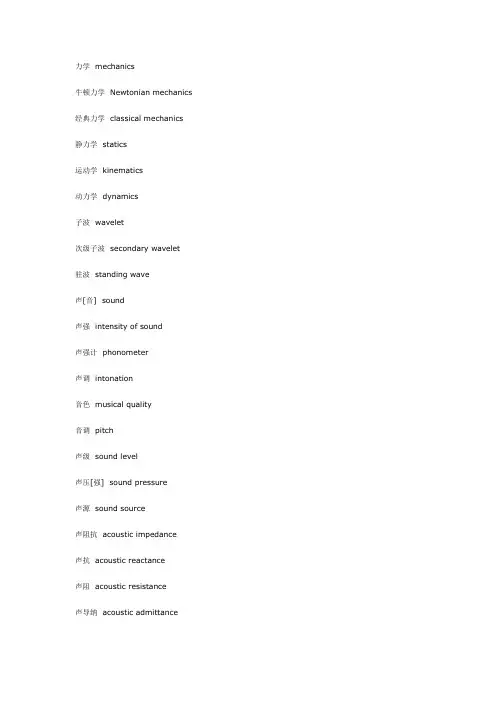
力学 mechanics牛顿力学 Newtonian mechanics 经典力学 classical mechanics静力学 statics运动学 kinematics动力学 dynamics子波 wavelet次级子波 secondary wavelet驻波 standing wave声[音] sound声强 intensity of sound声强计 phonometer声调 intonation音色 musical quality音调 pitch声级 sound level声压[强] sound pressure声源 sound source声阻抗 acoustic impedance声抗 acoustic reactance声阻 acoustic resistance声导纳 acoustic admittance声导 acoustic conductance声纳 acoustic susceptance声共振 acoustic resonance声波 sound wave超声波 supersonic wave声速 sound velocity次声波 infrasonic wave亚声速 subsonic speed又称“亚音速”。
超声速 supersonic speed又称“超音速”。
声呐 sonar共鸣 resonance回波 echo回声 echo拍 beat拍频 beat frequency群速 group velocity相速 phase velocity能流 energy flux能流密度 energy flux density材料力学 mechanics of materials, strength of materials 应力 stress法向应力 normal stress剪[切]应力 shear stress单轴应力 uniaxial stress双轴应力 biaxial stress拉[伸]应力 tensile stress压[缩]应力 compressive stress周向应力 circumferential stress纵向应力 longitudinal stress轴向应力 axial stress弯[曲]应力 bending stress, flexural stress 扭[转]应力 torsional stress局部应力 localized stress残余应力 residual stress热应力 thermal stress最大法向应力 maximum normal stress最小法向应力 minimum normal stress最大剪应力 maximum shear stress主应力 principal stress主剪应力 principal shear stress工作应力 working stress许用应力 allowable stress应力集中 stress concentration应力集中系数 stress concentration factor 应力状态 state of stress应力分析 stress analysis结构[强度]分析 structured analysis应变 strain剪[切]应变 shear strain法向应变 normal strain拉[伸]应变 tensile strain压[缩]应变 compressive strain体积应变 volumetric strain残余应变 residual strain热应变 thermal strain最大法向应变 maximum normal strain主应变 principal strain主剪应变 principal shear strain名义应变 nominal strain应变状态 state of strain载荷 load又称“荷载”。