
非人称主语句
- 格式:ppt
- 大小:180.00 KB
- 文档页数:13


非人称主语句子 Impersonal sentence
1、有过个几个月,我看见他们手上戴上了结婚戒指。可是,他们不像以前那样
健谈,他在看书,她在看报。 Months later, rings appeared glistening on their fingers, but chatting was replaced
by reading, one with a book, the other a newspaper.
2、便觉得有三分怅惘,三分无奈,然而思之又觉释然。 A touch of frustration and helpless comes over me. However, a second thought
brings me relived calm.
3、积习难除
Hard habits die hard.
4、新的一年将出现巨大变革。 A new year will witness great changes.
5、那个寒冷的下午,他独自在雪地里跋涉。
That chilly afternoon saw him trudging in the snow alone.
6、此事需立即办理。
This matter asks for immediate attention. ◆ see, look, witness, find, great, kiss, tell, ask 7、登上甲板,我们便见到了一轮旭日。
Boarding on the deck, a morning sun greeted us.
A morning sun greeted us as we come out on deck.
8、清风拂过树梢。 A breeze kissed the treetops.
9、他的心中充满了恐惧。
Dread (fear) seized (gripped) his mind.
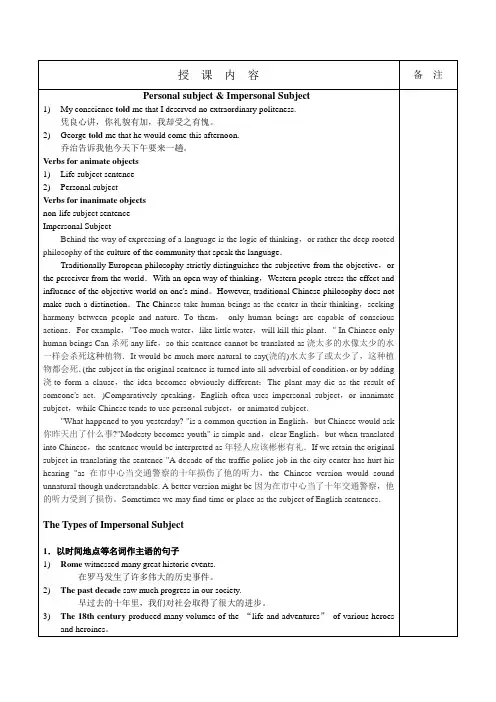
授 课 内 容 备 注
Personal subject & Impersonal Subject
1) My conscience told me that I deserved no extraordinary politeness.
凭良心讲,你礼貌有加,我却受之有愧。
2) George told me that he would come this afternoon.
乔治告诉我他今天下午要来一趟。
Verbs for animate objects
1) Life subject sentence
2) Personal subject
Verbs for inanimate objects
non-life subject sentence
Impersonal Subject
Behind the way of expressing of a language is the logic of thinking,or rather the deep rooted
philosophy of the culture of the community that speak the language.
Traditionally European philosophy strictly distinguishes the subjective from the objective,or
the perceiver from the world.With an open way of thinking,Western people stress the effect and
influence of the objective world on one's mind。However, traditional Chinese philosophy does not

龙源期刊网
浅析西班牙语中动词的非人称形式
作者:高宁进
来源:《智富时代》2015年第05期
【摘 要】西班牙语是一门屈折语,它的动词体系复杂,在西班牙语中动词分为人称形式与非人称或是无人称形式。三种非人称形式其中之一便是原形动词,原形动词分为原形动词简单形式和复合形式。原形动词在句中可以做主语、放在系动词后面做表语、并与不同的前置词搭配构成了不同的意思等,这需要我们进行系统的归纳及总结。
【关键词】原形动词的构成;原形动词的用法
西班牙语是一门屈折语。它的动词体系复杂,在西班牙语中动词分为人称形式与非人称或是无人称形式。动词的人称形式即动词的变位,这现了西班牙语的人称、式、时态等要素,人称即第一、二、三、人称的单复数;式:陈述式、虚拟式、条件式、命令式;时态即现在时、现在完成时、简单过去时、过去未完成时、过去完成时、将来未完成时、将来完成时等。另外一种即动词的非人称形式,具体包括动词原形动词、副动词、过去分词,它们自身都缺乏动词的人称形式所具有的人称、式、时态等要素且它们都不能像动词的人称形式一样独立成句或是作为句子的核心成分。结合笔者几年的教学经验,下面的部分笔者将浅析西班牙语动词的三种非人称形式之一原形动词。
一、原形动词的构成
原形动词分为简单形式和复合形式。简单形式即由动词词根加后缀,-ar, -er, ir而来,分别为第一变位动词、第二变为动词、第三变位动词,如hablar, tener, vivir;复合形式由动词原形haber + 动词的分词形式构成,如haber hablado, haber tenido, haber vivido. 它的构成较动词的其他两种非人称形式(副动词和过去分词)要简单的多。
二、原形动词简单形式的用法
(一)原形动词的简单形式可以作为名词使用,具有名词所有的功能,具体如下:

⽆灵主语
⽆灵主语
⽆灵主语,⼀种英语语法结构。英语⾥主语常⽤⼈称和⾮⼈称两种形式来表达。⽤⾮⼈称主语表达时,往往注重“什么事发⽣在什么⼈⾝上”。⽽汉语则较常⽤⼈称主语表达,侧重“什么⼈怎么样了”。英语中⾮⼈称作主语的句⼦主要有两种类型:1,从有⽆⽣命⾓度划分,主语可区分为有灵主语(animate) 和⽆灵主语(inanimate) 两类。⽆灵名词作主语,常翻译成各种状语,译成“由于……因此”,“因为……所以”,“在……之后”等等。⾮⼈称主语句采⽤“⽆灵主语”(inanimate subject),表⽰抽象概念、⼼理感觉、事物名称或时间地点等,但谓语却常常使⽤“有灵动词”(animate verb)表⽰⼈或社会团体的动作和⾏为,如:see,desert,find,bring,witness,give,escape,surround,kill,deprive,serve,send,know,tell,permit,invite,take,drive,prevent…from等,这类句⼦往往带有拟⼈化(personification)的修辞⾊彩。举⼏个例⼦: E.g. 1 Past experience has taught us that we should not depend onothers for everything. E.g. 2 His name slips my mind. E.g. 3 A good idea suddenly strikes me. (I suddenly have a good idea!) E.g. 4 A strangepeace came over her when she was alone. (She was peaceful when she was alone.) 2.⽤⾮⼈称代词“it”作主语。 E.g. 1 It never occurred to me thatshe was so dishonest.