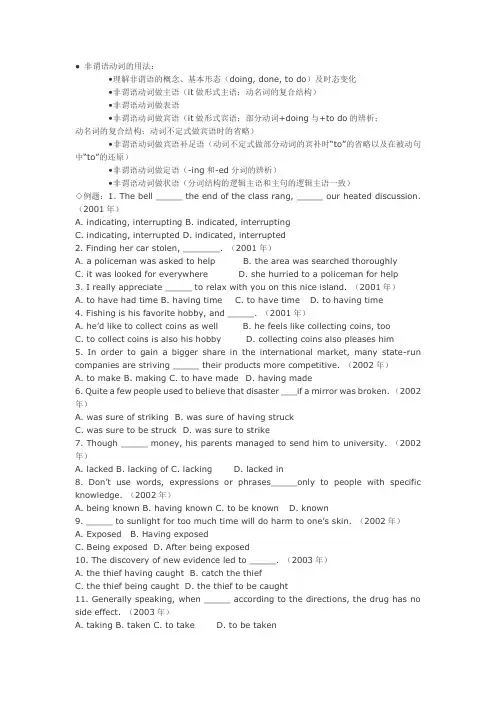
非谓语的用法
- 格式:docx
- 大小:37.17 KB
- 文档页数:4
非谓语的用法
一、什么是非谓语?
非谓语是指在句子中不作谓语的动词形式,包括动词的不定式、动名词和分词。
二、动词不定式的用法
1. 作主语:To learn English well is necessary.
2. 作宾语:I want to go to the cinema.
3. 作表语:His dream is to be a doctor.
4. 作定语:The best way to learn English is to practice speaking.
5. 作状语:
(1)目的状语:He went to the library to borrow some books.
(2)结果状语:He studied hard, only to fail the exam in the end.
(3)原因状语:He got up early so as not to miss the train.
6. 不定式的否定形式为“not+动词原形”,常用于否定意义。
三、动名词的用法
1. 动名词可以作主语、宾语和表语。
(1)主语:Reading books is a good habit.
(2)宾语:I enjoy reading books in my free time.
(3)表语:Her hobby is swimming in the sea.
2. 动名词可以与介词搭配构成介词短语,表示时间、原因、方式等。
(1)时间状语:After finishing his homework, he went to bed.
(2)原因状语:For lack of money, he couldn’t buy a new car.
(3)方式状语:By working hard, he got a promotion.
四、分词的用法
1. 现在分词和过去分词可以作定语和状语。
(1)现在分词作定语:The running water is very clear.
(2)现在分词作状语:He left the room, closing the door behind
him.
(3)过去分词作定语:The broken vase cannot be repaired.
(4)过去分词作状语:Feeling tired, he went to bed early.
2. 分词也可以与连系动词be搭配构成表语。
(1)现在分词作表语:She is always smiling.
(2)过去分词作表语:The book is written by a famous author.
五、注意事项
1. 非谓语动词的时态和语态要与句子的主谓保持一致。
2. 在非谓语结构中,主动形式表示主动意义,被动形式表示被动意义。
3. 非谓语结构中的名词、代词、形容词等要与其所修饰的名词或代词保持一致。
4. 在非谓语结构中,不定式和动名词可以相互替换,但是含义可能有所不同。
六、总结
非谓语是英文中重要的一种句子成分,在英文写作和口头表达中经常出现。正确使用非谓语可以使句子更加简洁、流畅,表达的意思更加准确。因此,我们需要认真学习和掌握非谓语的用法,提高自己的英文水平。