初中英语从句汇总
- 格式:docx
- 大小:44.53 KB
- 文档页数:24
初中英语从句汇总
In English。there are three main types of clauses: noun
clauses (including subject clauses。object clauses。predicate
clauses。and appositive clauses)。adjective clauses (also known
as relative clauses)。and adverbial clauses (including time。n。result。purpose。reason。n。place。and manner clauses).
Here are some basic grammar points about adjective clauses:
1.n of Adjective Clauses
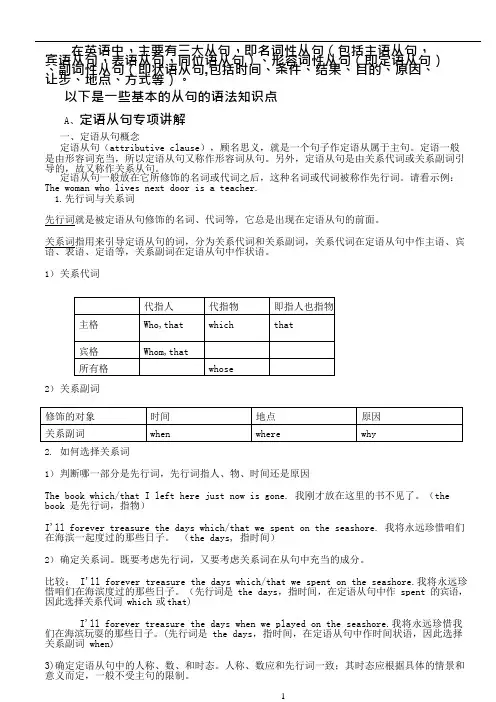
An adjective clause (also known as an attributive clause)
XXX.
2.Placement of Adjective Clauses
Adjective clauses are placedXXX: XXX.
3.Antecedents and Relative Words XXX is the noun or pronoun that is being modified by the
adjective clauseXXX subjects。objects。predicate nominatives。or adjectives in the clause。while XXX.
4.Relative Pronouns
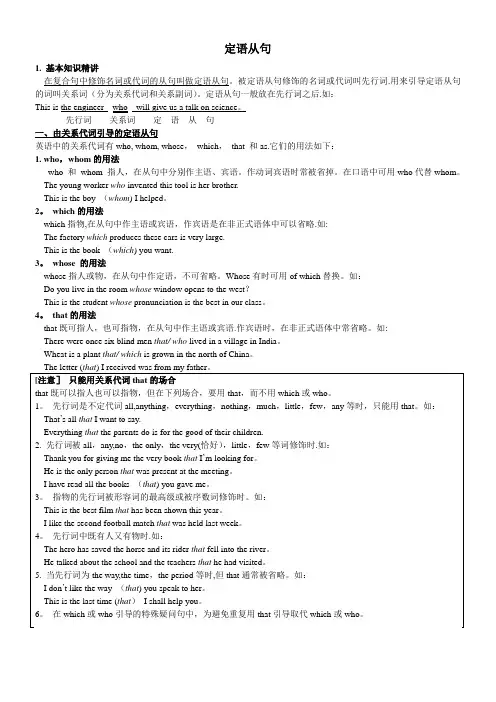
There are several relative pronouns in English。including
who。whom。that。which。and whose。Who and whom are
used to refer to people。while that and which can refer to either
people or things。Whose is used to show n.
5.Choosing the Right Relative Word
When choosing a relative word。you need to XXX and the n
of the relative word in the clause。For example: The book
which/that I left here just now is gone。(The antecedent is book。which refers to a thing。The relative word which or that is the
object of the verb left in the clause.)
I'll forever treasure the days when we played on the seashore。These were some of the happiest times of my life。and I will
always hold them close to my heart.
The person who is asking to see you is James。James is the
individual who is XXX.
定语从句的种类分为限定性定语从句和非限定性定语从句。限定性定语从句紧密地修饰先行词,删除后会影响整个句子的意义。非限定性定语从句则是补充说明,可用逗号隔开,删除后不会影响整个句子的意义。
XXX.
Yesterday。Jimmy left for Canada。where he had stayed for
two years。This non-restrictive XXX。
逗号的运用可以用于非限定性定语从句,而限定性定语从句则不需要逗号。关系代词that可用于限定性定语从句,而非限定性定语从句则不可用that。
关系代词who和whom代替人,在定语从句中分别作主格和宾格。Whose用于表示所属关系。例如:XXX.
我不喜欢结局不快乐的故事。 The book which I borrowed from the library is very
interesting.我从图书馆借来的那本书非常有趣。
The car。which was parked outside。XXX.停在外面的那辆车属于我的邻居。(这里的which指代先行词car)
Please bring me the book which is on the table.请把桌子上的那本书拿给我。(这里的which作宾语,可以省略)
三)关系代词that的用法
that既可代替人,也可代替物,在定语从句中作主语或宾语,作宾语时也可省略。例如:
The man that I saw in the park XXX XXX.我昨天在公园里看到的那个人是我的邻居。(这里的that指代先行词man)
The book that I borrowed from the library is very interesting.我从图书馆借来的那本书非常有趣。(这里的that也指代先行词book)
The car that was XXX.停在外面的那辆车属于我的邻居。(这里的that指代先行词car)
XXX me the book that is on the table.请把桌子上的那本书拿给我。(这里的that作宾语,可以省略)
I dislike XXX(No changes needed)
XXX XXX(Rephrased)
三) The usage of the relative pronoun "that"
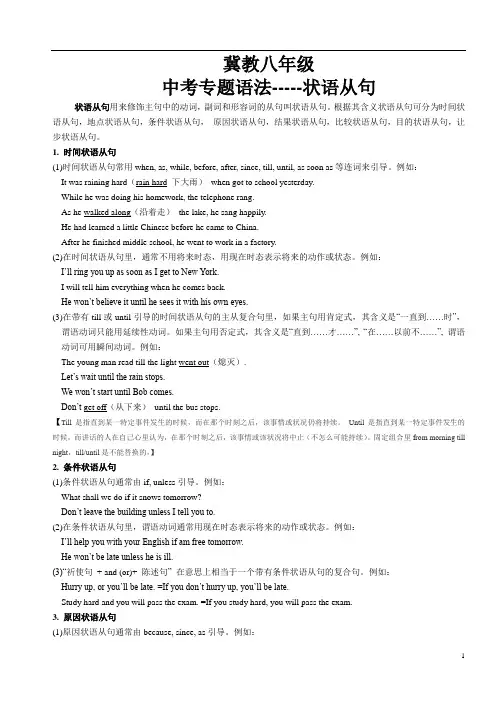
That" can refer to both people and things。but in modern
English it XXX。It is used in a relative clause as a subject or
object。and can be omitted when used as an object。For example:
Is she the girl who sells newspapers。(That XXX "who")
Where is the ice-cream that was in the fridge。(That can be
replaced by "which")
Is this the book that you want to buy。(That can be replaced
by "which"。and can also be omitted when used as an object in a
relative clause)
四) XXX
There are only three commonly used relative adverbs: when。where。and why。which n as adverbial clauses of time。place。and reason respectively。You can remember their usage with this
mnemonic:
The time when
The place where
XXX why
一) The usage of the relative adverb "when"
The relative adverb "when" XXX indicates time。and XXX:
In Beijing。July and August are the months when it rains
very often。(When refers to "months")
Do you remember the day when we first went to the Summer
Palace。(When refers to "day"。In modern English。"when" can
be replaced by "that" in this case。and "that" es a relative adverb
indicating time)
I haven't seen her since the year when I left Tokyo。(When
refers to "year"。and "that" can also be used to replace "when")
二) The usage of the relative adverb "where"
你可以拿走你想要的书。(as引导限制性定语从句,修饰books,表示“你想要的书”)
He is as tall as his father。who is 1.85 meters.
他和他的父亲一样高,他的父亲身高1.85米。(as引导非限制性定语从句,修饰father,表示“他的父亲是1.85米高”)
二)as引导的定语从句独立于主句之外,一般用于句首或句中强调。
As is known to all。China has a long history.
众所周知,中国有着悠久的历史。(as引导非限制性定语从句,表示“众所周知”)
I met him yesterday。as I was XXX.
我昨天在公园散步时遇到了他。(as引导限制性定语从句,修饰I,表示“我正在公园散步”)
You can take as many books as you want。
I have a computer like yours。
I have never seen a place as beautiful as Guilin。