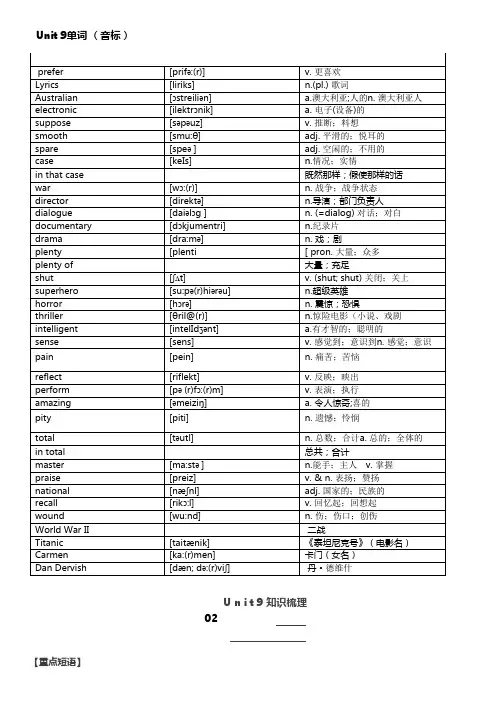
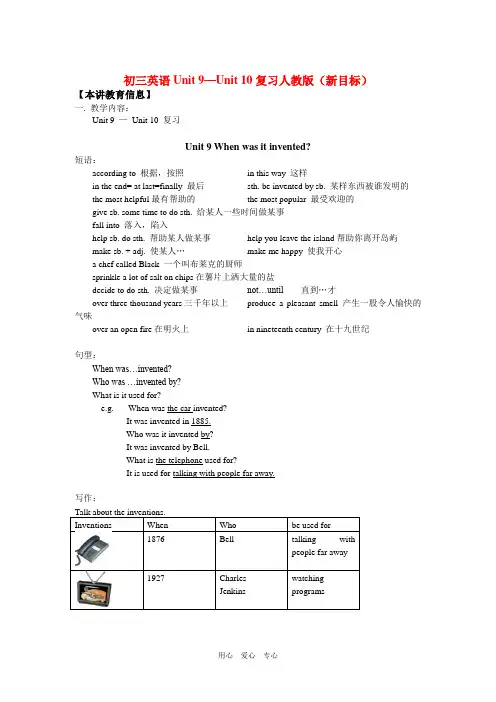
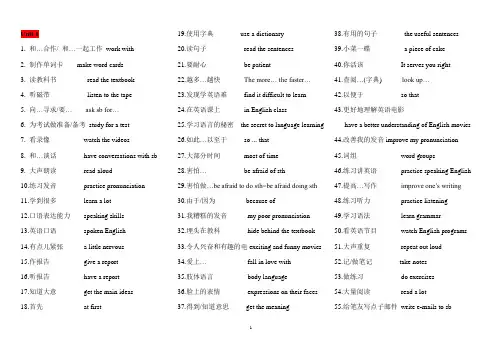
新版新目标英语九年级unit9知识点总结
- 格式:doc
- 大小:41.50 KB
- 文档页数:4
1 / 4 新版新目标英语九年级unit9知识点总结
1. prefer v 更喜爱;更喜欢;宁愿= like...better 现在分词preferring、过去式 preferred
prefer sb/sth 更喜欢某人或某物
prefer to do sth 宁愿做某事;更喜欢做某事
prefer doing A to doing B 宁愿做A而不愿做B
prefer sb to do sth 宁愿某人做某事
prefer A to B 喜欢A而不喜欢B to是介词 He prefers apples to bananas.
prefer to do A+ rather than + do B 宁愿做A 而不愿做B=would rather do A than do B
prefer sb to do sth 宁愿某人做某事
2. dance to 随着…..跳舞 to介词 按照;随着 sing to 和着...唱歌
The children danced to the music of the band.
the music that can dance to 能跟着跳舞的音乐
3. along with=together with 伴随着 sing along with 跟着一起唱
4. play different kind of music 演奏不同种类的音乐
5. spare adj 空闲的;不用的 spare time=free time 空闲时间
in one’s spare time 在某人的空闲时间里 have spare time有空闲时间
v 抽出时间;空出房间等 spare sb time 为某人挤出时间
6. in that case 即使那样的话;既然那样 in this case 如果这样(的话)
in case of 要是...;在...的时候 in case 万一; 以防; 免得;
in any case 无论如何;不管怎样=whatever happens
such being the case 既然如此;情况既然是这样
in no case 绝不 in nine case out of ten 十有八九;大体上
7.feel like doing sth感觉想做某事
8.stick v n. 棍; 棒; 手杖
1)坚持 后加诺言;观点;原则;计划;规定等的名词
stick to doing sth 坚持做某事
2)粘贴;附着于;将..刺入 stick a fork into a potato 把叉子叉进土豆 stick sth on sth
3)不移开;不偏离;不离题
4)紧跟;紧随;留在…附近 Stick to me; or you'll get lost.跟着我走;不然你会迷路的。
5) 保留;保存
6) [口语]忠于;信守;不放弃 stick to my promises.信守诺言
7)[口语]坚持;坚守;遵守 stick to one's post坚守岗位
9.depend on 视...而定;取决于+n/pron/doing sth/从句
1) sb+denpend on 依靠;依赖 You can’t depend on your parents forever.
2) sth+denpend on 视...而定;取决于
Good health depends on healthy food and regular exercise.
2 / 4
10. cheer up 使振奋;使高兴起来 代词放中间; 名词中间后面都可以
The good news cheered him up.
11. try one’s best to do sth 尽某人最大努力做某事
try to do sth 尽力做某事 try doing sth 试着做某事
try on 试穿 try out 试验
12. plenty of 充足;大量
There is plenty of time; you needn’t be in such a hurry.
a lot of 很多的 修饰可数名词复数会不可数名词
a great deal of 许多的 一般修饰不可数名词
a number of 许多的;大量的 修饰可数名词复数
a great many 许多的 修饰可数名词复数; 中间不用介词
13. provide v 提供
provide sb with sth=provide sth for sb 为某人提供某物
14. shut off
1)关闭;切断(水、电);停止运转 They shut off the gas before going on a holiday.
2)被隔绝;被隔离
3)使…隔开 The road is shut off from traffic此路禁止车辆行驶。
15. once in a while 偶尔; 有时; 时而
偶尔;有时小结
16.unusual (adj.)不同寻常的 作形容词;用作表语或定语。它是由usual加上否定前缀un-构成的。
happy 高兴的—unhappy 不高兴的 lucky幸运的—unlucky 不幸的
important重要的—unimportant 不重要的
舒服的— 不舒服的
friendly---unfriendly
17.How...feel about?=What...think of...?=How...like...? 认为...怎么样?
18. sense. v. 感觉到;意识到;领悟 发觉 sense danger
n用法
1)意义、意思=meaning可数名词
2)官能 可数名词 The five senses are hearing; taste; sight; smell and touch.
3)感觉 多用作单数;并与a 连用 a sense of coldness一种寒冷的感觉
4)判断力、见识、道理 常用作不可数名词 e见识 5)知觉、理性 常用复数;
They threw cold water on him to bring him to his senses. 他们向他身上泼冷水使他恢复知觉。
6)可用sense来表示某种"感"; 幽默感、正义感、责任感等;在sense前加不定冠词 sometimes Old people are sometimes forgetful
from time to time He does odd jobs for me from time to time
at times He can be really bad-tempered at times
once or twice He goes swimming once or twice
3 / 4 a sense of justice正义感 a sense of duty 责任感 a sense of humor幽默感
a sense of beauty 美感 a sense of safety 安全感 a sense of friendship 友好感
a sense of direction方向感 a sense of business 商业意识
7) make sense 有道理、讲得通 make sense of 理解、弄懂……的意思
lose one's senses = be out of one's senses in a sense 在某种意义上=in a way
in no sense决不 置于句首时要倒装
19.look up (在词典、参考书中)查找;查阅;抬头看;向上看
由v+adv构成的;接人称pron作宾语时;pron放在副词up之前;后接n作宾语时;n放在up之前或之后均可
He looked up and smiled at me. 他抬起头;对我笑了笑。
look at看…… look for寻找 look out 当心 look around 环视 look through 审核 look into检查
look the same看上去很相像 look like看上去像…… look after 照看;照顾 look over检查;察看
look the same 看起来一样 look forward to 盼望
20.marry 嫁; 娶
marry sb 和某人结婚;嫁给某人 marry ….to ….将…..嫁给……
married adj 结婚的;已婚的 get married 结婚
21. continue v
continue to do sth=continue doing sth=continue with sth 继续做某事
22 .perform v 表演;演出 performance n 表演;演出
performer n 表演者;演出者
perform a part 扮演角色;起作用 perform an operation 做一台手术
23.It’s a pity that...真是遗憾 It’s a shame耻辱/facr事实/wonder 奇迹that
It’s good news that 好消息 It’s no wonder/surprise that 难怪/不奇怪
24. in total 总共;合计 句首 句尾 In total; there were two hundred students
25. 辨析 by the end of at the end of 与in the end
by the end of “到….结束时; 到…. 时为止” 其后跟将来时间;句子用一般将来时;跟过去的时间; 句子用过去完成时。
at the end of “在….的尽头; 在….结束时”
in the end “最后; 终于”
You will find the hospital at the end of the road.
He came back at the end of March.
We had learned six units by the end of last weekend.