美国文学Lecture 2
- 格式:ppt
- 大小:196.50 KB
- 文档页数:11


The first lecture1. A general look at the American literaturePhases of the history of American literature:1)Colonial America ---- the 17th century from thesettlement of North America in the early seventeenth century through the end of it.2)Reason and revolution ---- the 18th century3)Romanticism ---- the first half of the nineteenth century,till the beginning of the Civil War ( 1861-1865)4)Realism ---- from the civil war till the early period of 19thcentury (1861—1919)5)20th century literature ---- the 1920s and 1930s.2.Historical introduction of the literature of Colonial America 1) Indians were migrants form eastern Siberia and might belong to the Mongoloid peoples. They traveled into the New World more than 20,000 years ago.2) About A.D. 1000, Norsemen from northern Europe happened on American, but their contact did not exert a tremendous influence in the world at that time. In 1492, the date of the discovery of America, Columbus sailed here. 3) The first permanent English settlement in North Americawas established at Jamestown, Virginia in May 14, 1607.4) In 1620, Mayflower with 102 passengers sailed toMassachusetts. They were the first group of puritans4) A large number of the settlers themselves left home in the first years of the 17th century in earnest quest of an ideal of their own. It is true that they wished to escape religious persecution ---- and the English government regarded its American colony as an ideal dumping ground for the undesirables, but they were also determined to find a place where they could worship in the way they thought true Christians should. When they arrived and saw the virgin forests, the virgin land, and the vast expanse of wildernessthat stretched miles around before them, they became aware that God must have sent them there for a definite purpose to reestablish a commonwealth based on the teachings of the Bible, restore the lost paradise, and build the wilderness intoa new Garden of Eden.3.Puritan thoughts1)American Puritanism was one of the most enduringshaping influences in American thought and American literatureIt has become so much a part of the national cultural atmosphere that the Americans breathe, that, without some understanding of Puritanism, there can be no real understanding of American culture and literature.2) They accepted the doctrine of predestination,original sin and total depravity, and limitedatonement through a special infusion of grace fromGod.2)the book3)the Puritans dreamed of living under a perfect order andworked with courage and confident hope toward buildinga new Garden of Eden in America, where man could atlong last live the way he should.Fired with such a sense of mission, the Puritans looked even the worst of life in the face with a tremendous amount of optimism. And this went to the making of American literature.4. The first American writer -- John Smith (1580-1631)1)lifeHe was England adventurer and one of the chief founders of the first permanent settlement in North America, the colony of Jamestown.In 1604, he came to know a group of people who were ready to go to north America to establish colonies thereafter returning to England from Russia. They landed on May 14, 1607, and soon he became the leader of the newly-established colony, and one year later he became the governor.He was once captured by Indians, whose chief was Powhatan (波瓦坦), but was rescued by the famous Indian princess, Pocahontas, the daughter of the chief.And this story becomes a legend.2)writingsA True Relation of Such Occurances and Accidents ofNote as Hath Happened in Virginia Since the First Planting of That Colony( in 1608) (<殖民地第一次在佛吉尼亚开拓以来发生的各种事件的真实介绍>A Map of Virginia: with a Description of the Country( in1612) (<佛吉尼亚地图: 一个乡村的描述>)General History of Virginia(1624) (<佛吉尼亚通史>)3)his writings about America became the source ofinformation about the New World for later settlers.And his narratives reveal the early settlers’ vision of the new land as something capable of being built into a new Garden of Eden.The second lecture1.Reason and RevolutionHistorical IntroductionPeople are industrious, natural resources are rich and economy developed. Fast developing economy will influence politics. Economy asked for political rights.English ruling class made huge profits out of American colonies. Laboring people suffered. Even the merchants and manufacturers did suffer because buying and selling were monopolized. South slave-owners were dissatisfied with theBritish as the price of tobacco and cotton they produced was fixed.1764, Sugar Act. 1765, Stamp Act. To levy tax on everything.Clashes were unavoidable. In April, 1775, some British troops were sent to Lexington and Concord, small towns 30 miles from Boston, to disarm the militiamen. The first shot.In 1783, colonies won independence.In 1787, the Constitution passed.2. Benjamin Franklin (1706-1790)1)lifeBorn in 1760 into a poor candle-maker’s family –―poor and obscure‖He had little education but he was a voracious reader.When still very young, he apprenticed to his older half-brother, a printer, and began at 16, to publish essays under the pseudonym, Silence Dogood.At 17, he ran away to Philadelphia to make his own fortune and set himself up as an independent printer and publisher.A s a scientist (the book)As a statesman (the book), he was the only American to sigh the four documents that created the United States: the Declaration of Independence, the treaty of alliance with France, the treaty of peace with England, and the constitution.2)writingsPoor Richard’s Almanac (<穷理查德的警句>)The Autobiography (<自传>)1)Poor Richard’s AlmanacHe kept writing it for almost a quarter of a century. Apart from poems and essays, he managed to put in a good many axioms and commonsense witticisms whichbecame, very quickly, household words and mottoes of the most practical kind.―Lost time is never found again.‖―A penny saved is a penny earned.‖―God help them that help themselves.‖―Early to bed, and early to rise, makes a man healthy, wealthy, and wise.‖Those and many other similar statements filled the almanac, and taught as much as amused.4) The Autobiography of Benjamin FranklinA fascinating record of a man rising to wealth andfame from a state of poverty into which he was born,a faithful account of the colorful career of America’sfirst self-made man.A Puritan document. It is Puritan because it is arecord of self-examination and self-improvement, anda convincing illustration of the Puritan ethic that, inorder to get on in the world one has to be industrious,frugal, and prudent.It is also an eloquent elucidation of the fact that Franklin was a spokesman for the new order of eighteenth-century enlightenment, and that he represented in America all its ideas, that man is basically good and free by nature endowed by God with certain inalienable rights of liberty and the pursuit of happiness. Franklin told himself and his fellowmen that for that century moderation and temperance were among the best virtues of man.The third lectureThe Literature of Romanticism1.The Romantic period stretches from the end of the eighteenth century through the outbreak of the Civil War.2.Historical introduction1)Political reviewGeorge WashingtonThomas Jefferson (1800-1808)During the two administrations of Jefferson, the relations between U. S. and Britain were becoming worse.The British were not reconciled to the loss of their thirteen colonies.Jefferson had to take some actions, but he had to try to avoid war as he knew the U.S. was ill-prepared.MadisonIn1812, Madison asked Congress to declare war on Britain, and the war broke out. The war lasted forthree 3years and ended in another American victoryover the British.This war has one important result – the strengthening of national unity and patriotism. And it was only afterthis that the United States was able to effect thechange of a semi-colonial economy into a reallyindependent national economy.James Monroe (1816-1824)In 1823, President Monroe announced his foreign policy which has come to be known as the MonroeDoctrine. The main idea of the doctrine was thatEuropean nations should not establish new coloniesin the Western Hemisphere; European nationsshould not intervene in the affairs of independentnations of the New World; and the United Stateswould not interfere in the affairs of Europeannations.2)Territorial expansionIn 1780s, the American government passed some laws to encourage people to move to the frontier region betweenthe Mississippi and the Ohio rivers.May 2, 1803, the acquisition of Louisiana (New Orleans) 1845, annexed Texas1846, the Oregon territory settlement between Britain and the U.S.1846, war on Mexico. The states of California, New Mexico and Arizona became part of the UnitedStates.3) Economic changesIn the south, slavery was the foundation of the economic system. After 1812, cotton played acritical role in the developing market economy ofthe entire nation. Consequently, slaves, whoworked in the cotton field, became rooted in theSouth.In the North, commerce and industry were the main character for its economy. Some northernerexpected to get the blacks from the south.4) The Civil WarFebruary 4, 1861, representatives from the seceded states met in Montgomery, Alabama. And theyorganized the Confederate States of America. Also aconstitution was passed.On March 4, 1861, Abraham Lincoln took the oath of office.In April 1861, the Confederates took Fort Sumter in the South Carolina and the Civil War began. The War lasted for 4 years from 1861 to 1865.The outcome of the war placed the northern capitalists in solid control of the federal government. It sweptaway the last obstacle to the development of U.S.capitalism.5) In this period we see a rising America fast burgeoninginto a political, economic, and cultural independence ithad never known before.3.Romanticism: Romantics share certain general characteristic: moral enthusiasm, faith in the value of individualism and intuitive perception, and a presumption that the natural world was a source of goodness and man’s societies a source of corruption.4.American romanticism1)Foreign influences added incentive to the growth ofromanticism in America. The Romantic Movement, which had flourished earlier in the century both in England and Europe, proved to be a decisive influence without which the upsurge of American romanticism would hardly have been possible. Sir Walter Scott, Samuel Taylor Coleridge, William Wordsworth, Byron, Robert Burns and many other English and European masters of poetry and prose all made a stimulating impact on the different departments of the country’s literature.2)Although foreign influences were strong, AmericanRomanticism exhibited from the very outset distinct features of its own. It was different from its English and European counterpart because it originated from factors that were altogether American rather than anything else.American romanticism was in essence the expression of ―a real new experience‖ and contained ―an alien quality‖for the simple reason that ―the spirit of the place‖was radically new and alien.3)Then there is American Puritanism as cultural heritage toconsider. American moral values were essentially Puritan.Public opinion was overwhelmingly Puritan; the Puritan atmosphere of the nation predominantly conditioned social life and cultural taste. Puritan influence overAmerican Romanticism was conspicuously noticeable.American romantic authors tended more to moralize than their English and European brother. Many American writings intended to edify more than they entertained.Sex and love, for instance, were subjects American authors were particularly careful in approaching.The forth lectureWashington Irving (1783-1859)1.LifeGently born and well educated, the youngest of eleven children of a prosperous New York merchant, he began a genteel reading for the law at sixteen, but preferred a literary Bohemianism. At nineteen he published in his brother’s newspaper his ―Jonathan Oldstyle, a satire of New York life. By the age of twenty-three, when he as admitted to the New York bar, he had roamed the Hudson valley and been a literary vagabond in England, Holland, France, and Italy, reading and studying what pleased him.From 1826 to 1829 he was in Spain on diplomatic business. And he served as secretary of the American legation in London from 1829 to 1831. In 1832 he was on the way back to united States. In 1836, he made his home at Sunnyside, near Tarrytown. From 1842 to 1845 he served as minister to Spain, then settled at Sunnyside. He died in 1859.2.Two important phases of his writing career1)From the first book in 1809 to 1832.The first period was predominantly ―English,‖ in which he was drawn to the ruins and relics of Europe and writing, most of the time, about subjects either English or European.He seemed to be endowed with a love for the antique that amounted to an obsession. He found value in the past andin the tradition of the Old World. America, being young, didn’t have what Europe had to offer for a man of imagination.A History of New York from the Beginning of the World tothe End of the Dutch Dynasty (1809) (<纽约外史>)Sketch Book (1819-1820) (<见闻札记>)Bracebridge Hall (1820) (<布雷斯布里奇田庄>)Tales of a Traveler (1824) (<旅行者的故事>)Charles the Second, or The Merry Monarch(<查尔斯二世>, 或<快乐君主>)A History of the Life and Voyage of Christopher Columbus(1828) (<哥伦布生平及航海史>)A Chronicle of the Conquest of Granada (1829) (<格林纳达征服史>)Voyages and Discoveries of the Companions of Columbus (1831) (<哥伦布同伴的生平及航海>)Alhambra (1832) (<阿尔罕伯拉>)2)Stretching over the remaining years of his life from1832-1859.Back in America, Irving found a whole new spirit of nationalism in American feeling and art and letters and awoke to the fact that there was beauty in America.A Tour on the Prairies (1835) (<草原游记>)Astoria (1836) (<阿斯托里亚>)The Adventures of Captain Bonneville (1837) (<伯纳维尔船长历险记>)Life of Oliver Goldsmith (1840) (<奥利弗.戈尔德史密斯传>)Life of George Washington (published 1855-1859) (<华盛顿传>)3.Features of his writing1)Irving avoids moralizing as much as possible; he wroteto amuse and entertain.2)He is good at enveloping his stories in an atmosphere,the richness of which is often more than compensation for the slimness of plot.3)The finished and musical language has been the criticalattention for a long time.4.Irving’s contribution to American literature is unique in more ways than one.He was first great belletrist, writing always for pleasure, and to produce pleasure. In Sketch Book appeared the first modern short stories and the first great American juvenile literature.He was the first American writer of imaginative literature to gain international fame. Americans took this as a sign that American literature was emerging as an independent entity.To say that he was father of American literature is not much exaggeration. The short story genre in American literature probably began with Irving’s The Sketch Book.5.Rip Van WinkleRip Van Winkle, ―one of those happy mortals, who take the world easy, eat white bread or brown, whichever can be got with least thought or trouble, and would rather starve on a penny than work for a pound. If left to himself, he would have whistled life away in perfect contentment.‖The story reveals, to some extent, the conservative attitude of its author. Rip goes to sleep before the War of Independence and wakes up after it. The change that has occurred in the twenty years he slept is to him not always for the better. The story might be taken as an illustration of Irving’s argument that change –revolution –upset the natural order of things, and of the fact that Irving never seemed to accept a modern democratic America.6.The Legend of Sleep HollowIchabod Crane, a memorable character with the mixture of shrewdness, credulity, self-assertiveness, and cowardice. Brom Bones, his rival in love, a Huck Fine –type of country bumpkin, rough, vigorous, boisterous but inwardly very good, a frontier type put out there to shift for himself, headless horseman throwing his head at his rival in love. KatrinaThe fifth lectureEdgar Allen Poe (1809-1849)1.Life (the book)Poe's parents, David Poe Jr. and Elizabeth Arnold Hopkins, were touring actors; both died before he was 3 years old, and he was taken into the home of John Allan, a prosperous merchant in Richmond, Va., and baptized Edgar Allan Poe. The remaining children were cared for by others. Poe's brother William died young and sister Rosalie become later insane. At the age of five Poe could recite passages of English poetry. Later one of his teachers in Richmond said: "While the other boys wrote mere mechanical verses, Poe wrote genuine poetry; the boy was a born poet." His childhood was uneventful, although he studied (1815-20) for 5 years in England. In 1826 he entered the University of Virginia but stayed for only a year. Although a good student, he ran up large gambling debts that Allan refused to pay. Allan prevented his return to the university and broke off Poe's engagement to Sarah Elmira Royster, his Richmond sweetheart. Lacking any means of support, Poe enlisted in the army. He had, however, already written and printed (at his own expense) his first book, Tamerlane and Other Poems (1827), verses written in the manner of Byron.Temporarily reconciled, Allan secured Poe's release from the army and his appointment to West Point but refused to provide financial support. After 6 months Poe apparently contrived to be dismissed from West Point for disobedience of orders. His fellow cadets, however, contributed the funds for the publication of Poems by Edgar A. Poe ... Second Edition(1831), actually a third edition. This volume contained the famous To Helen and Israfel, poems that show the restraint and the calculated musical effects of language that were to characterize his poetry.Poe next took up residence in Baltimore with his widowed aunt, Maria Clemm, and her daughter, Virginia, and turned to fiction as a way to support himself. In 1832 the Philadelphia Saturday Courier published five of his stories -- all comic or satiric -- and in 1833, MS. Found in a Bottle won a $50 prize given by the Baltimore Saturday Visitor.Poe, his aunt, and Virginia moved to Richmond in 1835, and he became editor of the Southern Literary Messenger and in 1836, he married Virginia.Poe published fiction, notably his most horrifying tale, Berenice in the Messenger, but most of his contributions were serious, analytical, and critical reviews that earned him respect as a critic. His contributions undoubtedly increased the magazine's circulation, but they offended its owner, who also took exception to Poe's drinking. The January 1837 issue of the Messenger announced Poe's withdrawal as editor but also included the first installment of his long prose tale, The Narrative of Arthur Gordon Pym, five of his reviews, and two of his poems. This was to be the paradoxical pattern for Poe's career: success as an artist and editor but failure to satisfy his employers and to secure a livelihood.First in New York City (1837), then in Philadelphia(1838-44), and again in New York (1844-49), Poe sought to establish himself as a force in literary journalism, but with only moderate success.In 1842, Virginia bust a blood vessel and remained a virtual invalid until her death from tuberculosis five years later. After the death of his wife, Poe began to lose his struggle with drinking and drugs. He had several romances, including an affair with the poet Sarah Helen Whitman, who said: "His proud reserve, his profound melancholy, his unworldliness - may we not say his unearthliness of nature - made his character one very difficult of comprehension to the casual observer." Though Virginia's death, Poe continued to write and lecture. In the summer of 1849 he revisited Richmond, lectured, and was accepted anew by the fiancee he had lost in 1826. After his return north he was found unconscious on a Baltimore street. In a brief obituary the Baltimore Clipper reported that Poe had died of "congestion of the brain."2.WritingsA dozen poems and seventy short stories.Poe’s literary output is small, but it is immensely interesting and influential as a literary inheritance.Tamerlane and Other Poems(1827) (《帖木尔》)Poems by Edgar A. Poe ... Second Edition(1831)Ms. Found in a bottle (in 1833) (<瓶中的房德小姐>)The Narrative of Arthur Gordon Pym (in 1838)Tales of Grotesque and Arabesque (in 1839) (<怪诞奇异故事集>)The Murders in the Rue Morgue(1841) (which is sometimes considered the first detective story.)3.Unfavorable criticism on PoeFor a long time after Poe’s death Poe remained probably the most controversial and most misunderstood literary figure in the history of American literature.As a critic Poe was perceptive, but the fact that he wrote some scathing criticisms on the works of such distinguished New England literary celebrities as Henry Wadsworth Longfellow incurred the wrath of quite a few of his contemporaries .And his executor, Rufus Griswold, spared no pains, after his death, to sully his reputation. He painted him as a Bohemian, depraved, and demonic, a villain with no virtue at all.Mark Twain declared his prose to be unreadable.Henry James made the ruthless statement that ―an enthusiasm for Poe is the mark of a decidedly primitive state of development.‖And Whitman, who was the only famous literary figure present at the Poe Memorial Ceremony in Baltimore in 1875, had mixed feelings about him: he did admit Poe’s genius, but it was ―its narrow range and unhealthy, lurid quality‖ that most impressed him.4.Poe’s poemsHis poetic theories are remarkable in their clarity.The poems, he says, should be short, readable at one sitting. Its chief aim is beauty, namely, to produce a feeling of beauty in the reader.The RavenIn this poem, one of the most famous American poems ever, Poe uses several symbols to take the poem to a higher level.The most obvious symbol is, of course, the raven itself.When Poe had decided to use a refrain that repeated the word "nevermore," he found that it would be most effective if he used a non-reasoning creature to utter the word. It would make little sense to use a human, since the human could reason to answer the questions (Poe, 1850). In "The Raven" it is important that the answers to the questions arealready known, to illustrate the self-torture to which the narrator exposes himself. This way of interpreting signs that do not bear a real meaning, is "one of the most profound impulses of human nature" (Quinn, 1998:441). Poe also considered a parrot as the bird instead of the raven; however, because of the melancholy tone, and the symbolism of ravens as birds of ill-omen, he found the raven more suitable for the mood in the poem (Poe, 1850). Quoth the Parrot, "Nevermore?"Another obvious symbol is the bust of Pallas. Why did the raven decide to perch on the goddessof wisdom? One reason could be, because it would lead the narrator to believe that the raven spoke from wisdom, and was not just repeating its only "stock and store," and to signify the scholarship of the narrator. Another reason for using "Pallas" in the poem was, according to Poe himself, simply because of the "sonorousness of the word, Pallas, itself" (Poe, 1850).A less obvious symbol, might be the use of "midnight" in the first verse, and "December" in thesecond verse. Both midnight and December, symbolize an end of something, and also the anticipation of something new, a change, to happen. The midnight in December, might very well be New Year’s eve, a date most of us connect with change. This also seems to be the last night of the year had arrived. Kenneth Silverman connected the use of December with the death of Edgar’s mother (Silverman, 1992:241), who died in that month; whether this is true or not is, however, not significant to its meaning in the poem.The chamber in which the narrator is positioned, is used to signify the loneliness of the man, andthe sorrow he feels for the loss of Lenore. The room is richly furnished, and reminds the narrator of his lost love,which helps to create an effect of beauty in the poem. The tempest outside, is used to even more signify the isolation of this man, to show a sharp contrast between the calmness in the chamber and the tempestuous night.The phrase "from out my heart," Poe claims, is used, in combination with the answer"Nevermore," to let the narrator realize that he should not try to seek a moral in what has been previously narratedTo Helen5.Poe’s short storiesThe Fall of the House of UsherRoderick Usher, the brotherThe sister, MadelineRoderick’s school friend, the narratorThe narrator is a boyhood friend of Roderick Usher. He has not seen Roderick since they were children; however, because of an urgent letter that he received from Roderick which requested his aid, the nameless narrator decides to make the long journey.Roderick and Madeline Usher are the sole, remainingmembers of the long, time-honored Usherrace. When Madeline supposedly "dies" and is placed in her coffin, the narrator notices "a striking similitude between brother and sister...." It is at this point that Roderick informs his friend that he and the Lady Madeline had been twins, and that "sympathies of a scarcely intelligible nature had always existed between them." Due to limited medical knowledge or to suit his purposes here, Poe treats Madeline and Roderick as if they were identical twins (two parts of one personality) instead of fraternal twins. He implies that Roderick and Madeline are so close that they can sense what is happening to each other. This becomes an important aspect in the unity of effect of this particular story.The sixth lectureNathaniel Hawthorne (1804-1864)1.Life (the book)Nathaniel Hawthorne was born in Salem, Massachusetts, in 1804.Some of his ancestors were men of prominence in the Puritan theocracy in seventeenth-century New England. One of them was a colonial magistrate notorious for his part in the persecution of the Quakers, and another, John Hathorne, Hawthorne’s grandfather, was a judge at the Salem Witchcraft Trial in 1692. Young Hawthorne was intensely aware of the misdeeds of his Puritan ancestors, and this awareness led to his understanding of evil being at the core of human life.His father, Nathaniel Hathorne, was a sea captain. He died when the young Nathaniel was four year old. Elizabeth Clarke Manning Hathorne, his mother, withdrew to a life of seclusion, which she maintained till her death. From Salem the family moved to Maine, where Hawthorne was educated at the Bowdoin College (1821-24). In the school among his friends were Henry Wadsworth Longfellow and Franklin Pierce, who became the 14th president of the U.S. Between the years 1825 and 1836, Hawthorne worked as a writer and contributor to periodicals. (the book)In 1842 Hawthorne became friends with the Transcendentalists in Concord, Ralph Waldo Emerson and Henry David Thoreau, who also drew on the Puritan legacy. However, generally he did not have much confidence in intellectuals and artists, and eventually he had to admit, that "the treasure of intellectual gold" did not provide food for his family. (the book) In 1842 Hawthorne married Sophia。
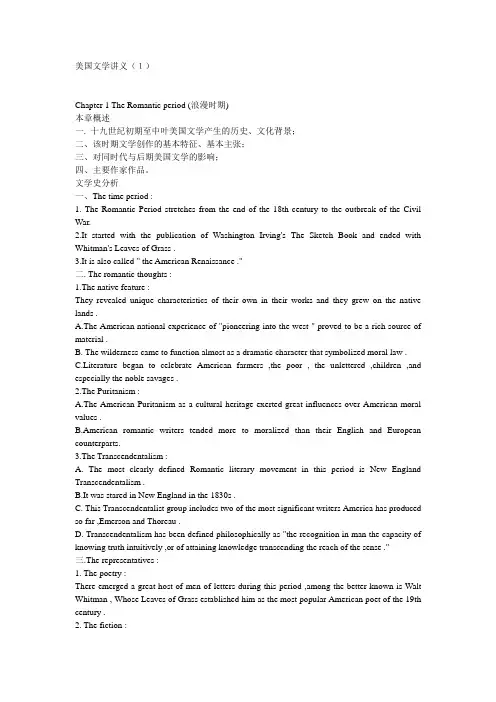
美国文学讲义(1)Chapter 1 The Romantic period (浪漫时期)本章概述一. 十九世纪初期至中叶美国文学产生的历史、文化背景;二、该时期文学创作的基本特征、基本主张;三、对同时代与后期美国文学的影响;四、主要作家作品。
文学史分析一、The time period :1. The Romantic Period stretches from the end of the 18th century to the outbreak of the Civil War.2.It started with the publication of Washington Irving's The Sketch Book and ended with Whitman's Leaves of Grass .3.It is also called " the American Renaissance ."二. The romantic thoughts :1.The native feature :They revealed unique characteristics of their own in their works and they grew on the native lands .A.The American national experience of "pioneering into the west " proved to be a rich source of material .B. The wilderness came to function almost as a dramatic character that symbolized moral law .C.Literature began to celebrate American farmers ,the poor , the unlettered ,children ,and especially the noble savages .2.The Puritanism :A.The American Puritanism as a cultural heritage exerted great influences over American moral values .B.American romantic writers tended more to moralized than their English and European counterparts.3.The Transcendentalism :A. The most clearly defined Romantic literary movement in this period is New England Transcendentalism .B.It was stared in New England in the 1830s .C. This Transcendentalist group includes two of the most significant writers America has produced so far ,Emerson and Thoreau .D. Transcendentalism has been defined philosophically as "the recognition in man the capacity of knowing truth intuitively ,or of attaining knowledge transcending the reach of the sense ."三.The representatives :1. The poetry :There emerged a great host of men of letters during this period ,among the better-known is Walt Whitman , Whose Leaves of Grass established him as the most popular American poet of the 19th century .2. The fiction :The fiction of the American Romantic Period is an original and diverse body of work .3.The human nature :American Romanticists also differed in their understanding of human nature . To Emerson and Thoreau , man is divine in nature and therefore forever perfectible ;to Hawthorne and Melville , everybody is potentially a sinner , and great moral courage is therefore indispensable for the improvement of human nature .主要作家作品A.华盛顿.欧文B.拉尔夫.华尔多.爱默生C.纳撒尼尔.霍桑D.华尔特.惠特曼E.赫尔曼.麦尔维尔A.华盛顿.欧文一.The literary creation1.The works :A. A History of New York ,which , written under the name of Diedrich knickerbocker , was a great success and won him wide popularity .The book is a parody of the Dutch colony .B. With the publication of The Sketch Book of Geoffery Crayon , Gent ,Irving won a measure of international fame on both side of the Atlantic .The book contains familiar essays like "Rip Van Winkle " and "The Legend of Sleepy Hollow . "C.Following The sketch Book , Irving published Bracebridge Hall ,and Tales of a Traveler .2.The literary source and contributions :A.Irving 's relationship with the Old World in terms of his literary imagination can hardly be ignored considering his success both abroad and at home . A History of New York is a patchwork of references .He parodies or imitates Homer , Fielding ,Swift and many other favorites of his .B. Washington Irving brought to the new nation what its people desired most in a man of letters ---"Rip Van Winkle " or "The Legend of Sleepy Hollow " are among the treasures of the American language and culture . It is not the sketches about the Old World but the tales about America that made Washington Irving a household word and his fame enduring .二. The artistic features :1.Irving 's taste was essentially conservative .2.Washington Irving has always been regarded as a writer who " perfected the best classic style that American Literature ever produce . "3. Yet Irving never forgets to associate a certain place with the inward movement of a person and to charge his sentences with emotion so as to create a true and vivid character .B.拉尔夫.华尔多.爱默生一. The literary creation :1.The chief spokesman of this spiritual movement , New England transcendentalism is Emerson .2.Nature ,Emerson's first little book ,established him ever since as the most eloquent sopkesman of New England Transcendentalism .3.His lasting reputation began only with the publication of Essays . Many of his famous essays are included in Essays ,such as the American Scholar , Self-Reliance , The Over-Soul .二. The thought1. The transcendentalism :A. The nature :Emersonian Transcendentalism is actually a philosophical school with absorbed some ideological concerns of American Puritanism and European Romanticism .B. The contents :Emerson put forward his philosophy of the over-soul , the importance of the Individual , and Nature . Transcendentalists believed that there should be an emotional communication between an individual soul and universal "over-soul "2.The influence :A. By employing nature as a big symbol of the spirit ,or God , or the over-soul , Emerson has brought the puritan legacy of symbolism to its perfection .B. Emerson is the most representative of the philosophical an literary school , and it inspired in his lifetime a whole generation of famous authors like Thoreau , Whitman , and Dickinson .三. The artistic features :1.The casual style :Emerson's essays often have a casual style . They are usually characterized by a series of short ,sentences .2. To use comparison and metaphors :Emerson's philosophical discussion is sometimes difficult to understand but he uses comparisons and metaphors to make the general idea of his work clearly expressed .3.To employ the literary sources :Emerson often employed these literary sources to make and enrich his own points but never let them take the full reins of his discussion .C.纳撒尼尔.霍桑一. The thoughts :1. The view of sin:A. According to Hawthorne , "There is evil in every human heart ." A piece of literary work should " show how we are all wronged and wronged , and avenge one another ." So in almost every book he wrote , Hawthorne discusses sin and evil .B. One source of evil that Hawthorne is concerned most is overreaching intellect . The tension between intellect " would be fully revealed .2. The Puritanism :A. Hawthorne 's view of man and human history originates , to a great extent , in Puritanism . He believed that "the wrong doing of one generation lives into the successive ones . "B. In many of Hawthorne 's stories and novels , the Puritan concept of life is condemned , or the Puritan past is shown in an almost totally negative light , especially in his The House of the Seven Gables and The Scarlet Letter .二. The masterpiece ---The Scarlet letter :1.The theme:In this particular novel , Hawthorne does not intend to tell a love story nor a story of sin , but focuses his attention on the moral , emotional , and psychological effects or consequences of the sin on the people in general and those main characters in particular , so as to show us the tension between society and individuals .2.The imagery :"The custom -House " to The Scarlet Letter proves fruitful to Hawthrone 's imagination , Byrelating a piece of red cloth shaped like "A" , Hawthorne succeeds in giving his tale a sense of historical reality and an air of authenticity .三. The artistic features :1.The structure:The structure and the form of his writings are always carefully worked out to cater for the thematic concern .2.The allegory :Hawthorne is also a great allegorist and almost every story can be read allegorically , as is the case in " Young Goodman Brown."3.The symbolism :Hawthorne is a master of symbolism . The symbol can be found everywhere in his writing . By using pearl as thematic symbol ,Hawthorne emphasizes the consequence the sin of adultery has brought to the community and people living in that community .4.The ambiguity :And the ambiguity is one of the salient characteristics of Hawthorne's art .D.华尔特.惠特曼一. The works ---Leaves of Grass :1.Leaves of Grass has always been considered a monumental work which commands great attention .2.The work has nine editions and the first edition was published in 1855.二. the thoughts :1. The nationalism :As Whitman saw it , poetry could play a vital part in the process of creating a new nation . The abundance of themes in his poetry voices freshness. He shows concern for the whole hardworking people and the burgeoning life of cities .2. The individual value :The realization of the individual value also found a tough position in Whitman's poems in a particular way . pursuit of love and happiness is approved of repeatedly and affectionately in his lines .3.The political thoughts :Some of Whitman's poems are politically committed , Such as a collection under the title of drum Taps , " Cavalry Crossing a Ford . " And " When Lilacs Last in the Dooryard Bloom 'd ."三.The artistic features :1. The brand-new means :Whitman employed brand-new means in his poetry .A. Whitman's poetic style is marked , first of all , by the use of the poetic "I".ually , the relationship Whitman is dramatizing is a triangular one :"I" the poet, the subject in the poem , and " you " the reader .C. What he prefers for his new subject and new poetic feeling is " free verse ,"that is , poetry without a fixed beat or regular rhyme scheme . However , there is still a strong sense of the poems being rhythmical .2. The imagery :A. unifying images of the body , the crowd , the sexuality are pervasive in his poems .B. One of the most often-used methods in Whitman's poems is to make colors and images fleetpast the mind's eye of the reader .3. The Language:A. Another characteristic in Whitman's language is his strong tendency to use oral English .B. Whitman's vocabulary is amazing . He would use powerful , colorful , as well as rarely-used words , words of foreign origin and sometimes even wrong words .E.赫尔曼.麦尔维尔一. The literary creation :Melville's writings can be well divided into two groups .1.The early period :His early works were written after he was back from the sea.A. Among them are Typee , Omoo , and Mardi, which drew from his adventures .B. Redburn is semi-autobiographical novel .C. In White Jacket Melville relates his life on a United states man-of-war .D. Moby-Dick proves to be the best .2. The later period :With the publication of Pierre ,Melville's public fame was on the decline .A. Among them are "Bartleby , the Scrivener , " "Benito Cereno, " The Confidence -Man .B. Bill Budd again deals with the sea and sailors and the theme of a conflict between innocence and corruption .3.The themes respectively :A. In the early ones , Melville is more enthusiastic about setting out on a quest for the meaning of the universe , hence they are more metaphysical and the main characters are ardent and self-dramatizing "I", defying God , as best reflected in Moby-Dick .B. In the late works , Melville becomes more reconciled with the world of man .二. The Masterpiece ---Moby -Dick :1.The literary status :Moby-Dick is regarded as the first American prose epic .2. The features :It is difficult to read because much of the talk in the talk in the novel is sailor's talk and much of the language is purposely old-fashioned and Elizabethan .3. The outline :The story is not complicated , dealing with Ahab , a man with an overwhelming obsession to kill the whale which has crippled him , on board his ship Pequod in the chase of the whale .4.The symbolism :It turns out to be a symbolic voyage of the mind in quest of the truth and knowledge of the universe , a spiritual exploration into man's deep reality and psychology .三. The artistic features:1.The style of symbol and imageryA. Different people on board the ship are representations of different ideas and different social and ethnic groups .B. Facts become symbols and incidents acquire universal meanings .C. Pequod is the microcosm of human society , and the voyage becomes a search for truth .D. For author ,Moby-Dick is still a mystery , an ultimate mystery of the universe .2. The other stills :Melville's great gifts of language , invention , psychological analysis , speculative agility , and narrative power are fused to make Moby-Dick a world classic .美国文学讲义(2)chapter2 The Realistic period (现实主义文学时期)本章概述一. 十九世纪中期现实主义文学产生的历史、文化背景;二、美国现实主义文学创作的基本特征、基本主张;三、对同时代与后期美国文学的影响;四、主要作家作品。