英语语法:介词
- 格式:docx
- 大小:36.97 KB
- 文档页数:2
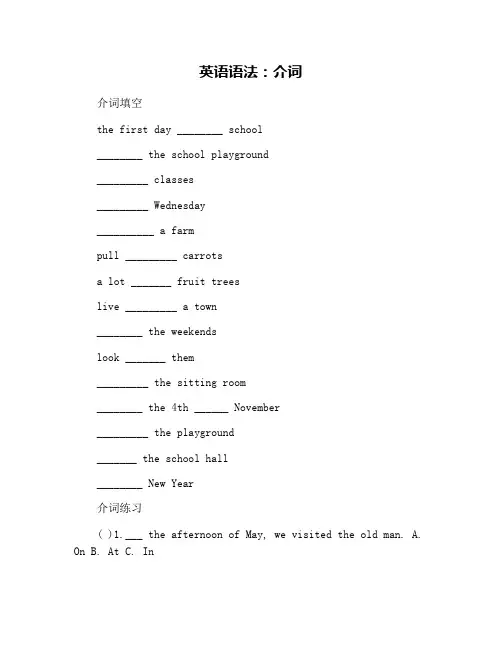

介词英语大全介词(Preposition)是英语语法中不可或缺的一部分,用来表示名词或代词与其他单词之间的关系。
掌握各种介词的用法对于学好英语非常重要。
以下是介词英语大全。
一、时间介词1. at - 表示准确的时刻,通常用于钟表的时间。
例如:at 3o’clock(3点钟)、at noon(中午)2. in - 表示一段时间或月份。
例如:in the evening(晚上)、in April(四月)3. on - 表示某天或日期。
例如:on Sunday(星期天)、on January 1st(1月1日)4. by - 表示限制时间。
例如:by next week(下周之前)、by 6 o’clock(6点钟之前)5. for - 表示持续时间。
例如:for two hours(两个小时)、for a week(一个星期)二、地点介词1. at - 表示准确位置。
例如:at home(在家)、at school(在学校)2. in - 表示封闭或相对大的区域,如城市或国家。
例如:in New York(纽约)、in China(中国)3. on - 表示在物体上面。
例如:on the table(在桌子上)、on the wall(在墙上)4. under - 表示在物体下面。
例如:under the bed(床底下)、under the tree(树下)5. over - 表示在物体上方。
例如:over the bridge(桥上)、over the sky(天上)6. behind - 表示在物体后面。
例如:behind the door(门后)、behind the curtain(帘后)7. in front of - 表示在物体前面。
例如:in front of the house (房子前面)、in front of the mirror(镜子前面)8. at the back of - 表示在物体后面。

语法归纳介词的分类与用法介词是英语语法中的一类虚词,用于连接名词、代词、动词或其他词组,起到指示、限定或补充的作用。
在日常交流中,正确使用介词可以使句子更加准确、通顺,并且更好地表达自己的意思。
本文将对常见的介词分类和用法进行归纳总结。
一、位置介词(Prepositions of Place)1. On(在……上面):- 表示某物处于平面上,例如:on the table(在桌子上)- 表示某物在某个交通工具上,例如:on the bus(在公交车上)2. In(在……里面):- 表示某物处于空间之中,例如:in the room(在房间里)- 表示某物位于某地,例如:in Beijing(在北京)3. At(在……处):- 表示某物在某个具体位置,例如:at the park(在公园里)- 表示某个时间点,例如:at 9 o'clock(在九点)4. Under(在……下面):- 表示某物处于其他物体下方,例如:under the bed(在床底下)- 表示某物位于某个地理位置下方,例如:under the bridge(在桥下)二、方向介词(Prepositions of Direction)1. To(到……):- 表示向某个地点移动,例如:go to the cinema(去电影院)- 表示给予某人或某物,例如:give the book to Tom(把书给了汤姆)2. From(从……来):- 表示从某个地点出发,例如:come from Beijing(从北京来) - 表示某物来源于某处,例如:a gift from my friend(来自我朋友的礼物)3. Into(进入……内):- 表示进入或穿过某个空间,例如:jump into the pool(跳进游泳池)- 表示某物转化为另一种状态,例如:transform into a butterfly (变成蝴蝶)4. Out of(离开……):- 表示离开某个地点,例如:get out of the car(从车里出来)- 表示摆脱某种状态或限制,例如:break out of prison(越狱)三、时间介词(Prepositions of Time)1. In(在……时):- 表示某个具体时间段,例如:in the morning(在早上)- 表示某个季节或年份,例如:in summer(在夏季)2. On(在……日):- 表示具体的某一天,例如:on Monday(在星期一)- 表示节日或特殊的日期,例如:on Christmas Day(在圣诞节)3. At(在……点):- 表示具体的某个时间点,例如:at 2 p.m.(在下午两点)- 表示某个时刻,例如:at midnight(在午夜)4. For(持续时间):- 表示持续的一段时间,例如:study for two hours(学习两个小时) - 表示某事发生的时间跨度,例如:for the whole week(整个星期)四、原因介词(Prepositions of Reason)1. Because of(因为):- 表示某个原因导致某个结果,例如:He couldn't come because of the bad weather(因为天气不好,他不能来)2. Due to(由于):- 表示某个原因导致某个结果,具有正式文体,例如:The train was delayed due to heavy rain(由于大雨,火车晚点了)3. Owing to(由于):- 与 due to 同义,用法上稍显书面,例如:The match was canceled owing to the lack of players(由于队员不足,比赛被取消)五、方式介词(Prepositions of Manner)1. By(通过、以……方式):- 表示某种方法或手段,例如:travel by plane(乘飞机旅行)- 表示某种交通方式,例如:go to work by bus(乘公交车上班)2. With(用……方式):- 表示伴随或使用某种物品,例如:write with a pen(用钢笔写)六、比较介词(Prepositions of Comparison)1. Like(像):- 表示类似、相似,例如:She looks like her mother(她长得像她妈妈)- 表示比较相近的程度,例如:It tastes like chicken(尝起来像鸡肉)2. Unlike(与……不同):- 较 like 相反,表示与某事物不同,例如:He is unlike his brother in personality(他的性格与他弟弟不同)以上是常见的介词分类和用法总结。
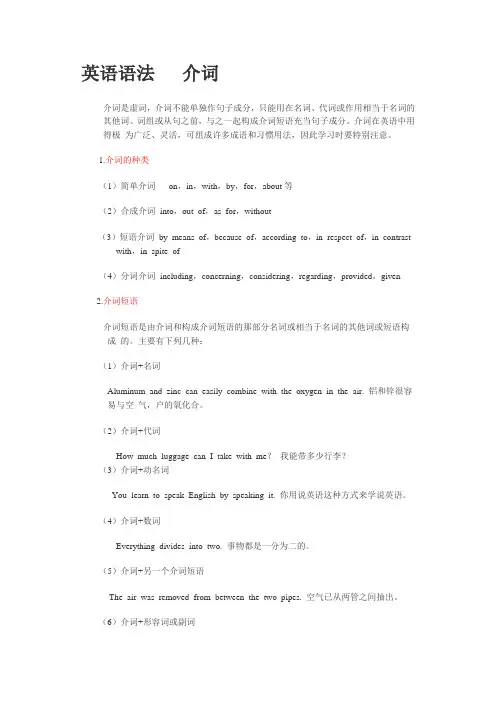
英语语法介词介词是虚词,介词不能单独作句子成分,只能用在名词、代词或作用相当于名词的其他词、词组或从句之前,与之一起构成介词短语充当句子成分。
介词在英语中用得极为广泛、灵活,可组成许多成语和习惯用法,因此学习时要特别注意。
1.介词的种类(1)简单介词on,in,with,by,for,about等(2)合成介词into,out of,as for,without(3)短语介词by means of,because of,according to,in respect of,in contrast with,in spite of(4)分词介词including,concerning,considering,regarding,provided,given2.介词短语介词短语是由介词和构成介词短语的那部分名词或相当于名词的其他词或短语构成的。
主要有下列几种:(1)介词+名词Aluminum and zinc can easily combine with the oxygen in the air. 铝和锌很容易与空气,户的氧化合。
(2)介词+代词How much luggage can I take with me?我能带多少行李?(3)介词+动名词You learn to speak English by speaking it. 你用说英语这种方式来学说英语。
(4)介词+数词Everything divides into two. 事物都是一分为二的。
(5)介词+另一个介词短语The air was removed from between the two pipes. 空气已从两管之间抽出。
(6)介词+形容词或副词It is far from satisfactory.We have made some progress,but it is far from enough.我们已经取得了一些进步,但还远远不够。