
英语人教新目标九年级全一册Unit 2 宾语从句
- 格式:pptx
- 大小:4.60 MB
- 文档页数:38


九年级英语专题复习教案之宾语从句
绵山一中刘海琴
【复习内容】宾语从句考点归纳
【复习目标】
1.掌握引导宾语从句的各种连词
2.掌握宾语从句的语序──主句+连接词+主语+谓语
3.掌握宾语从句,主句与从句在时态上的呼应。
【重点】语序和时态呼应
【难点】语序和时态呼应
【学生练习】
试一试,你能将下列句子改为宾语从句吗?
1. She is a careful girl.
The teacher said a careful girl.
2. Will they win?
I wonder .
3. Does the plane stop on the way?
Could you tell me the plane on the way or not?
4. What does he want?
Mother asked me .
5. He has bought the dictionary.
He said that he the dictionary.
6. What is his name?
The teacher asked me .
7. What is wrong with your computer?
Mr. Wang knew with your computer.
8. I asked, ―Are you doing your homework, Meimei?‖

1 / 1 宾语从句(上)
1. not
【经典例句】This is not my ruler. 这不是我的尺子。
I’m not Alice. 我不是爱丽丝。
【启发点拨】not用作副词,意为“不是”,它不能单独使用,必须放在be动词(am, is,
are)或助动词、情态动词之后,帮助构成否定句。例如:
Her name isn’t Linda. 她的名字不是琳达。
【知识拓展】no也可用作副词,可以单独使用,常用于对一般疑问句做出否定回答,其反义词为yes。例如:
—Is that your key? 那是你的钥匙吗?
—No, it isn’t. 不,不是。
no还可以用作形容词,意为“没有;无”,用于名词前修饰名词。例如:
I have no book. 我没有书本。
2. your
【经典例句】—What’s your name? 你叫什么名字?
—My name is Tom. 我的名字叫汤姆。
【启发点拨】your用作代词。意为“你的;你们的”。不能单独使用,后面常跟名词,在名词前面作定语。这一点类似形容词,因此有叫做形容词性的物主代词。例如:
Is this your jacket? 这是你的夹克衫吗?
【知识拓展】物主代词还有:my我的;his 他的;her她的;its 它的;our我们的;their他们的。
3. number
【经典例句】I am number five. 我是第五号。
【启发点拨】number 用作名词,意为“数,数字;(数目)大量;许多”。number也可缩写为“No.”。要注意No.的首个字母应大写,字母后的圆点不能省略,No.后要用阿拉伯数字,不能跟基数词。例如:
I’m Number 3. / I’m No. 3. 我是三号。
【知识拓展】number表示“第几号”时,常缩写成“No.”,而且词序与汉语不同,英语中常把小单位放在前面,而把大单位放在后面。例如:
1 单元评价检测(十) 附详细参考答案和听力材料
(90分钟 120分)
第Ⅰ卷 (共65分)
Ⅰ. 听力(20分)
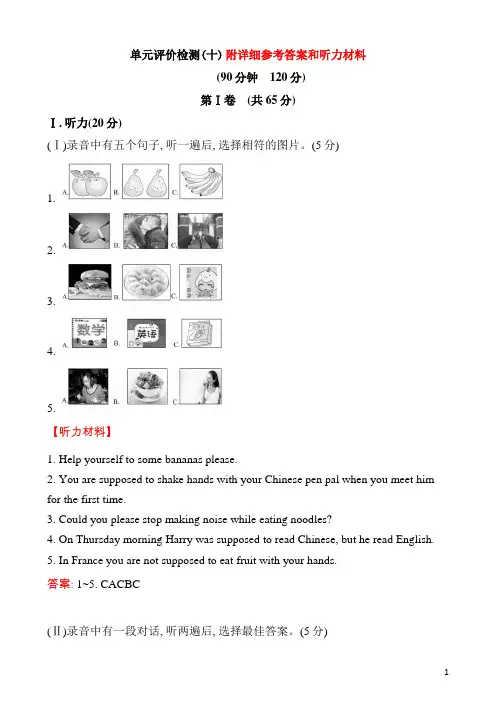
(Ⅰ)录音中有五个句子, 听一遍后, 选择相符的图片。(5分)
1.
2.
3.
4.
5.
【听力材料】
1. Help yourself to some bananas please.
2. You are supposed to shake hands with your Chinese pen pal when you meet him
for the first time.
3. Could you please stop making noise while eating noodles?
4. On Thursday morning Harry was supposed to read Chinese, but he read English.
5. In France you are not supposed to eat fruit with your hands.
答案: 1~5. CACBC
(Ⅱ)录音中有一段对话, 听两遍后, 选择最佳答案。(5分)
- - 2 6. How does the girl feel before going to Switzerland?
A. Excited. B. Unhappy.
C. Nervous.
7. What is Switzerland famous for?
A. Food. B. Good manners.
C. Watches.
8. What is the girl supposed to do if she goes to a party there?
A. To be later. B. To be earlier.
C. To be on time.
1 宾语从句讲解及练习
一、定义:在复合句中用作宾语的从句叫做宾语从句。宾语从句在句子中可以充当及物动词、介词或形容词的宾语。
E.g. He says (that) he is at home.
Everything depends on whether we have enough time.
Do you know what he wants to buy?
二、种类:根据引导宾语从句的不同引导词,宾语从句可以分为三类
1、由that 引导的陈述句性的宾语从句,连词that只起连接作用,在从句中不做句子的成分,也无词汇意义,在口语中常被省略,但在大多数情况下还是以不省为好,特别是在笔语中。
例:I told him that he was wrong.
He says (that) he is at home. I am sure (that) he will succeed.
2、由“疑问词”(what,where,who,whom,how等)引导的宾语从句(这些词在句子中充当一定的句子成分,因此不能省略,疑问词后要用陈述句语序,还可以改为:疑问词+to do。
E.g.Do you know what he wants to buy?
Could you please tell me where we will have a meeting?
(= Could you please tell me where to have a meeting?)
3、由“if/whether”引导的宾语从句。(if/whether:“是否”之意,一般可以互换。)
E.g.I want to know if/whether he lives there.
注:下列情况只能用whether,不能用if。
1>与 or not连用时。E.g. I don’t know whether he loves me or not.