
初中英语语法之形容词、副词的比较级
- 格式:ppt
- 大小:270.00 KB
- 文档页数:11

![初中英语形容词副词比较级最高级练习[1]](https://imgs-1438308264.cos.ap-hongkong.myqcloud.com/2c94faf6910ef12d2af9e71a.webp)
形容词副词比较级与最高级
( )1. I think science is _ than Japanese.
A. much important B. important C. much more important D. more much important
( ) 2 This pencil is___ than that one.
A. longest B. long C. longer D. as long
( ) 3 These children are ____ this year than they were last year.
A. more tall B. more taller C. very taller D. much taller
( ) 4 It was very hot yesterday, but it is___ today.
A. even hotter B. more hotter C. much more hot D. much hot
( )5 Our classroom is____ larger than theirs.
A. more B. quite C. very D. much
( ) 6 Maths is more popular than____.
A. any other subject B. all the subjects C. any subject D. other subject
( ) 7 China is larger than ____ in Africa
A. any other country B. other countries C. the other country D. any country
( ) 8 Tom is stronger than ___ in his class.
A. any other boy B. any boys C. any boy D. other boy

初中英语语法之形容词&副词
初中英语语法之形容词&副词
形容词副词的原级、比较级和最高级
1、分类:形容词和副词有原级、比较级和最高级三级。
2、规则变化:
(1)单音节和部分双音节形容词和副词,在原级的后面加上er,est构成比较级和最高级。
a)直接加er,est :
b)以重读闭音节结尾的,要双写最后一个辅音字母,后加er,est:
c)以辅音字母+y结尾的,先把y改为i再加上er,est:
(2)两个音节或两个以上的音节的,在原级前加more / most.
3、不规则变化:
原级
比较级
最高级
good好的
better更好的
best最好的
well好;(身体)好的,
bad,badly糟糕的,糟糕地
worse更糟糕的,更糟糕地;(身体)更不舒服的
worst最糟糕的,最糟糕地;(身体)最不舒服的
ill(身体)不舒服的
many许多的(可数) more更多的;更
most最多的;最
much许多的(不可数);非常
little少的
less更少的
least最少的
far远的;远地
farther更远的;更远地
farthest最远的;最远地
further进一步的(地)
furthest最深刻的(地)
4、形容词和副词的原级、比较级和最高级的用法:
(1) 讲述某人/物自身的情况时,用原级。基本句型是:
主语(sb./sth) + 谓语动词 +(very/too/so/quite/rather…) + 形容词/副词原级 +….如:
He is very oldnow. 他现在很老了。
They ran quitefast. 它们跑得相当快。
The weatherlooks rather bad. 天气看上去相当糟。
I am sohappy! 我是如此的快乐!
☆表示两者之间没有差别时,使用句型:
主语(第一个人物) + 谓语动词 + as + 形容词/副词原级 + as + 第二个人物
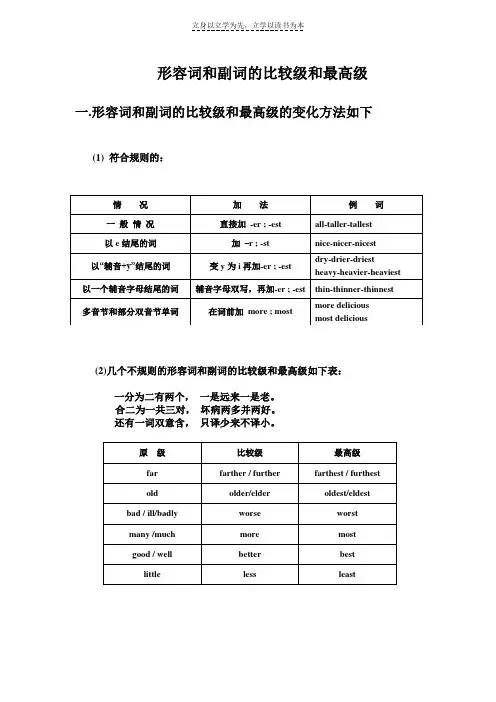
立身以立学为先,立学以读书为本
形容词和副词的比较级和最高级
一.形容词和副词的比较级和最高级的变化方法如下
(1) 符合规则的:
(2)几个不规则的形容词和副词的比较级和最高级如下表:
一分为二有两个, 一是远来一是老。
合二为一共三对, 坏病两多并两好。
还有一词双意含, 只译少来不译小。
原 级 比较级 最高级
far farther / further farthest / furthest
old older/elder oldest/eldest
bad / ill/badly worse worst
many /much more most
good / well better best
little less least
情 况 加 法 例 词
一 般 情 况 直接加 -er ; -est all-taller-tallest
以e结尾的词 加 –r ; -st nice-nicer-nicest
以“辅音+y”结尾的词 变y为i再加-er ; -est dry-drier-driest
heavy-heavier-heaviest
以一个辅音字母结尾的词 辅音字母双写,再加-er ; -est thin-thinner-thinnest
多音节和部分双音节单词 在词前加 more ; most more delicious
most delicious 立身以立学为先,立学以读书为本
二.形容词和副词比较级的用法
级别 比较程度 表达方式和意义 例
句 备 注
原
级 同
等
程
度 肯
定
形
式 As+原级+as
(像……一样) Art is as interesting
as music.
Play as well as you
can.
否
定
形
式 not + so (as) +原级+as
(不如……那样) English is not so

形容词和副词的比较级和最高级
一.形容词和副词的比较级和最高级的变化方法如下
(1) 符合规则的:
(2)几个不规则的形容词和副词的比较级和最高级如下表:
原 级 比较级 最高级
good , well better best
bad , ill worse worst
many , much more most
little less least
far farther / further farthest / furthest
二.形容词和副词比较级的用法
级别 比较程度 表达方式和意义 例 句 备 注
原
级 同
等
程
度 肯
定
形
式 As+原级+as
(像……一样) Art is as interesting
as music.
Play as well as you
can. 情 况 加 法 例 词
一 般 情 况 直接加 -er ; -est all-taller-tallest
以e结尾的词 加 –r ; -st nice-nicer-nicest
以“辅音+y”结尾的词 变y为i再加-er ; -est dry-drier-driest
heavy-heavier-heaviest
以一个辅音字母结尾的词 辅音字母双写,再加-er ; -est thin-thinner-thinnest
多音节和部分双音节单词 在词前加 more ; most more delicious
most delicious 否
定
形
式 not + so (as) +原级+as
(不如……那样) English is not so
difficult as science.
She does not study so
well as I do.
比较级 不同程度
(用于两者比较) 比较级+than
(比……) Jim is older than