虚拟语气讲解及练习题(含答案和解释)
- 格式:doc
- 大小:81.50 KB
- 文档页数:13
高中英语虚拟语气讲解及练习
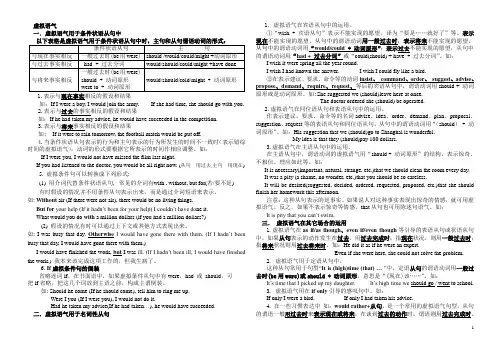
虚拟条件句就是对现实条件的一种虚拟假设,所假设的条件一般不符合事实或与事实相反或在现实中发生的可能性极小。根据时间的不同,虚拟条件句可分为三种,即与现在事实相反的虚拟条件句、与过去事实相反的虚拟条件句及与将来事实相反的虚拟条件句。具体情况请看下表:
条件状语从句 主 句
与过去事实相反 had + 过去分词 should /would/could/might + have
+ 过去分词
与现在事实相反 一般过去时(be用were) would/should/could/might + 动词原形
与将来事实相反 一般过去时或should(were to) + 动词原形 would/should/could/might + 动词原形
例句:
(1)表示与现在事实相反
If I had enough money now, I would lend it to you.
(2)表示与过去事实相反
If he had taken your advice, he wouldn’t have made such a bad mistake.
(3)表示与将来事实相反
I would go shopping with you if it were to be Sunday tomorrow.
1. 虚拟条件句的倒装
在虚拟条件句中,为了强调所假设条件的虚拟性,或突出说话人的一种主观愿望,虚拟条件句可用倒装结构。虚拟条件句的倒装是通过去掉if,把条件从句谓语中的助动词、情态动词或系动词放在句首实现的。例如:
Had I been(= If I had been ) in that situation, I would not have let the thief
escape away with so much money.
Should there be (= If there should be) a drought, what should we do at that
time ?
2. 错综时间条件句
有时条件从句的动作和主句的动作发生的时间并不一致,这时谓语动词的形式应根据它所要表示的具体时间来确定。例如:
If we hadn’t been working hard in the past few years ,things wouldn’t be going
so smoothly.
3. 含蓄条件句
有时假设的情况并不以条件从句的形式表现出来,而是通过某个介词或介词短语(如:with,otherwise,without,but for,in that position)、上下文或其它方式表现出来。这种句子称为含蓄条件句。例如:
But for the help from you , I would not have had the chance to go to college.
二、虚拟语气在某些从句中的运用
在某些词或短语后接的从句中要使用虚拟语气,表示愿望、建议或命令等。根据虚拟语气的形式不同,虚拟语气可以分为“should类”和“过去时态类”。
(一)should类 这一类的虚拟语气是通过从句中的谓语动词使用“should +动词原形”体现出来的,should可以省略。其具体运用体现在:
1. 在suggest , order, demand , propose, command, request, desire,insist等表示建议、命令、要求、意见的动词后接的宾语从句中要使用虚拟语气。
如:He suggests that she should leave the house at once.
The leader ordered that the task(should) be finished as soon as possible.
He proposed that we (should)deal with the problem by the view of
development.
2. 与suggest,order,demand,propose,command,request,desire,insist等动词相对应的名词suggestion,order,demand,proposal等后的表语从句或同位语从句中要使用虚拟语气。如:The general sent the order that the battle(should)be held on until the complete failure of the enemy.
My proposal is that we(should) set a deadline for handing in the plan.
3. 在It is/was suggested (ordered,demanded,proposed,etc.)结构以及necessary,essential,important,strange,natural等形容词后的主语从句中要使用虚拟语气。如:
It’s requested that we (should)keep the stability of the society for the people’s
peaceful life.
It is necessary that the badly wounded man(should) be treated immediately.
(二)过去时态类
英语中,还有一些词或短语后接的从句或句子,也要使用虚拟语气,虚拟语气是通过句中的谓语使用过去的某种时态(如:一般过去时、过去完成时等)来体现的。
1. wish,would rather 后的宾语从句。如:
He wished he had never been involved in such affairs.
I would rather you could teach me again.
2. as if,as though引导的从句。如:
The little boy knows so many things as if he was a man.
He acted as usual as though nothing had happened.
3. 由if only (要是……,那该多好啊!)引导的惊叹句。如:
If only I had passed the test!
If only it stopped raining!
4. It is(about/high) time 后的定语从句。如:
It is time we went out for a walk.
It was high time they had begun to prepare the experiment.
三、虚拟语气的其它用法
在英语中,一些表示建议、请求、劝告、愿望、祈祷、祝福或诅咒的句子,也需要使用虚拟语气。如:
Would you mind smoking here?
May you be lucky!
Long live the people of China!
God save me.
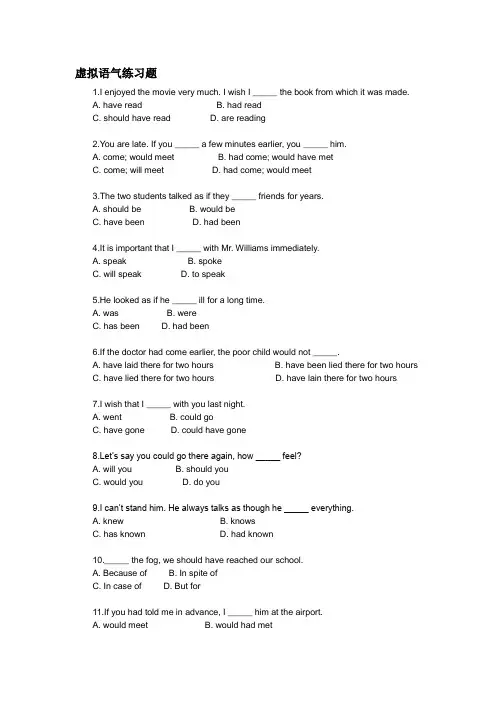
虚拟语气练习题
1.William was late. He ____________ earlier if he was really serious about the interview.
A.may have come B.should be coming
C.ought to have come D.must have come
【答案】C
【解析】
【详解】
考查情态动词+完成式。句意:William迟到了。如果他真的在意这场面试的话,他本该早点来的。ought to have done=should have done"本应该做却没有做"。故选C。
2.— Did you hear about Zhang Lili who saved the kids from being run over by a school bus?
— Yes. What do you think most people _____ if they were in a similar situation?
A.will do B.will have done. C.would do D.would have done
【答案】C
【解析】
【详解】
试题分析:本题考察的是if引导的条件句的虚拟语气,是对现在的情况的虚拟。在条件句if中使用一般过去时,be动词使用were,在主句中使用“情态动词+动词原形”,情态动词为:would ,should ,could ,might。句义:—你听说过为了挽救学生而被公交车撞到的张丽丽吗?—是的。如果大部分人在相似的情况下,你认为他们会怎么做?故C正确。
考点:考察虚拟语气
3._______ more energy to my study instead of being crazy about computer games, I would be
sitting in a comfortable office now.
A.If I devoted B.Had I devoted
C.Would I be devoted D.Should I be devoted
【答案】B
【解析】
【详解】
考查时间错综的虚拟条件句。此处主句用过去完成时,表示与过去的事实相反,如果省略if要用倒装句;从句用would + 动词原形的形式,表示与现在的事实相反。
4.-- It’s many years since I saw you last; I _____ you at all.
--- I wouldn’t have, either, if someone ______ you by the name.
A.didn’t recognize; hadn’t called B.didn’t recognize; didn’t call
C.haven’t recognized; didn’t call D.recognized; had called
【答案】A
【解析】