
人教版高三英语第一轮语法复习--虚拟语气
- 格式:pptx
- 大小:160.01 KB
- 文档页数:23


高中英语一轮复习
1 情态动词和虚拟语气
解题指导:
情态动词的用法复杂多变,在高考试题中占的比重一直比较稳定,每年总有一至两个题,可以单独考查,也可以结合虚拟语气考查。命题者常常利用语境和句子之间意义上的细微差别来考查考生对情态动词的理解和掌握,难度也保持较为稳定的趋势。
其考点主要包括:
1、考查情态动词的基本用法。
如:: can和could的用法及区别;will和would的用法及区别;must的用法;shall用于不同人称时的用法和should的各种用法;need的用法等。
2、考查情态动词的“推测”功能。
如:can,could,may,might,must 皆可表示推测,使用时要注意以下几点:
(1)注意语气。语气较强用must, cannot,couldn’t;语气较弱may,might或can,could;
(2)注意句式。在肯定句中,一般用may,might,must;在否定句,疑问句中常用can,could;
(3)注意时态。表示对现在或将来的情况的推测,此时通常用“情态动词+ 动词原形”结构;表示对现在或将来正在进行的情况进行推测,通常用“情态动词+进行体”结构;表示对过去情况的推测,通常用“情态动词+完成体”结构。
3、考查情态动词的特殊用法。
如:
(1)cannot/can't 与too/over(‐)/enough /perfectly /sufficiently 等词连用,意为“越…越…”“无论怎样… …也不为过”、“决不会… …够(过)”。
(2)cannot wait to do sth意为“急于做某事”,。
(3)would 和used to的区别;can 和be able to的区别。
(4)“may / might well+动词原形”意为“理应,有足够的理由”;“may/ might as well+动词原形”意为“还不如,不妨,还是…的好”。
(5)must表示偏执型,意为“偏要”;“硬要”;can用在肯定句,可以表示客观上的“可能性”;shall用在法律、条约、协定等文件中可以表示义务、规定等;should表示估计或推高中英语一轮复习

1 虚拟语气专项练习(新题版型)
语法填空:
1.I would rather Tom___________(come) tomorrow.
2.It seems as if it_____________(be) winter now.
3.What would have happened if you ______________(not help) her child?
4.It is strange that he _____________ (think) so.
5.I wish I ____________(meet) my uncle yesterday.
6.Galileo insisted that the earth______________(move) the sun.
7.Supposing the weather __________(be) bad, where would you go?
8.But for your help, I couldn’t _______(find) the place.
9.What do you think would happened if there __________(be) no light in the day?
10.I was very busy yesterday, otherwise I ________(go) to the party.
11.Without your help the old man_____(not live) now.
12.It is high time you________(take) the medicine ,sir.
13.I wish I ____________________( attend) the meeting yesterday.

导学案
Grammar Unreal conditionals 虚拟语气
和硕县高级中学集体备课
主备人:
马银雪 复议人: 张新华
马守东
李俊翔 备课组 高三年级备课组
【预习反馈】英语中的语气分为陈述语气、祈使语气、虚拟语气三类。虚拟语气用来表示说话人的主观愿望或假想,而不表示客观存在的事实,所说的是一个条件,不一定是事实,或与事实相反。虚拟语气通过谓语动词的特殊形式来表示。
条件状语从句分类
条件句可分为两类,一类为真实条件句,一类为非真实条件句。非真实条件句表示的是假设或实际可能性不大的情况,故采用虚拟语气。
eg: 1. If he doesn't hurry up,he will miss the bus.
2.If he is free,he will ask me to tell stories.
3.If I were you,I would go at once.
4.If there were no air,people would die.
以上四句中 和 是真实语气 ; 和 是虚拟语气
【自主探究】一、状语从句中的虚拟语气
(一) if 引导的条件状语从句
1 If I had time, I would attend the meeting.
2. If I were you, I should seize the opportunity to go abroad.
3. If you had taken my advice, you would not have failed in the exams.
4. If he had come earlier, he wouldn’t have missed the first bus.
5 If the headmaster came tomorrow, we would have the meeting. 6 If it were to rain tomorrow, the sports meeting would be put off.
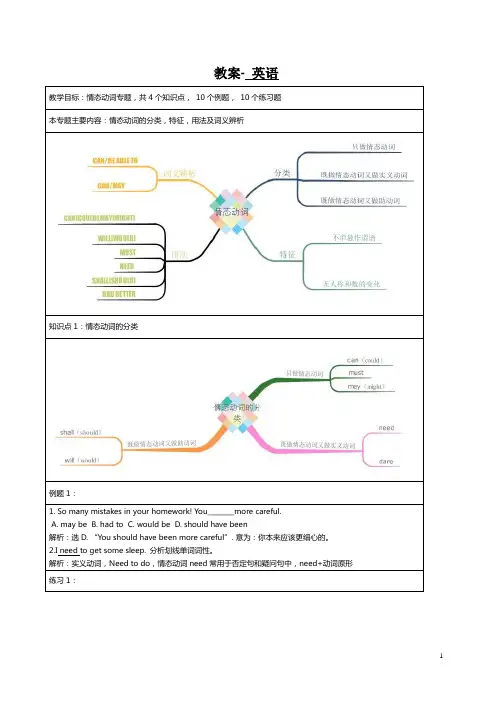
1 教案- 英语
教学目标:情态动词专题,共4个知识点, 10个例题, 10个练习题
本专题主要内容:情态动词的分类,特征,用法及词义辨析
知识点1:情态动词的分类
例题1:
1. So many mistakes in your homework! You________more careful.
A. may be B. had to C. would be D. should have been
解析:选D. “You should have been more careful”. 意为:你本来应该更细心的。
2.I need to get some sleep. 分析划线单词词性。
解析:实义动词,Need to do,情态动词need常用于否定句和疑问句中,need+动词原形
练习1: 2 1.—Must we leave now? —No, we _______.We still have two more hours.
A. can‘t B. mustn‘t C. needn‘t D. shouldn‘t
解析:选C,句意:---我们现在必须离开吗?---不,我们不必,我们仍有两个小时。根据上文,得知must引导的一般疑问句应用needn‘t或don‘t have to来作否定回答。
2.My younger sister ______________ go out alone.
我妹妹不敢单独出去。
解析:dare not 情态动词dare,常用于否定句和疑问句中。
知识点2:情态动词的特征
例题2:
1. You should ______(结束) reading the book as soon as possible.
解析:should finishing,情态动词should+动词原形,表示应该做某事。