英语作文各种信件
- 格式:docx
- 大小:15.69 KB
- 文档页数:5
英语作文各种信件
Writing Various Types of Letters。
In our daily life, we often need to write different
types of letters for various purposes, such as applying for
a job, making a complaint, expressing appreciation, etc.
Writing a letter is a good way to communicate with others
and convey our thoughts and feelings effectively. In this
article, we will discuss some common types of letters and
how to write them properly.
1. Formal Letters。
Formal letters are usually used for official or
business purposes, such as applying for a job, making a
complaint, or sending an invitation. They should be written
in a professional and polite tone, with a clear and concise
message. The format of a formal letter should include the
sender's address, date, recipient's address, salutation,
body, closing, and signature.
When writing a formal letter, it is important to
address the recipient properly, using their full name and
title if possible. The body of the letter should be
organized into paragraphs, each with a clear topic sentence.
The closing should be polite and respectful, such as
"Sincerely" or "Yours faithfully."
2. Informal Letters。
Informal letters are used for personal communication,
such as writing to friends or family members. They can be
written in a more relaxed and casual tone, with a
conversational style. The format of an informal letter is
less strict than a formal letter, but it should still
include the sender's address, date, salutation, body, and
closing.
In an informal letter, it is important to use a
friendly and personal tone, and to include details about
your life and interests. You can also use colloquial
language and slang, as long as it is appropriate for the recipient. The closing can be more casual, such as "Love"
or "Take care."
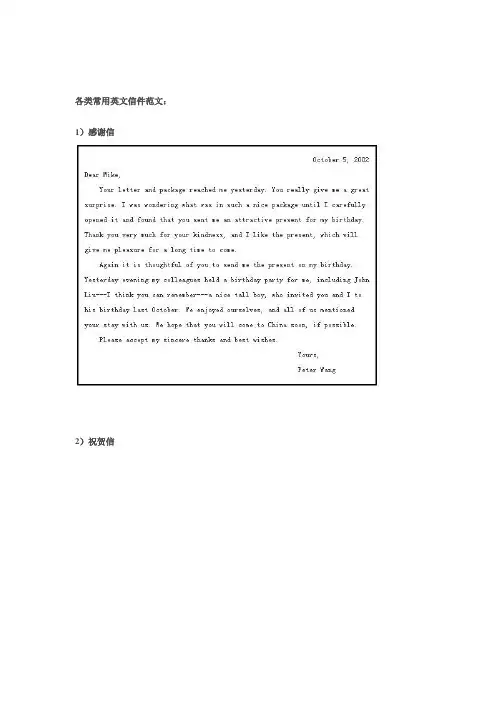
3. Thank-You Letters。
Thank-you letters are used to express gratitude and
appreciation for a gift, favor, or kindness. They should be
written in a sincere and heartfelt tone, with specific
details about what you are thanking the recipient for. The
format of a thank-you letter should include the sender's
address, date, recipient's address, salutation, body,
closing, and signature.
When writing a thank-you letter, it is important to be
specific about what you are thanking the recipient for, and
to express how their actions have made a positive impact on
your life. You can also include details about how you plan
to use the gift or how the favor has helped you. The
closing should be warm and appreciative, such as "Thanks
again" or "With gratitude."
4. Apology Letters。
Apology letters are used to express regret and
apologize for a mistake or wrongdoing. They should be
written in a sincere and humble tone, with a clear
statement of what you are apologizing for and how you plan
to make amends. The format of an apology letter should
include the sender's address, date, recipient's address,
salutation, body, closing, and signature.
When writing an apology letter, it is important to take
responsibility for your actions and express remorse for any
harm or inconvenience caused. You can also offer to make
things right or take steps to prevent the same mistake from
happening again. The closing should be humble and contrite,
such as "Sincerely sorry" or "With regret."
In conclusion, writing letters is an important skill
that can help us communicate effectively and build stronger
relationships with others. Whether it is a formal letter,
an informal letter, a thank-you letter, or an apology
letter, it is important to use the appropriate tone and format for the purpose and audience. With practice and
patience, anyone can become a skilled letter writer.