信用证英文
- 格式:docx
- 大小:11.38 KB
- 文档页数:4
信用证英文
Letter of Credit
Letter of credit (L/C) is a financial instrument issued by a bank on behalf
of a buyer (importer) to guarantee payment to a seller (exporter) for goods or
services rendered. It is one of the most commonly used methods of trade
financing in international trade.
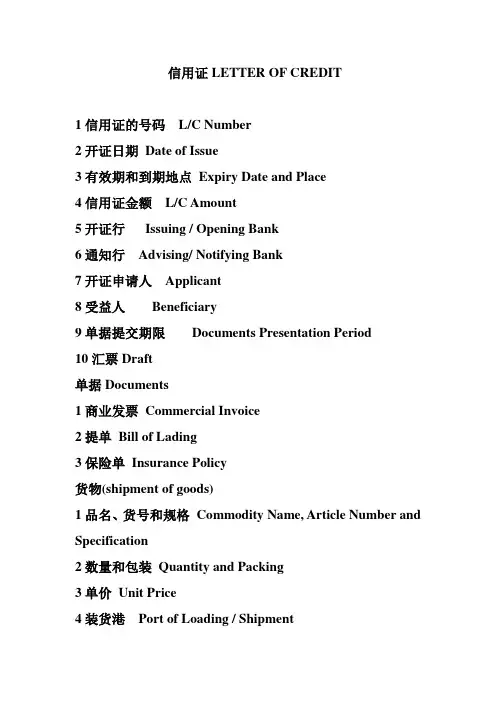
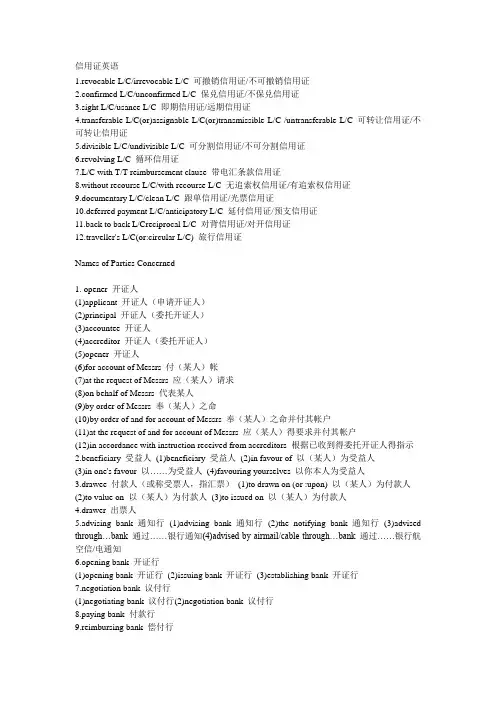
Types of Letters of Credit
1. Sight L/C: A type of L/C in which the payment is made immediately
upon presentation of the documents.
2. Deferred Payment L/C: A type of L/C in which the payment is made at
a later date, as agreed between the buyer and seller.
3. Revocable L/C: A type of L/C that can be cancelled or amended by the
issuing bank at any time without prior notice to the beneficiary.
4. Irrevocable L/C: A type of L/C that cannot be cancelled or amended
without the agreement of all parties involved.
5. Confirmed L/C: A type of L/C in which a second bank, usually in the
seller's country, confirms the L/C and guarantees payment to the seller.
6. Unconfirmed L/C: A type of L/C in which there is no second bank to
confirm the L/C.
Components of a Letter of Credit
1. Applicant: The party who requests the issuance of an L/C, usually the
importer or buyer.
2. Beneficiary: The party who will receive payment under the L/C, usually
the exporter or seller.
3. Issuing Bank: The bank that issues the L/C on behalf of the applicant.
4. Confirming Bank: An optional bank that adds its guarantee to the L/C
and confirms payment to the beneficiary.
5. Advising Bank: The bank that advises the beneficiary of the L/C's
terms and conditions.
6. L/C Number: The unique identification number assigned to each L/C.
7. Expiry Date: The date on which the L/C expires, after which the
beneficiary must present the required documents to claim payment.
8. Amount: The total value of the L/C.
9. Documents Required: The documents that the beneficiary must
present to claim payment, such as bills of lading, invoices, and certificates of
origin.
Advantages of Letters of Credit
1. Payment Security: The seller is guaranteed payment by a bank, as
long as they comply with the L/C's terms and conditions.
2. Reduced Risk: The buyer is guaranteed that the seller will fulfil their
contractual obligations before payment is made.
3. Dispute Resolution: Disputes can be resolved more easily with an L/C
as the terms and conditions are clearly stated.
4. Trade Financing: L/Cs can be used as a form of trade financing as the
seller can use the L/C as collateral to obtain financing.
Disadvantages of Letters of Credit
1. Time-consuming: The L/C process can be time-consuming and
complex, which may delay the shipment of goods.
2. Cost: The cost of an L/C can be high and varies depending on the
issuing bank, the value of the L/C, and the risks involved.
3. Limitations: L/Cs may have limitations that can affect the flexibility of
trade, such as the requirement to use specific banks or the acceptance of only
certain types of documents.
Conclusion
Letters of credit play a crucial role in facilitating international trade by
providing payment security and reducing risk for both buyers and sellers.
However, it is important to understand the different types of L/Cs and their
components, as well as their advantages and limitations, to make informed
decisions when using them as a method of trade financing.