
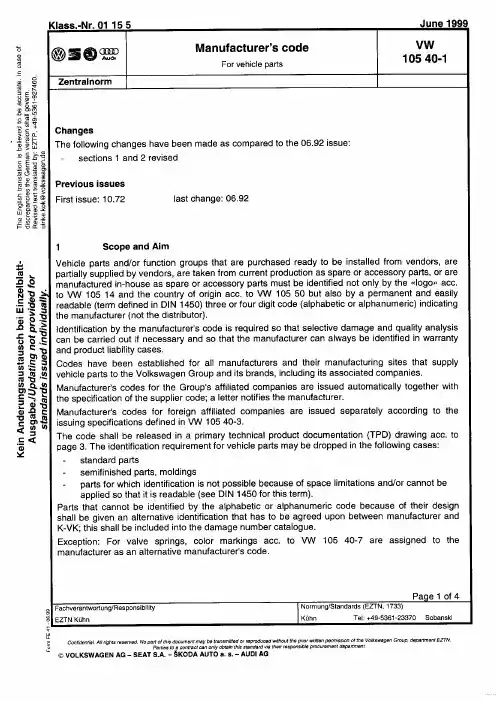
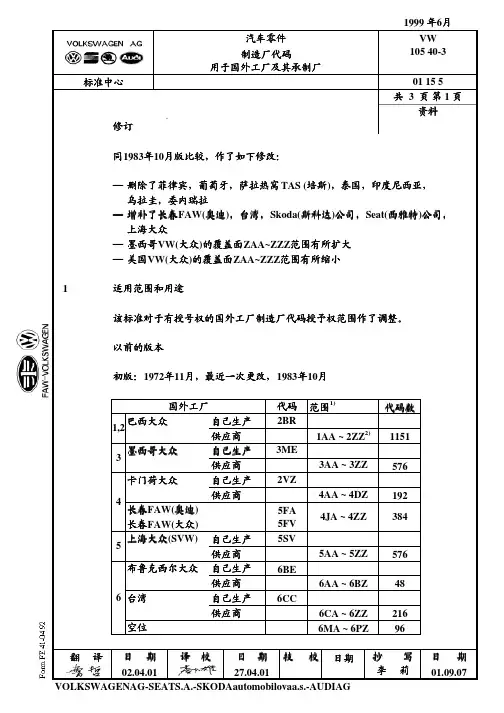
VW10540-1_en_061999
- 格式:pdf
- 大小:84.00 KB
- 文档页数:4

Safety Data Sheet1.IDENTIFICATIONProduct identifierMixture identification:Trade name: Ink, T10S400Recommended use of the chemical and restrictions on useRecommended use:Ink for inkjet printingDetails of the supplier of the safety data sheetCompany:Epson America, Inc.3131 Katella Ave.Los Alamitos, CA 90720United StatesTelephone : 562.276.1369Emergency phone numberTelephone : 562.276.13692.HAZARD(S) IDENTIFICATIONClassification of the chemicalThe product is not classified as dangerous according to OSHA Hazard CommunicationStandard (29 CFR 1910.1200).Label elementsThe product is not classified as dangerous according to OSHA Hazard CommunicationStandard (29 CFR 1910.1200).Hazard pictograms:NoneHazard statements:NonePrecautionary statements:NoneSpecial Provisions:NoneHazards not otherwise classified identified during the classification process:NoneAdditional classification informationNFPA rating:HMIS rating:POSITION/INFORMATION ON INGREDIENTSSubstancesNoMixturesHazardous components within the meaning of 29 CFR 1910.1200 and related classification:Qty Name Ident. Number Classification65% ~ 80% Water CAS: 7732-18-5EC: 231-791-2The product is not classified asdangerous according to OSHAHazard Communication Standard(29 CFR 1910.1200).10% ~ 12.5 % Glycerol CAS: 56-81-5EC: 200-289-5The product is not classified asdangerous according to OSHAHazard Communication Standard(29 CFR 1910.1200).1% ~ 3% 2-[2-(2-butoxyethoxy)ethoxy]ethanol; TEGBE;triethylene glycolmonobutyl etherIndexnumber:603-183-00-0CAS: 143-22-6EC: 205-592-6REACH No.: 01-2119475107-38A.3/1 Eye Dam. 1 H318Specific Concentration Limits:20% <= C < 30%: Eye Irrit. 2A H319C >= 30%: Eye Dam. 1 H3181% ~ 3% Triethanolamine CAS: 102-71-6EC: 203-049-8The product is not classified asdangerous according to OSHAHazard Communication Standard(29 CFR 1910.1200).4. FIRST-AID MEASURESDescription of necessary measuresIn case of skin contact:Wash with plenty of water and soap.In case of eyes contact:In case of contact with eyes, rinse immediately with plenty of water and seek medical advice.In case of Ingestion:Do not under any circumstances induce vomiting. OBTAIN A MEDICAL EXAMINATIONIMMEDIATELY.In case of Inhalation:Remove casualty to fresh air and keep warm and at rest.Most important symptoms/effects, acute and delayedNoneIndication of immediate medical attention and special treatment neededTreatment:None5. FIRE-FIGHTING MEASURESSuitable extinguishing media:Water.Carbon dioxide (CO2).Unsuitable extinguishing media:None in particular.Specific hazards arising from the chemicalDo not inhale explosion and combustion gases.Burning produces heavy smoke.Hazardous combustion products:NoneExplosive properties: No data availableOxidizing properties: No data availableSpecial protective equipment and precautions for fire-fightersUse suitable breathing apparatus .Collect contaminated fire extinguishing water separately. This must not be discharged intodrains.Move undamaged containers from immediate hazard area if it can be done safely.6. ACCIDENTAL RELEASE MEASURESPersonal precautions, protective equipment, and emergency proceduresWear personal protection equipment.Remove persons to safety.See protective measures under point 7 and 8.Methods and materials for containment and cleaning upWash with plenty of water.7. HANDLING AND STORAGEPrecautions for safe handlingAvoid contact with skin and eyes, inhalation of vapours and mists.Do not use on extensive surface areas in premises where there are occupants.Do not eat or drink while working.See also section 8 for recommended protective equipment.Conditions for safe storage, including any incompatibilitiesKeep away from food, drink and feed.Incompatible materials:None in particular.Instructions as regards storage premises:Adequately ventilated premises.Storage temperature:Store at ambient temperature.8. EXPOSURE CONTROLS/PERSONAL PROTECTIONControl parametersGlycerol - CAS: 56-81-5- OEL Type: OSHA - TWA: 5 mg/m3 - Notes: Respirable dust- OEL Type: OSHA - TWA: 15 mg/m3 - Notes: Total dustTriethanolamine - CAS: 102-71-6- OEL Type: ACGIH - TWA(8h): 5 mg/m3DNEL Exposure Limit ValuesNo data availablePNEC Exposure Limit Values2-[2-(2-butoxyethoxy)ethoxy]ethanol; TEGBE; triethylene glycol monobutyl ether - CAS:143-22-6Target: Fresh Water - Value: 1.5 mg/lTarget: Freshwater sediments - Value: 5.77 mg/kgTarget: Marine water - Value: 0.15 mg/lTarget: Marine water sediments - Value: 0.13 mg/kgTarget: Microorganisms in sewage treatments - Value: 200 mg/lAppropriate engineering controls:NoneIndividual protection measuresEye protection:Use personal protective equipment as required.Protection for skin:Use personal protective equipment as required.Protection for hands:Use personal protective equipment as required.Respiratory protection:Use personal protective equipment as required.Thermal Hazards:None9. PHYSICAL AND CHEMICAL PROPERTIESAppearance and colour: Yellow LiquidOdour: SlightlyOdour threshold: No data availablepH: 9.1 ~ 10.1 at 20 °CMelting point / freezing point: No data availableInitial boiling point and boiling range: No data availableFlash point: Does not flash.Evaporation rate: No data availableSolid/gas flammability: No data availableUpper/lower flammability or explosive limits: No data availableVapour pressure: No data availableVapour density: No data availableRelative density: No data availableSolubility in oil: No data availablePartition coefficient (n-octanol/water): No data availableAuto-ignition temperature: No data availableDecomposition temperature: No data availableViscosity: < 5 mPa·s at 20 °CMiscibility: No data availableFat Solubility: No data availableConductivity: No data available10. STABILITY AND REACTIVITYReactivityStable under normal conditionsChemical stabilityStable under normal conditionsPossibility of hazardous reactionsNoneConditions to avoidStable under normal conditions.Incompatible materialsNone in particular.Hazardous decomposition productsNone.11. TOXICOLOGICAL INFORMATIONToxicological information of the product:f) carcinogenicity:Does not contain carcinogens (Ref. 1)g) reproductive toxicity:Does not contain reproductive toxicity and developmental toxic substances (Ref. 2) Toxicological information of the main substances found in the product:Glycerol - CAS: 56-81-5a) acute toxicity:Test: LD50 - Route: Oral - Species: Guinea pig = 7750 mg/kg - Source: Journal ofIndustrial Hygiene and Toxicology. Vol. 23, Pg. 259, 1941Test: LDLo - Route: Oral - Species: Human = 1428 mg/kg - Source: "Toxicology ofDrugs and Chemicals," Deichmann, W.B., New York, Academic Press, Inc., 1969Vol. -,Pg. 288, 1969.2-[2-(2-butoxyethoxy)ethoxy]ethanol; TEGBE; triethylene glycol monobutyl ether - CAS:143-22-6a) acute toxicity:Test: LD50 - Route: Dermal - Species: Rabbit = 3.54 ml/kg - Source: AmericanIndustrial Hygiene Association Journal. Vol. 23, Pg. 95, 1962.Test: LD50 - Route: Oral - Species: Rat = 5300 mg/kg - Source: Office of ToxicSubstances Report. Vol. OTS,Triethanolamine - CAS: 102-71-6a) acute toxicity:Test: LD50 - Route: Oral - Species: Guinea pig = 2200 mg/kg - Source: "ToxicometricParameters of Industrial Toxic Chemicals Under Single Exposure," Izmerov, N.F., et al.,Moscow, Centre of International Projects, GKNT, 1982Vol. -, Pg. 114, 1982.Test: LD50 - Route: Oral - Species: Mouse = 5846 mg/kg - Source: Science Reports ofthe Research Institutes, Tohoku University, Series C: Medicine. Vol. 36(1-4), Pg. 10,1989.Substance(s) listed on the NTP report on Carcinogens:None.Substance(s) listed on the IARC Monographs:Triethanolamine - Group 3.Substance(s) listed as OSHA Carcinogen(s):None.Substance(s) listed as NIOSH Carcinogen(s):None.12. ECOLOGICAL INFORMATIONEcotoxicityAdopt good working practices, so that the product is not released into the environment.Toxicological information of the product:No data availableToxicological information of the main substances found in the product:No data availablePersistence and degradabilityNo data availableBioaccumulative potentialNo data availableMobility in soilNo data availableOther adverse effectsNone13. DISPOSAL CONSIDERATIONSWaste treatment and disposal methodsRecover if possible. In so doing, comply with the local and national regulations currently inforce.14. TRANSPORT INFORMATIONUN numberNot classified as dangerous in the meaning of transport regulations.UN proper shipping nameNo data availableTransport hazard class(es)No data availablePacking groupNo data availableEnvironmental hazardsNo data availableTransport in bulk (according to Annex II of MARPOL 73/78 and the IBC Code)No data availableSpecial precautionsNo data available15. REGULATORY INFORMATIONUSA - Federal regulationsTSCA - Toxic Substances Control ActTSCA inventory: all the components are listed on the TSCA inventory.TSCA listed substances:None.SARA - Superfund Amendments and Reauthorization ActSection 302 – Extremely Hazardous Substances: no substances listed.Section 304 – Hazardous substances: no substances listed.Section 313 – Toxic chemical list: 2-[2-(2-butoxyethoxy)ethoxy]ethanol; TEGBE;triethylene glycol monobutyl ether.CERCLA - Comprehensive Environmental Response, Compensation, and Liability ActSubstance(s) listed under CERCLA: 2-[2-(2-butoxyethoxy)ethoxy]ethanol; TEGBE;triethylene glycol monobutyl ether.CAA - Clean Air ActCAA listed substances:Glycerol is listed in CAA Section 1112-[2-(2-butoxyethoxy)ethoxy]ethanol; TEGBE; triethylene glycol monobutyl ether islisted in CAA Section 112, Section 112(b) - HON.CWA - Clean Water ActCWA listed substances:None.USA - State specific regulationsCalifornia Proposition 65Substance(s) listed under California Proposition 65:None.Massachusetts Right to knowSubstance(s) listed under Massachusetts Right to know:No substances listed.New Jersey Right to knowSubstance(s) listed under New Jersey Right to know:2-[2-(2-butoxyethoxy)ethoxy]ethanol; TEGBE; triethylene glycol monobutyl ether.Pennsylvania Right to knowSubstance(s) listed under Pennsylvania Right to know:2-[2-(2-butoxyethoxy)ethoxy]ethanol; TEGBE; triethylene glycol monobutyl ether. 16. OTHER INFORMATIONFull text of phrases referred to in Section 3:H318 Causes serious eye damage.H319 Causes serious eye irritation.Safety Data Sheet dated March 29, 2022, Revision: 1.0Main bibliographic sources:Ref. 1 ·Journal of Occupational Health (JOH) (Japan Society of Occupational Health (JSOH)) ·TLVs and BEIs (ACGIH: American Conference of Governmental Industrial Hygienists)·IRIS Carcinogenic Assessment (IRIS: Integrated Risk Information System of US EPA)·Annex VI of REGULATION (EC) No 1272/2008 OF THE EUROPEAN PARLIAMENTAND OF THE COUNCIL of 16 December 2008 on classification, labelling andpackaging of substances and mixtures, amending and repealing Directives 67/548/EECand 1999/45/EC, and amending Regulation (EC) No 1907/2006·MAK und BAT Werte Liste (DFG: German Research Foundation)·TRGS 905, Verzeichnis krebserzeugender, keimzell mutagener oderreproduktionstoxischer Stoffe (AGS: Committee on Hazardous Substances, Germany) Ref. 2 ·Annex VI of REGULATION (EC) No 1272/2008 OF THE EUROPEAN PARLIAMENT AND OF THE COUNCIL of 16 December 2008 on classification, labelling andpackaging of substances and mixtures, amending and repealing Directives 67/548/EECand 1999/45/EC, and amending Regulation (EC) No 1907/2006·TRGS 905, Verzeichnis krebserzeugender, keimzell mutagener oderreproduktionstoxischer Stoffe (AGS: Committee on Hazardous Substances, Germany) Disclaimer:The information contained herein is based on our state of knowledge at the above-specified date. It refers solely to the product indicated and constitutes no guarantee of particular quality. The information relates only to the specific material and may not be valid for such material used in combination with any other material or in any process.This Safety Data Sheet cancels and replaces any preceding release.ADR: European Agreement concerning the International Carriage ofDangerous Goods by Road.CAS: Chemical Abstracts Service (division of the American ChemicalSociety).CLP: Classification, Labeling, Packaging.DNEL: Derived No Effect Level.EINECS: European Inventory of Existing Commercial Chemical Substances.GHS: Globally Harmonized System of Classification and Labeling ofChemicals.HMIS: Hazardous Materials Identification SystemIARC: International Agency for Research on CancerIATA: International Air Transport Association.IATA-DGR: Dangerous Goods Regulation by the "International Air TransportAssociation" (IATA).ICAO: International Civil Aviation Organization.ICAO-TI: Technical Instructions by the "International Civil Aviation Organization"(ICAO).IMDG: International Maritime Code for Dangerous Goods.INCI: International Nomenclature of Cosmetic Ingredients.KSt: Explosion coefficient.LC50: Lethal concentration, for 50 percent of test population.LD50: Lethal dose, for 50 percent of test population.LTE: Long-term exposure.NFPA: National Fire Protection AssociationNIOSH: National Institute for Occupational Safety and HealthNTP: National Toxicology ProgramOSHA: Occupational Safety and Health AdministrationPNEC: Predicted No Effect Concentration.RID: Regulation Concerning the International Transport of Dangerous Goodsby Rail.STE: Short-term exposure.STEL: Short Term Exposure limit.STOT: Specific Target Organ Toxicity.TLV: Threshold Limiting Value.TWATLV: Threshold Limit Value for the Time Weighted Average 8 hour day.(ACGIH Standard).。
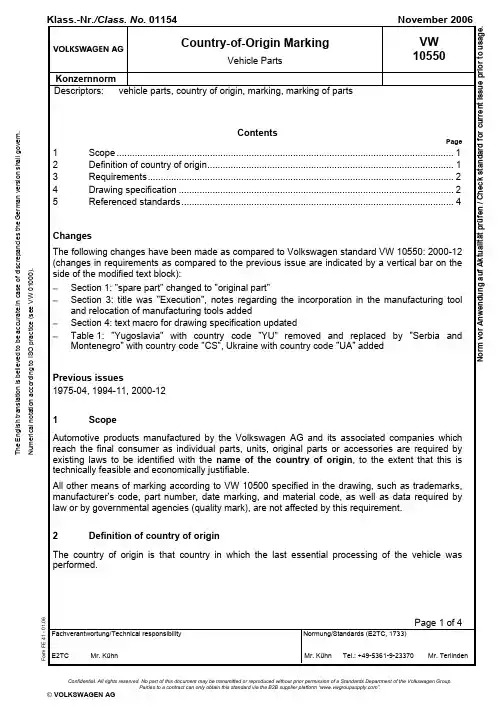
Confidential. All rights reserved. No part of this document may be transmitted or reproduced without prior permission of a Standards Department of the Volkswagen Group.Parties to a contract can only obtain this standard via the B2B supplier platform “”.VOLKSWAGEN AGF o r m F E 41 - 01.06Page 2VW 10550: 2006-113 RequirementsThe name of the country of origin must be applied to vehicle parts such that it is clearly visible and easily legible on a permanent basis. The country-of-origin marking shall preferably be applied to the part by incorporation in the manufacturing tool.In the case of relocations of manufacturing tools from the originally designated country of origin to other manufacturing countries, the country codes shall be adjusted accordingly.The English form of the country name, e.g. "Mexico", "Belgium", "Spain" according to ISO 3166-1 shall be used.The additional specification "Made in ..." is permissible.In situations where space is limited, the country-of-origin marking may be applied using the 2-letter code according to DIN EN ISO 3166-1, e.g. "DE" for "Germany". The name or code for the country of origin shall be approximately half the size of the brand trademark. However, it shall not directly precede or follow the manufacturer's code. Should the location be at the manufacturer's option, it is recommended that the country-of-origin marking be located below the brand trademark.The necessity of country-of-origin marking must be specified on the drawing, see drawing specification in Section 4.For further requirements concerning the marking of automotive products see VW 10500.specification4 DrawingThe country of origin shall be specified in drawings by means of a text macro according to VW 01014, NO-E2, for example:KennzeichnungVW 10500MarkingVW 10514 – C10MarkenzeichenTrademarkHerstelllandVW 10550 - 5Country of originVW 10540 – 1-5Hersteller-CodeMfr. CodeTeil-Nr.; SchriftDIN 1451-4 - 5Pt.-No; LetteringVW 10560 – A5DatumskennzeichnungDate markingVDA 260 > PP + EPDM <Werkstoff-KennzeichnungMaterial markingPage 3VW 10550: 2006-11Table 1 - Country names and 2-letter codes(excerpt from ISO 3166-1 and DIN EN ISO 3166-1)code German EnglishCountryAR Argentinien ArgentinaAU Australien AustraliaBelgien BelgiumBE Bosnien und Herzegowina Bosnia and Herzegovina BABR Brasilien BrazilBG Bulgarien BulgariaCL Chile ChileCN China ChinaDKDänemark DenmarkDE Deutschland GermanyFJ Fidschi FijiFinnland FinlandFIFR Frankreich FranceGR Griechenland GreeceGroßbritannien (siehe Vereinigtes Königreich) - -IN Indien IndiaID Indonesien IndonesiaIR Iran IranIE Irland IrelandIL Israel IsraelIT Italien ItalyJP Japan JapanSerbien und Montenegro Serbia and Montenegro CSCA Kanada CanadaKorea Korea, Republic of KRHR Kroatien CroatiaLI Liechtenstein LiechtensteinLU Luxemburg LuxembourgMY Malaysia MalaysiaMalta MaltaMTMX Mexiko MexicoMC Monaco MonacoNL Niederlande NetherlandsNG Nigeria NigeriaNO Norwegen NorwayATÖsterreich AustriaPE Peru PeruPL Polen PolandPT Portugal PortugalRO Rumänien RomaniaRussische Föderation Russian Federation RUSG Singapur SingaporeSE Schweden SwedenPage 4VW 10550: 2006-11CH Schweiz SwitzerlandSK Slowakei SlovakiaSI Slowenien SloveniaES Spanien SpainZAAfricaSüdafrika SouthTW Taiwan TaiwanTschechische Republik Czech Republic CZTN Tunesien TunisiaTR Türkei TurkeyHU Ungarn HungaryUA Ukraine UkraineVereinigte Staaten United States USVereinigtes Königreich United Kingdom GBstandards15 ReferencedVW 01014 Technical Drawings; Drawing Frames and Text MacrosVW 10500 Company Designation, Marking of PartsVW 10514 Logos; Marking of Vehicle PartsDIN EN ISO 3166-1 Codes for the Representation of Names of Countries and their Subdivisions -Part 1: Country CodesISO 3166-1 Codes for the Representation of Names of Countries and their Subdivisions -Part 1: Country Codes1 In this Section, terminological inconsistencies may occur as the original titles are used.。