整理be going to表一般将来时
- 格式:docx
- 大小:20.55 KB
- 文档页数:3
be going to表一般将来时
一、概念
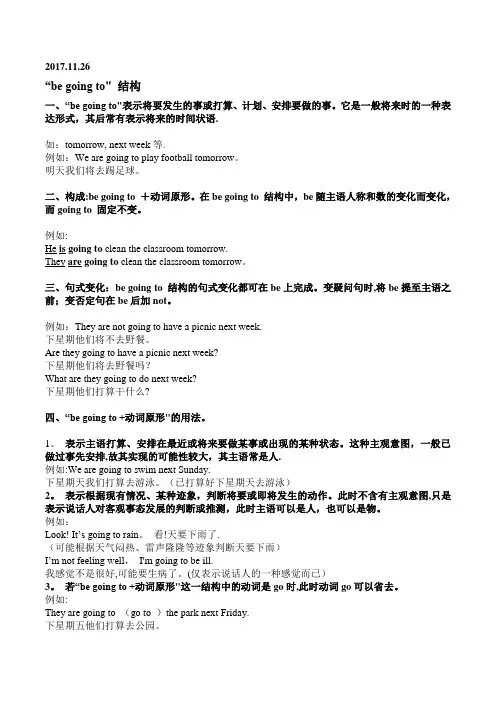
be going to 是一种固定结构,它后面要接动词原形。
含有be going to 结构的句子中往往有表示将来的时间状语,如:tomorrow, next week ,this morning, this afternoon, this evening, tonight, tomorrow, this weekend, next week, next year, soon 等。
(1) 表示主语的意图,即主语计划或打算要做的事。
We are going to have a class meeting this afternoon.今天下午我们打算开班会。
(安排)
(2) 表示主语根据目前迹象所作出的推测。
① Look at the black clouds. It's going to rain.看那些乌云,快要下雨了。
(推测)
① I’m not feeling well, I’m going to be ill. 我感觉不是很好,可能要生病了。
(表示说话人的感觉而已)
二、肯定句结构
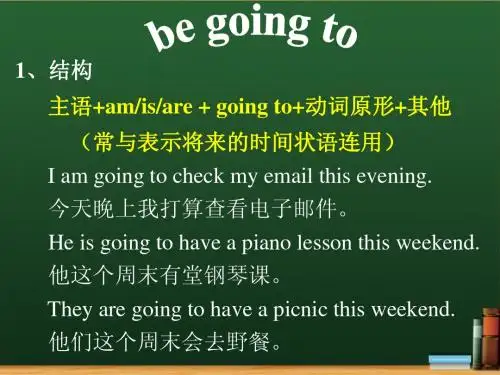
主语+be(am / is / are) + going to +动词原形+其它。
(当主语是I 时用am ;当主语是第三人称单数时用is;当主语是其他人称时用are)
① I am going to buy something tomorrow morning. 明天早上我要去买些东西。
① She is going to see Mr. Wang this afternoon. 她打算今天下午去看望王先生。
① They are going to visit the factory next week. 他们打算下周参观这家工厂。
三、否定句结构
主语+be(am / is / are)+not + going to +动词原形+其它。
They are not going to visit the factory next week. (否定句)
四、疑问句结构
be(am / is / are)+主语+ going to +动词原形+其它?
肯定回答:Yes, 主语+ am/is/are.
否定回答:No, 主语+ isn't/aren't. / No, I'm not.
不过I am... 在改为一般疑问句时常常改为“Are you ....?”。
—Are they going to visit the factory next week?
—Yes, they are. (No, they aren't.) (一般疑问句及其回答)
五、be going to 的特殊用法
(1) There be 句型的be going to 结构为:There is / are going to be... (注意句型中
going to 后面的be不能改为have。
) 常用来表示将有某事发生。
例如:
There is going to be a football match next Saturday in our school.
下周六我们学校将有一场足球比赛。
(2) come, go, leave, arrive等表示位置移动的动词常用现在进行时表示将要发生的动
作,它们很少与be going to 结构连用。
例如:
① Miss Sun is coming tonight.今晚孙小姐要来。
① They are going to the park next Friday. 下星期五他们打算去公园。
(3) be going to +动词原形”结构与表示将来的时间状语是否连用,在意思上有所差别。
如果其后有明确的时间状语,则表示该动作或状态发生的可能性较大;反之,则表示
一种推测,表示未来可能发生的事情。
例如:
① There is going to be a film in our school this evening.
今晚我们学校将有一场电影。
(一定会发生)
① Hurry up! We are going to be late. 快点!我们要迟到了。
(仅表示一种推测)
练习题
I.用所给动词的适当形式填空。
1.Jim and Li Lei __________(watch)the football match this evening.
2.__________ she __________(have)a Chinese lesson tomorrow?
3.—What __________ you __________(do)tomorrow morning?
—I __________(see)my grandparents.
4.__________ they__________(go)fishing this Friday afternoon?
5.There __________(be)a birthday party this evening.
II.按要求改写下列各句。
1.We are going to play ping-pong on Saturday.(改为一般疑问句并作否定回答)
—__________ __________ going to play ping-pong on Saturday?
—__________,we __________.
2.He's going to tell me all about it.(改为否定句)
He __________ __________ going to tell me all about it.
3.She is going to work hard at English this term.(对划线部分提问)
__________ she __________ __________ __________ this term?
4.They're going to the Sun Island by bus.(对划线部分提问)
__________ __________ they __________ __________ the Sun Island?
5.The students of Class Three have a field trip on Sunday.(用next Sunday 改写)
The students of Class Three __________ __________ __________ __________ a field trip next Sunday.
6.Linda has lunch at school on Tuesdays.(用next Tuesday改写)
Linda __________ __________ __________ __________ lunch at school next Tuesday.
III.把下列各句译成英语。
1.我叔叔今晚要来。
My uncle __________ __________ __________.
2.他没有打算住那座小屋。
He __________ __________ __________ __________ in the small house.
3.我们要读这本书。
We __________ __________ __________ __________ this book.
4.———你爸爸要去钓鱼吗?
———不,他要去游泳。
—__________ your father __________ __________?
—No,he is __________ __________.。