
福禄克测试仪
- 格式:ppt
- 大小:4.54 MB
- 文档页数:255
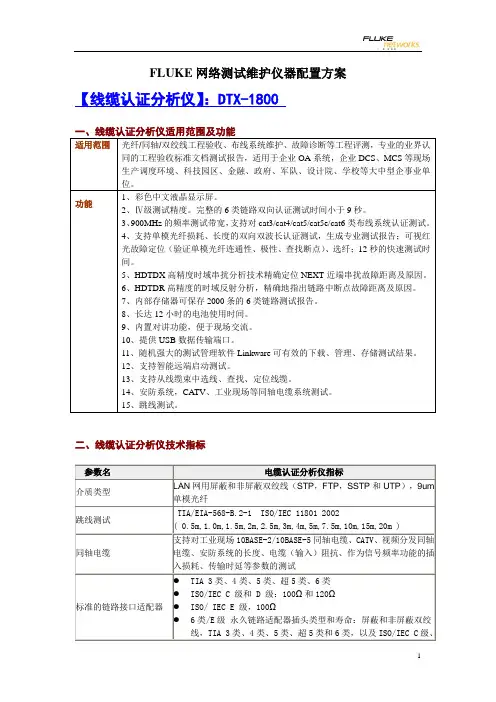
FLUKE网络测试维护仪器配置方案【线缆认证分析仪】:DTX-1800一、线缆认证分析仪适用范围及功能适用范围光纤/同轴/双绞线工程验收、布线系统维护、故障诊断等工程评测,专业的业界认同的工程验收标准文档测试报告,适用于企业OA系统,企业DCS、MCS等现场生产调度环境、科技园区、金融、政府、军队、设计院、学校等大中型企事业单位。
功能1、彩色中文液晶显示屏。
2、Ⅳ级测试精度。
完整的6类链路双向认证测试时间小于9秒。
3、900MHz的频率测试带宽,支持对cat3/cat4/cat5/cat5e/cat6类布线系统认证测试。
4、支持单模光纤损耗、长度的双向双波长认证测试,生成专业测试报告;可视红光故障定位(验证单模光纤连通性、极性、查找断点)、选纤;12秒的快速测试时间。
5、HDTDX高精度时域串扰分析技术精确定位NEXT近端串扰故障距离及原因。
6、HDTDR高精度的时域反射分析,精确地指出链路中断点故障距离及原因。
7、内部存储器可保存2000条的6类链路测试报告。
8、长达12小时的电池使用时间。
9、内置对讲功能,便于现场交流。
10、提供USB数据传输端口。
11、随机强大的测试管理软件Linkware可有效的下载、管理、存储测试结果。
12、支持智能远端启动测试。
13、支持从线缆束中选线、查找、定位线缆。
14、安防系统,CATV、工业现场等同轴电缆系统测试。
15、跳线测试。
二、线缆认证分析仪技术指标参数名电缆认证分析仪指标介质类型LAN网用屏蔽和非屏蔽双绞线(STP,FTP,SSTP和UTP),9um 单模光纤跳线测试TIA/EIA-568-B.2-1 ISO/IEC 11801 2002( 0.5m,1.0m,1.5m,2m,2.5m,3m,4m,5m,7.5m,10m,15m,20m )同轴电缆支持对工业现场10BASE-2/10BASE-5同轴电缆、CATV、视频分发同轴电缆、安防系统的长度、电缆(输入)阻抗、作为信号频率功能的插入损耗、传输时延等参数的测试标准的链路接口适配器●TIA 3类、4类、5类、超5类、6类●ISO/IEC C 级和 D 级:100Ω和120Ω●ISO/ IEC E 级,100Ω●6类/E级永久链路适配器插头类型和寿命:屏蔽和非屏蔽双绞线,TIA 3类、4类、5类、超5类和6类,以及ISO/IEC C级、D级和E级永久链路●6类/E级通道适配器插头类型和寿命:屏蔽和非屏蔽双绞线,TIA 3类、4类、5类、超5类和6类,以及ISO/IEC C级、D级和E级通道支持的测试参数(测试参数及测试的频率范围由所选择的测试标准所决定)接线图、长度、传输时延、时延偏离、支流环路电阻、插入损耗(衰减)、回波损耗、远端回波损耗近端串扰、远端近端串扰、衰减串扰比,远端衰减串扰比综合等效远端串扰、远端综合等效远端串扰综合近端串扰、远端综合近端串扰综合衰减串扰比、远端综合衰减串扰比测试标准●TIA/EIA-568B标准: 3类和超5类●TIA TSB-95标准:5类(1000BASE-T)●TIA/EIA-568B.2-1标准:6类(TIA/EIA-568B.2附录1)●ISO/IEC 11801标准:C级、D级和E级●EN 50173标准:C级、D级和E级●ANSI TP-PMD●10BASE5,10BASE2,10BASE-T,100BASE-TX,1000BASE-T●IEEE 802.5 (屏蔽线,IBM 1型,150W)令牌环,4Mbps和16Mbps ●10GBase-T: IEEE 802.3an ,TIA/EIA TSB155,ISO TR24570故障诊断能力HDTDX高精度时域串扰分析NEXT故障诊断能力,HDTDR高精度时域反射分析RL故障诊断能力自动测试速度6类链路完整的双向测试测试时间9秒电缆上的音频发生器产生可被例如IntelliTone智能音频探头等音频探头检测到的音频。

The Fluke 62 Mini Infrared ThermometerFor quick, basic temperature checksAdvances in technology have made the smallest infrared ther-mometers, such as the Fluke 62 Mini, especially practical. They’re convenient to carry and afford-able enough for everyone on an entire crew to own one, so that infrared temperature measure-ment isn’t limited to specialists. And the latest models are more accurate and measure greater temperature ranges than earlier “mini” generations.Point, shoot and readTo use the Fluke 62 Mini Infrared Thermometer, use the laser sight-ing to pinpoint the target, and pull the trigger to see the tem-perature on the built-in display.Increases in temperature are often the first sign of trouble for mechanical equipment, electri-cal circuits and building systems such as heating, ventilation and air conditioning (HVAC). A quick temperature check of key compo-nents and equipment can detect potential problems and prevent catastrophic failures. Regular contact measurement with a thermometer and probe takes time and can require gettingclose to dangerous or inaccessible operational equipment or shutting equipment down. Non-contact infrared (IR) thermometers take quick, safe measurements from a distance while equipment is operational.Application NoteFor more information on Fluke Predictive PART TWOof a predictive maintenance seriesCheck motor temperatures quickly, without contact.The thermometer works by measuring the infrared energy emitted from surfaces and con-verting the information into a temperature reading. It measures temperatures from -30 °C to +500 °C (-20 °F to +932 °F), is accurate to ± 1% of reading and can capture the maximum reading among a range of readings.While there are endless ways to use an infrared thermometer, here are the three primary ones:1) M easure the absolutetemperature at a spot. This is useful for trending thetemperature of an object such as a bearing housing over time. With a repeatability of ± 0.5 %, the new thermom-eters make this practice quite accurate.2) C ompare the temperature differential of two spots. For example to compare the run-ning temperatures of two like objects to determine if one is overheating.3) S can an object and detect changes within a continuous area on it, to find hot or cold spots on housings, panels and structures.Securing accurate measurementsThe uses for handheld infrared thermometers are limited only by the nature of infrared technology. The key restriction is the sur-face of the target object. Simply stated, these instruments cannot accurately measure shiny sur-faces. The issue is emitted versusreflected energy.CHAPTER 2.3EmissivityOf the kinds of energy—reflected, transmitted and emitted—emanat-ing from an object, only emitted infrared energy indicates the object’s surface temperature. Transmitted and reflected energy do not. When IR thermometers measure surface temperatures, they sense all three kinds of en-ergy. Therefore, they have to be adjusted to read emitted energy only. The Fluke 62 Mini Infrared Thermometer has a fixed, pre-set emissivity of 0.95, which is the emissivity value for most organic materials as well as painted or oxidized surfaces.To accurately measure the surface temperature of a shinyobject, cover the target surfacewith masking tape or flat blackpaint and allow enough timefor the tape or paint to reachthe temperature of the material underneath.Distance-to-spot ratioThe optical system of an infrared thermometer collects the infrared energy from a circular area or spot and focuses it on the detec-tor. The farther a target is fromcreated on the target will be. Optical resolution is defined by the ratio of the distance from theglass and, as noted, will be inac-curate if used to measure shiny or polished metal surfaces (stainless steel, aluminum, etc.).Users of IR thermometers also must be alert to environmen-tal conditions. Steam, dust and smoke, for example, can prevent accurate temperature readings by obstructing a unit’s optics. A dirty lens can also affect read-ings. Lenses should be cleaned with dry, clean plant air or a fluid made specifically for cleaning lenses. Also, changes in ambi-ent temperature can influence a thermometer’s performance. If an IR unit is exposed to abrupt temperature changes of 11 °C (20 °F) or more, the user should allow at least 20 minutes for the unit to adjust to the new ambienttemperature.instrument to the object com-pared to the size of the spot (“dis-tance-to-spot” or D:S ratio). For the Fluke 62 Mini the distance-to-spot ratio is 10:1. This means that at a distance of 10 inches the spot is about one inch in diam-eter. The larger its ratio number the better is the instrument’s resolution. Resolution is important becauseit relates directly to getting good readings by ensuring that the target is larger than the spot size. The smaller the target, the closer one must be to it. When accuracy is critical, the target should be at least twice as large as the spot. Other factors to consider These instruments measure only surface temperatures, not internal temperatures. Furthermore, they cannot take readings throughEven considering the limitations of infrared temperature moni-toring, there are still so many possible uses for this technology that trying to list them all would be fruitless. Here are some of the most common and particularly successful applications. Predictive maintenance Regular maintenance in industrial and institutional locations keeps motors, pumps and gearboxes from experiencing catastrophic failures that can halt production or pose safety problems. In an infrared maintenance program, technicians set up an inspection route and measurement param-eters for each piece of key equip-ment and/or component. Then, they take an infrared temperature measurement on a regular basis, record the measurement, and compare against previous read-ings for any changes.As an example, a technician can use a Fluke 62 Mini to check the operation of an induction motor on a critical piece of equip-ment. She or he would start by reading the unit’s specifications on the plate attached to it. The plate will reveal either a Temper-ature Rise Rating or a Motor Class Rating for the motor. The rise rat-ing gives the maximum allowable operating temperature above am-bient. The motor class rating, e.g. “Class A,” will reveal an absolute maximum operating temperature. Both pertain to internal-winding temperatures. Of course, a contact thermometer cannot measure these temperatures while the motor is running. However, an operator or technician can use a non-contact IR thermometer to measure the temperature of the motor case. She or he should add 10 °C (18 °F) to surface scans to determine the internal operating temperature. For each 10 °C (18 °F) above the maximum operating temperature, the life of the motor is likely to decrease by 50%.If the motor is extremely hot it could be a fire hazard.Using infrared thermometryfor plant maintenance reducesrepair costs and avoids equip-ment stoppages. Industrialmaintenance personnel, buildingmanagers, HVAC technicians andeven homeowners can reducecosts by repairing only whatneeds to be fixed. They can avoidunplanned equipment stoppagesby making specific, necessaryrepairs before equipment fails.Then, after repairs, they can per-form new temperature measure-ments on the same equipment todetermine whether the repairswere successful.Electrical inspectionsElectrical systems supply essen-tial power to every industrial,commercial and residential set-ting. With degradation over timeand the general vulnerability ofelectrical connections, it’s impor-tant to monitor electrical sys-tems for loose, dirty or corrodedconnections, flaws in transformerwindings, hot spots in panelboxes and other telltale signs oftrouble.The Fluke 62 Mini can beinvaluable for finding developinghotspots in electrical equipmentthat may indicate a short circuit,a fused switch or an overload. Ingeneral, higher operating temper-atures reduce the life of electricalcomponents by damaging insula-tion and raising the resistance ofconductor materials. Pinpointedby a non-contact IR thermometer,these situations signal that actionis required.Measure moving targets easily.Use unit in close range fornear-distance targets.HVAC inspectionsHeating and cooling systems, whether for maintaining pro-duction parameters or human comfort, are easily monitored with the Fluke 62 Mini Infrared Thermometer. Check air stratifica-tion, supply and return registers, furnace performance and steam distribution systems and conduct energy audits to pinpoint system upgrade opportunities.For example, IR non-contact thermometers can be used to troubleshoot steam traps, which are designed to remove water (condensate) that has condensed from the steam as it travels in transfer pipes. If a steam trap fails while open, it will leak steam, causing an energy loss. If it fails while closed, it won’t remove condensate from the steam line, making it useless. A faulty steam trap can cost a plant $500 USD or more per year, and in any given year, 10 % of all industrial steam traps fail. Since many plants have as many as 1,000 traps, they can quickly become high-value main-tenance targets.To verify whether a steam trap is working properly, use a non-contact thermometer like the 62 Mini to measure from input to output. On a properly operating trap, the temperature should drop significantly. If the temperature doesn’t drop, the steam trap has failed open and is passing super-heated steam into the condensate line. If the temperature drop is overly large, the trap may be stuck closed and is not ejecting heated condensate. Condensate in steam lines reduces the effec-tive energy of the steam and can cause difficulties in steam drivenprocesses.Use non-contact temperature measurements for inaccessible targets.Fluke.Keeping your worldup and running.Fluke CorporationPO Box 9090Everett, WA USA 98206Fluke Europe B.V.PO Box 1186, 5602 BDEindhoven, The NetherlandsFor more information call:U.S.A. (800) 443-5853 orFax (425) 446-5116Europe/M-East/Africa (31 40) 2 675 200 orFax (31 40) 2 675 222Canada (800) 36-FLUKE orFax (905) 890-6866Other countries (425) 446-5500 orFax (425) 446-5116Web access: ©2005 Fluke Corporation. All rights reserved.Printed in U.S.A. 6/2005 2517382 A-EN-N Rev A。
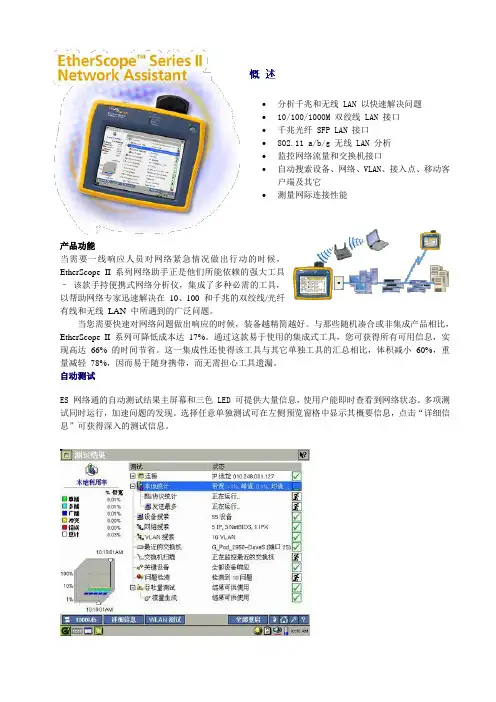
∙分析千兆和无线 LAN 以快速解决问题∙10/100/1000M 双绞线 LAN 接口∙千兆光纤 SFP LAN 接口∙802.11 a/b/g 无线 LAN 分析∙监控网络流量和交换机接口∙自动搜索设备、网络、VLAN、接入点、移动客户端及其它∙测量网际连接性能产品功能当需要一线响应人员对网络紧急情况做出行动的时候,EtherScope II 系列网络助手正是他们所能依赖的强大工具–该款手持便携式网络分析仪,集成了多种必需的工具,以帮助网络专家迅速解决在10、100 和千兆的双绞线/光纤有线和无线LAN 中所遇到的广泛问题。
当您需要快速对网络问题做出响应的时候,装备越精简越好。
与那些随机凑合或非集成产品相比,EtherScope II 系列可降低成本达17%。
通过这款易于使用的集成式工具,您可获得所有可用信息,实现高达66% 的时间节省。
这一集成性还使得该工具与其它单独工具的汇总相比,体积减小60%,重量减轻78%,因而易于随身携带,而无需担心工具遗漏。
自动测试ES 网络通的自动测试结果主屏幕和三色 LED 可提供大量信息,使用户能即时查看到网络状态。
多项测试同时运行,加速问题的发现。
选择任意单独测试可在左侧预览窗格中显示其概要信息,点击“详细信息”可获得深入的测试信息。
EtherScope 分析仪的自动网络发现的网络发现结果显示在主屏幕上,其中包括最近的交换机以及您连接的插槽和端口的标识信息。
ES 网络通二代用户界面采用 Linux 操作系统支持,导航方便。
linux 提供 WEB 浏览器,Telnet 和其它类似于PC 上提供的工具。
千兆链路测试验证 LAN 信令验证以太网信令以排除速度和双工不匹配以及端口自适应问题。
测试 802.3af 以太网供电 (PoE) 链路。
EtherScope 系列 II 可模仿 802.3af 带电设备模拟请求并测量每针上的电压。
查看交换机详细信息最近的交换机当诊断用户问题时,最重要的是确定从哪里连接到网络中。

福禄克绝缘电阻测试仪安全操作及保养规程1. 引言本文档旨在提供福禄克绝缘电阻测试仪安全操作及保养规程的详细说明。
绝缘电阻测试仪是一种重要的测试设备,用于检测电气设备的绝缘性能。
正确的操作和维护可确保设备的安全运行和延长其使用寿命。
2. 安全操作指南在使用福禄克绝缘电阻测试仪之前,请遵循以下操作指南:2.1 电源和电缆•使用电阻测试仪时,请确保电源线缆没有破损并且连接牢固。
•确保插头和插座之间的连接牢固,并检查电源电压与设备要求匹配。
•避免将电源线缆暴露在高温、潮湿或易磨损的环境中。
2.2 个人防护措施•使用绝缘手套和绝缘鞋等个人防护用品,并确保其在使用前经过检查和测试。
•在测试之前,务必断开电源并将设备置于安全位置。
•避免将测试仪置于易燃或易爆物体附近。
•若需要进行长时间测试,请确保有充足的通风设施。
2.3 设备操作•在使用前,请浏览并熟悉福禄克绝缘电阻测试仪的用户手册。
•在测试之前,应先检查设备是否正常工作,并保证操作界面清洁整齐。
•注意测试仪的测试范围,不要超出其额定范围以免损坏设备或造成人身伤害。
2.4 测试对象•在进行绝缘电阻测试之前,确保被测设备已断电并在安全状态下。
•被测设备应除去通电线缆,并通过独立的线路进行测试以确保准确性。
•避免测试设备过大,以免对设备和测试仪造成损害。
3. 保养规程适当的保养可确保绝缘电阻测试仪的性能和可靠性,延长其使用寿命。
以下是一些保养规程建议:3.1 周期性清洁•定期清洁绝缘电阻测试仪的外壳和按钮,使用干净的布进行擦拭。
•避免使用酒精或酸性清洁剂,以防损坏设备表面。
3.2 温度和湿度控制•绝缘电阻测试仪应存放在干燥、通风的环境中,避免暴露在高温、潮湿的环境中。
•长时间不使用时,应将设备存放在干燥的地方。
3.3 定期校验和维修•建议定期对绝缘电阻测试仪进行校验和维修,以确保其准确性和稳定性。
•在校验和维修期间,应由专业人员进行操作,确保设备能够正常工作。
4. 总结本文档详细介绍了福禄克绝缘电阻测试仪的安全操作和保养规程。