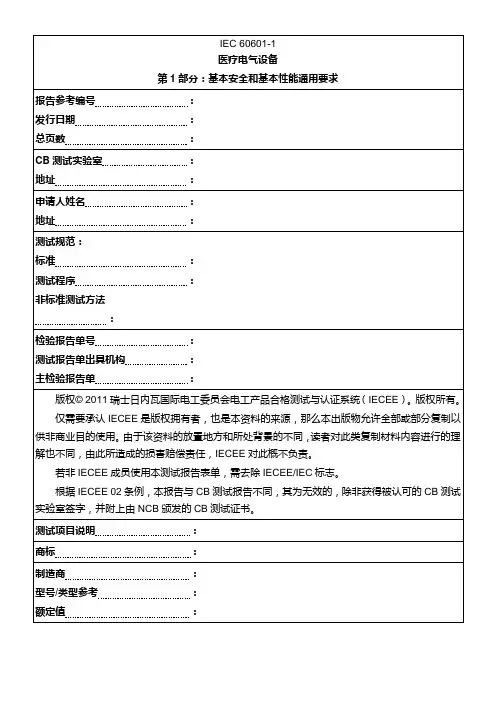
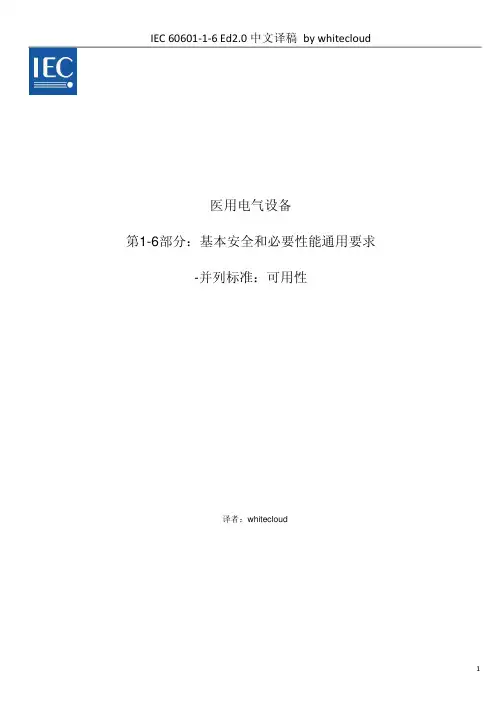
IEC60601-1-6 Edition 3 检查表 (英文)
- 格式:xls
- 大小:38.00 KB
- 文档页数:4
– storage; – installation; – operation; – maintenance and repair; and – disposal.
Where the requirements of 60601-1-6 and 62366 have been applied, risks associated with usability shall be -62366 considered acceptable according to ISO 14971 Where information for safety is used to control risks the 4.1.3 process defined in 60601-1-6 and 62366 shall be applied to -62366 that information. A Usability Engineering Process compliant with 62366 4.2 shall be applied using the following terms: (60601-1-6) – The term “MEDICAL DEVICE” shall assume the same meaning as ME EQUIPMENT. – The term “USER” shall assume the same meaning as 4.1.2
IEC 60601-1-6 Edition 3 checklist (3rd Edition)
Clause 4.1 Requirement Applies? Reference to Documentation (yes/no/na) Yes user manual
Equipment provides adequate usability, and the risks (60601-1-6) resulting from normal use and use errors are acceptable The usability PROCESS shall address OPERATOR interactions with the MEDICAL DEVICE according to the ACCOMPANYING 4.1.1 DOCUMENT, including, but not limited to: – transport; -62366
5.3.2
-62366
5.4
-62366
IEC 60601-1-6 Edition 3 checklist (3rd Edition)
Clause Requirement
– frequently used functions and – functions related to SAFETY of the MEDICAL DEVICE. The MANUFACTURER shall develop the USABILITY SPECIFICATION. The USABILITY SPECIFICATION shall provide: – testable requirements for USABILITY VERIFICATION; and – testable requirements for USABILITY of the PRIMARY OPERATING FUNCTIONS including criteria for determining the adequacy of RISK CONTROL achieved by the USABILITY
INTERFACE
4.2 -62366 4.3 -62366
IEC 60601-1-6 Edition 3 checklist (3rd Edition)
Clause Requirement Applies? Reference to Documentation (yes/no/na) If provided, the instructions for use shall include a brief description of the ME EQUIPMENT, its physical operating 5 principles and significant physical and performance characteristics relevant to its USABILITY. The same information shall also be included in the technical (60601-1-6) description, if this is provided as a separate document. Application of the equipment is specified in the usability 5.1 engineering file, and the specifications include the -62366 following information: – medical purpose such as conditions(s) or disease(s) to be screened, monitored, treated, or diagnosed : – patient population such as age, weight, region of body, health, and condition : – part of the body or type of tissue applied to or interacted with : – intended OPERATOR profile : – application such as environment, frequency of use, location, and mobility : The MANUFACTURER shall determine the frequently used 5.2 functions that involve USER interaction with the MEDICAL DEVICE -62366 and record them in the USABILITY ENGINEERING FILE An identification of characteristics related to SAFETY (part of a RISK ANALYSIS) that focuses on USABILITY shall be performed 5.3.1 according to ISO 14971:2007, 4.2. These shall consider at – application specification, including USER PROFILE(S); and -62366
INTERFACE.
– The term “USER PROFILE” shall assume the same meaning as OPERATOR PROFILE. The USABILITY ENGINEERING FILE shall: – established a USABILITY ENGINEERING PROCESS; – established acceptance criteria for USABILITY; and – demonstrated that the acceptance criteria for USABILITY have been met. Results of the usability engineering process recorded in the usability engineering file The Usability engineering process may be scaled based on the type and complexity of the device or where modifications are being made to an existing design. Risk analyses shall incorporate/consider the following: – application specification – OPERATOR PROFILE; – predictable USE ERRORS 4.2 – * task related requirements; – * context of use; – information on HAZARDS known for existing OPERATOREQUIPMENT INTERFACES for ME EQUIPMENT of a similar type – results of the review of the OPERATOR-EQUIPMENT
OPERATOR.
ቤተ መጻሕፍቲ ባይዱ
– The term “PATIENT” shall include animals. – The term "SAFETY” shall assume the same meaning as BASIC SAFETY and ESSENTIAL
PERFORMANCE.
– The term “USER INTERFACE” shall assume the same meaning as OPERATOR-EQUIPMENT
– frequently used functions The results of this identification characteristics related to SAFETY shall be recorded in the USABILITY ENGINEERING FILE. The MANUFACTURER shall identify known or foreseeable HAZARDS (part of a RISK ANALYSIS) to PATIENTS, USERS and reasonably foreseeable sequences or combinations of events involving the USER INTERFACE that can result in a HAZARDOUS SITUATION. The SEVERITY of the resulting possible HARM shall be determined and documented as part of the risk analysis and in the USABILITY ENGINEERING FILE. During the identification of HAZARDS and HAZARDOUS SITUATIONS, the following shall be considered: – application specification, including USER PROFILE(S) –task related requirements; –context of use; – information on HAZARDS and HAZARDOUS SITUATIONS known for existing USER INTERFACES of MEDICAL DEVICES of a similar type, if available; – preliminary USE SCENARIOS; – possible USE ERRORS – if an incorrect mental model of the operation of the MEDICAL DEVICE can cause a USE ERROR resulting in a HAZARDOUS SITUATION; and – results of the review of the USER INTERFACE The MANUFACTURER shall determine the PRIMARY OPERATING FUNCTIONS and record them in the USABILITY ENGINEERING FILE. The inputs to the PRIMARY OPERATING FUNCTIONS identification shall include the following:
Where the requirements of 60601-1-6 and 62366 have been applied, risks associated with usability shall be -62366 considered acceptable according to ISO 14971 Where information for safety is used to control risks the 4.1.3 process defined in 60601-1-6 and 62366 shall be applied to -62366 that information. A Usability Engineering Process compliant with 62366 4.2 shall be applied using the following terms: (60601-1-6) – The term “MEDICAL DEVICE” shall assume the same meaning as ME EQUIPMENT. – The term “USER” shall assume the same meaning as 4.1.2
IEC 60601-1-6 Edition 3 checklist (3rd Edition)
Clause 4.1 Requirement Applies? Reference to Documentation (yes/no/na) Yes user manual
Equipment provides adequate usability, and the risks (60601-1-6) resulting from normal use and use errors are acceptable The usability PROCESS shall address OPERATOR interactions with the MEDICAL DEVICE according to the ACCOMPANYING 4.1.1 DOCUMENT, including, but not limited to: – transport; -62366
5.3.2
-62366
5.4
-62366
IEC 60601-1-6 Edition 3 checklist (3rd Edition)
Clause Requirement
– frequently used functions and – functions related to SAFETY of the MEDICAL DEVICE. The MANUFACTURER shall develop the USABILITY SPECIFICATION. The USABILITY SPECIFICATION shall provide: – testable requirements for USABILITY VERIFICATION; and – testable requirements for USABILITY of the PRIMARY OPERATING FUNCTIONS including criteria for determining the adequacy of RISK CONTROL achieved by the USABILITY
INTERFACE
4.2 -62366 4.3 -62366
IEC 60601-1-6 Edition 3 checklist (3rd Edition)
Clause Requirement Applies? Reference to Documentation (yes/no/na) If provided, the instructions for use shall include a brief description of the ME EQUIPMENT, its physical operating 5 principles and significant physical and performance characteristics relevant to its USABILITY. The same information shall also be included in the technical (60601-1-6) description, if this is provided as a separate document. Application of the equipment is specified in the usability 5.1 engineering file, and the specifications include the -62366 following information: – medical purpose such as conditions(s) or disease(s) to be screened, monitored, treated, or diagnosed : – patient population such as age, weight, region of body, health, and condition : – part of the body or type of tissue applied to or interacted with : – intended OPERATOR profile : – application such as environment, frequency of use, location, and mobility : The MANUFACTURER shall determine the frequently used 5.2 functions that involve USER interaction with the MEDICAL DEVICE -62366 and record them in the USABILITY ENGINEERING FILE An identification of characteristics related to SAFETY (part of a RISK ANALYSIS) that focuses on USABILITY shall be performed 5.3.1 according to ISO 14971:2007, 4.2. These shall consider at – application specification, including USER PROFILE(S); and -62366
INTERFACE.
– The term “USER PROFILE” shall assume the same meaning as OPERATOR PROFILE. The USABILITY ENGINEERING FILE shall: – established a USABILITY ENGINEERING PROCESS; – established acceptance criteria for USABILITY; and – demonstrated that the acceptance criteria for USABILITY have been met. Results of the usability engineering process recorded in the usability engineering file The Usability engineering process may be scaled based on the type and complexity of the device or where modifications are being made to an existing design. Risk analyses shall incorporate/consider the following: – application specification – OPERATOR PROFILE; – predictable USE ERRORS 4.2 – * task related requirements; – * context of use; – information on HAZARDS known for existing OPERATOREQUIPMENT INTERFACES for ME EQUIPMENT of a similar type – results of the review of the OPERATOR-EQUIPMENT
OPERATOR.
ቤተ መጻሕፍቲ ባይዱ
– The term “PATIENT” shall include animals. – The term "SAFETY” shall assume the same meaning as BASIC SAFETY and ESSENTIAL
PERFORMANCE.
– The term “USER INTERFACE” shall assume the same meaning as OPERATOR-EQUIPMENT
– frequently used functions The results of this identification characteristics related to SAFETY shall be recorded in the USABILITY ENGINEERING FILE. The MANUFACTURER shall identify known or foreseeable HAZARDS (part of a RISK ANALYSIS) to PATIENTS, USERS and reasonably foreseeable sequences or combinations of events involving the USER INTERFACE that can result in a HAZARDOUS SITUATION. The SEVERITY of the resulting possible HARM shall be determined and documented as part of the risk analysis and in the USABILITY ENGINEERING FILE. During the identification of HAZARDS and HAZARDOUS SITUATIONS, the following shall be considered: – application specification, including USER PROFILE(S) –task related requirements; –context of use; – information on HAZARDS and HAZARDOUS SITUATIONS known for existing USER INTERFACES of MEDICAL DEVICES of a similar type, if available; – preliminary USE SCENARIOS; – possible USE ERRORS – if an incorrect mental model of the operation of the MEDICAL DEVICE can cause a USE ERROR resulting in a HAZARDOUS SITUATION; and – results of the review of the USER INTERFACE The MANUFACTURER shall determine the PRIMARY OPERATING FUNCTIONS and record them in the USABILITY ENGINEERING FILE. The inputs to the PRIMARY OPERATING FUNCTIONS identification shall include the following: