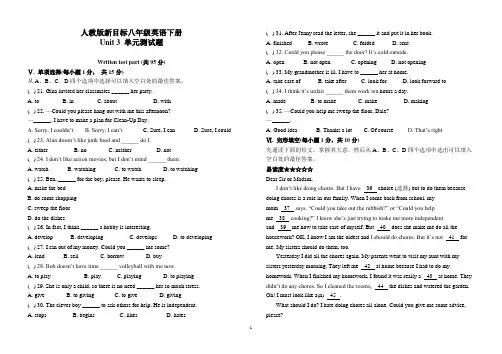
人教版新目标八下英语第三单元综合检测带答案详解
- 格式:doc
- 大小:404.00 KB
- 文档页数:10
人教版新目标八下第三单元综合检测(Unit 3)(45分钟100分)第Ⅰ卷(共40分)Ⅰ. 听力(10分)(Ⅰ)录音中有五个句子, 听一遍后, 选择与其内容相符的图片。
(5分)1.___________2.___________3.___________4.___________5.___________ (Ⅱ)录音中有一篇短文, 听两遍后, 选择最佳答案。
(5分)6. Does everyone do some chores at the writer‟s home?A. Yes, they do.B. No, they don‟t.C. Sorry, I don‟t know.7. Why does the writer never do the dishes?A. Because the writer is too young.B. Because the writer is too busy.C. Because the writer hates doing dishes.8. Who does the dishes?A. The father.B. The mother.C. Nobody.9. The mother every day.A. takes out the rubbishB. sweeps the living roomC. makes the bed10. How many people are there in the family?A. 2.B. 3.C. 4.Ⅱ. 单项选择(10分)1. —Which do you like better, coffee or juice?—of them. I like tea.A. AllB. BothC. NeitherD. None2. (2013·宁波中考)—Can I your bike?—With pleasure. But you mustn‟t it to others.A. lend; borrowB. borrow; lendC. lend; lendD. borrow; borrow3. —Great changes have taken place we enter E-Times.—Yeah. I agree with you.A. beforeB. as soon asC. whenD. since4. Thanks for your invitation, but I‟m so sorry I can‟t go. I need to my sister at home.A. take awayB. take offC. take care ofD. take out of5. (2013·兰州中考)—I‟m not going swimming tomorrow afternoon.—. I have to clean up my bedroom.A. So am IB. Neither am IC. Neither I amD. So I am6. —Could you please pass me the book?—.A. Yes, I couldB. No, I couldn‟tC. Sure. Here you areD. No, that‟s no problem7. The local people like that restaurant because it both delicious food and good service.A. usesB. wantsC. sharesD. provides8. (2013·湖州中考)—Shall we go for a picnic tomorrow?—Well, it all the weather.A. belongs toB. happens toC. depends onD. concentrates on9. —Why are you so excited?—Alan invited me on a trip to Tibet.A. to goB. goC. goingD. went10. (2013·黄冈中考)—Could I borrow your camera?—, but please give it back by Saturday.A. I am sorryB. Of courseC. Certainly notD. No, thanksⅢ. 完形填空(10分)V ery few people like1chores around the house. However, we all know that people must2them. Kids living3Washington have chores4to help their family every day. The chores5different for different kids. Parents often teach6what to do and how to do the chores.7is good for parents to teach their children to do chores at an earlyage. Many parents think chores are important8children—even veryyoung ones. Doing chores9children many important skills. Chores alsoteach children about fairness and commitment(承担义务). The skills andvalues(价值观)learned10doing chores will be good for childrenthroughout their lives.1. A. do B. does C. doing D. did2. A. do B. does C. to do D. doing3. A. on B. at C. for D. in4. A. do B. to do C. doing D. does5. A. are B. is C. be D. am6. A. they B. them C. their D. theirs7. A. This B. That C. It D. He8. A. for B. of C. in D. with9. A. teach B. teaches C. taught D. to teach10. A. by B. with C. to D. atⅣ. 阅读理解(10分)Most children don‟t enjoy doing chores. They like playing computer games rather than cleaning the rooms. But in Australia, Jim and Robert‟s mother, Mrs. Black, has good and proper methods to get their children to do housework.Here is an example.“Mom, have you worked out next week‟s chores? Let Jim and me choose the cards. I can‟t wait. It‟s fun! ”When Robert shouted out, his mother had already put all the cards on their big table. On the cards, there are some words like these, “sweep the floor, clean your bedroom, help mom cook, wash vegetables, make beds, feed the fish, cut the wood, clean the bathroom” and many others, Jim and Robert chose two cards for each day from Monday to Friday. Then they would hang them on the weekday task board. Jim likes to clean the bathroom, so he picked up the card “clean the bathroom”. Robert loves to make the bed so he picked up his favorite card. Jim again picked up “wash vegetables” and Robert chose “feed the fish”. Soon the two boys were happy to take aw ay all the cards.To help the children do chores, their mother thought hard and came up with this idea. Of course, the parents did the chores at weekends and left Jim and Robert two days free.1. From the passage we know that most children like.A. doing choresB. playing computer gamesC. playing cardsD. doing housework2. Jim and Robert chose cards for the weekdays from Monday to Friday.A. twoB. fourC. eightD. ten3. Jim likes to.A. clean the bathroomB. make the bedC. feed the fishD. sweep the floor4. The underlined phrase “came up with”in the last paragraph probably means“”.A. looked atB. gave upC. thought ofD. believed in5. Who did the chores at weekends?A. Jim.B. Robert.C. The parents.D. The whole family.第Ⅱ卷(共60分)Ⅴ. 词汇运用(10分)(Ⅰ)根据句意及汉语提示完成单词。