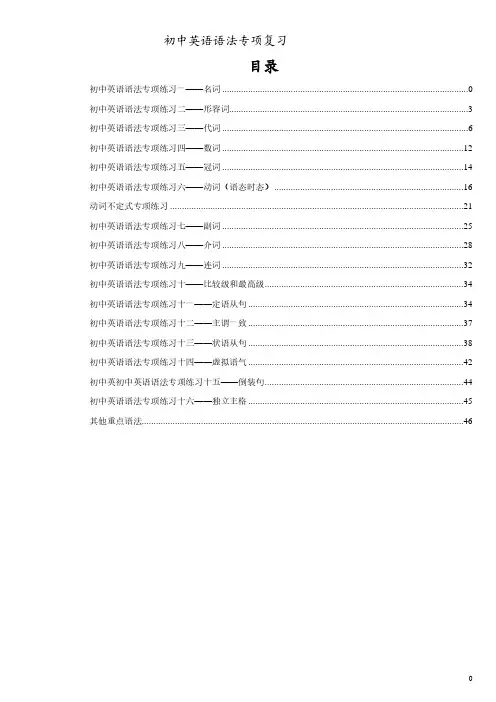
初中英语语法专项复习附参考答案目录初中英语语法专项练习一——名词 0初中英语语法专项练习二——形容词 (3)初中英语语法专项练习三——代词 (6)初中英语语法专项练习四——数词 (12)初中英语语法专项练习五——冠词 (14)初中英语语法专项练习六——动词(语态时态) (16)动词不定式专项练习 (21)初中英语语法专项练习七——副词 (25)初中英语语法专项练习八——介词 (28)初中英语语法专项练习九——连词 (32)初中英语语法专项练习十——比较级和最高级 (34)初中英语语法专项练习十一——定语从句 (34)初中英语语法专项练习十二——主谓一致 (37)初中英语语法专项练习十三——状语从句 (38)初中英语语法专项练习十四——虚拟语气 (42)初中英初中英语语法专项练习十五——倒装句 (44)初中英语语法专项练习十六——独立主格 (45)其他重点语法 (46)初中英语语法专项练习一——名词1( ) 1 She was very happy. She in the maths test.A. makes a few mistakeB. made a few mistakesC. made few mistakesD. makes few mistake( ) 2 We need some more____. Can you go and get some, please?A. potatoB. potatosC. potatoesD. potatoe( ) 3 _____are____for cutting things.A. Knife/usedB. Knives/usedC. Knife/usingD. Knives/using( ) 4 What big____ the tiger has!A. toothB. teethC. toothsD. toothes( ) 5 Please remember to give the horse some tree___.A. leafsB. leavesC. leafD. leave( ) 6 -Can we have some ___?-Yes, please.A. bananaB. orangesC.appleD. pear( ) 7 On the table there are five____.A. tomatosB. piece of tomatoesC. tomatoesD. tomato2( ) 1 They got much ___ from those new books.A. ideasB. photosC. informationD. stories( ) 2 He gave us____ on how to keep fit.A. some advicesB. some adviceC. an adviceD. a advice( ) 3 When we saw his face, we knew___ was bad.A. some newsB. a newsC. the news P. news( ) 4 What___ lovely weather it is!A. /B. theC. anD. a3( ) 1 -Would you like___tea?-No, thanks. I have drunk two____.A. any, bottles of orangeB. some, bottles of orangeC. many, bottles of orangesD. few, bottle of oranges( ) 2 He is hungry. Give him ___ to eat.A. two breadsB. two piece of breadC. two pieces of breadD. two pieces of breads( ) 3 It really took him:___ to draw the nice horse.A. sometimesB. hourC. long timeD. some time( ) 4 I would like to have___.A. two glasses of milkB. two glass of milk IC. two glasses of milksD. two glass of milks( ) 5 Can you give me ____?A. a teaB. some cup of teaC. a cup teaD. a cup of tea( ) 6 Please give me ___ paper. A. one B. a piece C. a D. a piece of( ) 7 John bought___for himself yesterday.A. two pairs of shoesB. two pair of shoeC. two pair of shoesD. two pairs shoes4( )1 -How many ____ have you got on your farm?-I've got five.A. sheepsB. sheepC. pigD. chicken( ) 2 Some ___ came to our school for a visit that day.A. GermansB. GermenC. GermanyD. Germanies( ) 3 In the picture there are many____ and two.A. sheep; foxes C. sheeps; foxesB. sheeps; fox D. sheep;foxs( ) 4 A group of______ will visit the museum tomorrow.A. HungarianB. AustralianC. JapaneseD. American5( ) 1 This table is made of___.A. many glassB. glassesC. some glassesD. glass( ) 2 -What would you like to have for lunch, sir?-I'd like____. !A. chickenB. a chickenC. chickensD. the chicken( ) 3 Children should make____ for old people in a bus.A. roomB. a roomC. roomsD. the room6( ) 1 Tables are made of___.A. woodB. some woodsC. woodenD. woods( ) 2 I wonder why ______ are so interested in action (武打片) films.A. peopleB. peoplesC. the peopleD. the peoples( ) 3I have read____ of the young writer.A. worksB. workC. this worksD. the works7( ) 1 Let's meet at 7: 30 outside the gate of___?A. the People's ParkB. the Peoples' ParkC. the People ParkD. People's Park( ) 2 ___ Chinese people are ___ hard working people.A. /; aB. We; theC. The; theD. The; a( ) 3 How many were there in the street when the accident happened?A. policemanB. policesC. policeD. peoples8( ) 1 If these trousers are too big, buy a smaller____.A. setB. oneC. pieceD. pair( ) 2 Last week I bought a TV____.A. pair .B. setC. pieceD. block( ) 3 There is a of wood left on the ground.A. cupB. piece ,C. boxD. pair9( ) 1 There are sixty-seven___ in our school.A. women's teacherB. women teachersC. woman teachersD. women teacher ( ) 2 There are five___in our factory.A. woman driver B, women driver C. woman drivers D. women drivers( ) 3 These ____ were sent to the villages to help the farmers.A. women doctorB. women doctorsC. woman doctorsD. woman doctor10( ) 1 They write most of their___ in English.A. business letterB. business lettersC. businessesD. businesses letters ( ) 2 We came to a ___ at last .and went in.A. watch shopB. watches shop ,'C. watching shopD. watchs shop( ) 3 This shop sells apples, bananas and things like these. It's a___.A. food shopB. book shopC. fruit shopD. vegetable shop( ) 4 She broke a___while she was washing up.A. glass of wineB. glass for wineC. glass wineD. wine glass( ) 5 I've forgotten both of the____.A. room numbers .B. rooms numberC. rooms numbersD. room number111. September 10th is____in China.A. Teacher's DayB. Teachers'DayC. Teacher DayD. Teachers Day( ) 2 -Is the broom under ____ desk? -No, it's under____.A. the teacher's; myB. teacher's; mineC. teacher's; meD. the teacher's; mine ( ) 3 Excuse me, where is the___?A. men's roomB. mens' roomC. men's roomsD. men rooms12( ) 1 The football under the bed is____.A. Lily and LucyB. Lily's and Lucy'sC. Lily's and LucyD. Lily and Lucy's ( ) 2 This is my____dictionary.A. sister MaryB. sister'sC. sister, Mary'sD. sister's Mary's( ) 3 He went to ___ shop to buy a shirt.A. a tailorB. the tailorC. a tailorsD. the tailors'( ) 4 Joan is____.A. Mary's and Jack sisterB. Mary and Jack's sisterC. Mary and Jack sisterD. Mary's and Jack's sister13( ) 1 In a few____ time, those mountains will be covered with trees.A. yearB. years'C. year'sD. years( ) 2 It's about ___ walk from my house.A. ten minuteB. ten minutes'C. ten minute'sD. ten minutes( ) 3 The post office is a bit far from here. It's about_____.A. thirty minutes's walkB. thirty minute's walkC. thirty minutes' walkD. thirty minutes walk( ) 4 Half___ telephone calls are made in English.A. the worldB. worldC. the world'sD. world's14( ) 1 ____ face to the south.A. Windows of the roomB. The windows of the roomC. The room's windowsD. The windows in room( ) 2 Please take two___.A. picture of the parkB. pictures of the parkC. the pictures of a parkD. picture of a park( ) 3 The workers are repairing____.A. the roof of the houseB. a roof of the houseC. roof of the houseD. this roof of house15( ) 1 Miss Smith is a friend of____.A. Mary's mother'sB. Mary's motherC. mother's of MaryD. Mary mothers( ) 2 This is a book of ___.A. TomB. Tom'sC. herD. him( ) 3 The post card is sent by ____.A. a friend of my fatherB. a friend of my father'sC. my father friendD. my father friend's16( ) 1 Sydney is a city of___.A. AmericaB. GermanyC. AustraliaD. Japan( ) 2 My father likes buying us ___.A. carsB. flowersC. peasantsD. presents( ) 3 In England, the last name is the ___.A. full nameB. family nameC. middle nameD. given name( ) 4 Mr Gao is a teacher. He works in a new____.A. shopB. schoolC. factoryD. hospital17( ) 1 My father is a____. He works in a hospital.A. teacherB. doctorC. farmerD. soldier( ) 2 -Which animal lives only in China?-The____.A. tigerB. monkeyC. pandaD. elephant( ) 3 April come before___and after___.A. March; MayB. May; MarchC. June; MayD. March; February( ) 4 Which of the following is right?A. China has a large population.B. China has much population.C. China has many populations.D. China has a great deal of population.( ) 5 Please do like this. Fold the paper____ and cut along the fold.A. into piecesB. in halfC. on halvesD. to half( ) 6 You played the violin wonderfully. Will you please play another____?A. oneB. gameC. programmeD. piece初中英语语法专项练习二——形容词一选择正确的答案1.Which does Jimmy like _______, Chinese or art?A. wellB. bestC. betterD. much2. The Changjiang River is one of ______ in the world.A. the longest riverB. The moreC. the longest riversD. longer river3. ______ of the two women is Mrs Brown.A. The beautifulB. The more beautifulC. More beautifulD. The most beautiful4. My mooncake is nicer _______ his.A. likeB. withC. forD. than5. You are fatter than _______.A. heB. hisC. himD. he is tall6. He jumps _______ of the three.A. farB. futherC. farthestD. furthest7. My hair is longer than _______.A. my sisterB. KateC. my brother’sD.Lucys’8. There is ______ paper here. Please bring some.A. littleB. lessC. fewerD. a little9. The pen is ______ than that one.A. more cheapB. cheapC. much cheaperD. quite cheaper10. Tom speaks Chinese _______ better than Jimmy.A. moreB. veryC. a lotD. much11. There are _______ girls in Class 2 than in Class 4.A. moreB. nicestC. mostD. best12. It’s too ______ for you to do that.A. easyB. more dangerousC. harderD. the easist13. Who has ______ apples now, Jim, Lily or Lucy?A. muchB. biggestC. betterD. the most14. You have more rulers than me. But ______ are nicer than _______.A. mine, yoursB. mine, yourC. my, yoursD. my, your15. Tingting is ______ than Meimei,but Meimei is ______ than Tingting.A. tall, strongerB. taller, strongestC. tallest, strongD. taller, stronger16. Mother is _______ in my family.A. busyB. busierC. the busiestD. more busy17. There are _______ in the park on Sundays.A. more childrenB. a lot of peopleC. much men and womenD. many peoples18. The dumplings are _______ than the noodles, I think.A. more nicerB. much deliciousC. very niceD. much more delicious19. She is _______ than me at drawing.A. betterB. bestC. goodD. harder20. This blue sweater is too big for me. Will you please show me a ______ one?A. smallB. smallerC. the smallestD. smallest二.用所给词的适当形式填空1. Your classroom is _______ (wide) and _______ (bright) than ours.2. There are _______ hours of sunlight a day in winter than in summer. (few)3. Which do you like _______, maths or chemistry?(well)4. This is the ______ film I have ever seen. (good)5. Africa is the second _______ continent. (large)6. What he said made his mother much ______. (angry)7. I’m not as _______ as he. (careful)8. We’ve got as _______ books as we need.(many)9. They have done _______ (much) work with ______ (little) money.10. Practice as ______ as you can. (much)11. You’re the ______ person I’ve ever seen. (kind)12. He is _____ than his two sisters. (young)13. The ______ (old) I get, the ______ (strong) I seem to feel.14. The weather is getting ______ (warm) and ______ (warm).15. You are far ______ than you were. (polite)16. The patient is no ______ than people. (well)17. Summer is ______ season of the year. (hot)18. I can do it well with even ______ money. (little)三.中考真题测试1. The air in Beijing is getting much ______ now than a few years ago. (2005年北京)A. cleanB. cleanerC. cleanestD. the cleanest2. My cousin has changed a lot. She used to be ______ but now she is tall.A. shortB. thinC. prettyD.heavy3. Mobile phones are very popular now and they are ______ than before. (2005北京海淀)A. cheapB. cheaperC. cheapestD. the cheapest4. —We spent all our money because we stayed at the most expensive hotel in town.—Why didn’t you stay at _____ one?A. a cheapB. a cheaperC. the cheapD. the cheaper5. —Do you like western food?— No. The food of our country is ______ that of western countries. (2005年广州)A. rather good thanB. much better thanC. more better thanD. not so good as6. This is _____ that all of us believe it’s very important. (2005年广州)A. such useful informationB. so useful an informationC. so useful informationD. such a useful information7. — Mum, could I have an MP3— Certainly, we can buy _____ one, but as good as this. (2005年沈阳)A. a cheapB. a cheapestC. a cheaperD. the cheapest8. The harder we work, the ______ result we will get.(2005年大连)A. fasterB. fewerC. betterD. the cheapest9. We should keep our eyes ______ while doing eye exercises. (2005年吉林)A. closeB. closedC. openD. opened10. Look at the man in the right picture. He is ______. (2005年吉林)A. right-handedB. left-handedC. no handD. a hand11. — Tom is good at drawing. How about Mike?— Mike is ______, I think. He has got more prizes than Tom.(2005年河南)A. wellB. OKC. goodD. better12. — Have you bought that digital camera?— No, I can’t afford it. The price is a bit ______. (2005年河南)A. nowB. highC. cheap expensive13. Now more and more Chinese people are ______ enough to buy cars.A. richB. weakC. poorD. strong14. Kate is really ______. She’s never angry with others. (2005年安徽)A. tallB. friendlyC. luckyD. clever15. —Which is ______ river in China? (2005年武汉)— The Changjiang River.A. longerB. the longestC. longestD. the longer参考答案;一.1. C 2. C 3. A 4. D 5. C6. C 三个人或三人以上比较时,用形容词最高级,表示“最远”用farthest, 而further, furthest多表示抽象意思,“更进一步”等7. C8. A little, a little修饰不可数名词,little表示否定含义,意为“没多少” a little表示肯定含义,意为“有一点儿”9. C 10. D11-15AADAD 16-20 CBDAB二.1. wider, brighter 2. fewer 3. better 4. best 5. largest 6. angrier 7. careful 8. many9. more, less 10. much 11. kindest 12. younger 13. older, stronger 14. warmer,warmer 15. politer 16. better 17. the hottest 18. less三.1-5 BABBB 6-10 ACCBB 11-15 DBABB初中英语语法专项练习三——代词单项填空: 人称代词、物主代词、反身代词、指示代词和疑问代词1. ____ is she? She's a nurse.A. WhoB. WhereC. WhichD. What2. ____ is Tom like? Oh, he's short.A. WhichB. WhoC. WhatD. Whom3. ____ cap is that?A. Who'sB. WhoC. WhoseD. Where4. ____ is no use telling him about that.A. ThisB. ThatC. TheseD. It5. The three men, Bob, Joe and ____ met at the station.A. IB. meC. herD. you6. ____ have been to Paris.A. I, you and heB. He, you and IC. You, he and ID. You, he and me7. My brother is so young that he can't take care of ____ .A. himB. herselfC. himselfD. his8. The young teacher teaches ____ politics.A. usB. ourC. oursD. ourself9. Our work is not so good as ____ .A. himB. heC. hisD. he's10. Has Jack got the money? Yes, I gave ____ yesterday.A .to him them B. to him if C. him them D. it to him11. How hard ____ works!A. we B .him C. he D. his12. Won't you let ____ help you?A. I and my friendB. my friend and IC. my friend and meD. my friend and I to13. He asked the three men, Bob, Joe and ____ to be ready.A. IB. himselfC. meD. herself14. All my classmates are going to the Summer Palace except ____ .A. he and IB. he and meC. him and ID. him and me15. Go ____ to ____!A. here, usB. there, theyC. there, themD. here, we16. The moon is shining brightly tonight .____ is like a round plate.A. ItsB. HeC. SheD. They17. He is as tall as ____ .A. sheB. herC. himD. himself18. If I were ____ , I would take the advice.A. sheB. herC. heD. his19. Open the door. please? It's ____ .A. IB. myC. mineD. me20. She hasn't brought ____ book with her. Will you lend her ____?A. hers, yourB. her, yourC. hers, yoursD. her, yours21. That's not ____ ; it is ____. I made it ____.A. yours, mine, myselfB.your, mine, myselfC. yours, her, myselfD. yours, my, myself22. John's book is more interesting than ____ .A. your bookB. your oneC. yourselfD. yours23. Either Mary or her parents will let me use ____ car.A. herB. theirC. mineD. him24. The bird builds ____ nest in the tree.A. herB. it'sC. itsD. her's25. The sun makes ____ day and night.A. itsB. weC. ourD. ours.26. ─I've forgotten my bread.─Never mind, you can have ____ .A. some of usB. us someC. some of oursD. some of our27. Two sisters of ____ help us with our English.A. himB. hisC. heD. he's28. Are they friends ____ ?A.of youB.to youC. to yoursD.of yours29. Lily and Bill want to see it ____ .A. theirselvesB. themselvesC. himselfD. themself30. We had better ask the secretary ____ .A. hisB. himC. himselfD. themselves31. We met his grandma ____ .A. himselfB. hersC. herselfD. her32. The girl dresses ____ when she gets up.A. herB. sheC. herselfD. himself33. Please help ____ to some tea.A. meB. himC. yourselfD. yours34. Tom is not quite ____ today.A. hisselfB. himC. hisD. himself35. I'll bring ____ dictionary with me.A. myselfB. ourselvesC. my ownD. own36. ____ magazine is over there.A. TheseB. ThoseC. ThisD. That37. ____ a good idea.A. This isB. That's38. He was ill. ____ is why he didn't attend the meeting.A. ThisB. ItC. ThereD. That39. What I want to tell you is ____ : The meeting is put off till Friday.A. itB. thisC. thatD. its40. She went to swim and I'll do ____ .A. suchB. sameC. the same asD. the same41. Our feeling was ____ .A. the same as theyB. same as theirsC. same as theyD. the same as theirs42. They left for Shanghai on ____ day.A. the sameB. such43. You can do it now or leave it till later, it is ____ to me.A. the sameB. all the same44. Who is that boy ? ____ .A. He is a studentB. He is a workerC. He is my brotherD. He is tall45. It was ____ warm day that they went swimming.A. suchB. such aC. soD. so a46. It was ____ a long time ago.A. suchB. very47. ____ is he? He is a bus driver.A. WhoB. WhichC. ThatD. What48. How is your brother ? ____ .A. That's heB. That's himC. He's very goodD. He's very well49. ____ these girls do you know?A. Which ofB. Who areC. WhatD. How many50. ____ paper do you read? I read " China Daily ".A. WhichB. HowC. How manyD. What51. ____ is the quickest way from here to the Bank?A. WhatB. WhichC. What wayD. Which the way52. What' s his name ? ____.A. It JohnB. John it's the nameC. It's JohnD. Its John53. What colour are your new shoes ? ____ .A. They are brown colourB. It's brownC. They are brownD. They are colour brown54. ____ hat is that?A. Who'sB. WhoseC. WhoD. Whom55. The TV sets made in Shanghai are much better than ____ made in Beijing.A. thatB. theseC. thoseD. it单项填空: 不定代词(70分, 70分钟)1. If you need money, I'll lend you ____ .A. oneB. someC. anyD. those2. The pen I'm writing with is different from ____ .A. that onesB. that oneC. that one'sD. those one3. I remember ____ word he said that day.A. allB. noneC. bothD. every4. " Does he study physics or chemistry ?" " He studies ____ ."A. eitherB. neitherC. none D .all5. "Does he study English or Russian ?" "He studies ____ ."A. bothB. allC. eitherD. none6. There are several windows in the room. The ____ face south.A. bothB. allC. everyD. either7. Do you have ____ to say at the meeting?A. something importantB. anything importantC. important somethingD. important anything8. I've had enough bread, would you like ____ ?A. one moreB. some moreC. any muchD. another more9. ____ wore what she liked best.A. Each of the womenB. Each of the womanC. Each of womenD. Each the women10. I don't know ____ .A. anyone of themB. any one of childrenC. no oneD. any one of the children11. She has four daughters. One is a doctor, but ____ are workers.A. anotherB. otherC. the othersD. the other12. I asked her if she know ____ .A. all themB. them allC. them of allD. every them13. ____ can always try to do a little better than ____ best.A. One, youB. One, oneC. One, hisD. One, one's14. One of the students hasn't prepared ____ lessons very well.A. one'sB. onesC. theirD. his15. Everyone should be careful of ____ pronunciation.A. theirB. onesC. ourD. his16. Have you any books on cooking? I'd like to borrow ____ .A. itB. thatC. thisD. one17. Have you got any apples? Yes, I've got ____ .A. a smallB. some smallC. two small onesD. two small18. Is this your coat? No, mine is ____.A. one blueB. a blue one19. If you need money,I'll lend you ____ .A. oneB. itC. thoseD. some.20. "Have you found the pen you lost yesterday ?"A. oneB. the oneC. one'sD. it21. I've got ____ interesting books.A. someB. any22. Put ____ bread on the table; we need ____ more.A. any, someB. some, anyC. some, someD. any, any23. There isn't ____ work for us to do.A. someB. any24. He remembers having read about it in ____ .A. any storybookB. some storybook25. I have ____ important to tell you.A. somethingB. anything26. Is there ____ wrong with your TV set?A. somethingB. anything27. If there are ____ good apples in the shop, buy me two pounds.A. someB. any28. Both of these are interesting books. You can borrow ____ of them.A. anyB. either29. All these are interesting books. You can borrow ____ of them.A. anyB. both30. Come ____ you like.A. some dayB. any day.31. ____ can answer the question. It's quite easy.A. SomebodyB. Anybody32. Why don't you get ____ to read during the winter vacation (寒假) ?A. anythingB. something33. Would you like ____ beer?A. anyB. some34. ____ of the students was given a book.A. EachB. Every35. ____ student should respect (尊敬) the teacher.A. EachB. Every36. Two boys came and I gave an apple to ____ .A. eachB. every37. The soldiers lined on ____ side of the road.A. eachB. every38. Everyone must do ____ best to help others.A. one'sB. his39. Here are two dictionaries. You may use ____ of them.A. eitherB. eachC. everyD. all40. There are flowers on ____ side of the door.A. eitherB. both41. On ____ banks of the river there are trees and flowers.A. eitherB. both42. He lent me two books, but ____ of them is easy to read.A. bothB. neither43. He lent me a few books, but ____ of them are easy to read.A. neitherB. none44. His parents are ____ English teachers.A. allB. both45. ____ like music.A. the both girlsB. Both this girlsC. Both of themD. Both they46. ____ are very good.A. Both theyB. The both boysC. Both those boysD. Both of they47. There are two windows in the room. They ____ face south.A. allB. bothC. everyD. either48. Does he speak English or Russian? He doesn't speak ____ .A. eitherB. neitherC. noneD. all49. The teacher wanted to invite them ____ to the musical evening.A. everybodyB. all50. I've read ____ of the books.A. no oneB. none51. " How many elephants did you see ?" "____."A. NoneB. No oneC. Not many onesD. No many52. My sister gave me two pictures.One is the Great Wall, ____ isthe Ming Tombs (明十三陵) .A. anotherB. the other53. Some like physics, ____ like chemistry.A. the othersB. others54. He has four brothers. One is in Beijing, but ____ are in Nanjing.A. anotherB. otherC. the otherD. the others55. I have five colour pencils. One is red, another is blue and ____ green.A. otherB. the otherC. othersD. the others56. I don't think this is a good idea. Has he any ____ suggestion (建议) ?A. oneB. anotherC. otherD. the other57. These cups are ours. Those are ____ .A. othersB. others'C. other'sD. others's58. The coat is too big. Please show me ____ .A. otherB. another59. Have ____ , please!A. the other cup of teaB. another cup of tea60. They are talking ____.A. each otherB. one anotherC. one to anotherD. to each other61. Joan dances better than ____ in the school.A. any girlB. any other girlC. some girlD. some other girl62. We have only ____ tickets left.A. fewB. a fewC. littleD. a little63. Not all workers go home on Saturday; ____ still stay in the factory.A. a fewB. fewC. noneD. a little64. A lot of people have tried, but ____ have succeeded (成功).A. the fewB. fewC. someD. a few65. He says ____ but does much.A. fewB. a littleC. littleD. a few66. Hurry up! We have only ____ time left.A. fewB. a fewC. littleD. a little67. Fred eats ____ bread.A .too many B. so much C. fewer D. so many68. How ____ is that fish?A. manyB. muchC. moreD. most69. Try to make as ____ mistakes as possible in your homework.A. lessB. littleC. fewD. fewer70. Quite ____ people came to the party though it was raining hard.A. fewB. a fewC. littleD. a little1.D2. C3. C4. D5. A6. C7. C8. A9. C 10. D11. C 12. C 13. C 14. D 15. C 16. C 17. A 18. B 19. D 20. D21. A 22. D 23. B 24. C 25. C 26. C 27. B 28. D 29. B 30.C31. C 32. C 33. C 34. D 35. C 36. D 37. B 38. D 39. B 40.D41. D 42. A 43. B 44. C 45. B 46. A 47. D 48. D 49. A 50.D51. B 52. C 53. C 54. B 55. C1. 1-7 C C B B B B C2. 1-4 C B C A3. 1-7 B C D A D D A4. 1-4 B A A C5. 1-3 D A A。