
skimming and scanning
- 格式:ppt
- 大小:316.50 KB
- 文档页数:38


方法探微Skimming与Scanning阅读策略———以人教版英语教学为例文|尹晓丽用Skimming(浏览)和Scanning(扫描)的方法进行快速阅读既是信息技术时代人们获取信息的主要方法,也是学生英语以及语文学习中进行阅读的主要方法。
在初中英语教学中,教师采用Skimming和Scanning的阅读方法培养和锻炼学生的阅读能力,让学生通过快速浏览或扫描获取文本中的关键信息,既能提升学生的阅读理解能力,又能提升学生的英语综合素质,促进英语教学的发展。
一、用Skimming与Scanning的阅读预习在预习时阅读是语文和英语预习中必不可少的,但是以往学生在预习阅读课文时,只是程式化进行阅读,从头到尾一词不落,读完就算任务完成了。
学生既不尝试快速获取信息,也无法深入理解文章的主要内容,导致预习过程中的阅读效果不佳。
用Skimming与Scanning的方法进行阅读预习,学生虽然一时也无法深入理解细节,但是能让学生通过阅读标题、副标题、引号中的文字、加粗文字、关键词、日期、人名、数字或其他标识等,快速捕捉到文章的主要信息,从而达到阅读的目的。
在预习时教师教学生掌握Skimming的技巧,就能让学生快速在阅读文本中找到重要信息从而让学生不会在细节上花太多时间的同时,更能抓住重点内容,获取文章的主要观点,从而缓解学生的预习压力,也增强学生的成就感、自信心,保证预习的效率。
学生用Scanning进行阅读,即用手指或者笔在文章中快速上下滑动,不用全面理解文章,但也能通过快速地Scanning,捕捉到文章中的日期、人名、关键词等目标信息,并进行标记或记录,为课堂学习做好准备。
显然,Skimming与Scanning两种阅读法有别于传统的通读、细读,既能缩短学生阅读的时间,又能帮助学生快速找到特定的信息,能有效培养学生阅读兴趣的同时提升学生的阅读能力,并养成学生运用Skimming与Scanning方法在各种阅读中获得目标信息与重点内容的能力,促进学生成长。
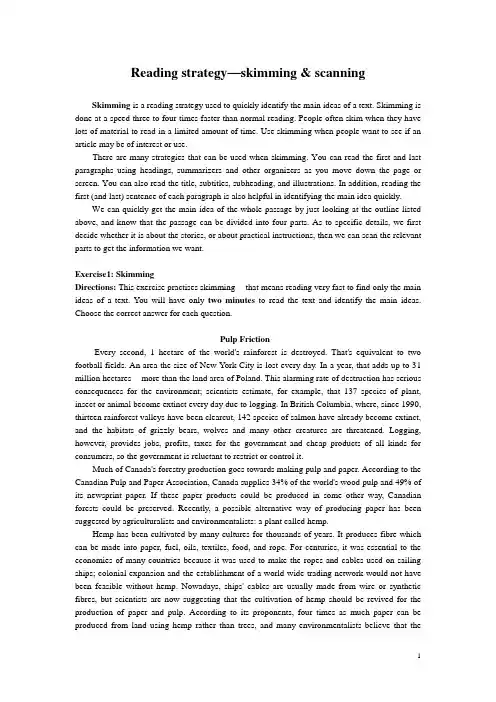
Reading strategy—skimming & scanningSkimming is a reading strategy used to quickly identify the main ideas of a text. Skimming is done at a speed three to four times faster than normal reading. People often skim when they have lots of material to read in a limited amount of time. Use skimming when people want to see if an article may be of interest or use.There are many strategies that can be used when skimming. You can read the first and last paragraphs using headings, summarizers and other organizers as you move down the page or screen. You can also read the title, subtitles, subheading, and illustrations. In addition, reading the first (and last) sentence of each paragraph is also helpful in identifying the main idea quickly.We can quickly get the main idea of the whole passage by just looking at the outline listed above, and know that the passage can be divided into four parts. As to specific details, we first decide whether it is about the stories, or about practical instructions, then we can scan the relevant parts to get the information we want.Exercise1: SkimmingDirections: This exercise practises skimming -- that means reading very fast to find only the main ideas of a text. You will have only two minutes to read the text and identify the main ideas. Choose the correct answer for each question.Pulp FrictionEvery second, 1 hectare of the world's rainforest is destroyed. That's equivalent to two football fields. An area the size of New York City is lost every day. In a year, that adds up to 31 million hectares -- more than the land area of Poland. This alarming rate of destruction has serious consequences for the environment; scientists estimate, for example, that 137 species of plant, insect or animal become extinct every day due to logging. In British Columbia, where, since 1990, thirteen rainforest valleys have been clearcut, 142 species of salmon have already become extinct, and the habitats of grizzly bears, wolves and many other creatures are threatened. Logging, however, provides jobs, profits, taxes for the government and cheap products of all kinds for consumers, so the government is reluctant to restrict or control it.Much of Canada's forestry production goes towards making pulp and paper. According to the Canadian Pulp and Paper Association, Canada supplies 34% of the world's wood pulp and 49% of its newsprint paper. If these paper products could be produced in some other way, Canadian forests could be preserved. Recently, a possible alternative way of producing paper has been suggested by agriculturalists and environmentalists: a plant called hemp.Hemp has been cultivated by many cultures for thousands of years. It produces fibre which can be made into paper, fuel, oils, textiles, food, and rope. For centuries, it was essential to the economies of many countries because it was used to make the ropes and cables used on sailing ships; colonial expansion and the establishment of a world-wide trading network would not have been feasible without hemp. Nowadays, ships' cables are usually made from wire or synthetic fibres, but scientists are now suggesting that the cultivation of hemp should be revived for the production of paper and pulp. According to its proponents, four times as much paper can be produced from land using hemp rather than trees, and many environmentalists believe that thelarge-scale cultivation of hemp could reduce the pressure on Canada's forests.However, there is a problem: hemp is illegal in many countries of the world. This plant, so useful for fiber, rope, oil, fuel and textiles, is a species of cannabis, related to the plant from which marijuana is produced. In the late 1930s, a movement to ban the drug marijuana began to gather force, resulting in the eventual banning of the cultivation not only of the plant used to produce the drug, but also of the commercial fiber-producing hemp plant. Although both George Washington and Thomas Jefferson grew hemp in large quantities on their own land, any American growing the plant today would soon find himself in prison -- despite the fact that marijuana cannot be produced from the hemp plant, since it contains almost no THC (the active ingredient in the drug).In recent years, two major movements for legalization have been gathering strength. One group of activists believes that ALL cannabis should be legal -- both the hemp plant and the marijuana plant -- and that the use of the drug marijuana should not be an offense. They argue that marijuana is not dangerous or addictive, and that it is used by large numbers of people who are not criminals but productive members of society. They also point out that marijuana is less toxic than alcohol or tobacco. The other legalization movement is concerned only with the hemp plant used to produce fiber; this group wants to make it legal to cultivate the plant and sell the fibre for paper and pulp production. This second group has had a major triumph recently: in 1997, Canada legalized the farming of hemp for fiber. For the first time since 1938, hundreds of farmers are planting this crop, and soon we can expect to see pulp and paper produced from this new source.1. The main idea of paragraph one is___________________.A. Scientists are worried about New York CityB. Logging is destroying the rainforestsC. Governments make money from loggingD. Salmon are an endangered species2. The main idea of paragraph two is___________________.A. Canadian forests are especially under threatB. Hemp is a kind of plantC. Canada is a major supplier of paper and pulpD. Canada produces a lot of hemp3. The main idea of paragraph three is__________________.A. Paper could be made from hemp instead of treesB. Hemp is useful for fuelC. Hemp has been cultivated throughout historyD. Hemp is essential for building large ships4. The main idea of paragraph four is__________________.A. Hemp is used to produce drugsB. Many famous people used to grow hempC. It is illegal to grow hempD. Hemp is useful for producing many things5. The main idea of paragraph five is__________________.A. Hemp should be illegal because it is dangerousB. Recently, many people have been working to legalize hempC. Hemp was made illegal in 1938D. Marijuana is not a dangerous drugScanning is a reading technique used when you want to find specific information quickly. In scanning you have a question in your mind and you read a passage to find the answer, ignoring unrelated information.How to scan:1.Pre-determine the specific information you are looking for.2.Try to anticipate how the answer will appear and what clues you might use to help you locatethe answer. For example, if you were looking for a certain date, you would quickly read the paragraph looking only for numbers.e headings and any other aids that will help you identify which sections might contain theinformation you are looking for.4.Selectively read and skip through sections of the passage.When scanning, look for the author's use of organizers such as numbers, letters, steps, or the words, first, second, or next. Look for words that are bold faced, italics, or in a different font size, style, or color. Sometimes the author will put key ideas in the margin.Exercise 2: ScanningDirections:This exercise practises scanning -- that means reading very fast to find specific information. You will have only two minutes to read the text of Pulp Friction and choose the correct answer for each question.1. How many species of salmon have become extinct in BC?A. 27B. 31C. 137D. 1422. How much of the world's newsprint paper is supplied by Canada?A. 31%B. 49%C. 34%D. 19%3. What equipment on a ship was made from hemp?A. RopesB. engine fuelC. life raftsD. waterproof cloth4. What drug can be obtained from a relative of hemp?A. cocaineB. heroinC. amphetamineD. marijuana5. Where was hemp farming recently legalized?A. the USAB. CanadaC. SingaporeD. the NetherlandsExercise 3: ScanningExercise: read each of the questions first, locate the relevant part of the text, and then find the correct answer1.Accord to the passage, self-esteem is important because______.A.it can affect your emotionB.it can affect your attitude toward lifeC.it can affect your behaviorD.it can affect your health1.Which of the following is NOT mentioned in the passage as factors influencing self-esteem?A. EducationB. Body changesC. Family lifeD. Comments from others3. In order to build healthy self-esteem, you should have ________.A. good friendshipsB. a positive attitudeC. a healthy lifestyleD. both B and C4. To build your self-esteem, you should give yourself ______compliments every day.A. twoB. threeC. fourD. five5. If you feel like your body image and self-esteem are affecting your life, the most important thing is to ________.A. learn how to handle the problems aloneB. ignore the problemsC. get helpD. face up with your problemsPassage readingBody Image and Self-Esteem1058 words I'm fat. I'm too skinny. I'd be happy if I were taller, shorter, had curly hair, straight hair, a smaller nose, bigger muscles, longer legs.Do any of these statements sound familiar? Are you used to putting yourself down? If so, you're not alone. As a teen, you're going through a ton of changes in your body. And as your body changes, so does your image of yourself. Lots of people have trouble adjusting, and this can affect their self-esteem.Why Are Self-Esteem and Body Image Important?Self-esteem is all about how much people value themselves, the pride they feel in themselves, and how worthwhile they feel. Self-esteem is important because feeling good about yourself can affect how you act. A person who has high self-esteem will make friends easily, is more in control of his or her behavior, and will enjoy life more.Body image is how someone feels about his or her own physical appearance. For many people, especially those in their early teens, body image can be closely linked to self-esteem. That's because as kids develop into teens, they care more about how others see them.What Influences a Person's Self-Esteem?PubertySome teens struggle with their self-esteem when they begin puberty because the body goes through many changes. These changes, combined with a natural desire to feel accepted, mean it can be tempting for people to compare themselves with others. They may compare themselves with the people around them or with actors and celebs they see on TV, in movies, or in magazines.But it's impossible to measure ourselves against others because the changes that come with puberty are different for everyone. Some people start developing early; others are late bloomers. Some get a temporary layer of fat to prepare for a growth spurt, others fill out permanently, and others feel like they stay skinny no matter how much they eat. It all depends on how our genes have programmed our bodies to act.The changes that come with puberty can affect how both girls and guys feel about themselves. Some girls may feel uncomfortable or embarrassed about their maturing bodies. Others may wish that they were developing faster. Girls may feel pressure to be thin but guys may feel like they don't look big or muscular enough.Outside InfluencesIt's not just development that affects self-esteem, though. Many other factors (like media images of skinny girls and bulked-up guys) can affect a person's body image too.Family life can sometimes influence self-esteem. Some parents spend more time criticizing their kids and the way they look than praising them, which can reduce kids' ability to develop good self-esteem.People also may experience negative comments and hurtful teasing about the way they look from classmates and peers. Sometimes racial and ethnic prejudice is the source of such comments. Although these often come from ignorance, sometimes they can affect someone's body image and self-esteem.Healthy Self-EsteemIf you have a positive body image, you probably like and accept yourself the way you are. This healthy attitude allows you to explore other aspects of growing up, such as developing good friendships, growing more independent from your parents, and challenging yourself physically and mentally. Developing these parts of yourself can help boost your self-esteem.A positive, optimistic attitude can help people develop strong self-esteem —for example, saying, "Hey, I'm human" instead of "Wow, I'm such a loser" when you've made a mistake, or not blaming others when things don't go as expected.Knowing what makes you happy and how to meet your goals can help you feel capable, strong, and in control of your life. A positive attitude and a healthy lifestyle (such as exercising and eating right) are a great combination for building good self-esteem.Tips for Improving Your Body ImageSome people think they need to change how they look or act to feel good about themselves. But actually all you need to do is change the way you see your body and how you think about yourself.The first thing to do is recognize that your body is your own, no matter what shape, size, or color it comes in. If you're very worried about your weight or size, check with your doctor to verify that things are OK. But it's no one's business but your own what your body is like —ultimately, you have to be happy with yourself.Next, identify which aspects of your appearance you can realistically change and which you can't. Everyone (even the most perfect-seeming celeb) has things about themselves that they can't change and need to accept — like their height, for example, or their shoe size.If there are things about yourself that you want to change and can (such as how fit you are), do this by making goals for yourself. For example, if you want to get fit, make a plan to exercise every day and eat nutritious foods. Then keep track of your progress until you reach your goal. Meeting a challenge you set for yourself is a great way to boost self-esteem!When you hear negative comments coming from within yourself, tell yourself to stop. Try building your self-esteem by giving yourself three compliments every day. While you're at it, every evening list three things in your day that really gave you pleasure. It can be anything from the way the sun felt on your face, the sound of your favorite band, or the way someone laughed at your jokes. By focusing on the good things you do and the positive aspects of your life, you can change how you feel about yourself.Where Can I Go if I Need Help?Sometimes low self-esteem and body image problems are too much to handle alone. A few teens may become depressed, lose interest in activities or friends — and even hurt themselves or resort to alcohol or drug abuse.If you're feeling this way, it can help to talk to a parent, coach, religious leader, guidance counselor, therapist, or an adult friend. A trusted adult — someone who supports you and doesn't bring you down —can help you put your body image in perspective and give you positive feedback about your body, your skills, and your abilities. The most important thing is to get help if you feel like your body image and self-esteem are affecting your life.Exercise 4How Do You See Diversity?As a manager, Tiffany is responsible for interviewing applicants for some of the positions with her company .During one interview, she noticed that the candidate never made direct eye contact. She was puzzled and somewhat disappointed because she liked the individual otherwise.He had a perfect resume and gave good responses to her questions, but the fact that he never looked her in the eye said “untrustworthy,” so she decided to offer the job to her second choice.“It wasn’t until I attended a diversity workshop t hat I realized the person we passed over was the perfect person,” Tiffany confesses. What she hadn’t known at the time of the interview was that the candidate’s “different” behavior was simply a cultural misunderstanding . He was an Asian-American raised in a household where respect for those in authority was shown by averting(避开) your eyes.“I was just thrown off by the lack of ye contact; not realizing it was cultural,” Tiffany says. “I missed out ,but will not miss that opportunity again.”Many of us have had similar encounters with behaviors we perceive as different. As the world becomes smaller and our workplaces more diverse, it is becoming essential to expand our understanding of others and to reexamine some of our false assumptions .Hire AdvantageAt a time when hiring qualified people is becoming more difficult ,employers who can eliminate invalid biases(偏爱) from the process have a distinct advantage .My company, Mindsets LLC ,helps organizations and individuals see their own blind spots . A real estate recruiter we worked with illustrates the positive difference such training can make .“During my Mindse ts coaching session ,I was taught how to recruit a diversified workforce.I recruited people from different cultures and skill sets .The agents were able to utilize their full potential and experiences to build up the company .When the real estate market began to change, it was because we had a diverse agent pool that we were able to stay in the real estate market much longer than others in the same profession.”Blinded by GenderDale is an account executive who attended one of my workshops on supervising a diverse workforce . “Through one of the sessions ,I discovered my personal bias ,” he recalls . “I learned I had not been looking at a person as a whole person , and being open to differences .” In his case ,the blindness was not about culture but rather gender .“I had a management position open in my department ; and the two finalists were a man and a woman . Had I not attended this workshop, I would have automatically assumed the man was the best candidate because the position required quite a bit of extensive travel . My reasoning would have been that even though both candidates were great and could have been successful in the position, I assumed the woman would have wanted to be home with her children and not travel.”Dale’s assumptions are another exa mple of the well-intentioned but incorrect thinking that limits an organization’s ability to tap into the full potential of a diverse workforce.“I learned from the class that instead of imposing my gender biases into the situation, I needed to present the full range of duties, responsibilities and expectations to all candidates and allow them to make an informed decision.” Dale credits the workshop, “because it helped me make decisions based on fairness.”Year of the Know-It-AllDoug is another supervisor who attended one of my workshops .He recalls a major lesson learned from his own employee.“One of my most embarrassing moments was when I had a Chinese-American employee put in a request to take time off to celebrate Chinese New Year. In my ignorance, I assumed he had his dates wrong , as the first of January had just passed . When I advised him of this, I gave him a long talking-to about turning in requests early with the proper dates.“He patiently waited , then when I was done , he said he would like Ch inese New Year did not begin January first , and that Chinese New Year ,which is tied to the lunar cycle ,is one of the most celebrated holidays on the Chinese calendar . Needless to say, I felt very embarrassed in assuming he had his dates mixed up. But I learned a great deal about assumptions, and that the timing of holidays varies considerably from culture to culture.“Attending the diversity workshop helped me realize how much I could learn by simply asking questions and creating dialogues with my employees, rather than making assumptions and trying to be a know-it-all ,” Doug admits . “The biggest thing I took away from the workshop is learning how to be more ‘inclusive’ to differences.”A better Bottom LineAn open mind about diversity not only improves organizations internally, it is profitable as well . These comments from a customer service representative show how an inclusive attitude can improve sales.” Most of my customers speak English as a second language . One of the best things my company has done is to contract with a language service that offers translations over the phone . It wasn’t until my boss received Mindsets’ training that she was able to understand how important inclusiveness was to customer service . As result , our customer bas e has increased .”Once we start to see people as individuals . and discard the stereotypes , we can move positively toward inclusiveness for everyone . Diversity is about coming together and taking advantage of our differences and similarities . It is about building better communities and organizations that enhance us as individuals and reinforce our shared humanity .When we begin to question our assumptions and challenge what we think we have learned from our past , from the media, peers , family , friends , etc , we begin to realize that some of ourconclusions are flawed(有缺陷的) or contrary to our fundamental values . We need to train our-selves to think differently , shift our mindsets and realize that diversity opens doors for all of us ,creating opportunities in organizations and communities that benefit everyone .1. What bothered Tiffany during an interview with her candidate?A) He just wouldn’t look her in the eye.B) He was slow in answering her questions.C) His answers to some of her questions were irrelevant.D) His answers to some of her questions were irrelevant .2. Tiffany’s misjudgment about the candidate stemmed from.A) Racial stereotypes. C) Cultural ignoranceB) Invalid personal bias . D) Emphasis on physical appearance3. What is becoming essential in the course of economic globalization according to the author?A) Hiring qualified technical and management personnel.B) Increasing understanding of people of other cultures.C) Constantly updating knowledge and equipment.D) Expanding domestic and international markets.4. What kind of organization is Mindsets LLC?A) A real estate agency. C) A cultural exchange organization.B) A personnel training company. D) A hi-tech company5. After one of the workshops, account executive Dale realized that .A) He had hired the wrong person.B) He could have done more for his company.C) He had not managed his workforce well.D) He must get rid of his gender bias.6. What did Dale think of Mindsets LLC’s workshop?A) It was well-intentioned but poorly conducted.B) It tapped into the executives’ full potential.C) It helped him make fair decisions.D) It met participants’ diverse needs.7. How did Doug, a supervisor, respond to a Chinese-American em ployee’s request for leave?A) He told him to get the dates right. C)He flatly turned it downB) He demanded an explanation. D)He readily approved it.8. Doug felt when he realized that his assumption was wrong.9. After attending Mindsets’ workshops, the participants came to know the importance of _ to their business.10. When we view people as individuals and get rid of stereotypes, we can achieve diversity and benefit from the between us.Exercise 5 Colleges taking another look at value of merit-based aidGood grades and high test scores still matter—a lot—to many colleges as they award financial aid.But with low-income students projected to make up an ever-larger share of the college-bound population in coming years, some schools are re-examining whether that aid, typically known as“merit aid”, is the most effective use of precious institutional dollars.George Washington University in Washington, D.C., for example, said last week that it would cut the value of its average merit scholarships by about one-third and reduce the number of recipients (接受者), pouring the savings, about $2.5million, into need-based aid. Allegheny College in Meadville, Pa., made a similar decision three years ago.Now, Hamilton College in Clinton, N.Y., says it will phase out merit scholarships altogether. No current merit-aid recipients will lose their scholarships, but need-based aid alone will be awarded beginning with students entering in fall 2008.Not all colleges offer merit aid; generally, the more selective a school, the less likely it is to do so. Harvard and Princeton, for example, offer generous need-based packages, but many families who don’t meet need eligibility (资格) have been willing to pay whatever they must for a big-name school.For small regional colleges that struggle just to fill seats, merit aid can be an important revenue-builder because many recipients still pay enough tuition dollars over and above scholarship amount to keep the institution running.But for rankings-conscious schools in between, merit aid has served primarily as a tool to recruit top students and to improve their academic profiles. “They’re trying to buy students,” says Skidmore Colllege economist Sandy Baum.Studies show merit aid also tends to benefit disproportionately students who could afford to enroll without it.“As we look to the future, we see a more pressing need to invest in need-based aid,” says Monica Inzer, dean of admission and financial aid at Hamilton, which has offered merit scholarships for 10 years. During that time, it rose in US News & World Report’s ranking of the best liberal arts colleges, from 25 to 17.Merit aid, which benefited about 75 students a year, or about 4% of its student body, at a cost of about $1 milion a year, “served us well,” Inzer says, but “to be discounting the price for families that don’t need financial aid doesn’t feel right any more.”Need-based aid remains by far the largest share of all student aid, which includes state, federal and institutional grants. But merit aid, offered primarily by schools and states, is growing faster, both overall and at the institutional level.Between 1995-96 and 2003-04, institutional merit aid alone increased 212%, compared with 47% for need-based grants. At least 15 states also offer merit aid, typically in a bid to enroll top students in the state’s public institutions.But in recent years, a growing chorus (异口同声) of critics has begun pressuring schools to drop the practice. Recent decisions by Hamilton and others may be “a sign that people are starting to realize that there’s this destructive competition going on.” says Baum, co-author of a recent College Report that raises concerns about the role of institutional aid not based on need.David Laird, president of the Minnesota Private College Council, says many of his schools would like to reduce their merit aid but fear that in doing so, they would lose top students to their competitors.“No one can take one-sided action,” says Laird, who is exploring whether to seek anexemption (豁免) from federal anti-trust laws so member colleges can discuss how they could jointly reduce merit aid. “This is a merry-go-round that’s going very fast, and none of the institutions believe they can sustain the risks of trying to break away by themselves.”A complicating factor is that merit aid has become so popular with middle-income families, who don’t qualify for need-based aid, that many have come to depend on it. And, as tuitions continue to increase, the line between merit and need blurs.That is o ne reason Allegheny College doesn’t plan to drop merit aid entirely.“We still believe in rewarding superior achievements and know that these top students truly value the scholarship,” says Scott Friedhoff, Allegheny’s vice president for enrollment.Emory University in Atlanta, which boasts a $4.7 billion endowment (捐赠), meanwhile, is taking another approach. This year, it announced it would eliminate loans for needy students and cap them for middle-income families. At the same time, it would expand its 28-year-old merit program.“Yeah, we’re playing the merit game,” acknowledges Tom Lancaster, associate dean for undergraduate education. But it has its strong points, too, he says, “The fact of the matter is, it’s not just about the lowest-income people. It’s the average American middle-class family who’s being priced out of the market.”*A few words about merit-based aid:Merit-based aid is aid offered to students who achieve excellence in a given area, and is generally known as academic, athletic and artistic merit scholarships.Academic merit scholarships are based on students’ grades, GPA and overall academic performance during high school. They are typically meant for students going straight to college right after high school. However, there are scholarships for current college students with exceptional grades as well. These merit scholarships usually help students pay tuition bills, and they can be renewed each year as long as the recipients continue to qualify. In some cases, students may need to be recommended by their school or a tearcher as part of the qualification process.Athletic merit scholarships are meant for student that excel (突出) in sports of any kind, from football to track and field events. Recommendation for these scholarships is required, since exceptional athletic performance has to be recognized by a coach or a referee (裁判). Applicants need to send in a tape containing their best performance.Artistic merit scholarships require that applicants excel in a given artistic area. This generally includes any creative field such as art, design, fashion, music, dance or writing. Applying for artistic merit scholarships usually requires that students submit a portfolio(选辑)of some sort, whether that includes a collection of artwork, a recording of a musical performance or a video of them dancing.1. With more and more low-income students pursuing higher education, a number of colleges are ________.A) offering students more merit-based aidB) revising their financial aid policiesC) increasing the amount of financial aidD) changing their admission processes。

