
新概念第二Lesson 3
- 格式:pptx
- 大小:1.88 MB
- 文档页数:35

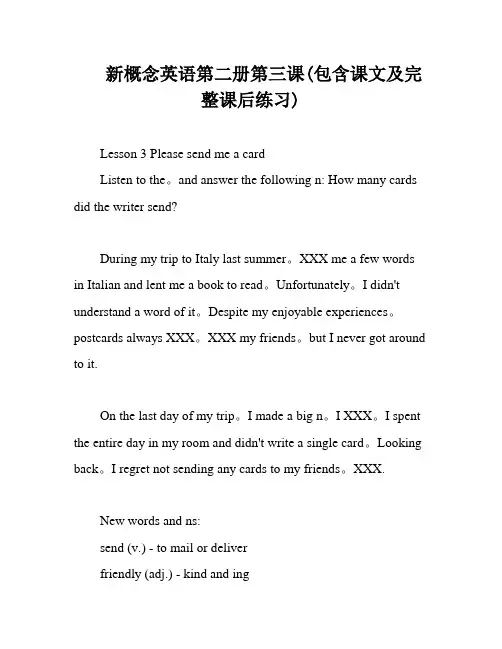
新概念英语第二册第三课(包含课文及完整课后练习)
Lesson 3 Please send me a card
Listen to the。and answer the following n: How many cards
did the writer send?
During my trip to Italy last summer。XXX me a few words
in Italian and lent me a book to read。Unfortunately。I didn't
understand a word of it。Despite my enjoyable experiences。postcards always XXX。XXX my friends。but I never got around
to it.
On the last day of my trip。I made a big n。I XXX。I spent
the entire day in my room and didn't write a single card。Looking
back。I regret not sending any cards to my friends。XXX.
New words and ns:
send (v.) - to mail or deliver
friendly (adj.) - kind and ing postcard (n.) - a card for sending a message by mail
waiter (n.) - a person who XXX
spoil (v.) - to ruin or damage
lend (v.) - to give something to someone for a short d of time
museum (n.) - a place where objects of historical。scientific。or XXX
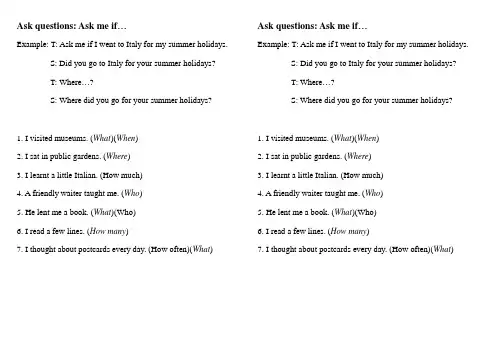
Ask questions: Ask me if…
Example: T: Ask me if I went to Italy for my summer holidays.
S: Did you go to Italy for your summer holidays?
T: Where…?
S: Where did you go for your summer holidays?
1. I visited museums. (What)(When)
2. I sat in public gardens. (Where)
3. I learnt a little Italian. (How much)
4. A friendly waiter taught me. (Who)
5. He lent me a book. (What)(Who)
6. I read a few lines. (How many)
7. I thought about postcards every day. (How often)(What)
Ask questions: Ask me if…
Example: T: Ask me if I went to Italy for my summer holidays.
S: Did you go to Italy for your summer holidays?
T: Where…?
S: Where did you go for your summer holidays?
1. I visited museums. (What)(When)
2. I sat in public gardens. (Where)
3. I learnt a little Italian. (How much)

5 Lesson 3 Please send me a card
Phrase:
1. in public gardends 在公园里 2. on the last day 在最后一天 3. every day 每天
4. make a decision 决定 5. think about 想到,想 6. not a single 连一个都没有
Intensive Reading:
1. but是连词,用来连接两个简单句,表示转折关系,它前面一般要用逗号点开。but决不能与 (al)though连用,注意中英文的区别。 eg. She was tired, but she went to work. (√) Although she was tired, but she went to work. (×)
2. spend 花费,度过,经常与on连用。 eg. Roy spent a lot of money on records.
spend 常用句型为:spend…doing/ on sth. eg. He’s spent half his life writing this book.
3. think about 意为“考虑”,think后不能直接加名词作宾语,而要借助合适的介词。
eg. think about a question 想问题,think of you 想你。但think后加句子时不需介词, eg. I think he will come soon.
4. make a big decision 意为“下大决心”,英语中make和take是两个搭配能力很强的动词,后接名词可组成许多不同的词组,但一般来说make和take不可互换使用,而分别与一定的名词搭配。

新概念英语第二册第3课:Please send me a card
Lesson 3 Please send me a card请给我寄一张明信片
听录音,然后回答以下问题。
How many cards did the writer send?
Postcards always spoil my holidays. Last summer, I went to Italy.
明信片总搅得我假日不得安宁。去年夏天,我去了意大利。
I visited museums and sat in public gardens. A friendly waiter taught me a few
words of Italian.
我参观了博物馆,还去了公园。一位好客的服务员教了我几句意大利语,
Then he lent me a book. I read a few lines, but I did not understand a word.
之后还借给我一本书。我 读了几行,但一个字也不懂。
Every day I thought about postcards. My holidays passed quickly, but I did not
send cards to my friends.
我每天都想着明信片的事。假期过得真快,可我还没有给我的朋友们寄过一张明信片。
On the last day I made a big decision. I got up early and bought thirty-seven
cards.
到了最后一天,我作出了一项重大决定。我早早 起了床,买来了37张明信片。
I spent the whole day in my room, but I did not write a single card!