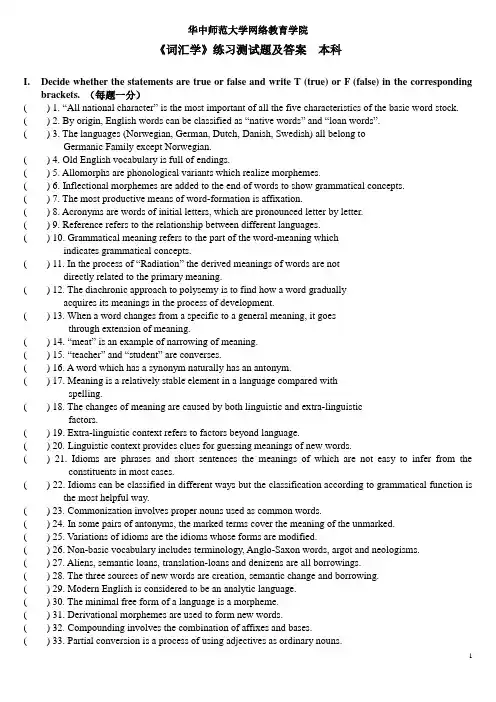
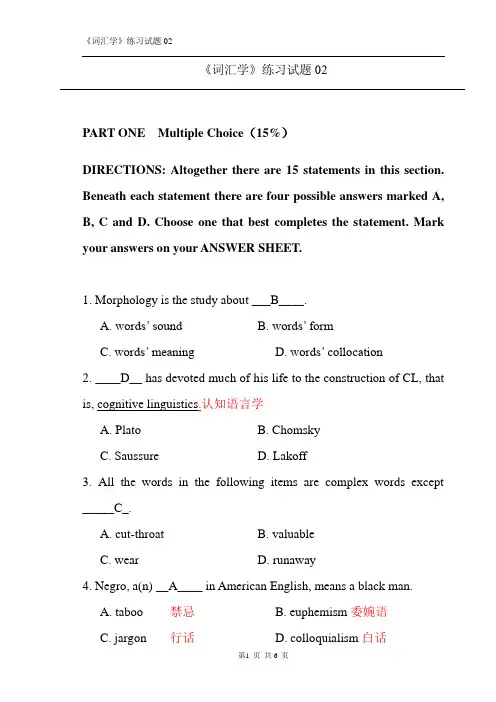
华中师范大学网络教育学院《词汇学》练习测试题及答案本科I. Decide whether the statements are true or false and write T (true) or F (false) in the correspondingbrackets. (每题一分)( ) 1. “All national character” is the most important of all the five characteristics of the basic word stock. ( ) 2. By origin, English words can be classified as “native words” and “loan words”.( ) 3. The languages (Norwegian, German, Dutch, Danish, Swedish) all belong toGermanic Family except Norwegian.( ) 4. Old English vocabulary is full of endings.( ) 5. Allomorphs are phonological variants which realize morphemes.( ) 6. Inflectional morphemes are added to the end of words to show grammatical concepts.( ) 7. The most productive means of word-formation is affixation.( ) 8. Acronyms are words of initial letters, which are pronounced letter by letter.( ) 9. Reference refers to the relationship between different languages.( ) 10. Grammatical meaning refers to the part of the word-meaning whichindicates grammatical concepts.( ) 11. In the process of “Radiation” the derived meanings of words are notdirectly related to the primary meaning.( ) 12. The diachronic approach to polysemy is to find how a word graduallyacquires its meanings in the process of development.( ) 13. When a word changes from a specific to a general meaning, it goesthrough extension of meaning.( ) 14. “meat” is an example of narrowing of meaning.( ) 15. “teacher” and “student” are converses.( ) 16. A word which has a synonym naturally has an antonym.( ) 17. Meaning is a relatively stable element in a language compared withspelling.( ) 18. The changes of meaning are caused by both linguistic and extra-linguisticfactors.( ) 19. Extra-linguistic context refers to factors beyond language.( ) 20. Linguistic context provides clues for guessing meanings of new words.( ) 21. Idioms are phrases and short sentences the meanings of which are not easy to infer from the constituents in most cases.( ) 22. Idioms can be classified in different ways but the classification according to grammatical function is the most helpful way.( ) 23. Commonization involves proper nouns used as common words.( ) 24. In some pairs of antonyms, the marked terms cover the meaning of the unmarked.( ) 25. V ariations of idioms are the idioms whose forms are modified.( ) 26. Non-basic vocabulary includes terminology, Anglo-Saxon words, argot and neologisms.( ) 27. Aliens, semantic loans, translation-loans and denizens are all borrowings.( ) 28. The three sources of new words are creation, semantic change and borrowing.( ) 29. Modern English is considered to be an analytic language.( ) 30. The minimal free form of a language is a morpheme.( ) 31. Derivational morphemes are used to form new words.( ) 32. Compounding involves the combination of affixes and bases.( ) 33. Partial conversion is a process of using adjectives as ordinary nouns.( ) 34. Motivation accounts for the connection between the linguistic symbol and its meaning.( ) 35. Associative meaning consists of connotative meaning, stylistic meaning,affective meaning and emotive meaning.( ) 36. Polysemy is concerned with words of more than one meaning.( ) 37. The most important source of English synonyms is shortening.( ) 38. Associated transfer involves words used in their figurative sense.( ) 39. Objective meaning shows that the subject (or agent) is the one to beaffected by the action of the verb.( ) 40. Complementaries are antonyms characterized by “mutual exclusion” and “gradability”.( ) 41. The superordinate term covers the concept of the subordinate.( ) 42. Elevation is also known as amelioration.( ) 43. “villain” is an example of degradation.( ) 44. Linguistic context refers to the words, clauses, sentences, paragraphs andeven cultural background.( ) 45. Ambiguity is often caused by inadequate context.( ) 46. Idioms are generally informal in nature.( ) 47. Structurally, idioms can never be changed.( ) 48. The four major foreign contributors to the development of Englishvocabulary are Latin, Greek, French and Scandinavian.( ) 49. Relative synonyms may differ in denotation, connotation and application.( )50. The contemporary vocabulary expansion of English is mainly by borrowing and affixation. ( ) 51. Old English refers to the language used between 100 and 450.( ) 52. “Radiation” shows that the derived meanings of a polysemant are not directly r elated to the primary meaning.( ) 53. The connection between sound and meaning is conventional and arbitrary.( ) 54. A word which has a synonym naturally has an antonym.( ) 55. Content words are numerous and more frequently used than functional words on average.( ) 56. Extra-linguistic context refers to the physical situation or culturalbackground.( ) 57. During the Middle English period, Celtic, Latin and English existed side byside.( ) 58. Inadequate context is often the cause of ambiguity.( ) 59. Compounding is the process of creating new words by combining affixes and bases.( )60. In some pairs of antonyms, one term may cover the meaning of the other word.( )61. In a natural language, most words are non-motivated.( )62. Inflectional affixes are grammatical markers.( )63. Concept and sense mean the same and thus are interchangeable.( )64. A form to which an affix of any kind can be added is called a stem.( )65. Contradictory terms are non-gradable.( )66. Acronyms are words of initial letters which are pronounced as commonwords.( )67. Grammatical meaning refers to part of speech, tenses of verbs, stylisticfeatures of words and so on.( )68. What remains of a word after the removal of all affixes is a stem.( )69. Affective meaning indicates the attitude of the user, whether positive ornegative.( )70. The connotative meaning is also known as connotations, which aregenerally found in the dictionary.( )71. Idioms are set phrases whose meaning is often difficult or impossible to infer from the constituent words.( )72. In modern times, vocabulary develops mainly by means of changingmeanings of old words.( )73. Most of the newly created words are associated with the change of life style and society.( )74. Homographs are words identical in form but different in pronunciation.( ) 75. Homonyms come mainly from borrowing—the most important source.( ) 76. Middle English lasted for more than four hundred years.( ) 77. Borrowing has brought most synonyms to the English language.( ) 78. The characteristics of the basic word stock include all national character,denizens and productivity.( ) 79. The superordinate differs from the subordinate in that the former covers theconcept of the latter.( ) 80. Words of old English were full of endings.( ) 81. The way to differentiate homonyms from polysemants is mainly to see theirorigins as well as sense relatedness.( ) 82. Modern English is an analytic language.( ) 83. Hyponymy deals with the relationship of semantic inclusion.( ) 84. Denizens are words which were borrowed from other languages but laterbecame assimilated into the English language.( ) 85. Lexical context refers to the words that appear only before the lexical itemin question.( ) 86. Generally speaking, native words have a higher frequency of use than loanwords.( ) 87. Reference refers to the relationship between the linguistic symbols and theobjective world.( ) 88. Free morphemes are morphemes which alone can be used as words.( ) 89. Context gives a polysemic word a definite meaning.( ) 90. Half-converted adjectives are used as common nouns while full-convertedones still retain adjective features.( ) 91. Motivation explains why a particular word of a language has a particularmeaning.( ) 92. By origin English is more closely related to German than to French.( ) 93. Unlike conceptual meaning, associative meaning is unstable and indeterminate.( ) 94. Prefixes do not generally change part of speech whereas suffixes do.( ) 95. In the phrase “the tongues of fire”, the word fire is semantically motivated.( ) 96. The origins of words are a key factor that distinguishes homonyms from polysemants.( ) 97. The objective meaning implies that the subject of the sentence is the one affected by the action.( ) 98. The meaning of a word which is etymologically motivated is closely related to its origin.( ) 99. The result of the human cognition of the objective world is called concept.( )100. Borrowing has brought most synonyms to the English language.( )101. “Radiation” shows that the derived meanings of a polysemant are not directly related to the primary meaning.( )102. The connection between sound and meaning is conventional and arbitrary.( )103. A word which has a synonym naturally has an antonym.( )104. Content words are numerous and more frequently used than functional words on average.( ) 105. The characteristics of the basic word stock include all national character,denizens and productivity.( ) 106. During the Middle English period, Celtic, Latin and English existed side by side.( ) 107. Inadequate context is often the cause of ambiguity.( ) 108. The way to differentiate homonyms from polysemants is mainly to see their origins as well as sense relatedness.( )109. In some pairs of antonyms, one term may cover the meaning of the other word.( )110. Aliens are words of the native element.( )111. Denizens are words which were borrowed from other languages but laterbecame assimilated into the English language.( )112. Inflectional affixes are grammatical markers.( )113. Concept and sense mean the same and thus are interchangeable.( )114. Reference refers to the relationship between the linguistic symbols and theobjective world.( )115. Contradictory terms are non-gradable.( )116. Acronyms are words of initial letters which are pronounced as common words.( )117. Grammatical meaning refers to part of speech, tenses of verbs, stylistic features of words and so on.( )118. Half-converted adjectives are used as common nouns while full-convertedones still retain adjective features.( )119. Affective meaning indicates the attitude of the user, whether positive or negative.( )120. The connotative meaning is also known as connotations, which are generally found in the dictionary. ( )121. Prefixes do not generally change part of speech whereas suffixes do.( )122. In modern times, vocabulary develops mainly by means of changing meanings of old words.( )123. Most of the newly created words are associated with the change of life style and society.( )124. The objective meaning implies that the subject of the sentence is the oneaffected by the action.一、答案1、T 2. T 3. F 4. T 5. T 6. T 7. T 8. F 9. F 10. T11. F 12. T 13. T 14. T 15. T 16. F 17. F 18. T 19. T 20. T21. T 22. T 23. T 24. F 25. T 26. T 27. T 28. T 29. T 30. F31. T 32. F 33. F 34. T 35. F 36. T 37. F 38. T 39. T 40. F41. T 42. T 43. T 44. F 45. T 46. T 47. F 48. T 49. T 50. F51. F 52. F 53. T 54. F 55. F 56. T 57. F 58. T 59. F 60. T61. T 62. T 63. F 64. T65. T 66. T 67. F 68. F 69. T 70. F71. T 72. F 73. F 74. T 75. T 76. F 77. T 78. F 79. T 80. T81. T 82. T 83. T 84. T 85. F 86. T 87. T 88. T 89. T 90. F91. T 92. T 93. T 94. T 95. T 96. F 97. T 98. T 99. T 100. T101. F 102. T 103. F 104. F 105. F 106. F 107. T 108. T 109. T 110. F111. T 112. T 113. F 114. T 115. T 116. T 117. F 118. F119. T 120. F 121. T 122. F 123. F 124. TII. Analyze the following words and say how they are formed, and put your answers in the brackets:(每词0.5分)Example: disobey ( prefixation)headache (compounding ) newton ( commonization)expresident (prefixation ) book (v) (conversion )ID (acronymy ) brunch (blending )enthuse (backformation ) deadline (compounding )tick-tuck (duplication ) quake (clipping )kodak (commonization ) exwife (prefixation )elbow(v) (conversion ) laser (acronymy )autocide (blending ) laze (backformation ) historic (suffixation ) bow-wow (duplication ) bike (clipping )airline ( compounding ) changeable (affixation/suffixation)postwar (prefixation ) NA TO (acronymy )bike (clipping ) smog (blending )donate (backformation ) ampere (proper words )antinuclear (prefixation ) daydreaming (compounding ) lase (back-formation ) copter (clipping/front clipping) newly-weds (conversion ) cutthroat (compounding ) memorize (affixation/suffixation) botel (blendin ) tantalize (proper names ) VIP (acronymy ) quake (clipping ) defeather (affixation/prefixation)三、填空答案1.meaning; conventional 2. affixation; compounding; conversion 3. root4. prefixes; suffixes5. synonym; relative6. superordinate; subordinate7. context; linguistic; extra-linguistic/non-linguistic 8. minimal/smallest; meaning; syntactic9. Latin; Scandinavian10. stem 11. verbs; adjectives 12. stylistic 13. semantic; related14. elevation/ amelioration; transfer/transference 15. morphological 16. concept17.intrinsic/logical meaning arbitrary 18. Latin Greek Scandinavian19. morpheme prefixes 20. suffixes unmarked 21. marked extension/generalization22. Anglo-saxon 23、affixation compounding conversion (注:位置可以调换)24.Latin Greek French (注:位置可以调换)25. derivation affixes26. superordinate subordinate 27. stable/fixed functional higher28. intrinsic/logical meaning arbitrary 29. affix 30. extension/generalization31.. antonyms contrary 32. elevation narrowing/specialization 33. connotativeIII. Fill in the blanks according to the coursebook and write your answers on thecorresponding lines. (每空1分)1. The connection between sound and is arbitrary and .2. The three major means of word-formation are , and .3. The form which remains after all affixes are removed is called .4. generally do not change part of speech whereas do.5. The words which are fully identical in meaning are called absolute and all the others care calledsynonyms.6. In hyponymy the term which denotes something general is and the term which conveys a specificmeaning is .7. falls into two kinds, namely context and context.8. A word is the free form which has a give sound, andfunction.9. The major foreign elements which contribute greatly to English vocabulary are, Greek, French and .10. The form which remains after removing an inflectional affix is called .11. The words which are involved in conversion are nouns, and .12. The stylistic features of words form their meaning.13. field refers to a set of words which are semantically .14. The modes of semantic change in words include extension, narrowing,, degradation and .15. motivation refers to the words whose meanings are suggested by their morphological structure.16. is one of the three kinds of meaning which has nothing to do withlanguage.17. There is no ______ relationship between sound and ______ as the connecion between them is ______ andconventional.18. The three main foreign languages that have affected the English vocabulary most are ______, ______ and______.19. A minimal meaningful unit of a language is ______.20. Generally speaking, ______ do not change part of speech of the stems but their meaning, whereas ______do.21. Among pairs of antonyms, the ______ term covers the meaning of the ______ term.22. ______ is the change of meaning from specific to general.23. The major means of word-formation are ______, ______ and ______.24. The three main foreign languages that have affected the English vocabulary most are ______, ______ and______.25. Affixation, also called ______, is the formation of new words by adding ______ to stems.26. Hyponymy deals with the relation of semantic inclusion. The general term is ______ and the specific termsare ______.27. Content words are changing all the time whereas functional words are ______. ______ words enjoy a______ frequency in use than content words.28. There is no ______ relationship between sound and ______ as the connection between them is ______ andconventional.29. A morpheme attached to a stem or root is ______.30. ______ is the change of meaning from specific to general.31. Words which are opposite in meaning are called ______, among which ______ terms are gradable andallow intermediate members.32. When a word changes its meaning from negative to positive, it goes through the process ______ and theopposite process is called ______.33. The overtones and associations suggested by the conceptual meaning is ____ meaning.IV选择答案:1. D 2. C 3. A 4. A 5. A 6. C 7. D 8. D 9. A10.B 11. B12.C 13.C 14.D 15. A16. B 17. C 18.D 19.D 20.D 21. D 22. A 23. B24. D 25. C 26. D 27. B 28. C 29. D 30.B 31.C 32. A 33. B 34. DIV. Each of the statements below is followed by four alternative answers. Choose the one that would best complete the statement and put the letter in the brackets. (每题一分)( )1. Non-basic vocabulary includes __________.A. argot and jargonB. archaisms and neologismsC. technical termsD. all the above( )2. Functional words are ________________.A. adverbs, prepositions, conjunctionsB. adjectives, nouns, articlesC. articles, prepositions, conjunctionsD. verbs, pronouns, prepositions( )3. ___________ is not a characteristic of basic word stock.A. ColloquialismB. All national characterC. StabilityD. Polysemy( ) 4. Modern English began with the establishment of ________ in England.A. printingB. Bourgeois RevolutionC. Industrial RevolutionD. Renaissance Time( )5. Stylistic meaning refers to the features of __________of words.A. formalityB. affectivenessC. appropriatenessD. part of speech( ) 6. The derivational process, in which an item is converted to a new word classwithout the addition of an affix, is called ____________.A. compoundingB. back-formationC. functional shiftD. derivation( )7. Grammatical meaning does not include ________.A. part of speechB. plural forms of nounsC. tensesD. appropriateness ( )8. English words can be motivated______.A. phonologicallyB. morphologicallyC. etymologicallyD. all the above ( )9. Stylistic meaning may be defined as the feature of ________ of words.A. formalityB. affectivenessC. appropriatenessD. part of speech ( )10. There are two main approaches to the study of English words namely ________.A. descriptive and prescriptiveB. synchronic and diachronicC . spoken and written D. competence and performance( )11. Which of the following is NOT studied in semantics?A. polysemyB. language familyC. ambiguityD. complementaries ( )12. The hyponyms of …vegetable‟ are ________.A. banana, pear, jamB. pear, apple, bananaC. cucumber, celery, peasD. tree, pine, elm( )13. The discrete units which realize morphemes are known as ________.A. allomorphsB. phonemesC. morphsD. lexis( )14. _________ is a word-formation process by which a word is changed from one word-class into another without the change of form.A. BlendingB. AffixationC. Back-formationD. Conversio( )15. The first monolingual English dictionary was compiled in ________.A. 1604B. 1066C. 1406D. 1046( )16. “The birds sing to welcome the smiling year.” Is an example of ________.A. euphemismB. synecdocheC. metonymyD. metaphor( )17. “child—parent” are _______ antonyms.A. rootB. derivativeC. relativeD. complementary( )18. Th e word “water” is _________ motivated.A. phoneticallyB. semanticallyC. morphologicallyD. non-( )19. “Give somebody an inch and he‟ll take a mile” is a _________.A. sentence idiomB. proverbC. clause idiom D .both A and B ( ) 20. Narrowing excludes ________.A. change from material nouns to common nounsB. change from common nouns to proper nounsC. words shortened from phrases to retain the meaning of the whole for economyD. change from specific meanings to general meanings( ) 21. According to the idiomaticity of idioms, idioms include ________.A. true idiomsB. semi-idiomsC. regular combinationsD. all the above( ) 22. Motel is a/an is ________.A. blendB. clipped wordC. initialismD. acronym ( ) 23. “sow” (to plant seeds on the ground) and “sow” (fully grown female pig )are called ________.A. HomophonesB. homographsC. perfect homonymsD. acronyms ( ) 24. “die” and “pass away” are synonyms. They differ i n ________.A. connotative meaningB. emotive meaningC. stylistic meaningD. all the above ( ) 25. He‟s nice, but he hasn‟t much brain. _________.A. SimileB. metaphorC. MetonymyD. synecdoche( ) 26. Which of the following is not associative meaning?A. collocative meaning B .stylistic meaning C. affective meaning D. primary meaning ( ) 27. One billion is ________ in British English.A. 1,000,000,000B. 1,000,000,000,000C. 1,000,000D. 1,000,000,000,000,000( ) 28. The morpheme “-s” in “desks” is ________ morpheme.A. derivationalB. freeC. inflectionalD. root( ) 29. ________ are contrary terms.A. dead / aliveB. parent / childC. single / marriedD. like / dislike ( ) 30. The first people known to inhabit the British Isles were ________. Their languages were dialects of still another branch of the In-do-European Language Family ________.A. German / GermanicB. Celts / CelticC. Italian / ItalicD. Sweden / Swedish ( ) 31. The modes of modem English vocabulary grow through three major channels: ________ , semantic change and __________.A. exchange/lendingB. derivation/borrowingC. creation/borrowingD. affixation/creation( ) 32. Conversion is a method of __________.A. turning words of one part of speech into those of a different part of speechB. converting words of one meaning into those of a different meaningC. deriving words by grammatical meansD. changing words in morphological structure( ) 33. Back-formation is considered to be the opposite process of _________.A. prefixationB. suffixationC. acronymyD. conversion ( ) 34. The Norman Conquest started a continual flow of French words into English._________ of them are still in use today.A. 85%B. 56%C. 72%D. 75%V.Match the words in the left column with the words in the right column. (右栏的词每词1分)(1)narrowing manuscriptdeerextension poisongovernorelevation vulgarbonfiredegradation journallustdiseasealibi(2)narrowing journalgirlextension villainmarshalelevation barnmilldegradation deerknightcriticizeliquor(3)narrowing picturemeatextension girlmarshalelevation cunningbonfiredegradation journalangel连线(3)答案Narrowing: meat, girl, bonfire Extension: picture, journalElevation: marshal, angel Degradation: cunning连线(4)答案Narrowing: wife, deer Extension: holiday, manuscriptElevation: minister, governor Degradation: criticize, villain(4)narrowing holidayvillainextension wifeministerelevation deergovernordegradation manuscriptcriticizeVI. Do the following according to instructions.A Study the following sentences and explain the contextual clues which help you guess the meaning of theitalicized words, using such terms as definition, example, explanation, synonym, antonym, superordinate, subordinate, relevant details and so on, and put your answers in the brackets. (每题1分)1. Refugees crossed the border to escape the carnage in their homeland. Many ofthem still remembered the horrible slaughter not long ago. ( )2. I like fruit, but not avocado, which is too soft. ( )3.Carnivores are very dangerous. A tiger, for example, escaped from the zoo last month and killed a dog inthe street and ate it. ( )4. Most dentists‟ offices are drab places, but Emilio‟s new office is bright, cheerful.( )5. After a day of hunting, John was ravenous. He ate two bowls of soup, salad, alarge chicken, and a piece of chocolate cake before he was finally satisfied. ( )6. A north-east wind brings cold dry weather to England, but a sou’wester usuallybrings rain. ()7. Some African tribes still practice polyandry, a marriage system which allows awoman to have more than one husband. ( )8. Modern technology is a kind of dehumanization of the human society. ( )A.答案 1. synonym/synonymy 2. subordinate/hyponym3. example/exemplification/superordinate4. antonym/antonymy5. relevant details6. antonym/antonymy7. explanation 8. word structureB Decide whether the words in italics are used in the subjective or objective sense and put your answersin the corresponding brackets. (每题1分)1. The policeman was suspicious of the suspicious proof given by the suspect to show that he had nothing todo with the robbery. ( ) ( )2. The old man, though poor, is a respectable gentleman in the neighborhood.( )3. The earthquake was so dreadful that many people would be afraid even to see themovie based on it. ( )4.Fearful TV programs are not suitable to pre-school children.( )5. It is very considerate of Mr Li to make that arrangement. ( )6. The excuse given by the United States of America is really doubtful.( )7. The children were fearful of the fearful picture of the monster.( ) ( )8. What a pitiful girl! She lost her parents when she was so small.( )9. The listeners were doubtful of the witness‟s testimony which sounded verydoubtful.( ) ( )10. What a boring man he is! ( )11. The doubtful teacher listened patiently to the doubtful story told by the student who was late for class.( ) ( )12. It is very considerable of you to make such arrangements. ( )13. The little match girl was really pitiful. She died from cold and hunger on the Christmas Eve.( )14. Learning a foreign language is a painful process. No one can expect to learn the language well withoutpains. ( )B. 答案1. subjective; objective 2. objective3. objective4. objective5. subjective6. objective7. subjective; objective 8. objective9. subjective; objective 10. objective11. subjective, objective 12. subjective13. objective 14. objectiveC. Study the following sentences and explain the contextual clues which help you guess the meaning of the italicized words,using such terms as definition, example, synonym, relevant details and so on, and put your answers in the brackets.(每题1分)1.Refugees crossed the border to escape the carnage in their homeland. Many of them still remember the horrible killing notlong ago. ( )2.Carnivores are very dangerous. A tiger, for example, escaped from the zoo last month and killed a dog in the street and ateit. ( )3.The tribal community still practices polygamy, a custom in which someone can be married to more than one person at thesame time. ( )4.As fighting on all fronts reached its peak, the economy neared its nadir ( ).5. In spite of the fact that the fishermen were wearing sou’wester, the storm was so heavy that they were wet through.C. 答案1. synonym/synonymy 2. example/ exemplification3. definition/explanation4. antonym/antonymy5. relevant detailsVII. Match the rhetorical devices in Column A with the idioms in Column B and put the letters in the corresponding brackets. (每题1分)A B( ) 1. alliteration a. snake in the grass( ) 2. rhyme b. toss and turn( ) 3. reiteration c. powder one‟s nose( ) 4. repetition d. earn one‟s bread( ) 5. juxtaposition e. wear and tear( ) 6. metaphor f. up and down( ) 7. metonymy g. pick and choose( ) 8. synecdoche h. from cradle to grave( ) 9. personification i. Failure is the mother of success.( ) 10. euphemism j. hand in handVII连线答案:1. (b) 2. (e) 3. (g) 4. (j) 5. (f) 6. (a) 7. (h) 8. (d) 9. (i) 10. (c)VIII. Change each of the following into a word, paying attention to part of speech: (每题1分)1.break record (adj) ( record-breaking)2、fight with fists (adj) (ist-fighting)3. walk in one‟s sleep (n) (sleepwalking)4. a worm which glows (n) (glowworm)5. draw the bridge (n) (drawbridge)6. down to the earth (adj) (down-to-earth)7. sick for missing home (adj) ( homesick)8. the blood which causes the stain (n) (bloodstain)9. the part which is bitten by frost (n) (frostbite )10. shake hands (n) (handshake )IX. Define the following terms.(每题3分)1.notional words: Notional words are also called content words which denote clear notions. They includenouns, most verbs, adjectives, adverbs and numerals.2.primary meaning: At the time when the word was created, it was endowed with only one meaning. This first meaningis the primary meaning .3.context :In a narrow sense, context refers to the words, clauses, sentences, a paragraph, a whole chapterand even the entire book in which a word appears. In a broad sense, it includes the physical situation including the people, time, place and even the whole cultural background.4、marked terms:Many pairs of antonyms contain specific words and general words. In such a pair, thespecific word is included in meaning within the general word. The specific words are called marked terms.5、transfer :Words which were used to designate one thing but later changed to mean something else haveexperienced transfer.6、ambiguity: If there is more than one meaning for a word used in a context, ambiguity occurs. Ambiguity is mainly。