
情态动词
- 格式:ppt
- 大小:459.00 KB
- 文档页数:40

情态动词
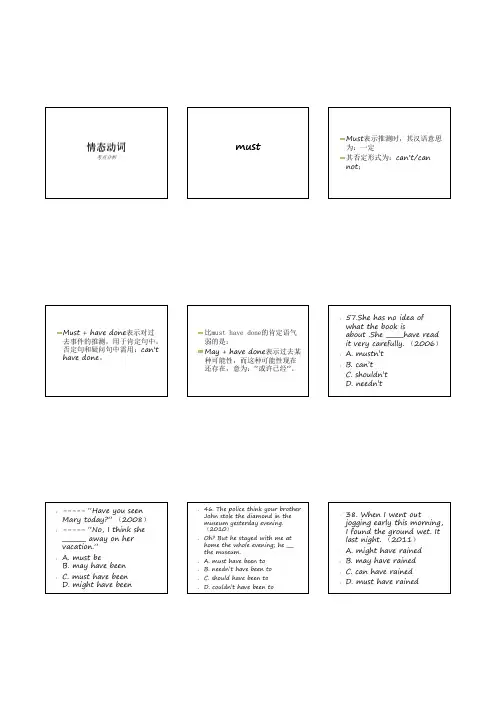
考点分析must
Must表示推测时,其汉语意思
为:一定其否定形式为:can‘t/can not;Must + have done表示对过
去事件的推测,用于肯定句中。否定句和疑问句中需用:can't have done。
比must have done的肯定语气弱的是:May + have done表示过去某
种可能性,而这种可能性现在还存在,意为:“或许已经”。
•57.She has no idea of what the book is about .She ______have read it very carefully. (2006)
•A. mustn’t
•B. can’t
•C. shouldn’t D. needn’t •----- “Have you seen Mary today?” (2008)
•----- “No, I think she ________ away on her vacation.”
•A. must be B. may have been
•C. must have been D. might have been•46. The police think your brother John stole the diamond in the museum yesterday evening. (2010)
•Oh? But he stayed with me at home the whole evening; he ___ the museum.
•A. must have been to
•B. needn’t have been to
•C. should have been to
•
D. couldn’t have been to•38. When I went out jogging early this morning, I found the ground wet. It last night. (2011)
English Grammar
情态动词
情态动词 (Model Verbs) 又称为情态助动词 (Model Auxil-iaries)。英语中助动词主要有两类:一是基本助动词,如have, do, be;二是情态助动词,如may, must, need等。情态动词与其他动词连用表示说话人的语气。情态动词可表达建议、要求、可能和意愿等。情态动词没有人称和数的变化。在大学英语四、六级考试中,情态动词部分重点测试以下内容:
(1)情态动词+行为动词完成式
(2)情态动词+行为动词进行式
(3)情态动词+行为动词完成进行式
(4)某些情态动词的特殊用法
一、情态动词+行为动词完成式
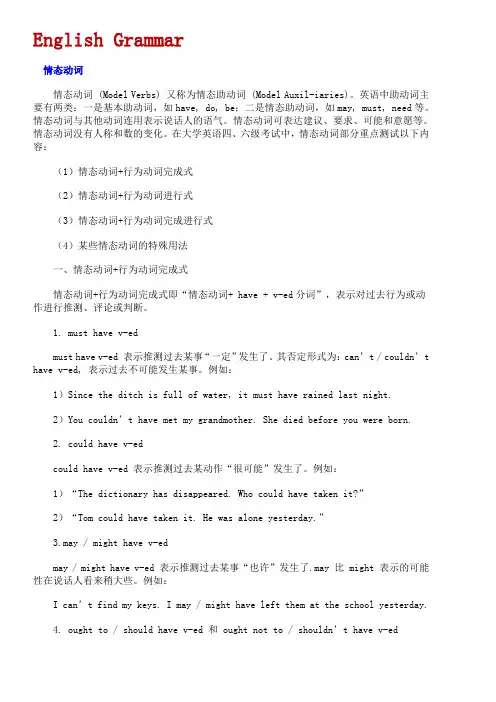
情态动词+行为动词完成式即“情态动词+ have + v-ed分词”,表示对过去行为或动作进行推测、评论或判断。
1. must have v-ed
must have v-ed 表示推测过去某事“一定”发生了。其否定形式为:can’t / couldn’t
have v-ed, 表示过去不可能发生某事。例如:
1)Since the ditch is full of water, it must have rained last night.
2)You couldn’t have met my grandmother. She died before you were born.
2. could have v-ed
could have v-ed 表示推测过去某动作“很可能”发生了。例如:
1)“The dictionary has disappeared. Who could have taken it?”
2)“Tom could have taken it. He was alone yesterday.”

情态动词must用法归纳
1. 表示―必须‖―一定要‖,用法注意:
(1) 可用于肯定句、否定句或疑问句;用于否定句时,mustn’t 意为―一定不要‖―(可)不能‖。如:
You must phone him this evening. 今天晚上你必须给他打电话。
You mustn’t phone him this evening. 今天晚上你可不能给他打电话。
Must I phone him this evening? 我今天晚上必须给他打电话吗?
注意,回答must引起的一般疑问句,如果要作否定回答,一般是用 needn’t(不能用 mustn’t)。如:
A:Must I go there today? 我必须今天去吗?
B:Yes, you must. 是的,你必须今天去。
B:No, you needn’t. 不,你不必今天去。
(2) 含有 must 的陈述句,其反意问句有两种可能:若must表示―必须‖,反意问句用 mustn’t;若 must 表示―有必要‖,反意问句用 needn’t,但是由于在没有上下文的情况下,很难分清must是表示―必须‖还是表示―有必要‖,所以有时两者都可用。如:
You must go there at once, needn’t [mustn’t] you? 你必须(有必要)马上去那儿,不是吗?
2. 表示推测,意为―准是‖―一定是‖,注意以下用法:
(1) 对现在情况作推测,后接动词原形;对现在正在进行的情况作推测,后接动词进行式;对一直在进行的情况作推测,后接动词完成进行式;对过去已发生的情况作推测,后接动词完成式。如:
The man must have a lot of money. 这个人一定有不少钱。
He must be writing a letter to his girl friend. 他一定在给他女朋友写信。
Someone must have been smoking here. 一定有人一直在这里抽烟。
高中语法之情态动词
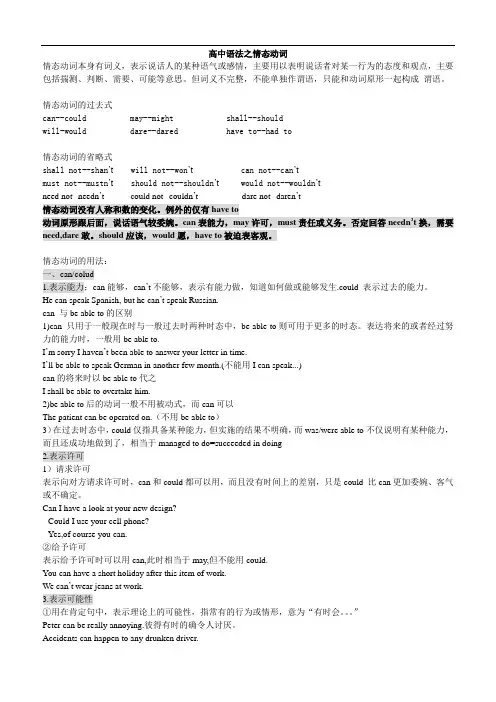
情态动词本身有词义,表示说话人的某种语气或感情,主要用以表明说话者对某一行为的态度和观点,主要包括揣测、判断、需要、可能等意思。但词义不完整,不能单独作谓语,只能和动词原形一起构成 谓语。
情态动词的过去式
can--could may--might shall--should
will-would dare--dared have to--had to
情态动词的省略式
shall not--shan’t will not--won’t can not--can’t
must not--mustn’t should not--shouldn’t would not--wouldn’t
need not--needn’t could not--couldn’t dare not--daren’t
情态动词没有人称和数的变化。例外的仅有have to
动词原形跟后面,说话语气较委婉。can表能力,may许可,must责任或义务。否定回答needn’t换,需要need,dare敢。should应该,would愿,have to被迫表客观。
情态动词的用法:
一、can/colud
1.表示能力;can能够,can’t不能够,表示有能力做,知道如何做或能够发生.could 表示过去的能力。
He can speak Spanish, but he can’t speak Russian.
can 与be able to的区别
1)can 只用于一般现在时与一般过去时两种时态中,be able to则可用于更多的时态。表达将来的或者经过努力的能力时,一般用be able to.
I’m sorry I haven’t been able to answer your letter in time.