
Translation tips
- 格式:ppt
- 大小:442.50 KB
- 文档页数:93


t r a n s t i p s翻译技巧入门1.中英文定语位置的差别?中:定语+主语英:主语+定语2.英译汉的主要步骤?断句+翻译+重读3.英中介词翻译成中文的什么词性?方位adv.&v.4.中英文句式差异?中:句子较短重点在后多用标点主语+废话+最重要成分英:句子较长重点在前不重视标点主语+最重要成分+废话{Ps 废话:定从,状从,补语,同位语} 5.定从的几种译法?<8个词-------定从+先行词“……的…”>8个词-------先行词,that/which具体指代内容+定从内容至于前置还是后置,根据8词原则。
6.循环套句用定语从句是什么?怎么翻译?中心词+定从1+定从2+定从3+.........①.定从1+定从2==定从3:1,2和在一块翻译②.定从2+定从3==定从1:2,3合在一起翻译7.需要断句的长句和不需要断句的长句怎么翻?大长句,有好多定语,很少标点:断句+翻译+重读一堆小短句,从前往后简单易懂,很多短句:断句+找重点句和微弱逻辑关系+翻译+重读第二课8.什么是定从的“并列套用”和“循环套用”?区别?怎么翻?并列套用:中心词+定从1+定从2+…and+定从n循环套用:中心词+定从1+定从2+…+定从n区别:并列套用:每个定从都修饰中心词且是并列关系用and连接循环套用:每个定从的先行词都在前一个定从里环环相扣翻译:并列套用:后置译法关系词只翻译一次循环套用:①.定从1+定从2==定从3:1,2合在一块翻译②.定从2+定从3==定从1:2,3合在一起翻译9.中文里的本位词?末位词?怎么翻?本位词:e.g. 这这样这些末位词:被本位词替代的部分翻译:本位词取代末位词要不然中文句子就太长了10.英文中四种句子类型?怎么翻?①长句多标点专有名词生词多——按顺序翻+注意查词准确+重读②长句少标点多从句插入语——断句+翻译+重读③长句多标点——断句+分析句句微弱逻辑关系+重读④短句——再短变中文都要加标点+重读11.中英文事实和评论的关系?怎么翻?中:事实+评论英:评论+事实按中英文习惯翻12.中英文关联词使用原则/中:虽然……,但是……英:①虽然……,……②……,但是……13.谓语动词的过度?例如?英到中:意思微弱的v不用翻译出来中到英:补微弱v词只要中文中出现adv+v,翻英时就把adv变为v,把v变为n e.g.加快建立rapid the foundation of...例如:我支持你I support you.I give you a support.——谓动过度。

1.中英文定语位置得差别?中:定语+主语英:主语+定语2.英译汉得主要步骤?断句+翻译+重读3.英中介词翻译成中文得什么词性?方位adv、&v、4.中英文句式差异?中:句子较短重点在后多用标点主语+废话+最重要成分英:句子较长重点在前不重视标点主语+最重要成分+废话{Ps 废话:定从,状从,补语,同位语}5.定从得几种译法?<8个词定从+先行词“……得…”>8个词先行词,that/which具体指代内容+定从内容至于前置还就是后置,根据8词原则。
6.循环套句用定语从句就是什么?怎么翻译?中心词+定从1+定从2+定从3+、、、、、、、、、①、定从1+定从2==定从3:1,2与在一块翻译②、定从2+定从3==定从1:2,3合在一起翻译7、需要断句得长句与不需要断句得长句怎么翻?大长句,有好多定语,很少标点:断句+翻译+重读一堆小短句,从前往后简单易懂,很多短句:断句+找重点句与微弱逻辑关系+翻译+重读第二课8、什么就是定从得“并列套用”与“循环套用”?区别?怎么翻?并列套用:中心词+定从1+定从2+…and+定从n 循环套用:中心词+定从1+定从2+…+定从n区别:并列套用:每个定从都修饰中心词且就是并列关系用and连接循环套用:每个定从得先行词都在前一个定从里环环相扣翻译:并列套用:后置译法关系词只翻译一次循环套用:①、定从1+定从2==定从3:1,2合在一块翻译②、定从2+定从3==定从1:2,3合在一起翻译9.中文里得本位词?末位词?怎么翻?本位词:e、g、这这样这些末位词:被本位词替代得部分翻译:本位词取代末位词要不然中文句子就太长了10.英文中四种句子类型?怎么翻?①长句多标点专有名词生词多——按顺序翻+注意查词准确+重读②长句少标点多从句插入语——断句+翻译+重读③长句多标点——断句+分析句句微弱逻辑关系+重读④短句——再短变中文都要加标点+重读11.中英文事实与评论得关系?怎么翻?中:事实+评论英:评论+事实按中英文习惯翻12.中英文关联词使用原则/中:虽然……,但就是……英:①虽然……,……②……,但就是……13.谓语动词得过度?例如?英到中:意思微弱得v不用翻译出来中到英:补微弱v词只要中文中出现adv+v,翻英时就把adv变为v, 把v变为n e、g、加快建立rapid the foundation of、、、例如:我支持您I support you、I give you a support、——谓动过度。
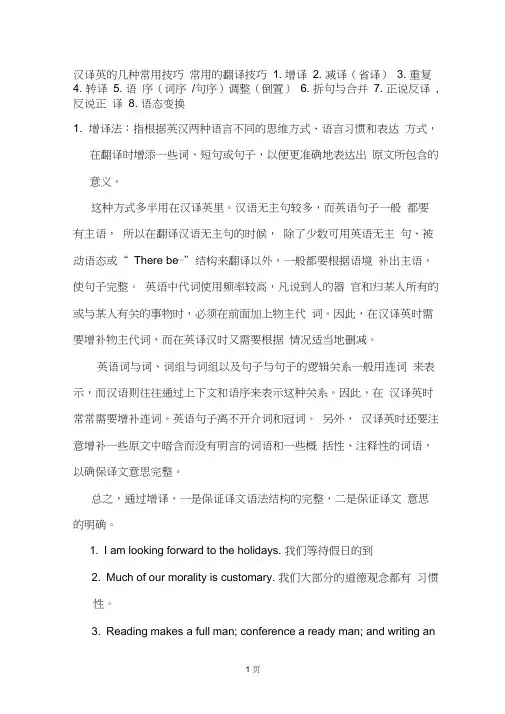
汉译英的几种常用技巧常用的翻译技巧 1. 增译 2. 减译(省译) 3. 重复4. 转译5. 语序(词序/句序)调整(倒置)6. 拆句与合并7. 正说反译, 反说正译8. 语态变换1. 增译法:指根据英汉两种语言不同的思维方式、语言习惯和表达方式,在翻译时增添一些词、短句或句子,以便更准确地表达出原文所包含的意义。
这种方式多半用在汉译英里。
汉语无主句较多,而英语句子一般都要有主语,所以在翻译汉语无主句的时候,除了少数可用英语无主句、被动语态或“ There be⋯”结构来翻译以外,一般都要根据语境补出主语,使句子完整。
英语中代词使用频率较高,凡说到人的器官和归某人所有的或与某人有关的事物时,必须在前面加上物主代词。
因此,在汉译英时需要增补物主代词,而在英译汉时又需要根据情况适当地删减。
英语词与词、词组与词组以及句子与句子的逻辑关系一般用连词来表示,而汉语则往往通过上下文和语序来表示这种关系。
因此,在汉译英时常常需要增补连词。
英语句子离不开介词和冠词。
另外,汉译英时还要注意增补一些原文中暗含而没有明言的词语和一些概括性、注释性的词语,以确保译文意思完整。
总之,通过增译,一是保证译文语法结构的完整,二是保证译文意思的明确。
1. I am looking forward to the holidays. 我们等待假日的到2. Much of our morality is customary. 我们大部分的道德观念都有习惯性。
3. Reading makes a full man; conference a ready man; and writing anexact man.读书使人充实,讨论使人机智,笔记使人精确。
4. Histories make men wise; poets witty; the mathematics subtle; natural philosophy deep; moral grave; logic and rhetoric able to contend. 读史使人明智,读诗使人灵秀,数学使人周密,科学使人深刻,伦理使人庄重,逻辑修辞之学使人善辩。

英语翻译十大技巧Trick 1: Mastering the basic grammar rules.One of the most important skills in English translation is to have a strong foundation in basic grammar rules. This includes having a good understanding of sentence structure, verb tenses, and parts of speech. For example, knowing when to use the present perfect tense versus the simple past tense can greatly affect the accuracy of a translation.Trick 2: Expanding your vocabulary.Having a wide range of vocabulary is crucial for accurate and precise translation. The more words you know, the better equipped you are to find the right words to express a specific meaning in another language. For instance, instead of using a generic word like "nice," you can substitute it with more specific and descriptive words like "pleasant," "charming," or "delightful."Trick 3: Understanding idioms and figurative language.Idioms and figurative language are often used in English speech or writing. However, translating them can be challenging as they may not have a direct equivalent in another language. One example is the idiomatic phrase "break a leg," which means good luck in the theater world.Trick 4: Being aware of cultural nuances.Cultural differences can greatly impact the way language is used and understood. It is crucial to be aware of these nuances and adapt the translation accordingly. For instance, an advertisement that may be considered humorous in one culture may not be perceived the same way in another.Trick 6: Paying attention to punctuation and formatting.Trick 7: Using appropriate translation tools.Utilizing translation tools such as dictionaries, online resources, and translation software can aid in enhancing the accuracy and efficiency of translation work. However, it is important to use these tools judiciously and verify the accuracy of the translations obtained.Trick 8: Collaborating with native speakers.Working with native speakers of the target language can provide valuable insight and feedback, especially in terms of colloquialisms and cultural expressions. Collaboration encourages growth and improved understanding of the target language.Trick 9: Proofreading and editing extensively.Trick 10: Continuously learning and improving language skills.Language is constantly evolving, and as a translator, it is important to stay updated with new words, phrases, and changesin language usage. Engaging in continuous learning through reading, attending language courses, or interacting with native speakers helps maintain proficiency and improve translation skills.By applying these ten tricks, English translation can be done with greater accuracy, ensuring a smooth and natural flow of language between the source and target texts.。