拜伦简介
- 格式:doc
- 大小:26.50 KB
- 文档页数:2
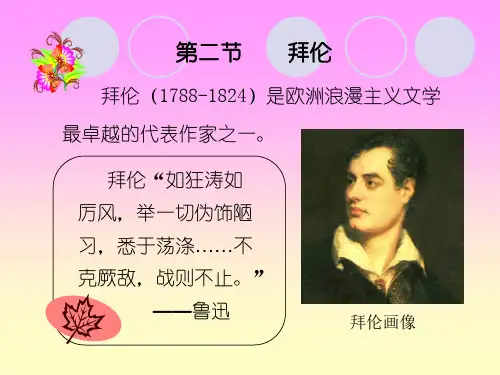
Lord George Gordon Byron was the most notorious Romantic poet and satirist. Byron was famous in his lifetime for his love affairs with women and Mediterranean boys. He created his own cult of personality, the concept of the 'Byronic hero' - a defiant, melancholy young man, brooding on some mysterious, unforgivable in his past. "There's not a joy the world can give that it takes away When the glow of early thought declines in feeling's dull decay, 'Ties not on youth's smooth cheek the blush alone, which fades so fast, But the tender bloom of heart is gone, ere youth itself be past." Byron's influence on European poetry, music, novel, opera, and painting has been immense, although the poet was widely condemned on moral grounds by his contemporaries. As famous in his lifetime for his personality cult as for his poetry. He created the concept of the 'Byronic hero' - a defiant, melancholy young man, brooding on some mysterious, unforgivable event in his past. Byron's influence on European poetry, music, novel, opera, and painting has been immense, although the poet was widely condemned on moral grounds by his contemporaries.He was the son of Captain John Byron, and Catherine Gordon. He was born with a club-foot and became extreme sensitivity about his lameness. Byron spent his early childhood years in poor surroundings in Aberdeen, where he was educated until he was ten. After he inherited the title and property of his great-uncle in 1798, he went on to Dulwich, Harrow, and Cambridge, where he piled up debts and aroused alarm with bisexual love affairs. Staying at Newstead in 1802, he probably first met his half-sister, Augusta Leigh with whom he was later suspected of having an incestuous relationship.In 1807 Byron's first collection of poetry, Hours Of Idleness appeared. It received bad reviews. The poet answered his critics with the satire English Bards And Scotch Reviewersin 1808. Next year he took his seat in the House of Lords, and set out on his grand tour, visiting Spain, Malta, Albania, Greece, and the Aegean. Real poetic success came in 1812 when Byron published the first two cantos of Childe Harold's Pilgrimage .He became an adored character of London society; he spoke in the House of Lords effectively on liberal themes, and had a hectic love-affair with Lady Caroline Lamb. Byron's The Corsair (1814), sold 10,000 copies on the first day of publication. He married Anne Isabella Milbanke in 1815, and their daughter Ada was born in the same year. The marriage was unhappy, and they obtained legal separation next year.When the rumors started to rise of his incest and debts were accumulating, Byron left England in 1816, never to return. He settled in Geneva with Percy Bysshe Shelley, Mary Wollstonecraft Shelley, and Claire Clairmont, who became his mistress. There he wrote the two cantos of Childe Harold and "The Prisoner of Chillon". At the end of the summer Byron continued his travels, spending two years in Italy. During his years in Italy, Byron wrote Lament Of Tasso, inspired by his visit in Tasso's cell in Rome, Mazeppa and started Don Juan, his satiric masterpiece. While in Ravenna and Pisa, Byron became deeply interested in drama, and wrote among others The Two Foscari, Sardanapalaus, Cain, and the unfinished Heaven and Earth.After a long creative period, Byron had come to feel that action was more important than poetry. He armed a brig, the Hercules, and sailed to Greece to aid theGreeks, who had risen against their Ottoman overlords. However, before he saw any serious military action, Byron contracted a fever from which he died in Missolonghi on 19 April 1824. Memorial services were held all over the land. Byron's body was returned to England but refused by the deans of both Westminster and St Paul's. Finally Byron's coffin was placed in the family vault at Hucknall Torkard, near Newstead Abbey in Nottinghamshire.The above biography is copyrighted. Do not republish it without permission.His works character: his persistence attacks at on “cant political, religious, and moral”. His descriptions are simp le and fresh, often bring vivid objects before the reader. “a stream sometimes smooth, sometimes rapid and sometimes rushing down in cataracts---a mixture of philosophy and slang—of everything”. He was regarded in England as the perverted man, the satanic poet; while on the continent, he was hailed as the champion of liberty, poet of the people. He enriched European poetry with and abundance of ideas, images, artistic forms and innovations.what are the characteristics of Byron‟s works?In most of his work s, we can see Byron‟s violent attack on cant politics, religion and morals, his novelty of the oriental scenery, the romantic character of Byronic hero and easy, fluent and natural beauty of his verse.In conclusion:Byron is one of the most excellent representatives of English Romanticism and one of the most influential poets of the time.His literary career was closely linked with the struggle and progressive movements of his age.He opposed oppression and slavery, and has an ardent (passionate) love for liberty.He praised the people…s revolutionary struggles in his works.His poems are favorites of the British workers and the laboring people of other countries.Byron…s poems show energy and vigor, romantic daring (bold, brave) and powerful passion.He stands with Shakespeare and Scott among the British writers who exert the greatest influence over the mainland Europe and the Chinese youth greatly.But some critics think many of his lines are harsh (unkind), rugged (rough) and not rhythmical.。