Unit-2--What-time-do-you-go-to-school-教案
- 格式:doc
- 大小:141.00 KB
- 文档页数:9
Unit 2 What time do you go to school?
Period I
I. Teaching content:What time do you go to school? (Section A 1a-2c)
II. Teaching aims
1. Ability aims:(1)谈论日常作息时间。 (2)询问、表达时间。
2. Knowledge aims:
(1)To master some new words: time, shower, usually, go to school, get up, brush teeth, take a shower,
what time
(2)学会用句型-What time do you usually…? -I/we usually…来询问日常作息
(3)学会用频度副词usually
3.Emotion aims:加强时间观念,养成良好的生活习惯。
4.Teaching methods:直观教学法、情景教学、任务型教学法
5. Teaching aids:录音机、钟表
III. Teaching key and difficult points:
1. Key points:一般现在时的特殊疑问句,即掌握:“What time do you usually…?I/We usually…”这个句型
2. Difficult points: 助动词do在一般现在时的特殊疑问句中的用法。
IV.Teaching Procedures:
Step 1 Warm-up and revision
(1)Daily greetings to the Ss.
(2) Revision:A number game.
T: Let’s play a number game. We will say the numbers out loud together. When you reach
seven, seventeen, seventy or the multiples of seven, you should clap your hands instead of
saying the number.
Step 2 Presentation
(1) Present some pictures of clocks. Teach Ss how to say the time.
T: Look, what time is it? Ss: It’s six/six thirty/seven/seven thirty/eight o’clock, etc.
Teach Ss how to use what time/o’clock. Have Ss practice saying them.
(2) Present some pictures of activities in 1a. Help Ss to understand these new phrases:
get up, go to school, get dressed, brush teeth, eat breakfast, take a shower.
Step 3 Work on 1a
(1) Match the activities with the pictures. (2) Check the answers.
Step 4 Work on 1b
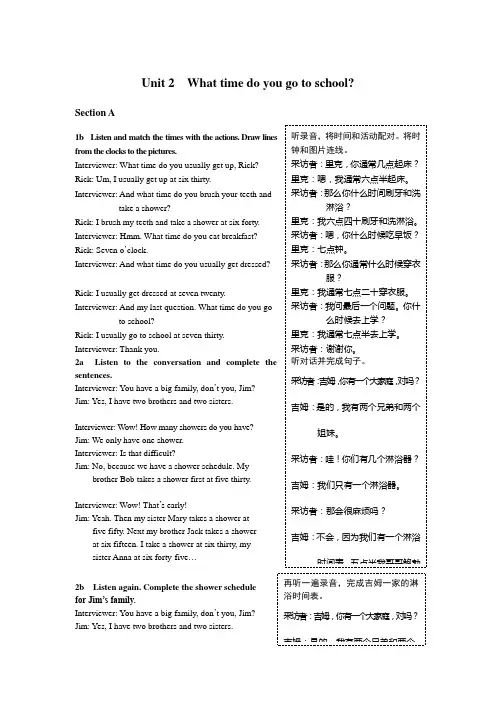
(1)Listen and match the times with the actions. Draw lines from the clocks to the pictures.
(2) Check the answers like this: T: Now you are Rick and I am the interviewer.
What time do you usually get up/go to school/get dressed/brush your teeth/eat breakfast/take a shower?
S: I usually … at …
Step 5 Work on 1c
(1)Student A is the interviewer. Student B is Rick. Ask and answer questions about Rick’s
day.
A: What time do you usually take a shower, Rick? B: I usually take a shower at six forty.
(2) Have some pairs present their conversations to the class.
Step 6 Work on 2a & 2b
(1)T: Now let’s listen to the conversation and complete the sentences.
(2)T: Can you get the answers? Please check the answers.
(3)T: Please look at 2b. I’ll play the conversation once again. Complete the shower schedule
for Jim’s family.
(4)T: What time does Bob take a shower? S: He usually takes a shower at 5:30.
Step 7 Work on 2c
Ask and answer questions according your day.
A: What time do you usually …? B: I usually … at …
A: I always … at … B: I never … so …
Step 8 Homework
Oral: 1. 朗读并熟记第7页的单词和句子。 2. 背诵2a听力材料。
Written: 抄写第7页的单词和句子。
Ⅴ. Layout: Words on the left, key sentences in the middle.
Ⅵ. 个性修改:
Ⅶ. 教学反思:
Period II
I. Teaching content:What time do you go to school? (Section A Section A 2d-3c)
II. Teaching aims
1. Ability aims:(1)谈论日常作息时间。(2)询问、表达时间。
2. Knowledge aims: (1)To master some new words: work,hour,station,night,morning,job,home,
listen,go to work,get to,go to bed, exercise
(2)要求掌握句式:——When do you usually …? ——I/we … prep…
3.Emotion aims:加强时间观念,养成良好的生活习惯,学会合理的安排学习和课外时间。
4.Teaching methods:直观教学法、情景教学、任务型教学法
5. Teaching aids:录音机,时间表
III. Teaching key and difficult points:
1. Key points:
a.一般现在时的特殊疑问句,即掌握:When do you usually …?
b.频度副词的熟练运用
2. Difficult points: 频率副词的使用。
IV. Teaching Procedures:
Step 1 Warming-up and revision
(1) 幕打出下列单词或词组 以组为单位派出两名同学, 一人用 body language 表演,一人用英语猜,看谁在1分钟内猜对的多,哪组胜利,发奖品。
1.go to school 2.get up 3.run 4. eat breakfast5. take a shower 6. go to bed 7. do one’s homework 8. eat dinner
9. go home 10. eat lunch 11. watch TV 12. play basketball
13. play chess 14. play the violin 15. play the piano 16. play the guitar
17. play the drums 18. play volleyball 19. write stories 20. sing
21. dance 22. swim 23. play tennis 24. speak English
25. do Chinese kung fu 26. brush one’s teeth
(2)Have Ss do a survey by asking and answering questions and filling in the chart.
(3)Have Ss talk about their daily routines.
Step 2 Presentation
(1) Show Miss Li’s schedule to Ss. Then talk about Miss Li’s daily routine.
A: What time does she usually get up?
B: She usually gets up at eight o’ clock.
(2) Look at the pictures, and talk about Wang Hai’s activities.
T: Please look at the pictures, and ask your classmates questions about Wang Hai’s day.
A: What time does Wang Hai usually …? B: He always … at …
Step 3 Work on 2d
(1)Read the conversation and answer the following questions.
Q1. Where does Scott work? He works at a radio station.