
人教英语九年级上第三单元第4课时
- 格式:ppt
- 大小:3.20 MB
- 文档页数:2


第四课时Section B (2a-2d)一、用所给词的适当形式填空并写出其汉语意思。
1.Where we will go __depends__ (depend) on the weather.__依靠;取决于__2.__Correct__ (incorrect) ideas come from social practice.__正确的__3.It is __impolite__ (polite) to speak loudly in public.__不礼貌的__4.The man to __whom__(who) Jack is talking is Mr.Green.__谁__5.Milk solids __include__(including) salts,protein and sugar.__包括__二、写出下列画线短语的汉语意思。
1.We also need to learn how to be polite when we ask_for_help.__求助__2.The expressions they use might depend_on whom they are speaking to or how well they know each other.__取决于__3.Sometimes we even need to spend time leading_into a request. __引入__环节1新课导入T:Do you often have any problems in your life?Ss:Yes.T:Do you know how to ask for help?Where do you need to make polite requests?Today we will learn how to ask for information politely.Think of some possible situations.Discuss them with your partner.设计意图:以图片的形式进行直观教学,再配合师生之间的对话,吸引学生的学习兴趣,快速引入课文。
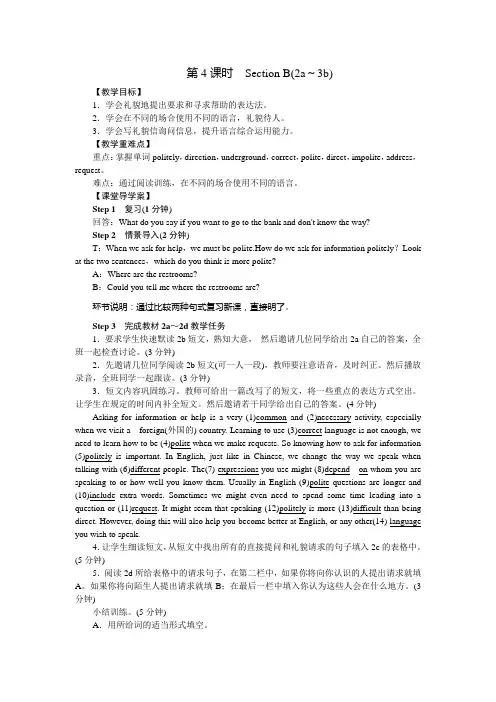
第4课时Section B(2a~3b)【教学目标】1.学会礼貌地提出要求和寻求帮助的表达法。
2.学会在不同的场合使用不同的语言,礼貌待人。
3.学会写礼貌信询问信息,提升语言综合运用能力。
【教学重难点】重点:掌握单词politely,direction,underground,correct,polite,direct,impolite,address,request。
难点:通过阅读训练,在不同的场合使用不同的语言。
【课堂导学案】Step 1复习(1分钟)回答:What do you say if you want to go to the bank and don't know the way?Step 2情景导入(2分钟)T:When we ask for help,we must be polite.How do we ask for information politely?Look at the two sentences,which do you think is more polite?A:Where are the restrooms?B:Could you tell me where the restrooms are?环节说明:通过比较两种句式复习新课,直接明了。
Step 3完成教材2a~2d教学任务1.要求学生快速默读2b短文,熟知大意,然后邀请几位同学给出2a自己的答案,全班一起检查讨论。
(3分钟)2.先邀请几位同学阅读2b短文(可一人一段),教师要注意语音,及时纠正。
然后播放录音,全班同学一起跟读。
(3分钟)3.短文内容巩固练习。
教师可给出一篇改写了的短文,将一些重点的表达方式空出。
让学生在规定的时间内补全短文。
然后邀请若干同学给出自己的答案。
(4分钟) Asking for information or help is a very (1)common and (2)necessary activity, especially when we visit a foreign(外国的) country. Learning to use (3)correct language is not enough, we need to learn how to be (4)polite when we make requests. So knowing how to ask for information (5)politely is important. In English, just like in Chinese, we change the way we speak when talking with (6)different people. The(7) expressions you use might (8)depend__on whom you are speaking to or how well you know them. Usually in English (9)polite questions are longer and (10)include extra words. Sometimes we might even need to spend some time leading into a question or (11)request. It might seem that speaking (12)politely is more (13)difficult than being direct. However, doing this will also help you become better at English, or any other(14) language you wish to speak.4.让学生细读短文,从短文中找出所有的直接提问和礼貌请求的句子填入2c的表格中。
