
Producer surplus
- 格式:ppt
- 大小:125.50 KB
- 文档页数:6
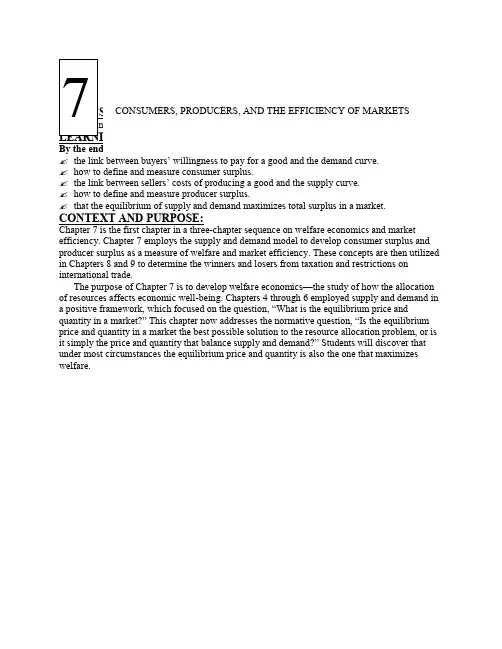
✍ how to define and measure consumer surplus.✍ the link between sellers’ costs of producing a good and the supply curve.✍ how to define and measure producer surplus.✍ that the equilibrium of supply and demand maximizes total surplus in a market. CONTEXT AND PURPOSE:Chapter 7 is the first chapter in a three-chapter sequence on welfare economics and market efficiency. Chapter 7 employs the supply and demand model to develop consumer surplus and producer surplus as a measure of welfare and market efficiency. These concepts are then utilized in Chapters 8 and 9 to determine the winners and losers from taxation and restrictions on international trade.The purpose of Chapter 7 is to develop welfare economics—the study of how the allocation of resources affects economic well-being. Chapters 4 through 6 employed supply and demand in a positive framework, which focused on the question, “What is the equilibrium price and quantity in a market?” This chapter now addresses the normative question, “Is the equilibrium price and quantity in a market the best possible solution to the resource allocation problem, or is it simply the price and quantity that balance supply and demand?” Students will discover that under most circumstances the equilibrium price and quantity is also the one that maximizes welfare.KEY POINTS:? Consumer surplus equals buyers’ willingness to pay for a good minus the amount they actually pay for it, and it measures the benefit buyers get from participating in a market.Consumer surplus can be computed by finding the area below the demand curve and above the price.? Producer surplus equals the amount sellers receive for their goods minus their costs of production, and it measures the benefit sellers get from participating in a market. Producer surplus can be computed by finding the area below the price and above the supply curve.? An allocation of resources that maximizes the sum of consumer and producer surplus is said to be efficient. Policymakers are often concerned with the efficiency, as well as the equality, of economic outcomes.? The equilibrium of supply and demand maximizes the sum of consumer and producer surplus.That is, the invisible hand of the marketplace leads buyers and sellers to allocate resources efficiently.? Markets do not allocate resources efficiently in the presence of market failures such as market power or externalities.CHAPTER OUTLINE:I. Definition of welfare economics: the study of how the allocation of resources affects economic well-being.A. Willingness to Pay1. Definition of willingness to pay: the maximum amount that a buyer will pay for a good.2. Example: You are auctioning a mint-condition recording of Elvis Presley’s first album. Four buyers show up. Their willingness to pay is as follows:for John. Because John is willing to pay more than he has to for the album,he derives some benefit from participating in the market.3. Definition of consumer surplus: the amount a buyer is willing to pay for a good minus the amount the buyer actually pays for it.4. Note that if you had more than one copy of the album, the price in the auction would end up being lower (a little over $70 in the case of two albums) and both John and Paul would gain consumer surplus.B. Using the Demand Curve to Measure Consumer Surplus1. We can use the information on willingness to pay to derive a demand curve for the rare2. . Because the demand curve shows the buyers’ willingness to pay, we can use the demand curve to measure consumer surplus.C. How a Lower Price Raises Consumer Surplusare paying less for the product than before (area A on the graph).b. Because the price is now lower, some new buyers will enter the market and receive consumer surplus on these additional units of output purchased (area B on the graph).D. What Does Consumer Surplus Measure?1. Remember that consumer surplus is the difference between the amount that buyers are willing to pay for a good and the price that they actually pay.2. Thus, it measures the benefit that consumers receive from the good as the buyers themselves perceive it.III. Producer SurplusA. Cost and the Willingness to Sell1. Definition of cost: the value of everything a seller must give up to produce a good .2. Example: You want to hire someone to paint your house. You accept bids for the work from four sellers. Each painter is willing to work if the price you will pay exceeds her opportunity cost. (Note that this opportunity cost thus represents willingness to sell.) The costs are: ALTERNATIVE CLASSROOM EXAMPLE:Review the material on price ceilings from Chapter 6. Redraw the market for two-bedroom apartments in your town. Draw in a price ceiling below the equilibriumprice.Then go through:✍ consumer surplus before the price ceiling is put into place.✍ consumer surplus after the price ceiling is put into place.You will need to take some time to explain the relationship between the producers’ willingness to sell and the cost of producing the good. The relationship between cost and the supply curve is not as apparent as the relationship between the demand curve and willingness to pay. It is important to stress that consumer surplus is measured in monetary terms. Consumer surplus gives us a way to place a monetary cost on inefficient market outcomes (due to government involvement or market failure).except for Grandma. Because Grandma receives more than she would require to paint the house, she derives some benefit from producing in the market.4.Definition of producer surplus: the amount a seller is paid for a good minus the seller’s cost of providing it.5. Note that if you had more than one house to paint, the price in the auction would end up being higher (a little under $800 in the case of two houses) and both Grandma and Georgia would gain producer surplus.B. Using the Supply Curve to Measure Producer Surplus1. We can use the information on cost (willingness to sell) to derive a supply curve for2. marginal seller . Because the supply curve shows the sellers’ cost (willingness to sell), we can use the supply curve to measure producer surplus.are receiving more for the product than before (area C on the graph).b. Because the price is now higher, some new sellers will enter the market and receive producer surplus on these additional units of output sold (area D on the graph).D. Producer surplus is used to measure the economic well-being of producers, much like consumer surplus is used to measure the economic well-being of consumers.ALTERNATIVE CLASSROOM EXAMPLE:Review the material on price floors from Chapter 6. Redraw the market for anagricultural product such as corn. Draw in a price support above the equilibriumprice.Then go through:✍ producer surplus before the price support is put in place.✍ producer surplus after the price support is put in place.Make sure that you discuss the cost of the price support to taxpayers.IV.Market EfficiencyA. The Benevolent Social Planner1. The economic well-being of everyone in society can be measured by total surplus, which is the sum of consumer surplus and producer surplus:Total Surplus = Consumer Surplus + Producer SurplusTotal Surplus = (Value to Buyers – Amount Paid by Buyers) +(Amount Received by Sellers – Cost to Sellers)Because the Amount Paid by Buyers = Amount Received bySellers:2. Definition of efficiency: the property of a resource allocation of maximizing the total surplus received by all members of society .3. Definition of equality: the property of distributing economic prosperity uniformly the members of society .a. Buyers who value the product more than the equilibrium price will purchase the product; those who do not, will not purchase the product. In other words, the free market allocates the supply of a good to the buyers who value it most highly, as measured by their willingness to pay.b. Sellers whose costs are lower than the equilibrium price will produce the product; those whose costs are higher, will not produce the product. In other words, the free market allocates the demand for goods to the sellers who can produce it at the lowest cost.to the marginal buyer is greater than the cost to the marginal seller so total surplus would rise if output increases.b. At any quantity of output greater than the equilibrium quantity, the value of the product to the marginal buyer is less than the cost to the marginal seller so total surplus would rise if output decreases.3. Note that this is one of the reasons that economists believe Principle #6: Markets are usually a good way to organize economic activity.It would be a good idea to remind students that there are circumstances whenthe market process does not lead to the most efficient outcome. Examplesinclude situations such as when a firm (or buyer) has market power over priceor when there are externalities present. These situations will be discussed inlater chapters.Pretty Woman, Chapter 6. Vivien (Julia Roberts) and Edward (Richard Gere)negotiate a price. Afterward, Vivien reveals she would have accepted a lowerprice, while Edward admits he would have paid more. If you have done a goodjob of introducing consumer and producer surplus, you will see the light bulbsgo off above your students’ heads as they watch this clip.C. In the News: Ticket Scalping1. Ticket scalping is an example of how markets work to achieve an efficient outcome.2. This article from The Boston Globe describes economist Chip Case’s experience with ticket scalping.D. Case Study: Should There Be a Market in Organs?1. As a matter of public policy, people are not allowed to sell their organs.a. In essence, this means that there is a price ceiling on organs of $0.b. This has led to a shortage of organs.2. The creation of a market for organs would lead to a more efficient allocation of resources, but critics worry about the equity of a market system for organs.V. Market Efficiency and Market FailureA. To conclude that markets are efficient, we made several assumptions about how markets worked.1. Perfectly competitive markets.2. No externalities.B. When these assumptions do not hold, the market equilibrium may not be efficient.C. When markets fail, public policy can potentially remedy the situation. SOLUTIONS TO TEXT PROBLEMS:Quick Quizzes1. Figure 1 shows the demand curve for turkey. The price of turkey is P1 and the consumer surplus that results from that price is denoted CS. Consumer surplus is the amount a buyer is willing to pay for a good minus the amount the buyer actually pays for it. It measures the benefit to buyers of participating in a market.Figure 1 Figure 22. Figure 2 shows the supply curve for turkey. The price of turkey is P1 and the producer surplus that results from that price is denoted PS. Producer surplus is the amount sellers are paid for a good minus the sellers’ cost of providing it (measured by the supply curve). It measures the benefit to sellers of participating in a market.Figure 33. Figure 3 shows the supply and demand for turkey. The price of turkey is P1, consumer surplus is CS, and producer surplus is PS. Producing more turkeys than the equilibrium quantity would lower total surplus because the value to the marginal buyer would be lower than the cost to the marginal seller on those additional units.Questions for Review1. The price a buyer is willing to pay, consumer surplus, and the demand curve are all closely related. The height of the demand curve represents the willingness to pay of the buyers. Consumer surplus is the area below the demand curve and above the price, which equals the price that each buyer is willing to pay minus the price actually paid.2. Sellers' costs, producer surplus, and the supply curve are all closely related. The height of the supply curve represents the costs of the sellers. Producer surplus is the area below the price and above the supply curve, which equals the price received minus each seller's costs of producing the good.Figure 43. Figure 4 shows producer and consumer surplus in a supply-and-demand diagram.4. An allocation of resources is efficient if it maximizes total surplus, the sum of consumer surplus and producer surplus. But efficiency may not be the only goal of economic policymakers; they may also be concerned about equity the fairness of the distribution of well-being.5. The invisible hand of the marketplace guides the self-interest of buyers and sellers into promoting general economic well-being. Despite decentralized decision making and self-interested decision makers, free markets often lead to an efficient outcome.6. Two types of market failure are market power and externalities. Market power may cause market outcomes to be inefficient because firms may cause price and quantity to differ from the levels they would be under perfect competition, which keeps total surplus from being maximized. Externalities are side effects that are not taken into account by buyers and sellers. As a result, the free market does not maximize total surplus.Problems and Applications1. a. Consumer surplus is equal to willingness to pay minus the price paid. Therefore, Melissa’s willingness to pay must be $200 ($120 + $80).b. Her consumer surplus at a price of $90 would be $200 ? $90 = $110.c. If the price of an iPod was $250, Melissa would not have purchased one because the price is greater than her willingness to pay. Therefore, she would receive no consumer surplus.2. If an early freeze in California sours the lemon crop, the supply curve for lemons shifts to the left, as shown in Figure 5. The result is a rise in the price of lemons and a decline in consumer surplus from A + B + C to just A. So consumer surplus declines by the amount B + C.Figure 5 Figure 6In the market for lemonade, the higher cost of lemons reduces the supply of lemonade, as shown in Figure 6. The result is a rise in the price of lemonade and a decline in consumer surplus from D + E + F to just D, a loss of E + F. Note that an event that affects consumer surplus in one market often has effects on consumer surplus in other markets.3. A rise in the demand for French bread leads to an increase in producer surplus in the market for French bread, as shown in Figure 7. The shift of the demand curve leads to an increased price, which increases producer surplus from area A to area A + B + C.Figure 7The increased quantity of French bread being sold increases the demand for flour, as shown in Figure 8. As a result, the price of flour rises, increasing producer surplus from area Dto D + E + F. Note that an event that affects producer surplus in one market leads to effects on producer surplus in related markets.Figure 84. a.Figure 9b. When the price of a bottle of water is $4, Bert buys two bottles of water. His consumer surplus is shown as area A in the figure. He values his first bottle of water at $7, but pays only $4 for it, so has consumer surplus of $3. He values his second bottle of water at $5, but pays only $4for it, so has consumer surplus of $1. Thus Bert’s total consumer surplus is $3 + $1 = $4, which is the area of A in the figure.c. When the price of a bottle of water falls from $4 to $2, Bert buys three bottles of water, an increase of one. His consumer surplus consists of both areas A and B in the figure, an increase in the amount of area B. He gets consumer surplus of $5 from the first bottle ($7 value minus $2 price), $3 from the second bottle ($5 value minus $2 price), and $1 from the third bottle ($3 value minus $2 price), for a total consumer surplus of $9. Thus consumer surplus rises by $5 (which is the size of area B) when the price of a bottle of water falls from $4 to $2.5. a.Figure 10b. When the price of a bottle of water is $4, Ernie sells two bottles of water. His producer surplus is shown as area A in the figure. He receives $4 for his first bottle of water, but it costs only $1 to produce, so Ernie has producer surplus of $3. He also receives $4 for his second bottle of water, which costs $3 to produce, so he has producer surplus of $1. Thus Ernie’s total producer surplus is $3 + $1 = $4, which is the area of A in the figure.c. When the price of a bottle of water rises from $4 to $6, Ernie sells three bottles of water, an increase of one. His producer surplus consists of both areas A and B in the figure, an increase by the amount of area B. He gets producer surplus of $5 from the first bottle ($6 price minus $1 cost), $3 from the second bottle ($6 price minus $3 cost), and $1 from the third bottle ($6 price minus $5 price), for a total producer surplus of $9. Thus producer surplus rises by $5 (which is the size of area B) when the price of a bottle of water rises from $4 to $6.6. a. From Ernie’s supply schedule and Bert’s demand schedule, the quantityequilibrium quantity of two.b. At a price of $4, consumer surplus is $4 and producer surplus is $4, as shown in Problems 3 and 4 above. Total surplus is $4 + $4 = $8.c. If Ernie produced one less bottle, his producer surplus would decline to $3, as shown in Problem 4 above. If Bert consumed one less bottle, his consumer surplus would decline to $3, as shown in Problem 3 above. So total surplus would decline to $3 + $3 = $6.d. If Ernie produced one additional bottle of water, his cost would be $5, but the price is only $4, so his producer surplus would decline by $1. If Bert consumed one additional bottle of water, his value would be $3, but the price is $4, so his consumer surplus would decline by $1. So total surplus declines by $1 + $1 = $2.7. a. The effect of falling production costs in the market for stereos results in a shift to the right in the supply curve, as shown in Figure 11. As a result, the equilibrium price of stereos declines and the equilibrium quantity increases.Figure 11b. The decline in the price of stereos increases consumer surplus from area A to A + B + C + D, an increase in the amount B + C + D. Prior to the shift in supply, producer surplus was areas B + E (the area above the supply curve and below the price). After the shift in supply, producer surplus is areas E + F + G. So producer surplus changes by the amount F + G – B, which may be positive or negative. The increase in quantity increases producer surplus, while the decline in the price reduces producer surplus. Because consumer surplus rises by B + C + D and producer surplus rises by F + G – B, total surplus rises by C + D + F + G.c. If the supply of stereos is very elastic, then the shift of the supply curve benefits consumers most. To take the most dramatic case, suppose the supply curve were horizontal, as shown in Figure 12. Then there is no producer surplus at all. Consumers capture all the benefits of falling production costs, with consumer surplus rising from area A to area A + B.Figure 128. Figure 13 shows supply and demand curves for haircuts. Supply equals demand at a quantity of three haircuts and a price between $4 and $5. Firms A, C, and D should cut the hair of Ellen, Jerry, and Phil. Oprah’s willingness to pay is too low and firm B’s costs are too high, so they do not participate. The maximum total surplus is the area between the demand and supply curves, which totals $11 ($8 value minus $2 cost for the first haircut, plus $7 value minus $3 cost for the second, plus $5 value minus $4 cost for the third).Figure 139. a. The effect of falling production costs in the market for computers results in a shift to the right in the supply curve, as shown in Figure 14. As a result, the equilibrium price of computers declines and the equilibrium quantity increases. The decline in the price of computers increases consumer surplus from area A to A + B + C + D, an increase in the amount B + C + D.Figure 14 Figure 15Prior to the shift in supply, producer surplus was areas B + E (the area above thesupply curve and below the price). After the shift in supply, producer surplus isareas E + F + G. So producer surplus changes by the amount F + G – B, whichmay be positive or negative. The increase in quantity increases producer surplus,while the decline in the price reduces producer surplus. Because consumer surplusrises by B + C + D and producer surplus rises by F + G – B, total surplus rises byC +D + F + G.b. Because typewriters are substitutes for computers, the decline in the price of computers means that people substitute computers for typewriters, shifting the demand for typewriters to the left, as shown in Figure 15. The result is a decline in both the equilibrium price and equilibrium quantity of typewriters. Consumer surplus in the typewriter market changes from area A + B to A + C, a net change of C – B. Producer surplus changes from area C + D + E to area E, a net loss of C + D. Typewriter producers are sad about technological advances in computers because their producer surplus declines.c. Because software and computers are complements, the decline in the price and increase in the quantity of computers means that the demand for software increases, shifting the demand for software to the right, as shown in Figure 16. The result is an increase in both the price and quantity of software. Consumer surplus in the software market changes from B + C to A + B, anet change of A – C. Producer surplus changes from E to C + D + E, an increase of C + D, so software producers should be happy about the technological progress in computers.Figure 16d. Yes, this analysis helps explain why Bill Gates is one the world’s richest people, because his company produces a lot of software that is a complement with computers and there has been tremendous technological advance in computers.10. a. With Provider A, the cost of an extra minute is $0. With Provider B, the cost of anextra minute is $1.b. With Provider A, my friend will purchase 150 minutes [= 150 – (50)(0)]. WithProvider B, my friend would purchase 100 minutes [= 150 – (50)(1)].c. With Provider A, he would pay $120. The cost would be $100 with Provider B.Figure 17d. Figure 17 shows the friend’s demand. With Provider A, he buys 150 minutes andhis consumer surplus is equal to (1/2)(3)(150) – 120 = 105. With Provider B, hisconsumer surplus is equal to (1/2)(2)(100) = 100.e. I would recommend Provider A because he receives greater consumer surplus.11. a. Figure 18 illustrates the demand for medical care. If each procedure has a price of $100, quantity demanded will be Q1 procedures.Figure 18b. If consumers pay only $20 per procedure, the quantity demanded will be Q2 procedures. Because the cost to society is $100, the number of procedures performed is too large to maximize total surplus. The quantity that maximizes total surplus is Q1 procedures, which is less than Q2.c. The use of medical care is excessive in the sense that consumers get procedures whose value is less than the cost of producing them. As a result, the economy’s total surplus is reduced.d. To prevent this excessive use, the consumer must bear the marginal cost of the procedure. But this would require eliminating insurance. Another possibility would be that the insurance company, which pays most of the marginal cost of the procedure ($80, in this case) could decide whether the procedure should be performed. But the insurance company does not get the benefits of the procedure, so its decisions may not reflect the value to the consumer.。

微观经济学英⽂版9-14章⾃测题及答案第九章⾃测题:1. If the world price of a product is higher than a country’s domestic price we know that countrya. should import that product.b. should no longer produce that product.c. has a comparative advantage in that product.d. could benefit by imposing a tariff on that product.2. Which of the following is NOT a benefit of trade?a. an increased variety of goodsb. lower costs through economies of scalec. increased competitiond. an ability to control domestic and world prices3. When a country allows trade and becomes an exporter of a good, domestic producersa. gain and domestic consumers lose.b. lose and domestic consumers gain.c. and domestic consumers both gain.d. and domestic consumers both lose.4. The world price of yo-yo’s is $4.00 each. The pre-trade price of yo-yo’s in Taiwan is $3.50 each. If Taiwan allows trade in yo-yo’s we know that Taiwan willa. import yo-yo’s and the price in Taiwan will be $4.00 each.b. import yo-yo’s and the price in Taiwan will be $3.50 each.c. export yo-yo’s and the price in Taiwan will be $4.00 each.d. export yo-yo’s and the price in Taiwan will be $3.50 each.5. When a country moves from a free trade position and imposes a tariff on imports, this causesa. a decrease in total surplus in the market.b. a decrease in producer surplus in the market.c. an increase in consumer surplus in the market.d. a decrease in revenue to the government.6. A tariff and an import quota will botha. increase the quantity of imports and raise domestic price.b. increase the quantity of imports and lower domestic price.c. reduce the quantity of imports and raise domestic price.d. reduce the quantity of imports and lower domestic price.7. The major difference between tariffs and import quotas is thata. tariffs create deadweight losses, but import quotas do not.b. tariffs help domestic consumers, and import quotas help domestic producers.c. tariffs raise revenue for the government, but import quotas create a surplus for import license holders.d. All of the above are correct.8. According to the graph, consumer surplusin this market before trade would bea. A.b. B + C.c. A + B + D.d. C.9. According to the graph, consumer surplusin this market after trade would bea. A.b. C + B.c. A + B + D.d. B + C + D.10. According to the graph, the change in total surplus in this market because of trade isa. Ab.Bc. Cd. D参考答案:1.c2.d3.a4.c5.a6.c7.c8.a9.c 10.d第⼗章⾃测题:1. An externality is the impact ofa. society’s decisions on the well-being of society.b. a person’s actions on that person’s well-being.c. one person’s actions on the well-being of a bystander.d. society’s decisions on the well-being of one person in the society2. If education produces positive externalities we would expecta. government to tax education.b. government to subsidize education.c. people to realize the benefits and therefore cause demand for education to increase.d. colleges to relax admission requirements.3. When a negative externality exists in a market the cost to producersa. is greater than the cost to society.b. will be the same as the cost to society.c. will be less than the cost to society.d. and society will be different regardless of whether an externality is present.4. Internalizing an externality refers to makinga. buyers and sellers take into account the external effects of their actions.b. certain that all market transaction benefits go to only buyers and sellers.c. certain government does not disrupt the internal workings of the market.d. buyers pay the full price for the products they purchase.5. Technology spillover is one type ofa. negative externality.b. positive externality.c. subsidy.d. producer surplus.6. According to the Coase theorem, private markets will solve externality problems and allocate resources efficiently as long asa. private parties can bargain without cost.b. government assigns property rights to the harmed party.c. the externalities that are present are positive and not negative.d. businesses determine an appropriate level of production.7. Pigovian taxes are typically advocated to correct for the effects ofa. positive externalities.b. negative externalities.c. regulatory burden.d. All of the above are correct.8. If the government were to limit the release of air-pollution produced by a steel mill to 10,000 units, this policy would be considered aa. regulation.b. Pigovian tax.c. subsidy.d. market-based policy.9. When one firm sells its pollution permit to another firm, which of the following does NOT occur?a. Both firms benefit.b. The total amount of pollution remains the same.c. Social welfare is enhanced.d. Over time, pollution will be eliminated.10. Which of the following policies is government most inclined to use when faced with a positive externality?a. taxationb. permitsc. subsidiesd. usage fees参考答案:1.c2.b3.c4.a5.b6.a7.b8.a9.d 10.c第⼗⼀章⾃测题1. Goods that are excludable include botha. natural monopolies and public goods.b. public goods and common resources.c. common resources and private goods.d. private goods and natural monopolies.2. Which of the following would be considered a private good?a. national defenseb. a public beachc. local cable television serviced. a bottle of natural mineral water3. The government provides public goods becausea. private markets are incapable of producing public goods.b. free-riders make it difficult for private markets to supply the socially optimal quantity.c. markets are always better off with some government oversight.d. external benefits will occur to private producers.4. The difference between technological knowledge and general knowledge is thata. general knowledge creation is usually more profitable for the creator.b. technological knowledge is excludable and general knowledge is not.c. general knowledge is excludable and technological knowledge is not.d. general knowledge is rival and technological knowledge is not.5. A lighthouse is typically considered a good example of a public good becausea. the owner of the lighthouse is able to exclude beneficiaries from enjoying the lighthouse.b. there is rarely another lighthouse nearby to provide competition.c. a nearby port authority cannot avoid paying fees to the lighthouse owner.d. all passing ships are able to enjoy the benefits of the lighthouse without paying.6. The Tragedy of the Commons results when a good isa. rival and not excludable.b. excludable and not rival.c. both rival and excludable.d. neither rival nor excludable.7. If the use of a common resource is not regulated,a. it cannot be used by anyone.b. the economy will end up with too much of a good thing.c. it becomes a private good.d. it will be overused.8. Government may be able to solve the problem of overuse of a common resource by doing each of the following EXCEPTa. regulating the use or consumption of the common resource.b. taxing the use or consumption of the common resource.c. selling the common resource to a private entity.d. allowing individuals to voluntarily reduce their use of the resource.9. Why do elephants face the threat of extinction while cows do not?a. Cattle are a valuable source of income for many people and elephants have no market value.b. There is a high demand for products that come only from the cow.c. There are still lots of cattle that roam free, while most elephants are in zoos.d. Cattle are owned by ranchers, while elephants are owned by no one.10. Excessive fishing occurs becausea. each individual fisherman has little incentive to maintain the species for the next year.b. fishermen rely on government managers to worry about fish populations.c. fishermen are concerned about the population dynamics of fish biomass, not current harvest rates.d. fishermen have other marketable skills and do not fear exploitation of fish reserves.参考答案:1.d2.d3.b4.b5.d6.a7.d8.d9.d 10.a第⼗⼆章⾃测题1. Which of the following is an implicit cost?(i) the owner of a firm forgoing an opportunity to earn a large salary working for a Wall Street brokerage firm(ii) interest paid on th e firm’s debt(iii) rent paid by the firm to lease office spacea. (ii) and (iii)b. (i) and (iii)c. (i) onlyd. All of the above are correct.2. John owns a shoe-shine business. His accountant most likely includes which of the following costs on his financial statements?a. wages John could earn washing windowsb. dividends John’s money was earning in the stock market before John sold his stock and bought a shoe-shine boothc. the cost of shoe polishd. All of the above are correct.3. Economic profita. will never exceed accounting profit.b. is most often equal to accounting profit.c. is always at least as large as accounting profit.d. is a less complete measure of profitability than accounting profit.4. Zach took $500,000 out of the bank and used it to start his new cookie business. The bankaccount pays 4 percent interest per year. During the first year of his business, Zach sold 12,000 boxes of cookies for $3 per box. Also, during the first year, the cookie business incurred costs that required outl ays of money amounting to$14,000.Zach’s economic profit for the year wasa. $–478,000.b. $–56,000.c. $2,000.d. $22,000.5. The marginal product of labor is equal to thea. incremental cost associated with a one unit increase in labor.b. incremental profit associated with a one unit increase in labor.c. increase in labor necessary to generate a one unit increase in output.d. increase in output obtained from a one unit increase in labor.6. Suppose Jan is starting up a small lemonade stand business. Va riable costs for Jan’s lemonade stand would include the cost ofa. building the lemonade stand.b. hiring an artist to design a logo for her sign.c. lemonade mix.d. All of the above are correct.7. Variable cost divided by quantity produced isa. average total cost.b. marginal cost.c. profit.d. None of the above are correct.8. The average fixed cost curvea. always declines with increased levels of output.b. always rises with increased levels of output.c. declines as long as it is above marginal cost.d. declines as long as it is below marginal cost.9. The efficient scale of the firm is the quantity of output thata. maximizes marginal product.b. maximizes profit.c. minimizes average total cost.d. minimizes average variable cost.10. Average total cost is increasing whenevera. total cost is increasing.b. marginal cost is increasing.c. marginal cost is less than average total cost.d. marginal cost is greater than average total cost.11. Which of the following expressions is correct?a. marginal cost = (change in quantity of output)/(change in total cost).b. average total cost = total cost/quantity of output.c. total cost = variable cost + marginal cost.d. All of the above are correct.12. Which of the following must always be true as the quantity of output increases?a. Marginal cost must rise.b. Average total cost must rise.c. Average variable cost must rise.d. Average fixed cost must fall.13. In the long run,a. inputs that were fixed in the short run remain fixed.b. inputs that were fixed in the short run become variable.c. inputs that were variable in the short run become fixed.d. variable inputs are rarely used.14. The length of the short runa. is different for different types of firms.b. can never exceed 3 years.c. can never exceed 1 year.d. is always less than 6 months.15. Economies of scale occur whena. long-run average total costs rise as output increases.b. long-run average total costs fall as output increases.c. average fixed costs are falling.d. average fixed costs are constant.16. Long-run average total cost curves are often U-shapeda. for the same reasons that average total cost curves are often U-shaped.b. because of constant returns to scale.c. because of increasing coordination problems at low levels of production and increasing specialization of workers at high levels of production.d. because of increasing specialization of workers at low levels of production and increasing coordination problems at high levels of production.参考答案:1.c2.c3.a4.c5.d6.c7.d8.a9.c 10.d 11.b 12.d 13.b 14.a 15.b 16.d第⼗三章⾃测题:1. For a firm in a perfectly competitive market, the price of the good is alwaysa. equal to marginal revenue.b. equal to total revenue.c. greater than average revenue.d. All of the above are correct.2. Which of the following is NOT a characteristic of a perfectly competitive market?a. Firms are price takers.b. Firms have difficulty entering the market.c. There are many sellers in the market.d. Goods offered for sale are largely the same.3. When a competitive firm triples the amount of output it sells,a. its total revenue triples.b. its average revenue triples.c. its marginal revenue triples.d. All of the above are correct.4. When a profit-maximizing firm in a competitive market has zero economic profit, accounting profita. is negative (accounting losses).b. is positive.c. is also zero.d. could be positive, negative or zero.5. For a competitive firm,a. Total revenue = Average revenue.b. Total revenue = Marginal revenue.c. Total cost = Marginal revenue.d. Average revenue = Marginal revenue.6. If marginal cost exceeds marginal revenue, the firma. is most likely to be at a profit-maximizing level of output.b. should increase the level of production to maximize its profit.c. must be experiencing losses.d. may still be earning a profit.7. When price is greater than marginal cost for a firm in a competitive market,a. marginal cost must be falling.b. the firm must be minimizing its losses.c. there are opportunities to increase profit by increasing production.d. the firm should decrease output to maximize profit.8. When fixed costs are ignored because they are irrelevant to a business’s production decision, they are calleda. explicit costs.b. implicit costs.c. sunk costs.d. opportunity costs.9. When a firm makes a short-run decision not to produce anything during a specified period of time because of current market conditions, the firm is said toa. shut down.b. exit.c. withdraw.d. leave the industry.10. Profit-maximizing firms enter a competitive market when, for existing firms in that market,a. total revenue exceeds fixed costs.b. total revenue exceeds total variable costs.c. average total cost exceeds average revenue.d. price exceeds average total cost.11. A firm’s short-run supply curve is part of which of the following curves?a. marginal revenueb. average variable costc. average total costd. marginal cost12. Suppose you bought a ticket to a football game for $30, and that you place a $35 value on seeing the game. If you lose the ticket, then what is the maximum price you should pay for another ticket?a. $30b. $35c. $60d. $6513. When new firms have an incentive to enter a competitive market, their entry willa. increase the price of the product.b. drive down profits of existing firms in the market.c. shift the market supply curve to the left.d. All of the above are correct.14. In a perfectly competitive market, the process of entry and exit will end when, for firms in the market,a. price is equal to average variable cost.b. marginal revenue is equal to average variable cost.c. economic profits are zero.d. All of the above are correct.15. In a competitive market that is characterized by free entry and exit,a. all firms will operate at efficient scale in the short run.b. all firms will operate at efficient scale in the long run.c. the price of the product will differ across firms.d. the number of sellers in the market will steadily decrease over time.16. The assumption of a fixed number of firms is appropriate for analysis ofa. the short run, but not the long run.b. the long run, but not the short run.c. both the short run and the long run.d. neither the short run nor the long run.参考答案:1.a2.b3.a4.b5.d6.d7.c8.c9.a 10.d 11.d 12.b 13.b 14.c 15.b 16.a第⼗四章⾃测题:1. Which of the following statements is correct?a. A competitive firm is a price maker and a monopoly is a price taker.b. A competitive firm is a price taker and a monopoly is a price maker.c. Both competitive firms and monopolies are price takers.d. Both competitive firms and monopolies are price makers.2. Which of the following is an example of a barrier to entry?(i) A key resource is owned by a single firm.(ii) The costs of production make a single producer more efficient than a large number of producers. (iii) The government has given the existing monopoly the exclusive right to produce the good.a. (i) and (ii)b. (ii) and (iii)c. (i) onlyd. All of the above are correct.3. The defining characteristic of a natural monopoly isa. constant marginal cost over the relevant range of output.b. economies of scale over the relevant range of output.c. constant returns to scale over the relevant range of output.d. diseconomies of scale over the relevant range of output.4. Patent and copyright laws are major sources ofa. natural monopolies.b. government-created monopolies.c. resource monopolies.d. None of the above are correct.5. The De Beers diamond monopoly is a classic example of a monopoly thata. is government-created.b. arises from the ownership of a key resource.c. results in very little advertising of the product that the monopolist produces.d. was broken up by the government a long time ago.6. In order to sell more of its product, a monopolist musta. sell to the government.b. sell in international markets.c. lower its price.d. use its market power to force up the price of complementary products.7. For a profit-maximizing monopolist,a. P>MR = MC.b. P = MR = MC.c. P >MR >MC.d. MR <MC <P.8. For a monopoly, the supply curve is a portion of itsa. marginal revenue curve.b. marginal cost curve.c. average total cost curve.d. none of the above; a monopoly does not have a supply curve.9. What is the monopolist’s profit under the following conditions? The profit-maximizing price charged for goods produced is $16. The intersection of the marginal revenue and marginal cost curves occurs where output is 10 units and marginal cost is $8. Average total cost for 10 units of output is $6.a. $20b. $80c. $100d. $16010. Antitrust laws allow the government toa. prevent mergers.b. break up companies.c. promote competition.d. All of the above are correct.参考答案:1.b2.d3.b4.b5.b6.c7.a8.d9.c 10.d。
1、Elasticity(弹性)the percent change in one variable resulting from a 1 percent change in another variable.2、Consumer surplus : the increase in the economic well-being of consumers who are able to buy the product at a market price lower than the highest price that they are willing and able to pay for the product.3、Producer surplus : the increase in the economic well-being of producers who are able to sell the product at a market price higer than the lowest price that would have drawn out their supply.4、Opportunity cost : the value of other goods and services that are not produced because resources are instead used to produce this product.5、Arbitrage (套利) buying something in one market and reselling the same thing in another market to profit from a price difference .6、international price(world price) free-trade equilibrium price .7、one-dollar,one-vote metric : each dollar of gain or loss is valued equally,regardless of who experiences it.8、labor productivity : the number of units of output that a worker can produce in one hour.9、principle of comparative advantage : a country will export the goods and services that it can produce at a low opportunity cost and import the goods and services that it would otherwise produce at a high opportunity cost.10、relative price(相对价格) the ratio of one product price to another product price.11、production-possibility curve(ppc)(生产可能性曲线)which shows all combinations of amounts of different products that an economy can produce with full employment of its resources and maximum feasible productivity of these resources. 12、increasing marginal costs(边际成本递增) as one industry expands at the expense of others ,increasing amounts of the other products must be given up to get each extra unit of the expanding industry’s product.13、indifference curve(无差异曲线) shows the various combinations of consumption quantities that lead to the same level of well-being or happiness.14、community indifference curve (社会无差异曲线) which purport to show how the economic well-being of a whole group depends on the whole group’s consumption of products.15、terms of trade (一国的贸易条件) which are the price the country receives from foreign buyer for its export products , relative to the price that the country pays foreign sellers for its import products.16、Heckscher-Ohlin theory : predictd that a country exports the products that use its relatively abundant factors intensively and imports the products using its relatively scarce factors intensively.17、labor-abundant(劳动力丰裕型)a country is relatively labor-abundant if it has a higher ratio of labor to other factors than dose the rest of the world.18、labor-intensive(劳动力密集型)a country is relatively labor-intensive if labor costs are a greater share of its value than they are of the value of other products.19、Stolper-Samuelson theorem(斯托尔珀-萨缪尔森定理) opening to trade splits a country into specific gainers and losers in the long run is an application of a generalrelationship.(开放贸易会在长期内将一国成员划分为得者与失者)20、factor-price equalization theorem(要素价格均等化定理) states that, given certain conditions and assumptions , free trade equalizes not only product prices but also the prices of individual factors between the two countries.(在特定条件和假设前提下,自由贸易不仅将使两国间的商品价格均等化,而且会使两国间的各种要素价格均等化,以至于即便在要素不能在各国间流动的情况下,两国工人也将享受同样的工资水平,两国中单位面积的土地也将获得同样的地租收益)---错误理论21、constant returns ti scale : input use and total cost rise in the same proportion as output increases.22、internal scale economies(内部规模经济) a large firm may have a lower average cost for a number of different reasons.(公司自身规模的扩大会使其平均成本下降) 23、monopolistic competition(垄断竞争)属于不完全竞争(imperfect competition)is a type of market structure in which a large number of firms compete vigorously with each other in producing and selling varieties of the basic product.24、oligopoly(寡头垄断)if a few large firms dominate the global industry , perhaps because of substantial scale economies , then we have an oligopoly.25、external scale economies(外部规模经济)The second type of scale economies is external to any individual firm . External scale economies are based on the size of an entire industry within a specific geographic area,26、intra-industry trade(产业内贸易) two-way trade in which a country both exportsand imports the same or very similar products.(相同或相似产品的双向贸易)27、net trade : the difference between exports and imports of that product.28、product differentiation (产品差异化): consumers view the varieties of a productoffered by different firms in an industry as close but not perfect substitutes for each other.29、small country : one whose trade dose not affect the international price ratio.30、large country : one whose trade can have an impact on the relative internationalprice ratio.31、tariff(关税)as the term is used in international trade , is a tax on importing a goodor service into a country , usually collected by customs officials at the place of entry .(包括:specific tariff、ad valorem tariff)32、one-dollar , one-vote metric : every dollar of gain or loss is just as important asevery other dollar of gain or loss , regardless of who the gainers or losers are . 33、consumption effect(消费效应) shows the loss to consumers in the importingnation based on the reduction in their total consumption of bicycles .(area d) 34、production effect(生产效应) This extra cost of shifting to more expensive homeproduction .(area b)35、terms-of-trade effect(贸易条件效应) :a nation with such power over foreignselling prices could exploit this advantage with a tariff on imports . Let’s look at a case in which a large country can affect the world price of a good it imports , just by imposing a tariff .36、nationally optimal tariff(最优关税)this best tariff is called the nationally optimaltariff , the tariff that creates the largest net gain for the country imposing it . For a large country , this optimal tariff lies between no tariff and a prohibitively highone .)37、nontariff barrier (NTB) : a nontariff barrier to imports is any policy used by thegovernment to reduce imports , other than a simple tariff on imports.38、import quota : a limit on the total quantity of imports of a product allowed into thecountry during a period of time.(one NTB)39、ways to allocate import licenses(进口许可证的分配方式): fixed favoritism、import licenses auction、resource-using application.(one NTB)40、voluntary export restraint(VER)(自愿出口限制) is an odd-looking trade barrier inwhich the importing country government coerces the foreign exporting country yo agree “voluntarily” to restrict its exports to this country(one NTB)41、other NTB : product standards、domestic content requirements、governmentprocurement42、foreign retaliation、enforcement costs、rent-seeking costs、rents to foreignproducers、innovation(5 ways in which the true cost is probably bigger than the calculation )43、dumping(倾销) is selling exports at a price that is too low—less than normalvalue.Types: predatory dumping、cyclical dumping、seasonal dumping、persistent dumping44、antidumping duty (反倾销税) an extra tariff equal to the discrepancy between theactual export price and the normal value.45、safeguard policy(百卫政策): is the use of temporary import protection when asudden increase in imports causes injury to domestic producers.。