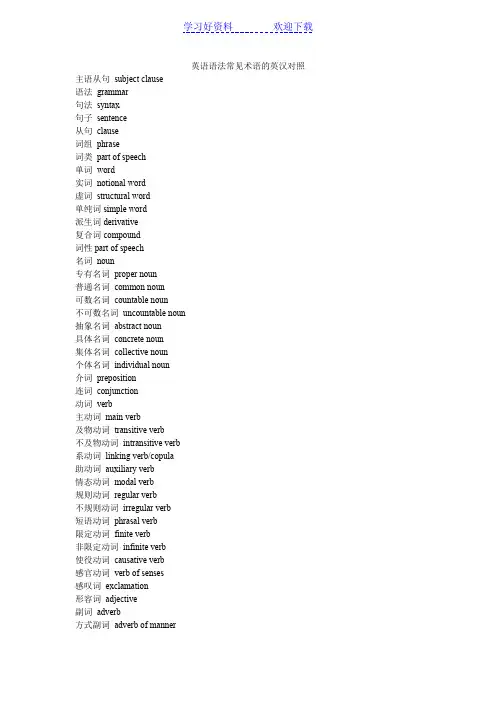
语法术语中英文1. Noun (名词)countable uncountable (可数名词、不可数名词)Number of N (名词的数)Irregular plurals (不规那么复数)Genitive case of N (名词的所有格)Double genitive (双重所有格)2.Pronoun (代词)Personal pronoun (人称代词)Possessive pronoun (物主代词)Reflexive pronoun (反身代词)Interrogative pronoun (疑问代词)Indefinite pronoun (不定代词)3.Numeral (数次)Cardinal 、ordinal numbers (基数词、序数词)Percentage (百分数)Fraction (分数)Decimal (小数)Multiple (倍数)4.Determiner (限定词)Definite, indefinite, zero articles (定冠词,不定冠词,零冠词)Quantifiers (数量词)5.Preposition (介词)6.Adjective (形容词)Attributive 定语Predicative 表语Adverb clause equivalent 副词性从句7. Adverb (副词)Modifier of Adj / Adv / Prep-phrase / N-Phrase / Adverb-clause (形容词、副词、介词短语、副词性从句的修饰语)The comparative and superlative degrees of Adj / Adv (形容词和副词的比较级和最高级)9. Verb classes (动词)Transitive and intransitive verbs(及物动词和不及物动词)Auxiliaries and modal auxiliaries(助动词和情态动词)Semi-auxiliaries (半助动词)Phrasal verbs (短语动词)10. Tense (时态)Simple present, past, future and with modals (一样此刻时,一样过去时,一样以后时和情态助动词加动词)Present and past progressive(此刻进行时和过去进行时)Future progressive and with modals(以后进行时和情态动词加进行时)Present and past perfect(此刻完成时和过去完成时)Future perfect and with modals (以后完成时和情态动词加完成时)Present perfect progressive(此刻完成进行时)Past perfect progressive (过去完成进行时)voice (被动语态)Passive voice in simple tense(被动语态的一样时态)Passive voice in perfect and progressive tenses (被动语态的完成和进行时态)Passive voice of phrasal verbs (短语动词的被动语态)12.Subjunctive mood (虚拟语气)13.To V (Infinitive 动词不定式)as subject, object and complement (用作主语,宾语和补足语)Indicating purpose / result (表示目的和结果)Modifying adjective (修饰形容词)as post modifier in a noun phrase (后位修饰名词)to be + V-ed2, to have + V-ed2, to be + V-ing (不定式的被动式,完成式和进行式)14.V-ing (Gerund 动名词)object, subject and predicative (宾语, 主语和表语)N / Pronouns or their possessive + V-ing as subject and object (名词/ 代词或其所有格加动名词作主语和宾语)Prep + N / Pronouns or their possessive + V-ing (介词加名词/代词或其所有格加动名词)being + V-ed2, having + V-ed2, having been + V-ed2 as a noun equivale nt (动名词的被动式,完成式和完成被动式起名词作用)15pre-modifier and post modifier in a noun phrase 此刻分词和过去分词)as complement (补足语)as an adverb clause equivalen t(作状语)When / while, etc. + V-ing / V-ed2 (When / While 等加此刻分词或过去分词)(with) N + V-ing / V-ed2 ( [ with ] 名词加此刻分词或过去分词)Dangling V-ing as adverb clause equivalen t(无归属此刻分词作状语)being + V-ed2, having + V-ed2, having been + V-ed2 as an adverb or adjective clause equivalen t(此刻分词的被动式、完成式和完成被动式作状语或定语)16. Basic sentence patterns and sentence elements (大体句型和句子成份)Pattern 1: S + VPattern 2: S + V + CsPattern 3: S + V + OPattern 4: S + V + Oi + OdPattern 5: S + V + Od + Co17. Interrogative form (疑问形式)Negative form (否定形式)Passive form (被动形式)relative clause (定语从句)Restrictive and non-restrictive (限制Pare nt hesis (插入语)Omission (省略)Omission through coordination (并列结构中的省略)Negation (否定)Total negation (全数否定)Partial negation (部份否定)Double negation (双重否定)Transferred negation (转移否定)性和非限制性定语从句)Appositive clause (同位语从句)Noun phrase appositive to clause(名词短语作句子的同位语)Clause of time and space(时刻从句和地址从句)Clauses of condition, concession and con tras t (条件从句、妥协从句和对照从句)Clauses of cause, result and purpose(缘故从句、结果从句和目的从句)Clauses of manner and comparison(方式从句和比较从句)Clauses of proportion and other types(比例从句和其它从句)3rd person pronouns, and plurals of the 1st and 2nd person pronouns (第三人称代词,第一、二人称代词的复数)indefinite pronouns (不定代词)(+ of + N / Pron)Subjec t-verb inversion(主语与谓语倒装)朗文高级英语语法》第一章动词时态概述(Overview Of Verb Tenses)1- 1 一样时态(The Simple Tenses)1- 2 进行时态(The ProgressiveTenses)31- 3 完成时态(The Perfect Tenses)1- 4 完成进行时态(The PerfectProgressive Tenses)1-5 时态用法总结(Summary Chart ofVerb Tenses)1- 6 -ing 和-ed 形式的拼写(Spelling of -ing and -ed Forms)第二章一样此刻时,一样过去时,此刻进行时和过去进行时(Present And Past,Simple And Progressive)2- 1 一样此刻时(Simple Present) 2- 2 此刻进行时(Present Progressive)2- 3 静态动词( Stative Verbs)2-5 规那么动词和不规那么动词(Regular and Irregular Verbs)2-6 规那么动词:-ed的发音(RegularVerbs: Pronunciation of -ed Endings)2-7 不规那么动词表(Irregular Verbs: an Alphabetical List)2-8 易混淆的动词:raise/rise, set/sit, lay/lie (Troublesome Verbs: raise/rise, set/sit, lay/lie)2-9 一样过去时(Simple Past)2-10 过去进行时(Past Progressive)2-11进行时态与always连用表示抱怨(Using Progressive Verbs with always to Complain)2-12 进行时态中地址状语的用法(Using Expressions of Place with Progressive Verbs) being + Adjective)3- 1 此刻完成时(Present Perfect)2-4 am/is/are being+形容词(am/is/are第三章完成时和完成进行时(Perfect And Perfect Progressive Tenses)3- 2 此刻完成进行时(Present Perfect Progressive) 3- 3 过去完成时(Past Perfect)3- 4 过去完成进行时(Past Perfect Progressive)第四章以后时(Future Time)4- 1 一样以后时:will 和be going to (Simple Future: will and be going to)4- 2 will 与be going to 的比较(will vs. be going to)4- 3 历时刻状语从句表示以后(Expressing the Future in Time Clauses)4-4 用一样此刻时和此刻进行时表示以后(Using the Present Progressive and the Simple Present to Express Future Time)4- 5 以后进行时(Future Progressive)4- 6 以后完成时(Future Perfect)4-7 以后完成进行时(Future Perfect Progressive)第五章时刻状语从句和时态的温习(Adverb Clauses Of Time And Review Of Verb Tenses)5- 1 时刻状语从句:形式(Adverb Clauses of Time: Form)5- 2 历时刻状语从句表示时刻关系(Using Adverb Clauses to Show Time Relationships)第六章主谓一致(Subject-verbAgreement)6-1以-s或-es结尾的词:用法、发音和拼写(Final -s/-es: Use, Pronunciation, and Spelling)6-2 大体的主谓一致问题(BasicSubject-verb Agreement)6-3 主谓一致:表达数量(Subject-verb Agreement: Using Expressions of Quantity)6-4 主谓一致:there be的用法(Subject-verb Agreement: Using there + be)6- 5 主谓一致:不规那么用法(Subject-verb Agreement: Some Irregularities)第七章名词(Nouns)7- 1 名词复数形式的规那么和不规那么转变(Regular and Irregular Plural Nouns)7- 2 所有格(Possessive Nouns)1037- 3 名词作修饰语(Using Nouns as Modifiers)7-4 可数名词和不可数名词(Count andNoncount Nouns)7- 5 不可数名词(Noncount Nouns)7- 6 常见不可数名词(Some Common Noncount Nouns)7-7 冠词的大体用法(Basic ArticleUsage)7-8 冠词用法的大体原那么(General Guidelines for Article Usage)7-9 数量的表达(Expressions of Quantity)7-10 a few 和few, a little 和little 的用法(Using a few and few; a little and little)7-11 带of 的数量表达(Using of in Expressions of Quantity)7-12 all (of)和both (of)〔All (of) and both (of) 7-13 单数的数量表达:one, each, every (Singular Expressions of Quantity: one, each, every)第八章代词(Pronouns)8- 1 人称代词(Personal Pronouns)8- 2 人称代词:与类属名词、不定代词的一致性(Personal Pronouns: Agreement with Generic Nouns and Indefinite Pronouns)8-3 人称代词:与集合名词的一致性(Personal Pronouns: Agreement with Collective Nouns)8- 4 反身代词(Reflexive Pronouns)8-5 you, one 和they 用作非人称代词(Using you, one, and they as Impersonal Pronouns)8- 6 other 的形式(Forms of other)8-7 other 的常见表达(CommonExpressions with other)第九章情态动词(一) (Modals, Part 1)9- 1 概述(Introduction)9-2 I作主语的礼貌请求(PoliteQuestions with I as the Subject)9-3 you 作主语的礼貌请求(PoliteQuestions with you as the Subject)9- 4 would you mind 用作礼貌请求(Polite Requests with would you mind)9- 5 表示必需:must, have to, have got to (Expressing Necessity: must, have to, have got to)9-6 没必要要和禁止:have to和must的否定形式(Lack of Necessity and Prohibition: have to and must in the Negative)9-7 忠告:should, ought to, had better (Advisability: should, ought to, had better)9-8 should 的过去式(The Past Form of should)9-9 期望:be supposed to (Expec tatio ns: be supposed to)9-10 提议:let's, why don't, shall I/we(Making Suggestions: let's, why don't, shall I/we)9-11 提议:could与should的比较(Making Suggestions: could vs. should) 第十章情态动词(二) (Modals, Part 2)10- 1 表示确信程度:此刻时(Degrees of Certainty: Present Time)10-2 表示确信程度:此刻时的否定形式(Degrees of Certainty: Present Time Negative)10-3 表示确信程度:过去时(Degrees of Certainty: Past Time)10-4 表示确信程度:以后时(Degrees of Certainty: Future Time)10-5 情态动词的进行式(Progressive Forms of Modals)10-6 表示能力:can 和could (Ability:can and could)10-7 would 表示过去重复性的动作(Using would to Express a RepeatedAction in the Past)10-8 表示偏向: would rather(Expressing Preference: would rather)10-9 情态动词和短语情态动词的结合(Combining Modals with Phrasal Modals)10-10 情态动词和类似表达的总结表(Summary Chart of Modals and Similar Expressions)第十一章被动语态(The Passive)11-1 被动语态的组成(Forming the Passive)11-2 被动语态的用法(Using thePassive)11-3 间接宾语用作被动语态的主语(Indirect Objects Used as Passive Subjects)11-4 情态动词与短语情态动词的被动语态(The Passive Form of Modals and Phrasal Modals)11-5 静态被动语态(Stative Passive)11-6 常见静态被动语态动词 + 介词(Common Stative Passive Verbs + Prepositions)11-7 get 与被动语态(The Passive with get) 11-8 分词形容词(Participial Adjectives)第十二章名词性从句(Noun Clauses)12-1 概述(Introduction)12-2 以疑问词开头的名词性从句(Noun Clauses Beginning with a Question Word)12-3以whether或if开头的名词性从句(Noun Clauses Beginning with whether or if)12-4疑问词后接不定式(Ques tion Words Followed by Infinitives)12-5 以that 开头的名词性从句(NounClauses Beginning with that)12-6 直接引语(Quoted Speech)12-7 间接引语:名词性从句中动词的形式(Reported Speech: Verb Forms in Noun Clauses)12-8 名词性从句中虚拟语气的用法(Using the Subjunctive in Noun Clauses)12-9 带有-ever的辞汇的用法(Using -ever Words)第十三章定语从句(Adjective Clauses)13- 1 概述(Introduction)13-2 定语从句的关系代词作主语(Adjective Clause Pronouns Used as the Subject)13-3 定语从句的关系代词作动词的宾语(Adjective Clause Pronouns Used as the Object of a Verb)13-4 定语从句的关系代词作介词的宾语(Adjective Clause Pronouns Used as the Object of a Preposition)13-5 定语从句的经常使用句型(UsualPatterns of Adjective Clauses)13-6 whose 的用法(Using whose)13-7定语从句中where的用法(Using where in Adjective Clauses)13-8 定语从句中when的用法(Using when in Adjective Clauses)13-9 定语从句修饰代词的用法(Using Adjective Clauses to Modify Pronouns)13-10 定语从句中标点符号的利用(Punctuating Adjective Clauses) 13-11 定语从句中数量的表示方式(Using Expressions of Quantity in Adjective Clauses)13-12 名词+of which 的用法(U sing Noun + of which)28613-13 which修饰整个句子的用法(Using which to Modify a Whole Sentence)28613-14 将定语从句简化为形容词短语:概述(Reducing Adjective Clauses to Adjective Phrases: Introduction)13-15 将定语从句转变成形容词短语(Changing an Adjective Clause to an Adjective Phrase)第十四章动名词和不定式(一) (GerundsAnd Infinitives, Part 1)14- 1 动名词:概述(Gerunds: Introduction)14-2 动名词作介词的宾语(Using Gerunds as the Objects of Prepositions)14-3 后面接动名词的常见介词短语(Common Preposition CombinationsFollowed by Gerunds)14-4 后面接动名词的常见动词(CommonVerbs Followed by Gerunds)14-5 go+动名词(go + Gerund)14-6后面接动词-ing形式的固定搭配(Special Expressions Followed by -ing)14-7 后面接不定式的常见动词(CommonVerbs Followed by Infinitives)14-8 后面既可接不定式又可接动名词的常见动词(Common Verbs Followed by either Infinitives or Gerunds)14-9 后面接动名词的动词列表(Reference List of Verbs Followed byGerunds) 14-10 后面接不定式的动词列表(Reference List of Verbs Followed by Infinitives)14-11 it +不定式;动名词和不定式作主语(it + Infinitive; Gerunds and Infinitives as Subjects) And Infinitives, Part 2)15-1 表示目的的不定式:in order to (Infinitive of Purpose: in order to)15-2 后面接不定式的形容词(Adjectives Followed by Infinitives)15-3 不定式与too和enough连用(Using Infinitives with too and enough)15-4 不定式和动名词的被动语态和完成式(Passive and Past Forms of Infinitives and Gerunds)15-5 need 后接动名词或不定式的被动语态形式(Using Gerunds or Passive Infinitives Following need)15-6 所有格修饰动名词(Using a Possessive to Modify a Gerund)15-7 感官动词的用法(Using Verbs of Perception)15-8 let和help后接动词原形(Using the Simple Form after let and help)15-9 使役动词的用法:make, have, get(Using Causative Verbs: make, have, get)第十五章动名词和不定式(二) (Gerunds第十六章并列连词(Coordinating16-1 平行结构(Parallel Structure)16-2 成对连词:both・・・and; not only… but also; either … or; neither … nor (Using Paired Conjunctions: both . . . and; not only . . . but also; either . . . or; neither . . . nor)16- 3 用并列连词连接独立分句(Combining Independent Clauses with Coordinating Conjunctions)第十七章状语从句(Adverb Clauses)17- 1 概述(In troduc tion)17-2 缘故状语从句(Using Adverb Clauses to Show Cause and Effect)17-3表达对照(意外的结果):even though 的用法〔Expressing Contrast (Unexpected Result): Using even though〕17-4 表达直接对照:while和whereas (Showing Direct Contrast: while and whereas)17-5条件状语从句:if从句(Expressing Conditions in Adverb Clauses: 17-6 条件状语从句:whether or not和even if 的用法(Adverb Clauses of Condition: Using whether or not and even if)17-7 条件状语从句:in case和in the event that 的用法(Adverb Clauses of Condition: Using in case and in the event that)17-8 条件状语从句:unless的用法(Adverb Clauses of Condition: Using unless)17-9 条件状语从句:only if的用法(Adverb Clauses of Condition: Using only if)第十八章将状语从句简化为修饰性的副词短语(Reduction Of Adverb Clauses To Modifying Adverbial Phrases)18- 1 概述(In troduc tion)18-2 将时刻状语从句简化为修饰性的副词短语(Changing Time Clauses to Modifying Adverbial Phrases)18-3 用修饰性的副词短语表达“与此同时”的概念(Expressing the Idea of “During the Same Time” in Modifying Adverbial Phrases)18-4 用修饰性的副词短语表示因果关系(Expressing Cause and Effect in Modifying Adverbial Phrases)18-5 在修饰性的副词短语中利用“upon + -ing” (Using upon + -ing in Modifying Adverbial Phrases)第十九章表示因果、对照和条件关系的关联词(Connectives That Express Cause And Effect, Contrast, And Condition)19-1 because of 和due to 的用法(Using because of and due to)19-2用过渡词表示因果关系:therefore 和consequently (Using Transitions to Show Cause and Effect: therefore and consequently)19-3 句型和标点符号小结(Summary ofPatterns and Punctuation)19-4其它表示因果关系的方式:such… that 和so …that (Other Ways of Expressing Cause and Effect: such . . . that and so . . . that)19-5 表示目的:so that的用法(Expressing Purpose: Using so that)19-6 表示对照(意料之外的结果) 〔Showing Contrast (Unexpected Result)〕19-7 表示直接对照(Showing Direct Contrast)19-8 表示条件:otherwise 和or (else) 的用法〔Expressing Conditions: Using otherwise and or (else)〕19-9 关联词小结:因果、对照和条件关系(Summary of Connectives: Cause and Effect, Contrast, Condition)第二十章条件句和表达愿望的方式(Conditional Sentences And Wishes)20- 1 条件句中一样动词形式概述(Overview of Basic Verb Forms Used in Conditional Sentences)20-2 此刻和以后的真实条件句(True in the Present or Future)20-3 此刻和以后的非真实条件句(与事实相反)〔Untrue (Contrary to Fact) in the Present or Future〕20-4 过去的非真实条件句 (与事实相反) 〔Untrue (Contrary to Fact) in the Past〕20-5 在条件句中利用动词的进行时形式(Using Progressive Verb Forms in Conditional Sentences)20-6条件句中“混合时刻”的用法(Using“ Mixed Time ” in ConditionalSentences)42420-7 if 的省略(Omitting if)20-8 暗含的条件(Implied Cond it ions)20-9 as if / as though 的用法(Using as if/as though) 20-10 wish后面的动词形式(Verb Forms Following wish)20-11 用would 表达关于以后的希望(Using would to Make Wishes about the Future)434and Objects)A-2 介词和介词短语(Prepositions and Prepositional Phrases) A-3 形容词(Adjectives)A-4 副词(Adverbs)A-5 be 动词(The Verb be)A-6 系动词(Linking Verbs)B单元:疑问句(Questions)B-1 一样疑问句和特殊疑问句的形式(Forms of Yes/No and Information Questions)B-2 疑问词(Ques tion Words)B-3 简化的一样疑问句(Shortened Yes/No Questions)B-4 否定疑问句(Negative Questions) B-5 反意疑问句(Tag Questions)附录增补语法单元(Supplementary Grammar Units)A 单元:大体语法术语(Basic GrammarTerminology)C 单元:缩写(Contractions) D单元:否定句(Negatives)D-1 not与其它否定词的用法(Using not and Other Negative Words)A-1 主语、动词和宾语(Subjects, Verbs,D-2 幸免“重复两次否定” (Avoiding Double Negatives)D-3 以否定词开头的句子(Beginning a Sentence with a Negative Word)E 单元:介词搭配(Preposition Combinations)E 形容词和动词的介词搭配(Preposition Combinations withAdjectives and Verbs)F 单元:用来举例和延续观点的关联词(Connectives To Give Examples And To Continue An Idea)F-1 用来举例的关联词(Connectives to Give Examples)F-2 用来延续观点的关联词(Connectives to Continue the Same Idea)G 单元:动词形式的回忆练习(Verb Form Review Exercises)。