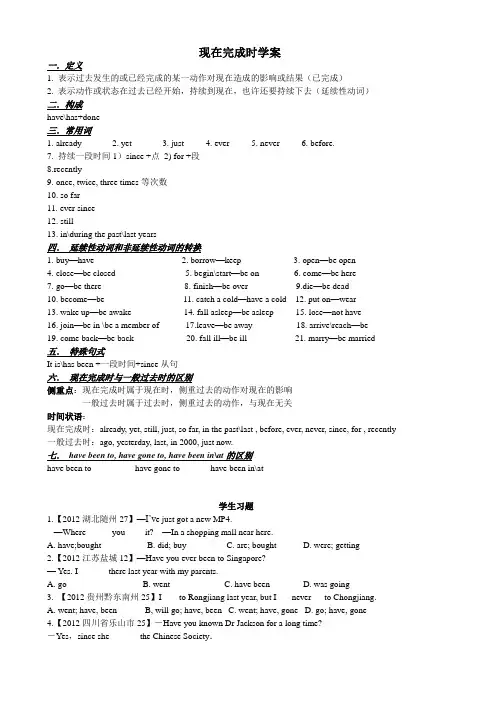
(完整)外研版八年级下册现在完成时
- 格式:doc
- 大小:60.07 KB
- 文档页数:6
新外研版八年级下册英语语法-现在完成时I Warm-up选择题。
()1. He often______his clothes on Sundays.A. washingB. washesC. has washedD. wash()2. Next month______twenty five.A. has my sisterB. my sister will beC. my sister shall have()3. We will start as soon as our teacher______ .A. comesB. will comeC. comeD. is coming()4. Last week John______his leg.A. felt and brokenB. fell and brokeC. feels and breaksD. fallen and broken()5. It______ hard when I left my house .A. is rainingB. rainsC. was rainingD. will rainII Grammar现在完成时(一)构成:1.肯定句主语(第一、二人称,第三人称复数)+have +过去分词+其他主语(第三人称单数)+has+过去分词+其他如:I have been to Beijing.2.否定句3.主语+ have/has +not +过去分词+其他如:He hasn’t finished his homework yet.4.一般疑问句Have/Has +主语+过去分词+其他?如:Has the letter arrived yet?5.特殊疑问句特殊疑问词+have/has +主语+过去分词+其他?如:Where have you been to ?(二)用法:1. 现在完成时表示过去发生或已经完成的某一动作对现在造成的影响或结果。
(汉语中常用“已经”、“过”、“了”等表达)通常与表示包括现在在内的时间副词just, already, before, yet, never, ever 等状语连用。
例如:同步练习(1)①I have _______________________that before. (我从来没有听说过那回事)② Have you_____________________? (你曾经骑过马吗?)③ She ________________________the math exercises.(他已经完成了数学作业)④ I__________________________ book.. (我刚刚丢了历史书)2. 现在完成时表示过去已经开始,持续到现在,也许还会持续下去的动作或状态。
可以和表示延续的时间状语连用。
如for、since 等引导的时间状语。
(注意:句中谓语动词要用延续性动词)一段时间的表达方法有两种:for: + 一段时间for a year, for two weeks, for three years过去的某一时刻:since nine hours ago, since last week, since 1990 since一般过去时态的时间状语从句:since you came,since you got home注意:for 和since 所引导的时间状语都表示一段时间.对划线部分提问都用How long同步练习(2)用since 和for填空1. I have had this car a year.2. The shop has been closed last week.3. —How long have you studied Chinese?two years ago.4. We haven’t seen each other she went back to her country.重难点★h a v e b e e n(t o)和h a v e g o n e(t o)的区别:★have / has been (to) 表示“曾经到过某地......”,说话时此人不在那里,已经回来。
侧重指经历。
★have / has gone (to) 表示某人“已经去某地了......”,说话时此人可能在路上或已到那里,反正不在这里。
试比较:He has been to Beijing. 他曾去过北京。
(人已回来,可能在说话人的地方)He has gone to Beijing. 他已经去北京了。
(人去了,不在说话人的地方)Exercises I:用gone或been填空。
1.I am sorry I'm late, everyone. I've_ _ ___ to the dentist's.2.There's nobody at home. I think they've ____ _______ away for the weekend.3.You look very brown. Where have you __ _________ on holiday?4.Simon isn't here at the moment. He's __ _________ _to a football match.5.—Have you ever_ __________ _to Scotland?—Yes, I've _____ ___________ there quite a few times.一般过去时与现在完成时之比较:1)一般过去时:表示过去某个时间发生的事、存在的状态或经常发生的动作,与现在无关;现在完成时表示与现在有关系的发生在过去的动作,它不与表示过去的时间状语(如yesterday , last week , a moment ago,just now)连用.⑴be 结构:肯定式:主语+was \were + 其他否定式:主语+was \were +not + 其他一般疑问句:Was \Were +主语+ 其他⑵V 结构:肯定式:主语+v.过去式+其他否定式:主语+didn’t +v.原形+其他一般疑问句:Did +主语+v.原形+其他2)一般过去时常与具体的时间状语连用,而现在完成时通常与模糊的时间状语连用,或无时间状语。
◎ 一般过去时的时间状语有:yesterday, last week ,…ago, in1980, , just now, thismorning 等具体的时间状语。
◎ 现在完成时的时间状语有:for, since, ever, never, just, already, yet, in past years等不确定的时间状语。
请大家认真分析、比较下列各例句:I saw this film yesterday.(只说明动作发生在过去。
)I have seen this film.(强调对现在的影响,电影的内容已经知道了。
)She has returned from Paris.(她已从巴黎回来了。
)She returned yesterday.(她是昨天回来的。
)He has been in the League for three years. (在团内的状态可延续)He joined the League three years ago. ( 三年前入团,joined 为短暂行为。
)注意:句子中如有一般过去时的时间副词(如 yesterday, last week, in 1960)时,不能使用现在完成时,要用一般过去时。
例如:Tom has written a letter to his parents last night. (Ⅹ)Tom wrote a letter to his parents last night. (√)判断: When did you lose it? ( ) When have you lost it? ( )Exercises II :用括号内单词的现在完成时或一般过去时形式完成句子1. My friend is a writer. He (write) many books.2. We (not/have) a holiday last year.3. I (play) table tennis yesterday afternoon.4. What time (you/go) to bed last night?5. (you/ever/meet) a famous person?6. The weather (not/ be ) very good yesterday.7. My hair is wet. I (just/wash) it.8. I (wash) my hair before breakfast this morning.9. Kathy travels a lot. She (visit) many countries.10.— Is Sonia here?— No, she (not/ come) yet.Mary has watered the flowers just now. ( ) Mary watered the flowers just now. ( ) Mary has just watered the flowers . ( )(三)现在完成时与瞬间动作:瞬间动词可以用于现在完成时,但不能和表示一段时间的状语连用。
如可说“He has left.”但不能说“He has left for three years.” 如果要表达“他已走了三年了”可用以下几种表达法:1.)用ago,使用一般过去时。
He left here three years ago.2.)用“It is +一段时间+ since +一般过去时从句”It is three years since he left here.3.)用“ 一段时间+have/ has passed + since + 一般过去时从句”Three years have passed since he left here.以上三种表示方法适用于所有瞬间动词。
另外,还可用其它表示方法,但只适用于部分瞬间动词。
具体办法是将瞬间动词转化为表延续的动词或者表状态的be+名词/形容词或副词/介词短语等。
1.直接转化成延续性动词buy → have catch (get) a cold → have a coldborrow → keep become → be2.转换成be+名词join the army be a soldierjoin the Party be a Party member / be a member of the Partygo to school be a student3转换成be+形容词或副词die → be dead finish → be over begin → be on leave → b e awayfall sleep → be asleep close → be closed open → be open come → be here go → be there marry → be married4.转换成be+介词短语go to school → be in school join the army →be in the army一般过去时态和现在完成时态可以构成同义句①.我们买这本书三年了.We have had the book for three years. / We bought the book three years ago.②他感冒三天了.He has had a cold for three days. / He caught a cold three days ago.③自从上星期以来,我就借了这本书.I borrowed the book last week. / I have kept the book since last week.④我成为一个学生两年多了.I have been a student for over two years. / I became a student two years ago.⑤ Mr Black死了三年了。