
中国世界遗产(英语课)
- 格式:ppt
- 大小:4.77 MB
- 文档页数:19
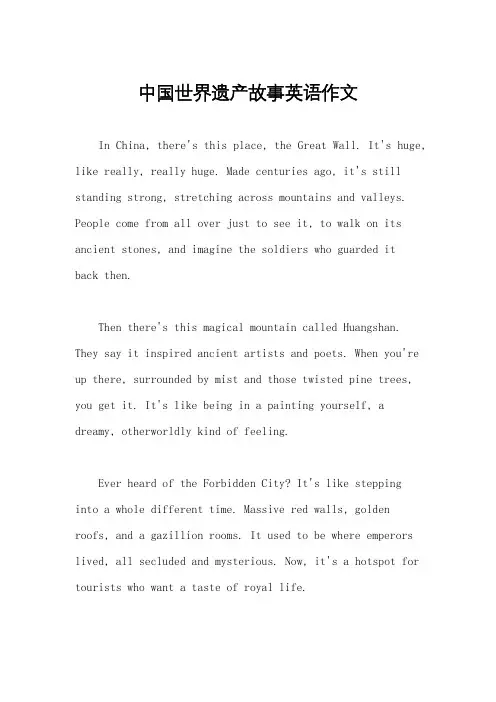
中国世界遗产故事英语作文In China, there's this place, the Great Wall. It's huge, like really, really huge. Made centuries ago, it's still standing strong, stretching across mountains and valleys. People come from all over just to see it, to walk on its ancient stones, and imagine the soldiers who guarded itback then.Then there's this magical mountain called Huangshan. They say it inspired ancient artists and poets. When you're up there, surrounded by mist and those twisted pine trees, you get it. It's like being in a painting yourself, a dreamy, otherworldly kind of feeling.Ever heard of the Forbidden City? It's like steppinginto a whole different time. Massive red walls, golden roofs, and a gazillion rooms. It used to be where emperors lived, all secluded and mysterious. Now, it's a hotspot for tourists who want a taste of royal life.And don't forget about the Terracotta Army. It's wild, thousands of life-sized soldiers and horses, buried with China's first emperor. Imagine stumbling upon that underground army by accident! It's like a scene straight out of an adventure movie.Last but not least, there's the Summer Palace. Picture this: a huge lake, grand palaces, and lush gardens. It's where ancient emperors went to chill during those scorching summer months. Even now, it's the perfect spot for a peaceful stroll or a boat ride.So yeah, China's got some seriously cool UNESCO World Heritage sites. Each one tells a different story, from ancient battles to imperial extravagance. You've gotta see them to believe them!。
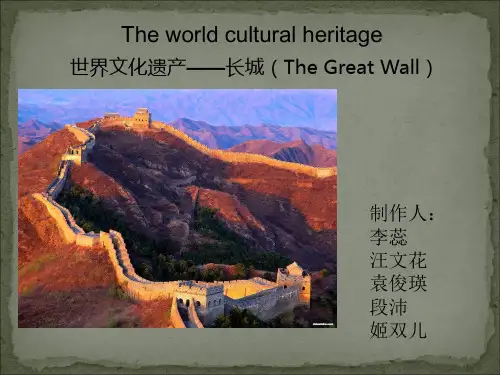

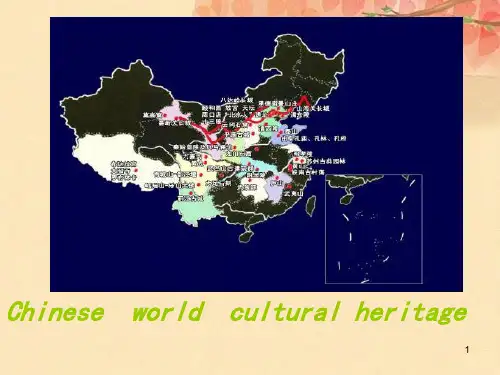
中国世界文化遗产中英文名称• Imperial Palaces of the Ming and Qing Dynasties in Beijing and Shenyang (1987)故宫• Mausoleum of the First Qin Emperor – Terracotta Warriors in Xian (1987)秦始皇陵• The Great Wall (1987)长城• Mogao Caves in Dunhuang, Gansu (1987)莫高窟• Peking Man Site at Zhoukoudian in Beijing (1987)周口店“北京人”遗址• Historic Ensemble of the Potala Palace in Lhasa, Tibet (1994)西藏布达拉宫• Ancient Building Complex in the Wudang Mountains in Hubei (1994)武当山古建筑群• Mountain Resort and its Outlyin g Temples, Chengde, Hebei (1994)承德避暑山庄与周围寺庙• Temple and Cemetery of Confucius and the Kong Family Mansion in Qufu, Shandong (1994)孔府、孔庙、孔林• Classical Gardens of Suzhou in Jiangsu (1997)苏州古典园林• Old Town of Lijiang in Yunnan (1997)丽江古城• A ncient City of Ping Yao in Shanxi (1997)平遥古城• Temple of Heaven, an Imperial Sacrificial Altar in Beijing (1998)北京天坛• Summer Palace, an Imperial Garden in Beijing (1998)北京颐和园• Dazu Rock Carvings in Chongqing (1999)大足石刻• Imperial Tombs of the Ming and Qing Dynasties in Beijing and Hebei (2000)明清皇家陵寝• Ancient Villages Xidi and Hongcun in Anhui (2000)皖南古村落• Mount Qingcheng and the Dujiangyan Irrigation System in Sichuan (2000) 青城山-都江堰• Longmen Grottoes in Luoyang, Henan(2000)龙门石窟• Yungang Grottoes in Shanxi (2001)云冈石窟• Capital Cities and Tombs of the Ancient Koguryo Kingdom in Jilin (2004) 高句丽王城、王陵及贵族墓葬• Historic Centre of Macao (2005)澳门历史城区• Yin Xu, the ruins of the last capital of Shang Dynasty, Henan (2006)安阳殷墟• Kaiping Diaolou and Villages in Guangdong (2007)开平碉楼与村落• Fujian Tulou (2008)福建土楼• 河南登封“天地之中”历史建筑群(2010)。
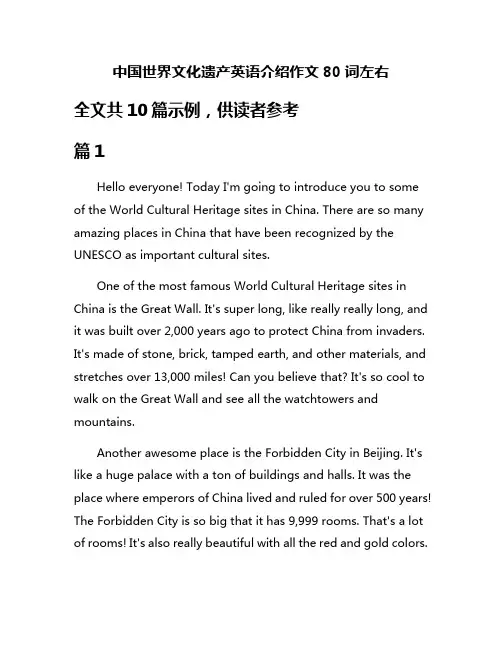
中国世界文化遗产英语介绍作文80词左右全文共10篇示例,供读者参考篇1Hello everyone! Today I'm going to introduce you to some of the World Cultural Heritage sites in China. There are so many amazing places in China that have been recognized by the UNESCO as important cultural sites.One of the most famous World Cultural Heritage sites in China is the Great Wall. It's super long, like really really long, and it was built over 2,000 years ago to protect China from invaders. It's made of stone, brick, tamped earth, and other materials, and stretches over 13,000 miles! Can you believe that? It's so cool to walk on the Great Wall and see all the watchtowers and mountains.Another awesome place is the Forbidden City in Beijing. It's like a huge palace with a ton of buildings and halls. It was the place where emperors of China lived and ruled for over 500 years! The Forbidden City is so big that it has 9,999 rooms. That's a lot of rooms! It's also really beautiful with all the red and gold colors.Then, there's the Terracotta Army in Xi'an. It's a bunch of life-sized clay soldiers, horses, and chariots that were buried with the first emperor of China, Qin Shi Huang. There are over 8,000 soldiers in total, and they were made over 2,000 years ago! Each soldier has a unique face and armor, which is so cool.These are just a few of the World Cultural Heritage sites in China. There are so many more amazing places to explore and learn about in this beautiful country. I hope you can visit them one day and see for yourself the wonder and history of China's cultural heritage!篇2Hello everyone, do you know that China has a lot of World Heritage Sites? Today, I'm going to introduce some of them to you. Let's explore together!The Great Wall is one of the most famous World Heritage Sites in China. It is a long wall that was built over 2,000 years ago to protect China from invaders. The Great Wall stretches over 13,000 miles and is made of stone, brick, tamped earth, wood, and other materials. It's amazing to think about how people built such a big wall without modern machines!Another cool World Heritage Site in China is the Forbidden City. It was the imperial palace during the Ming and Qing dynasties and is located in the capital city of Beijing. The Forbidden City has over 9,000 rooms and was home to emperors and their families. Today, it is a museum where you can learn about China's history and see beautiful artifacts and architecture.The Terracotta Army is another World Heritage Site in China. It is a collection of terracotta sculptures that were buried with Emperor Qin Shi Huang to protect him in the afterlife. The Terracotta Army has over 8,000 soldiers, horses, and chariots, all made of clay. It's amazing to see how detailed and lifelike the sculptures are!There are many other World Heritage Sites in China, such as the Mogao Caves, the Peking Man Site at Zhoukoudian, and the Summer Palace. Each site has its own history and significance, and they all help to tell the story of China's rich cultural heritage.I hope you enjoyed learning about some of China's World Heritage Sites. Remember, it's important to protect and preserve these sites so that future generations can continue to learn from them. Let's all do our part to safeguard these treasures of the past!篇3Hello everyone, today I want to tell you about some of China's world cultural heritage sites. They are super cool and have a lot of history behind them!The first one is the Great Wall of China. It's like a giant dragon snaking its way through the mountains. People say you can see it from space! The Great Wall was built a long long time ago to keep out invaders. It's really long, over 13,000 miles! Can you imagine walking that far?Next up is the Forbidden City in Beijing. It's called that because back in the day, only the emperor and his family could go inside. It's like a huge palace with over 9,000 rooms! Can you imagine having a house that big?Then there's the Terracotta Warriors in Xi'an. They're like an army of soldiers made out of clay, all lined up in rows. They were buried with the first emperor of China to protect him in the afterlife. There are over 8,000 of them! That's a lot of warriors!Last but not least, there's the Summer Palace in Beijing. It's like a beautiful garden with a huge lake in the middle. The emperors used to go there to relax and have fun. Can you imagine having your own palace to play in?So there you have it, some of China's world cultural heritage sites. They're all super awesome and have so much history behind them. I hope you get a chance to visit them one day!篇4Title: Let's Learn about China's World Cultural Heritage Sites!Hey guys! Are you ready to learn about some awesome places in China that have been recognized as World Cultural Heritage Sites? Let's dive right in and explore these amazing treasures together!The first World Cultural Heritage Site we're going to talk about is the Great Wall of China. It's like super duper long and was built over 2,000 years ago to protect China from invaders. The Great Wall is made of stone, brick, tamped earth, and other materials, and it stretches for about 13,171 miles. Can you believe that? It's like the longest wall ever!Next up is the Forbidden City in Beijing. It's a giant palace complex that used to be the home of emperors and their families. The Forbidden City has like over 9,000 rooms and covers an area of about 180 acres. That's like soooo huge! It's full of beautiful ancient buildings, gardens, and artifacts that will totally blow your mind.Another cool World Cultural Heritage Site in China is the Terracotta Army in Xi'an. It's like this big army of clay soldiers that was buried with the first Emperor of China to protect him in the afterlife. There are over 8,000 soldiers, horses, and chariots in the army, and they're all life-sized and super detailed. It's like a real-life version of an ancient army!There are so many more amazing World Cultural Heritage Sites in China, like the Summer Palace, the Peking Man Site, and the Mogao Caves. Each site has its own unique history and significance that makes it a special part of China's cultural heritage.I hope you guys had fun learning about these awesome places in China! Let's continue to explore and appreciate the rich cultural heritage of our world together. Bye for now!篇5Hello everyone! Today I'm going to introduce you to some of the World Heritage Sites in China. There are so many amazing places in China that have been recognized by UNESCO for their cultural and historical significance. Let's take a look at a few of them:The Great Wall of China is one of the most famous landmarks in the world. It's over 13,000 miles long and was built over 2,000 years ago to protect the Chinese Empire from invaders. Walking along the Great Wall is like stepping back in time and imagining what it was like to defend ancient China.The Forbidden City in Beijing is another incredible World Heritage Site. It was once the imperial palace during the Ming and Qing dynasties and is now a museum that showcases China's rich history and culture. The architecture and design of the Forbidden City are simply breathtaking.The Terracotta Army in Xi'an is a fascinating archaeological site that was discovered in 1974. It consists of thousands oflife-sized terracotta soldiers and horses that were buried with Qin Shi Huang, the first Emperor of China. It's amazing to see the intricate details of each warrior and imagine what life was like in ancient China.These are just a few examples of the World Heritage Sites in China. Each one tells a unique story and gives us a glimpse into the rich history and culture of this amazing country. I hope you get a chance to visit China and see these incredible sites for yourself one day!篇6Once upon a time, there were lots of really old and important places in China that were so special they got called World Heritage Sites. These sites are like superstars in the world of history and culture!Let me tell you about some of them. The Great Wall is one of the most famous World Heritage Sites in China. It's like a really long dragon made of bricks and stones that goes up and down the mountains. People built it a long, long time ago to keep bad guys out of China. It's so big you can even see it from outer space!Another cool World Heritage Site is the Forbidden City. It's a giant palace with red walls and yellow roofs where emperors used to live a zillion years ago. Inside, there are beautiful gardens, big halls, and even a Hall of Supreme Harmony where the emperor did important stuff.The Terracotta Army is also a World Heritage Site in China. It's a bunch of clay soldiers and horses buried in the ground to protect an emperor in the afterlife. Imagine having your own army to keep you safe forever!These are just a few examples of the amazing World Heritage Sites in China. They are like treasures that show how awesome and ancient Chinese culture is. So, next time you visit a World Heritage Site, remember to appreciate and respect the history and traditions they represent.篇7Hey guys, do you know that China has a lot of cool stuff that is on the World Heritage List? Yeah, it's true! Let me tell you about some of them.First off, we have the Great Wall of China. It's super duper long, like, over 13,000 miles long! Can you imagine walking that far? The Great Wall was built a long time ago to protect China from invaders. It's made of stones, bricks, and even earth. Some parts of the wall are really old and crumbly, but it's still super cool to see.Next up, we have the Forbidden City. It's in Beijing and used to be where emperors lived and ruled China. The Forbidden City is HUGE, with over 900 buildings inside! It's all red and gold and looks like something out of a fairy tale. You can go visit and see where the emperors used to sit on their throne and make important decisions.Another cool World Heritage Site in China is the Terracotta Army. Have you heard of it before? It's thousands of life-sized clay soldiers that were buried with China's first emperor, Qin Shi Huang. The soldiers are all different and have different faces and outfits. It's like a huge army frozen in time!Last but not least, we have the Mogao Caves. These caves are full of ancient Buddhist art and statues. There are over 700 caves with paintings and sculptures that are over 1,000 years old! It's like walking into a time machine and seeing what China was like a long time ago.So, there you have it, some of China's awesome World Heritage Sites. There are even more out there to discover, so let's go explore and learn more about China's rich history and culture!篇8Hello everyone, today I want to introduce to you some of China's world cultural heritage sites. These sites are super duper important and special because they show how cool and amazing China's history and culture are.The first world cultural heritage site in China is the Great Wall. It's like a super long dragon made of stones and bricks that stretches across China. It's so big that you can even see it fromspace. The Great Wall was built a long long time ago to protect China from enemies. Isn't that super cool?The second world cultural heritage site is the Forbidden City in Beijing. It used to be the palace where emperors and empresses lived. There are so many rooms and gardens inside, and the buildings are painted in beautiful colors. It's like a magical kingdom from a fairy tale!The third world cultural heritage site is the Terracotta Warriors in Xi'an. It's like an army of clay soldiers that were buried with the first emperor of China to protect him in the afterlife. There are thousands of them and each one is unique. It's like a super cool art project from a long long time ago.There are many more world cultural heritage sites in China, like the Mogao Caves, the Peking Man Site, and the Summer Palace. Each one is special and important in its own way, and they all show how awesome China's history and culture are.I hope you enjoyed learning about China's world cultural heritage sites. They're like treasure chests full of cool stories and secrets from the past. China is such an amazing place, don't you think?篇9Hello everyone, do you know what a World Heritage Site is? Well, let me tell you all about it!A World Heritage Site is a special place that is recognized by the United Nations Educational, Scientific and Cultural Organization (UNESCO) as being important to the cultural or natural heritage of the world. There are many World Heritage Sites in China, and they are all really cool!One of the most famous World Heritage Sites in China is the Great Wall. It is a really big wall that was built a long time ago to keep out bad guys. It is over 13,000 miles long and you can even see it from space! Isn't that amazing?Another World Heritage Site in China is the Forbidden City. It is a really big palace where the emperors used to live a long time ago. It has over 9,000 rooms and it is super fancy!There are also lots of beautiful natural World Heritage Sites in China, like Mount Taishan and Mount Huangshan. These mountains are really pretty and lots of people like to visit them.I think it's really cool that China has so many World Heritage Sites. It shows how special and important our country's history and culture are. I hope you all get to visit these amazing places someday!That's all for now, thanks for listening!篇10Hello everyone! Today I want to talk to you about the World Cultural Heritage in China. There are so many cool and amazing places in China that are on the list of World Cultural Heritage. Let’s explore some of them together!The Great Wall is one of the most famous World Cultural Heritage sites in China. It is a long wall that was built a long time ago to protect China from invaders. The Great Wall is really long, it stretches for over 13,000 miles! Can you imagine walking all that way? It’s so cool to see all the bricks and stones that were used to build the wall hundreds of years ago.Another cool place in China is the Forbidden City. It used to be where emperors lived in ancient China. The Forbidden City has over 9,000 rooms, can you believe that? It’s like a city inside a city! The buildings are so beautiful and colorful, and there are even some cool statues of dragons and lions guarding the entrance.Do you like pandas? Well, if you do, you’ll love the Sichuan Giant Panda Sanctuary. It’s a place in China where pandas live in the wild. The pandas are so cute and fluffy, and they love toeat bamboo. It’s so cool to see them playing and climbing trees in their natural habitat.There are so many more amazing World Cultural Heritage sites in China, like the Terracotta Warriors, the Summer Palace, and the Potala Palace. Each of these places has its own unique history and beauty that makes them special.I hope you enjoyed learning about the World Cultural Heritage in China with me today. Remember to always appreciate and respect the history and culture of different countries around the world. Thank you for listening!。
中国的非物质文化遗产介绍英文段落一:Chinese Calligraphy (中国书法)Chinese Calligraphy, known as "Shufa" in Chinese, is an art form that transcends mere writing. It embodies the harmony between strokes, ink, and paper, reflecting the calligrapher's personality, emotions, and philosophical insights. Each character is a microcosm of balance, rhythm, and vitality, making calligraphy not only a means of communication but also a profound aesthetic experience. As a spiritual pursuit, it has been deeply ingrained in Chinese society for over 3,000 years, fostering virtues such as patience, concentration, and self-cultivation.Chinese Calligraphy (中国书法)Chinese Calligraphy, or “Shufa”in Chinese, transcends mere writing as an art form. It harmoniously unites strokes, ink, and paper, mirroring the calligrapher’s personality, emotions, and philosophical insights. Each character embodies balance, rhythm, and vitality, rendering calligraphy not only a mode of communication but also a profound aesthetic experience. For over 3,000 years,it has been deeply rooted in Chinese society as a spiritual pursuit, nurturing virtues like patience, concentration, and self-cultivation.段落二:Peking Opera (京剧)Peking Opera, or "Jingju" in Chinese, is a theatrical spectacle combining singing, recitation, acting, martial arts, and acrobatics. Its distinctive makeup, costumes, and gestures convey complex characters and narratives, often drawn from historical events, myths, and legends. With a history spanning more than 200 years, Peking Opera has evolved into a national symbol, representing the pinnacle of Chinese operatic art. It continues to captivate audiences worldwide with its vivid storytelling, exquisite music, and profound cultural significance.Peking Opera (京剧)Peking Opera, known as “Jingju” in Chinese, is a theatrical extravaganza integrating singing, recitation, acting, martial arts, and acrobatics. Distinctive makeup, costumes, and gestures convey intricate characters and narratives, often derived from historical events, myths, and legends. Over 200 years old, Peking Opera has becomea national emblem, embodying the apex of Chinese operatic art. It enthralls global audiences with its vivid storytelling, sublime music, and profound cultural import.段落三:Dragon Boat Festival (端午节)The Dragon Boat Festival, or "Duanwu Jie" in Chinese, is a time-honored celebration held annually on the fifth day of the fifth lunar month. It commemorates the ancient poet Qu Yuan and his unwavering loyalty to his country. The festival is marked by vibrant dragon boat races, where teams paddle furiously to the beat of drums, symbolizing attempts to rescue Qu Yuan from the river. Additionally, Zongzi –glutinous rice dumplings wrapped in bamboo leaves –are enjoyed as a traditional delicacy. This festive occasion encapsulates China's respect for history, reverence for ancestors, and commitment to preserving cultural heritage.Dragon Boat Festival (端午节)The Dragon Boat Festival, or “Duanwu Jie” in Chinese, is an age-old celebration observed annually on the fifth day of the fifth lunar month. It honors the ancient poet Qu Yuan and his steadfast devotion to his homeland.Characterized by energetic dragon boat races, where teams paddle in sync with drumbeats, symbolizing efforts to save Qu Yuan from the river, the festival also features Zongzi —glutinous rice dumplings wrapped in bamboo leaves—as a traditional treat. This jubilant event exemplifies China’s respect for history, veneration of ancestors, and dedication to cultural preservation.段落四:Paper-cutting (剪纸)Paper-cutting, or "Jianzhi" in Chinese, is a delicate folk art that dates back to the 6th century. Artists use scissors or knives to intricately cut patterns and images on red paper, symbolizing good fortune and happiness. These vibrant creations, often depicting auspicious symbols, flora, fauna, or scenes from daily life, adorn windows, doors, and walls during festivals or special occasions. Paper-cutting reflects the Chinese people's appreciation for beauty, symmetry, and symbolism, as well as their ability to transform simple materials into extraordinary expressions of cultural identity.Paper-cutting (剪纸)Paper-cutting, or “Jianzhi” in Chinese, is a refinedfolk art with roots dating back to the 6th century. Using scissors or knives, artists skillfully cut intricate patterns and images onto red paper, signifying good luck and joy. Vibrant designs, frequently portraying auspicious symbols, plants, animals, or everyday scenes, embellish windows, doors, and walls during festivals or special events. This artform mirrors the Chinese populace’s admiration for beauty, symmetry, and symbolism, as well as their talent for transforming humble materials into extraordinary manifestations of cultural identity.In conclusion, China's intangible cultural heritage is a treasure trove of artistic expression, historical narrative, and communal spirit. From the graceful lines of calligraphy to the dramatic spectacle of Peking Opera, from the festive traditions of the Dragon Boat Festival to the intricate charm of paper-cutting, each element contributes to the rich tapestry of Chinese culture. These living legacies continue to thrive, evolve, and inspire, serving as vital links to the past while enriching the present and future of Chinese society and humanity at large.总结China's intangible cultural heritage is a wealth ofartistic expression, historical narrative, and communal spirit. Spanning from the elegant strokes of calligraphy to the theatrical grandeur of Peking Opera, from the festive customs of the Dragon Boat Festival to the delicate allure of paper-cutting, each facet adds to the diverse fabric of Chinese culture. These dynamic traditions persist, adapt, and motivate, functioning as crucial connections to the past while enhancing the present and future of both Chinese society and humanity writ large.。
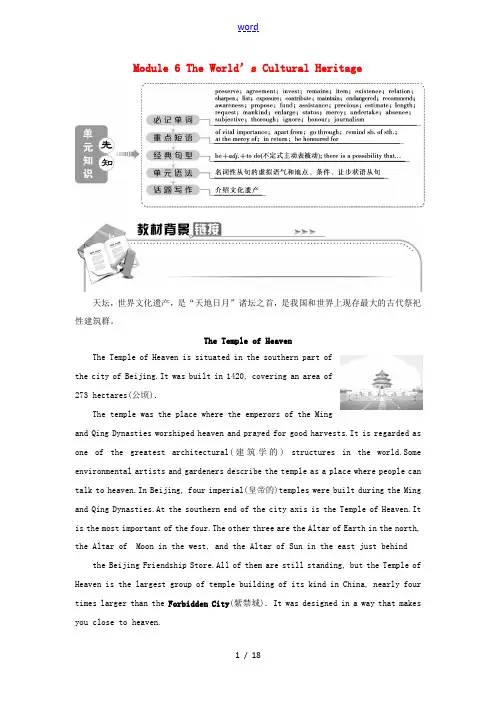
Module 6 The World’s Cultural Heritage天坛,世界文化遗产,是“天地日月”诸坛之首,是我国和世界上现存最大的古代祭祀性建筑群。
The Temple of HeavenThe Temple of Heaven is situated in the southern part ofthe city of Beijing.It was built in 1420, covering an area of273 hectares(公顷).The temple was the place where the emperors of the Mingand Qing Dynasties worshiped heaven and prayed for good harvests.It is regarded as one of the greatest architectural(建筑学的) structures in the world.Some environmental artists and gardeners describe the temple as a place where people can talk to heaven.In Beijing, four imperial(皇帝的)temples were built during the Ming and Qing Dynasties.At the southern end of the city axis is the Temple of Heaven.It is the most important of the four.The other three are the Altar of Earth in the north, the Altar of Moon in the west, and the Altar of Sun in the east just behind the Beijing Friendship Store.All of them are still standing, but the Temple of Heaven is the largest group of temple building of its kind in China, nearly four times larger than the Forbidden City(紫禁城).It was designed in a way that makes you close to heaven.In making the heaven like structures, the designers made good use of the color, sound, and figures of the circle and the square. The bination of building and gardens helps to make it appear mysterious and magical. The temple’s architecture has two themes. One is “on the earth” while the other is “in the heaven”.In imperial days, the Chinese people believed that the sky was circular and the earth was square.On the basis of this traditional concept, the circle was widely adopted in the design of the temple’s main building.It is in accordance(依据;依照) with people’s imagination of heaven.Section ⅠIntroduction & Reading and Vocabulary—prehending重点单词写作词汇1.preserve v.保护;保存2.remains n. 遗迹;遗体3.list v. (按某次序)把……列表,列清单4.maintain v. 保持;维持;保养5.remend v.建议6.fund n.基金;专款7.precious adj. 宝贵的;珍贵的;贵重的8.estimate n. 估计;估算9.request n. 请求;要求拓展词汇10.agreement n.协议→agree v.同意;承认;商定11.invest v.投资→investment n.投资→investor n.投资者12.existence n.存在→exist vi.存在13.relation n.亲属;亲戚→relationship n.关系;关联→ relate v.使……有联系→related adj.有关系的;相关的14.sharpen v.使变锋利→sharp adj.锋利的15.evolution n.进化;演变→evolve v.发展,(使)进化16.exposure n.暴露;显露→expose v.暴露;揭露17.contribute v.促成→contribution n.贡献18.endangered adj.濒危的→endanger v.危险;危机→danger n.危险→dangerous adj.危险的19.awareness n.意识;认识;感悟能力→aware adj.认识到的20.assistance n.帮助,援助→assist vt.援助→assistant n.助手21.length n.长度→long adj.长的→lengthen v.变长阅读词汇22.venue n.会场;举办地点23.divert v. 使改道24.prehistoric adj. 史前的;有历史记载以前的25.primitive adj. (人类或动植物)原始的,原生的26.skull n. 头颅;颅骨27.item n. (一)件28.span n.时距;期间29.fossil n. 化石30.beast n. 野兽31.excavation n. 发掘32.evolution n. 进化;演变33.weed n. 野草;杂草34.propose v. 建议;提议35.catastrophe n. 毁灭性的大灾难重点短语1.of vital importance 至关重要2.apart from除……之外3.in danger处于危险之中4.be made from/of由……制成5.at the moment 目前;现在6.take place发生7.agree on就……达成一致8.contribute to导致;有助于重点句型1.分词结构作结果状语:Some areas are almost pletely covered in weeds, causing serious damage(损坏严重).2.be+adj.+to do(不定式主动表被动):The site is extremely expensive to maintain(维护需要高额的费用) and it will cost between three and five million yuan to repair it.3.be of+抽象名词:They are a precious part of our cultural heritage—it is of vital importance(极其重要) that we do something.ⅠScan the text and tell the following statements True (T) or False (F).1.What changed China’s knowledge of its history were some prehistoric human bones discovered by archaeologists in Zhoukoudian in the 1920s.( )2.Beijing Man and his relations lived in the trees on the hill.( ) 3.Beijing Man died very young.( )4.The Zhoukoudian Beijing Man Site is the most important world heritage site in China.( )5.The reason why Zhoukoudian is in serious danger is that it is polluted by some nearby cement factories.( )答案:1-5.TFTFFⅡRead the text carefully and choose the best answer according to the text. 1.This passage is mainly about ________.A.the amazing caves of ZhoukoudianB.Beijing Man Heritage Site in dangerC.the amazing caves of Zhoukoudian and Beijing Man Heritage Site in danger D.how to protect Zhoukoudian2.Which of the following sentences is NOT true about Zhoukoudian?A.It’s a small village about 50 kilometers southwest of Beijing. B.Archaeologists discovered some prehistoric human bones there in 1920.C.It was listed as a world heritage site in December 1987.D.A human species once lived in the area between 700,000 and 200,000 years ago.3.Why did the excavations at the Beijing Man Site stop in 1937?A.Because there was nothing underground.B.Because the government forbade digging.C.Because Japan invaded China.D.Because the fossils had been dug up.4.From the passage we can infer that________.A.both the government and the ordinary people can help preserve the site B.Zhoukoudian is in dangerC.Zhoukoudian has been an important place for archaeologists from all over the world D.if nothing is done to repair it, Zhoukoudian could be removed from the list 答案:1-4.CBCAⅢAnalyze the following difficult sentences in the text.1.Ashes were found alongside the fossils which showed they used fire for cooking food and also for light,warmth and protection from wild beasts.[翻译] 跟化石一起被发现的灰烬表明他们用火来做饭、照明、取暖和抵御野兽。

英语介绍中国文化遗产Introducing Chinese cultural heritage in English can cover a vast array of topics due to China's rich history and diverse cultural landscape. Here's a general outline of how you might approach such an introduction:1.Introduction to Chinese Culture:Start by providing a brief overview of Chinese culture, highlighting its ancient origins, diversity, and enduring influence on the world stage. Mention key aspects such as Confucianism, Daoism, Buddhism, traditional Chinese medicine, calligraphy, and martial arts.2.Historical Landmarks:Discuss some of China's most iconic historical landmarks, such as the Great Wall, the Forbidden City, the Terracotta Army, and the Silk Road. Explain their historical significance and architectural brilliance.3.Art and Literature:Highlight China's rich artistic and literary heritage, including classical Chinese painting, poetry, opera (such as Peking Opera), and literature (such as the works of Confucius, Laozi, and Zhuangzi). Explain their themes, styles, and contributions to world culture.4.Cuisine:Mention the diversity and significance of Chinese cuisine, known for its regional variations, flavors, and ingredients. Talk about staple foods like rice and noodles, as well as iconic dishes such as Peking duck, Sichuan hotpot, and dim sum.5.Traditional Festivals:Introduce major Chinese festivals like the Lunar New Year (Spring Festival), Mid-Autumn Festival (Mooncake Festival), and Dragon Boat Festival. Explain their cultural origins, customs, and traditional celebrations.6.Philosophy and Religion:Discuss the profound impact of Chinese philosophy and religion, including Confucianism, Daoism, and Buddhism. Explain their core principles, moral teachings, and influence on Chinese society and culture.7.Traditional Arts and Crafts:Highlight traditional Chinese arts and crafts, such as porcelain, silk weaving, embroidery, paper-cutting, and jade carving. Explain their techniques, symbolism, and cultural significance.8.Traditional Clothing:Briefly describe traditional Chinese clothing, such as the cheongsam (qipao) and hanfu, and their evolution over time. Discuss their cultural significance and ceremonial use.9.Performing Arts:Explore China's vibrant performing arts scene, including traditional music, dance, acrobatics, and puppetry. Mention famous performers, venues, and regional styles.10.Modern Cultural Revival:Conclude by mentioning China's efforts to preserve and promote its cultural heritage in the modern world, including UNESCO World Heritage Sites, cultural preservation projects, and international cultural exchanges.By covering these topics, you can provide a comprehensive introduction to China's rich cultural heritage in English.。
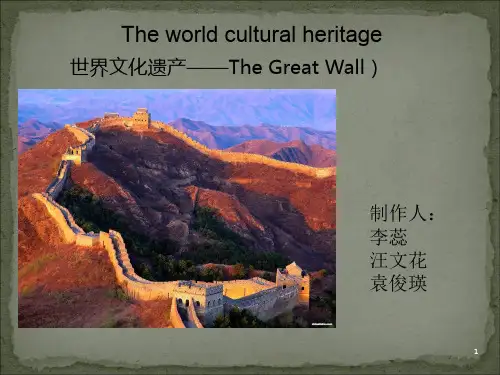
中国世界遗产英文介绍中国拥有丰富多彩的世界遗产资源,这些遗产代表了中国深厚的历史文化底蕴和博大精深的自然景观。
下面是对中国世界遗产的英文介绍,按照列表划分。
1. 故宫博物院The Palace Museum, also known as the Forbidden City, is located in the heart of Beijing and was the imperial palace for almost 500 years from the Ming Dynasty to the end of the Qing Dynasty. It is one of the finest surviving examples of ancient Chinese palatial architecture and has over 9,000 rooms containing a priceless collection of imperial treasures.2. 长城The Great Wall of China is the world's longest wall, stretching over 13,000 miles. It was built over 2,000 years ago and still stands as a testament to the determination and skill of the Chinese people. The Great Wall is made up of many sections, each with its own unique characteristics and history.3. 兵马俑The Terracotta Warriors and Horses are located in the city of Xi'an and were discovered by local farmers in 1974. The warriors are life-sized and were buried with the first emperor of China, Qin Shi Huang, to protect him in theafterlife. The army consists of over 8,000 soldiers, horses, and chariots, each with a different facial expression and unique clothing.4. 孔庙及孔府The Temple of Confucius and the Kong Family Mansion are located in Qufu, the hometown of Confucius. The temple was built in 478 BC and has been rebuilt several times. It is a beautiful example of traditional Chinese architecture and is the largest and oldest Confucian temple in the world. The Kong Family Mansion is nearby and was the residence of Confucius' descendants for over 2,000 years.5. 庐山国家公园Lushan National Park is located in the Jiangxi Province and is known for its natural beauty and cultural significance. The park is home to many important temples and historic sites, including the White Deer Grotto Academy and the Lushan Conference Hall. Lushan is also home to many rare plant and animal species, making it an important ecological reserve.6. 古城口镇The Ancient City of Pingyao is located in the Shanxi Province and is one of the best-preserved ancient cities in China. It was a major center for trade and banking during the Ming and Qing dynasties and has many well-preserved buildings and architecture from that time. The city is also known for its citywalls, which are over 2,700 years old.7. 雅康高原The Three Parallel Rivers of Yunnan Protected Areas are located in the Yunnan Province and consist of three rivers that run parallel to each other through steep canyons. The area is one of the most biologically diverse areas in the world and is home to many rare plant and animal species. It is also the site of many important cultural and historic sites, including the first Buddhist temple in China.8. 石林风景区The Stone Forest Scenic Area is located in the Yunnan Province and is a natural wonder of towering stone formations. The area covers over 350 square kilometers and is home to many unique geological formations, as well as rare plant and animal species. The area is also home to several ethnic minority groups, who have lived in the area for centuries.以上是对中国世界遗产的英文介绍,每一个遗产都代表着中国深厚的历史文化和自然景观。
Module 6 The World’s CulturalHeritageI.教学内容分析本模块以世界文化遗产为中心话题,介绍了有形和无形文化遗产、周口店北京人遗址、英国巨石阵、新墨西哥首府圣达菲的文化保护计划。
要求学生通过本模块学习,能够运用所学词汇简单介绍我国的世界文化遗产的概况和周口店北京人遗址的情况;陈述自己对有形文化和无形文化遗产的看法;了解世界文明,增强保护和发扬人类文明的意识;学会书面介绍一种无形文化遗产。
Introduction 部分通过介绍苏州园林引起学生的兴趣,使他们了解世界文化遗产名单,学习有关词汇和短语。
为本模块的学习奠定基础。
Vocabulary and Reading部分通过阅读The Amazing Caves of Zhoukoudian和Beijing Man Heritage sits in Danger,让学生学习相关词汇,训练在阅读过程中迅速获取有效信息的能力;并围绕文章内容,进行听说读写等各项活动。
Grammar (1) 部分通过观察课文中的例句,要求学生学会虚拟语气在宾语从句等中的用法。
Listening and Vocabulary 部分听取一段关于英国巨石阵的对话录音,培养学生准确获取有效信息的能力,完成相关练习。
Grammar (2) and Function部分的句子来自听力材料,通过学习,让学生学会正确识别地点、条件和让步状语从句,通过Activity 2的练习进一步巩固。
Reading and Writing部分通过阅读介绍无形文化遗产的文章,展开讨论,整理和扩充讨论要点,建立学生对无形文化遗产介绍的基本概念,然后根据提示写一篇介绍无形文化遗产的文章。
Everyday English部分总是与听力材料的内容连在一起的。
通过选择正确答案、编对话的形式,使学生熟练掌握这几个短语在具体日常语境中的意义和用法。
Speaking部分是就“世界上有许多语言正在消失”这个话题展开头讨论,让学生阐述自己的看法,学会珍爱文化遗产。
2019-2020年外研版高中英语选修7 Module 6《The World’s CulturalHeritage》(Section 1)素材1. Conkers:(英国的)康克戏(一种儿童游戏,双方各用绳子系住一个七叶树果,以击破对方的七叶树果为胜)Playing conkers is a British game which is centuries old. In the autumn, boys collect the fallen nuts of the Horse Chestnut tree, which are large, round and brown and commonly known as conkers. They make a hole in the middle of each nut from top to bottom and thread a piece of string through it, knotting it underneath. They then find a partner who has a conker and play the game like this: Boy A takes his conker string at the top and holds it at arm’s length, so that the conker dangles down free at the other end of the string; Boy B then tried to hit this conker with his, with the arm of breaking it. When B has had his turn, he holds his conker out and Boy A tries to hit his conker. This continues until one of the conkers is broken. The first time a new conker breaks another conker it becomes a “oner”, and if it goes on to break others it becomes a “twoer”, a “threer” and so on. Children are very proud of conkers that break many others. The conker “season”is from the end of September on into October, when the horse chestnuts fall from the trees. School playgrounds are often covered with broken conkers, as many pairs of boys play the game. Playing conkers is an important part of British intangible cultural heritage which has been passed down orally from generation to generation.2. Scottish GaelicScottish Gaelic(盖尔语) is one of the languages in the Celtic branch of Indo-European family. It was introduced into Scotland from Ireland around 500AD. By the 11th Century, it was the dominant language throughout Scotland, but since then has been declining, due to the influence of England and the English.In the 2001 Census, the population of Scotland was 5,062,011; of these 4,968,729 people said they had no knowledge of Gaelic, and only 31,235 said they could speak, read and write Gaelic, while a further 27,415 said they could speak but not read or write it, and 7.413 other people said they could do one of the other skills.There was a decline in Gaelic speakers from 1991(65,978) to 2001 (58,652). This decline was particularly noticeable in the traditional heartlands of the Gaidhealtachd (Gaelic-speaking area) in the northwestern parts of Scotland. This was also connected with loss of population in general from remote island areas to the cities.The Scottish government has been trying to do something about the death of Gaelic. In July 2005, they brought in a Gaelic Language Act, rather along the lines of that introduced in Wales 20 years before. They have been particularly concerned with education, and have been having some success. In 1985 there were only 20 children in Gaelic immersion schools in Glasgow and Inverness. In 2005, there were 2008 children being taught through Gaelic in 61 primary schools, 307 in 18 secondaryschools and 638 in 60 pre-schools in a range of Scottish cities. Scotland’s only all-Gaelic primary school will have 200 pupils in 2005-2006.The main TV channel is reducing its Gaelic programmes from 26 hours to 6 hours a year. The government, however, says it must contribute $ 1-1.5 million towards new Gaelic digital TV channel.The Scottish government is looking at the success of programmes in Ireland (1926:500,000 speakers-2005:1.5 million speakers of Irish Gaelic), Wales (an, 80.000 increase in Welsh speakers in the past 10years) and Catalunya in Spain.3. Zhou Koudian – Home of Peking ManIn December, a Chinese paleoanthropologist named Pei Wenzhong discovered a complete skull of “Peking Man”on Dragon Bone Hill northwest of Zhoukoudian, in the southwest suburbs of Beijing. Later, archaeologists unearthed 40-odd individually fossilized skeletons of “Peking Man”, male, female, old and young, all at the same place. Zhoukoudian, therefore, became the most common site for human remains with the most abundant fossils in the world from the same period. The discovery pushed the history of Beijing’s civilization back to some 600,000 years. These fossils remains prove that “Peking Man”was primitive man in an evolutionary process from ancient ape to modern man, and is the ancestor of the Chinese nation.Inside the 140-meter Peking Man Cave, stratum accumulation was of a depth of40 meters. The inhabitants spanning more than 300,000 years left their remains, stone tools and traces of fire here. On Dragon Bone Hill were also found fossilized remains of Upper Cave Man, who lived 18,000 years ago, as well as sites of New Cave Man, who lived 18,000 years ago, as well as sites of New Cave Man, who lived between Peking Man and Upper Cave Man.In 1987, the Zhoukoudian caves were listed as one of the world cultural heritage sites.2)世界自然遗产九寨沟(Jiuzhaigou Valley Scenic and Historic Interest Area),黄龙(Huanglong Scenic and Historic Interest Area),武陵源(Wulingyuan Scenic and Historic Interest Area),三江并流(Three Parallel Rivers of Yunnan Protected Areas),四川大熊猫栖息地3)世界文化与自然遗产泰山(Mount Taishan),黄山(Mount Huangshan),峨眉山-乐山大佛(Mount Emei Scenic Area, including Leshan Giant Buddha Scenic Area),武夷山(Mount Wuyi)4)文化景观庐山(Lushan National Park)5)人类口述和非物质遗产代表作昆曲(Kunqu Opera),古琴 (Guqin Music)。
介绍中国的世界文化遗产的英语作文全文共6篇示例,供读者参考篇1China's Amazing World Heritage SitesHave you ever heard of World Heritage Sites? They are places that are so special and important that they need to be protected and taken care of forever. These places could be natural wonders like beautiful mountains or forests, orman-made marvels like ancient buildings or cities. A group called UNESCO decides which places get to be World Heritage Sites.Did you know that China has the most World Heritage Sites of any country in the world? That's right, China has a whopping 54 of these amazing places! Today, I'm going to tell you about some of the most incredible ones.The Great Wall of ChinaLet's start with one of the most famous sites in the whole world – the Great Wall of China! This massive wall stretches for thousands of miles across the north of China. It was built a really,really long time ago to protect ancient Chinese cities from invaders.Imagine trying to build a wall that long without any modern machines or tools! It took hundreds of years and millions of workers to construct this incredible feat of engineering. Even today, looking at the Great Wall snaking over hills and mountains is totally mind-blowing.The Forbidden CityAnother one of China's most famous sites is the Forbidden City in Beijing. This was the imperial palace where China's emperors lived for almost 500 years. It's called the "Forbidden City" because ordinary people were not allowed to go inside its walls.The Forbidden City is like a small city itself, with nearly 1,000 buildings and rooms for the emperor, his family, and servants. The buildings are beautifully decorated with intricate carvings, painted designs, and glazed tiles. Walking through the Forbidden City today, you can almost imagine what life was like for the royal families who lived there centuries ago.The Terracotta WarriorsOne of the coolest World Heritage Sites in China has to be the Terracotta Warriors in Xi'an. This is an underground army of thousands of life-size clay soldier statues. They were buried over 2,000 years ago to guard the tomb of China's first emperor, Qin Shi Huang.Each of the terracotta warrior statues is unique, with different facial features and details. It's incredible to think that ancient artists were able to create so many distinct clay sculptures all those years ago. The Terracotta Warriors were one of the greatest archaeological finds of the 20th century and a real window into China's ancient history.The Classical Gardens of SuzhouWhile some of China's World Heritage Sites are huge and grand, others are smaller and quieter but just as beautiful. The Classical Gardens of Suzhou are a perfect example. These are a group of small, elegant gardens located in the city of Suzhou, near Shanghai.Classical Chinese gardens are designed to feel like miniature landscapes, with ponds, rockeries, trees, flowers, and pavilions all carefully arranged. Walking through the gardens in Suzhou is like stepping into a peaceful, natural wonderland. The sound ofrunning water, the smell of blossoms, and the sight of koi fish swimming in the pools make these gardens feel almost magical.Mount Emei and Leshan Giant BuddhaLet's move on to some of China's stunning natural World Heritage Sites now. One of the most famous is the area around Mount Emei, a sacred Buddhist mountain in Sichuan province. At the base of Mount Emei, you'll find the incredible Leshan Giant Buddha – a massive stone statue of Buddha carved into a cliff face.The Giant Buddha statue is over 230 feet tall, which is taller than a 20-story building! It's so detailed that you can see the folds in Buddha's robe and the serene expression on his face. To give you an idea of how big this statue is, the nose alone is over 16 feet long! Both Mount Emei and the Giant Buddha attract Buddhist pilgrims from all around the world.Wulingyuan Scenic AreaFinally, let's talk about the Wulingyuan Scenic Area, a stunningly beautiful natural site in Hunan province. This area is famous for its thousands of tall, thin rock pillars and spires that seem to stretch up to the sky.Walking among the rock forests of Wulingyuan feels like you've stepped into another world or onto an alien planet. The pillars rise up hundreds of feet overhead, while wispy clouds cling to their peaks. Some of the rocks have such funny shapes that people have given them nicknames like "The Avatar Hallelujah Mountain."Between the Wulingyuan rock pillars, you'll also find deep canyons, caves, waterfalls, and rivers. It's no wonder that filmmakers have used this incredible location for movies like Avatar!So those are just a few of the incredible World Heritage Sites you can find in China. From amazing ancient buildings to breathtaking natural landscapes, China has so many precious places that deserve to be cherished and protected. Maybe one day you'll get to visit some of these wonders yourself! Let me know which one sounds the most exciting to you.篇2My Favorite Chinese World Heritage SitesHi there! My name is Xiaoming, and I'm a 10-year-old student from Beijing, China. Today, I want to share with you some of my favorite World Heritage sites in my beautiful country.China has so many amazing historical and cultural treasures that have been recognized by UNESCO as World Heritage sites. Let me tell you about a few of them!The Great Wall of ChinaThis one is probably the most famous Chinese attraction of all time. The Great Wall is a massive ancient wall that winds across the mountains of northern China. It was built over 2,000 years ago to protect the Chinese empire from invaders. Can you believe that the total length of the Great Wall is over 13,000 miles (21,000 kilometers)? That's incredible!I've been to a section of the Great Wall near Beijing called Badaling. It's absolutely breathtaking to see this enormous stone wall snaking along the tops of the mountains. You can even walk on top of the wall and imagine what it was like for the soldiers who guarded it centuries ago. The views from the Great Wall are simply stunning.The Forbidden CityAnother famous site in Beijing is the Forbidden City, which used to be the imperial palace for 24 emperors during the Ming and Qing dynasties. It's called the "Forbidden City" becauseordinary people were not allowed to enter this vast complex of palaces, gardens, and courtyards.When you step through the huge gates of the Forbidden City, it's like stepping back in time. Everything is so grand and ornate, with intricate carvings, beautiful painted designs, and bright colors everywhere. My favorite part is the Imperial Garden, which has these amazing rockeries (piles of rocks) arranged in artistic ways, along with pagodas, pavilions, and ponds.The Terracotta WarriorsIn the city of Xi'an, you can find one of the most incredible archaeological discoveries of the 20th century – the Terracotta Warriors. These are thousands of life-size clay soldiers, horses, and chariots that were buried underground to guard the tomb of China's first emperor, Qin Shi Huang.When farmers were digging a well in 1974, they accidentally stumbled upon this underground terracotta army. It'smind-blowing to see row after row of these realistic clay warriors, each with a unique facial expression and hairstyle. Historians think there may be over 8,000 of them in total!The Classical Gardens of SuzhouSuzhou is a city known for its beautiful classical gardens, which are masterpieces of design that combine nature and architecture. Nine of these gardens in Suzhou have been designated as a World Heritage site.One of my favorite gardens is the Humble Administrator's Garden, which has charming pavilions, bridges, ponds, and rock formations arranged in a clever篇3China's Amazing World Heritage SitesHi everyone! Today I'm going to tell you about some of the incredible World Heritage sites in China. The World Heritage program was created by UNESCO, which is an organization that works to protect special places around the world that have important natural, cultural or historical value. China has so many amazing World Heritage sites - more than any other country in the world!The Great Wall of ChinaOne of the most famous World Heritage sites not just in China but everywhere is the Great Wall of China. It's a massive ancient wall that winds across mountains and deserts for over13,000 miles! It was built over 2,000 years ago to protect ancient Chinese empires from invading armies and nomads. Can you imagine how much work it must have taken to build such a gigantic wall just using human labor and simple tools? Incredible!Parts of the Great Wall are now in ruins, but other stretches are very well preserved. Walking along the ancient stone pathways while gazing out at the rugged landscapes is like traveling back in time. The most popular section for visitors is at Badaling, about 40 miles from Beijing. From the wall's snaking ridges you can sometimes spot the Chinese characters that workers carved into the stonework over 20 centuries ago!The Terracotta ArmyIn the city of Xi'an you can find one of the most extraordinary archaeological discoveries of modern times - an underground necropolis filled with thousands of life-sized terracotta warrior statues! This collection of detailed pottery figures depicting the armies of China's first emperor was created around 210 BCE to guard his tomb in the afterlife. They lay undiscovered for over 2,000 years until farmers stumbled upon them in 1974.Row after row of intensely lifelike warriors stand in battle formation inside the specially constructed pits where they were meticulously arranged so long ago. Each figure has unique facial features and details like hairstyles and ranks. The sheer scale of this ancient underground palace is absolutely mind-blowing. To date, over 8,000 soldiers have been excavated along with hundreds of horses and chariots. It's an awe-inspiring sight that gives us a window into China's rich history and culture.The Classical Gardens of SuzhouWhile the Great Wall and Terracotta Army provide glimpses into China's ancient past, there are also many World Heritage sites showcasing the country's renowned gardens and landscaping traditions. One of the most famous examples are the beautiful Classical Gardens of Suzhou. Dating back over1,000 years, Suzhou's historic gardens seamlessly blend architecture with ingenious landscaping in the Chinese tradition emphasizing harmony with nature.Strolling along the winding paths and over the arched bridges of places like the Humble Administrator's Garden is like walking through a real-life Chinese painting. Intricate pavilions and pagodas peek篇4China's Amazing World Heritage SitesHave you ever heard of the World Heritage Sites? They are amazing places around the world that are protected because they are so special and important. China has a lot of these sites, and I want to tell you about some of the coolest ones!The Great Wall of ChinaI'm sure you've heard of the Great Wall before. It's one of the most famous sites in the whole world! This massive wall was built a long, long time ago to protect ancient Chinese cities from invaders. Can you imagine how much work it took to build something so huge out of stone, brick, and earth? The Great Wall stretches for thousands of miles across northern China. Some parts are now in ruins, but other sections are still standing tall after all these centuries. Walking along the Great Wall must feel like taking a journey back in time!The Forbidden CityIn the heart of Beijing, you'll find the Forbidden City, which was the imperial palace where China's emperors lived hundreds of years ago. It's called the "Forbidden City" because nobody wasallowed to go inside except the emperor, his family, and his servants. The city itself is like a park filled with nearly a thousand buildings deckedout in yellow glazed tiles. The biggest halls were used for important ceremonies, and the living quarters give us a glimpse into how royalty lived long ago. I wouldn't mind being an emperor and living in such a breathtaking palace!The Terracotta WarriorsIn the city of Xi'an, you can see one of the most incredible archaeological finds ever made—the Terracotta Army! Thousands of life-size clay warrior statues were buried underground for over 2,000 years until farmers stumbled upon them in 1974. Each statue is unique, with different facial features, heights, and even hair and clothing styles. It's mind-blowing that ancient artists created such realistic statues to guard the tomb of China's first emperor, Qin Shi Huang. The sheer number of these clay warriors is simply astonishing!The Classical Gardens of SuzhouThe city of Suzhou has some of the most beautiful classic gardens you'll ever see. With their pretty pavilions, winding covered paths, and ponds full of colorful fish, these gardens were designed to capture the essence of nature in miniature form. As you wander through the lush gardens like the HumbleAdministrator's Garden, you'll feel completely at peace surrounded by all the meticulous landscaping and decorative architecture. These gardens were built as private retreats for the scholarly and artistic elite hundreds of years ago. I wish I could travel back in time and spend an afternoon in one of these peaceful sanctuaries!Mount Emei and Leshan Giant BuddhaThe last site I want to tell you about is actually two amazing places located right next to each other in Sichuan province. Mount Emei is one of China's four sacred Buddhist mountains, covered in ancient temples and towering ancient trees. If you make the climb to the peak, you'll be rewarded with incredible views. At the base of this holy mountain sits the Leshan Giant Buddha, which is exactly what it sounds like—a huge, 233-foot tall statue of Buddha carved right into the side of a cliff! This Giant Buddha statue is so massive that it's hard to comprehend. It makes me feel so tiny just thinking about how it was built over 1,200 years ago!Those are just a few of the incredible World Heritage Sites in China that showcase its long history and rich culture. From the Great Wall to the Forbidden City to the Terracotta Warriors, these places give us a window into China's fascinating past. I feelso lucky that amazing sites like these still exist today so we can learn about the incredible achievements and creativity of the people who lived so long ago. I hope I can visit some of China's World Heritage Sites myself one day and experience their wonder and beauty in person! Let me know which site you think sounds the most amazing.篇5China's Amazing World Heritage SitesHi there! My name is Xiao Ming and I'm a 5th grader at Beijing Elementary School. Today, I want to tell you about some of the incredible World Heritage sites we have here in China. These are places that have been officially recognized by UNESCO as having outstanding universal value to humanity. We're so lucky to have so many of these amazing treasures right here in our country!The Great WallLet's start with one you've probably heard of – the Great Wall of China! This massive ancient wall snakes over 13,000 miles across the mountains of northern China. It was built over many centuries to protect ancient Chinese states from nomadic groups. The most famous section is at Badaling, near Beijing. I went thereon a school trip and it was so cool climbing up the steep stone steps! You can see the wall winding along the mountain ridges as far as the eye can see. Parts of the wall are over 2,000 years old. Just imagine how much work it took to build something so huge with just basic tools and human labor! The Great Wall really showcases the determination and brilliant engineering of ancient Chinese people.The Forbidden CityAnother iconic Beijing landmark is the Forbidden City, the former imperial palace from the Ming and Qing dynasties. This massive complex of nearly 1,000 buildings used to be off-limits to ordinary people (that's why it's called the "Forbidden" City). Only emperors, concubines, eunuchs and servants were allowed inside. When you walk through the grand gates and see the bright yellow glazed roof tiles glittering in the sun, you can imagine how awe-inspiring it must have been for ancient visitors. My favorite areas were the exquisitely decorated throne rooms and the lush gardens. The Forbidden City housed 24 emperors over nearly 500 years until the last emperor was forced out in 1924.The Terracotta WarriorsOne of the most mind-blowing sites I've visited is the Terracotta Warriors in Xi'an. In 1974, farmers were digging a well and accidentally discovered an underground pit filled with thousands of life-sized terracotta soldier statues! They were built to guard the tomb of Qin Shi Huang, the first emperor of a unified ancient China. Each warrior statue is unique, with different facial features, hair styles and even different outfits and ranks. It's incredible they were constructed over 2,200 years ago. So far, they've uncovered four main pits with over 8,000 soldier statues, plus horses and chariots! There may still be even more treasures buried there that haven't been excavated yet. Walking among these rows of silent terracotta warriors makes me feel like I've traveled back in time.The Classical Gardens of SuzhouChina is also famous for its traditional gardens, and some of the most beautiful are located in the city of Suzhou. These exquisite gardens date back to the 11th century and display the harmony of human design blending seamlessly with nature. My favorite was the Humble Administrator's Garden, with its winding covered walkways, serene ponds, intricate pavilions and lush plantings of bamboo, lotus and plum trees. Every twist and turn revealed a new picturesque scene. It's meant to be a privatesanctuary for quiet contemplation and poetic musings. I could spend hours exploring the gardens' hidden nooks and corners. The Classic Gardens of Suzhou show the brilliant Chinese talent for recreating the beauty of natural landscapes in an artistic, cultivated setting.Mount Emei and the Leshan BuddhaFor natural scenery, it's hard to beat Mount Emei in Sichuan province. This towering sacred Buddhist mountain has ancient temples clinging to its misty peaks and lush forests teeming with rare plants and animals. I went on a hike there last year and it felt like journeying to a magical realm. One of the most astounding sights was the massive Leshan Giant Buddha, a colossal 233-foot statue carved right into the side of a river cliff! It's the largest Buddha sculpture in the world and depicts him seated upright with his hands resting on his knees. Just the fingers alone are taller than a person! We took a boat cruise to get up close and it was awe-inspiring. The Buddha watches over the river with a look of supreme serenity and grace. It took about 90 years to carve during the Tang Dynasty using just chisels and simple tools. I can't even fathom how the ancient workers were able to create something of that immense scale and detail.Well, those are just a few highlights from China's incredible collection of World Heritage treasures. From the Silk Road ruins to sacred Tibetan monasteries, there are so many more I could tell you about! Visiting these sites in person has given me such an appreciation for China's long, rich history and culture. They are priceless gifts from our ancestors that we're so fortunate to be able to experience and enjoy today. I hope you get a chance to see some of these wonders for yourself someday!篇6China's Amazing World Heritage SitesHi there! My name is Lily and I'm going to tell you all about some of the incredible World Heritage sites in China. These are places that are so special and important that they have been chosen to be protected by the United Nations for the whole world.The Great WallLet's start with one you've probably heard of - the Great Wall of China! This massive wall snakes across the north of China for thousands of miles. It was built over 2,000 years ago to protect ancient Chinese empires from invading armies and nomads from the north.The Great Wall is truly huge - in some places it's over 30 feet high and 15 feet thick at the base! It winds over steep mountains and through valleys. The best-preserved stretches have watchtowers where soldiers could keep a lookout.Just imagine the work it took to build the Great Wall with just basic tools and human labor. Millions of workers toiled for generations to create this amazing monument. Walking along the Great Wall gives you a real sense of the grit and determination of those ancient Chinese people.The Forbidden CityAnother iconic site in China is the Forbidden City in Beijing. This was the imperial palace of China's powerful emperors for almost 500 years. It's called the "Forbidden City" because nobody could enter without the emperor's permission!The Forbidden City covers an enormous area - about the same as 100 football fields! Within the high red walls and golden-tiled roofs are 9,000 rooms, including throne rooms, living quarters, gardens, and even a private palace just for the emperor.What I find really cool is how intricately decorated everything is. The buildings are covered in carved wooden pillars,painted details, and ceramic sculptures of dragons and phoenixes. Some of the throne rooms have ceilings completely covered in radiant pearls!You can imagine how grand and intimidating the Forbidden City must have seemed to visitors in imperial times. It was designed to show off the wealth and power of China's rulers.The Terracotta ArmyOne of the most mind-blowing sites has to be the Terracotta Army near the city of Xi'an. About 2,200 years ago, a powerful emperor had this entire army of terracotta (fired clay) warrior statues created to protect him in the afterlife.There are thousands of detailed, life-size terracotta soldiers, along with horses and chariots for them to "ride" into battle. Each warrior statue is unique, with different facial features, hair styles, and even different ranks and uniforms. It's amazing how much work went into creating such an enormous and meticulous underground army.。