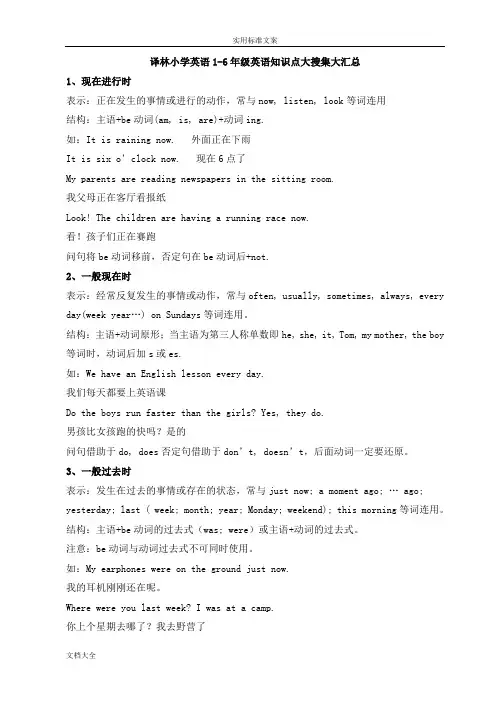
新版译林小学英语3B期末复习知识点归纳
- 格式:docx
- 大小:40.18 KB
- 文档页数:15
新版译林小学英语3B期末复习知识点归纳
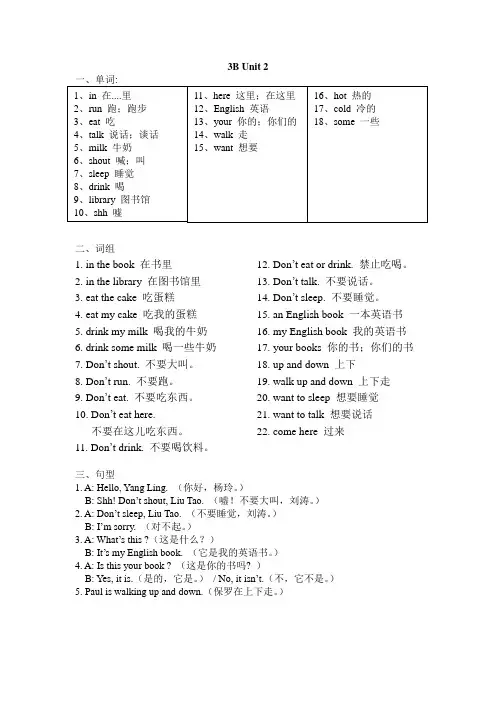
In class 在上课
在上课时,我们可以使用简单的祈使句表达一些交际用语。以下是一些常见的词汇和句型:
一、词汇
please 请
open 开
反义词 close 关上
the 这、这个
door 门
sorry 对不起
___ 进来
window 窗户
blackboard 黑板
rubber 橡皮 parrot 鹦鹉
___ 听
don’t = do not 不要
二、句型及语法
1、惯搭配/短语
在上课时,我们需要使用一些固定的搭配和短语,例如:
Good morning。class。早上好,同学们。
Stand up。起立。
Sit down。please。请坐。
___ 开门。
Open/close the book。打开/合上书。
Close the window。关窗。
___。看黑板。
Come in。请进。
Off we go。我们一起走。
I’m sorry。对不起(用于表达歉意)。 ___… 听…
例如:___…(听我/他/刘涛/鹦鹉/老师…)
2、___的用法
the”是定冠词,用来特指人或事物。所指的人或事物是同类中特定的一个。可以和单、复数名词,也可以和不可数名词连用。
例如:the apple 这个苹果(许多的苹果中,特指这一个苹果,而不是其他的苹果。)
3、Mr的用法
对男士的尊称为Mr…(…先生);Mrs太太、夫人(是对已婚妇女的称呼);___小姐(是对未婚妇女的称呼)。
4、询问“这/那是什么?”的句型及其答句
___?” “It’s a/an…”
例如:“What’s this?” “It’s a book.”
5、Don’t引导的祈使句
Don’t”引导的祈使句用于表达否定的命令或建议。结构为:①Don’t +动词原形+其他。例如:Don’t listen to the parrot。不要听鹦鹉的。②Don’t be +其他。例如:Don’t be late。不要迟到。
6、“某人有某物”的表达
主语+ have/has…”用于表达某人拥有某物。当主语是第三人称时,要用“has”。
例如:Bob has two big。big books。鲍勃有2本的书。I
have a red toy car。我有一辆红色的玩具小汽车。
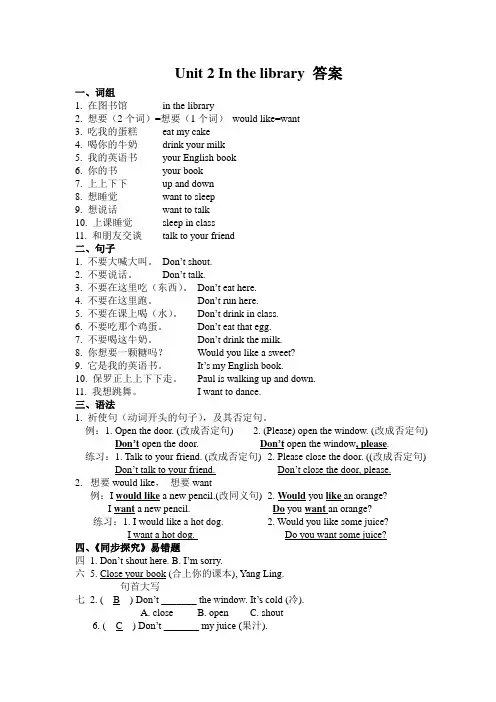
In the library。there are ___。___ or run in the library。You
also shouldn't eat or drink here。Instead。you ___ who are trying
to read or study.
To express these rules。we can use the phrase "Don't。"
followed by the n we want to prohibit。For example。"Don't run"
or "Don't talk" are both ways to ___.
If you want to ask someone if they would like something。you can use the phrase "Would you like。" followed by the item
you are offering。For example。"Would you like some milk?"
The person can then respond with "Yes。please" or "No。thanks."
When it comes to milk。it'___。This means we can't say "a
milk" or "milkS." Instead。we can say "a glass of milk" or "some
milk."
If you're trying to find something in the library。you can ask
"Is this/that your。" followed by the item you're looking for。For
example。"Is this your pencil?" If the answer is yes。the person
will say "Yes。it is." If the answer is no。they will say "No。it
isn't."
It'___。You can say "This/That is my。" followed by the
item you want to introduce。For example。"This is my pencil."
This/That isn't ___.
Where is/are + someone/something?
Where's your lunch box。
It's over there。on the ___.
___.
Here's something for you。
In Unit Four。we learn how to describe the specific n of an
object.
Vocabulary: bird。beautiful。desk。chair。tree。guess。under。on。in。behind。one。two。three。oh。wow.
Grammar:
1.ns: under。on。in。behind.
2.___ "how."
3.___ with "is" and their answers.
4.___ describing an object's specific n.
5.Asking about the n of ___.
Where is your pen。Do you know where your pen is located?
Where is the milk。Can you tell me where the milk is?
They’re over there。Your ___.
Here you are。I am giving this to you.
It’s not here。The item is not located here.
___ ___.
Stand on my desk。Please stand on top of my desk.
___. In the tree refers to foreign objects such as birds。kites。clothes。___ in the tree。On the tree refers to native objects such
as apples。oranges。and pears that grow on the tree.
How old are you。What is your age?
Nine。eight。four。five。six。seven。ten are numbers.
___.
What a nice cake。That is a beautiful cake!
___.
It’s time for。It is the time to do something.
Wake up means to。___’clock refers to the time of day。Breakfast is the morning meal。Class refers to a d of ___ is a
piece of ___.
1.What’s your name?你叫什么名字?
2.My name is…我的名字是…
3.How old are you?你几岁了?
4.I’m…years old.我…岁了。
5.What’s this in English?这个用英语怎么说?
6.It’s a…它是一个…
7.Can you spell it?你能拼写它吗?
8.Yes。it’s…是的,它是… 9.No。I can’t.不,我不会。
10.Nice to meet you.很高兴见到你。
Unit3
1.What’s your favourite colour?你最喜欢的颜色是什么?
2.___…我的最喜欢的颜色是…
3.What’s this in Chinese?这个用中文怎么说?
4.It’s a…它是一个…
5.Can you write it?你能写它吗?
6.Yes。I can.是的,我能。
7.No。I can’t.不,我不会。
8.How many…do you have?你有多少个…?
9.I have…我有…
10.What’s your favourite food?你最喜欢的食物是什么?
11.___…我的最喜欢的食物是…
Unit4
1.What day is it today?今天是星期几?
2.It’s…今天是…
3.___?天气怎么样?
4.It’s…天气是…
5.What do you do on…?你在…做什么?