
communication
- 格式:ppt
- 大小:459.00 KB
- 文档页数:72

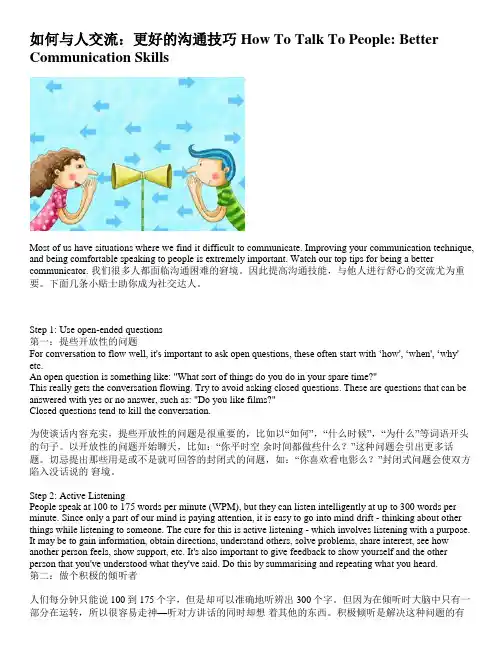
如何与人交流:更好的沟通技巧How To Talk To People: Better Communication Skills
Most of us have situations where we find it difficult to communicate. Improving your communication technique,
and being comfortable speaking to people is extremely important. Watch our top tips for being a better
communicator. 我们很多人都面临沟通困难的窘境。因此提高沟通技能,与他人进行舒心的交流尤为重要。下面几条小贴士助你成为社交达人。
Step 1: Use open-ended questions
第一:提些开放性的问题
For conversation to flow well, it's important to ask open questions, these often start with ‘how', ‘when', ‘why'
etc.
An open question is something like: "What sort of things do you do in your spare time?"
This really gets the conversation flowing. Try to avoid asking closed questions. These are questions that can be
answered with yes or no answer, such as: "Do you like films?"
Closed questions tend to kill the conversation.
the potential problems of intercultural communication
Intercultural communication is communication between members of different
cultures. The potential problems of intercultural communication include emotional
problems、attitudinal problems 、language problems and so on. Emotional problems
complete with assuming similarity instead of difference、anxiety, and uncertainty.
Attitudinal problems include ethnocentrism、 stereotyping and prejudice racism.
Assuming similarity instead of difference is as “Birds of a feather flock
together.” Most people seek to be near others with whom they share common outlooks,
habits and traits. The problem arises when the pull of similarities excludes those who
are different.
In short, many people deal with the unfamiliar by withdrawing from interaction
with strangers or by experiencing feelings of anxiety. Anxiety occurs because of not

Intercultural Communication
1. What is intercultural communication?
Intercultural communication is a form of global communication. It is
used to describe the wide range of communication problems that naturally
appear within an organization made up of individuals from different
religious, social, ethnic, and educational backgrounds. Intercultural
communication is sometimes used synonymously with cross-cultural
communication. In this sense it seeks to understand how people from
different countries and cultures act, communicate and perceive the world
around them. Many people in intercultural business communication argue
that culture determines how individuals encode messages, what mediums
they choose for transmitting them, and the way messages are interpreted.
As a separate notion, it studies situations where people from different
1 Culture, Communication and Intercultural Communication
A brief introduction to the history of the study of ICC:
1. In 1946: The US government passed the Foreign Service Act and established the Foreign Service Institute.
2. In 1959: The publication of the Silent Language by the American cultural anthropologist, Edward T. Hall
marked the emergence of ICC.
3. In 1966: ICC was regarded as curriculum in the US.
4. In 1970: ICC was recognized as an independent area of study by the International Communication Association
(国际传播学会).
5. In 1972: The first international conference on intercultural communication was held in Japan.
6. In 1983: Gudykunst, American well known scholar in ICC, edited the first text on intercultural communication
theory, Intercultural Communication Theories.
Keywords:
1. Culture (from intellectual perspective): Culture is “the arts and other manifestations of human intellectual