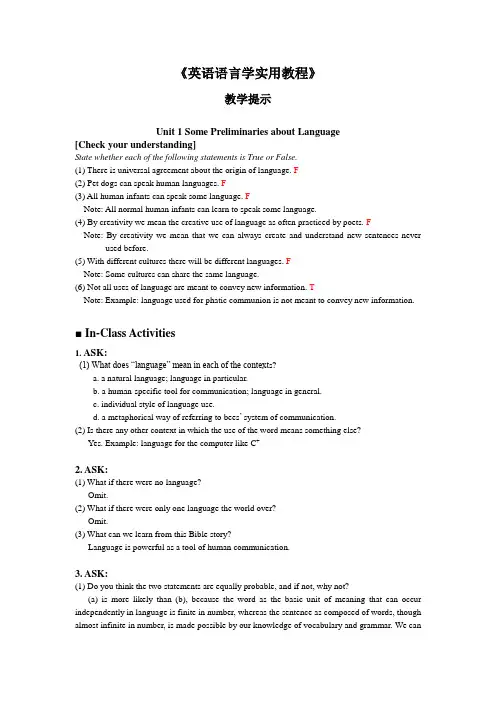
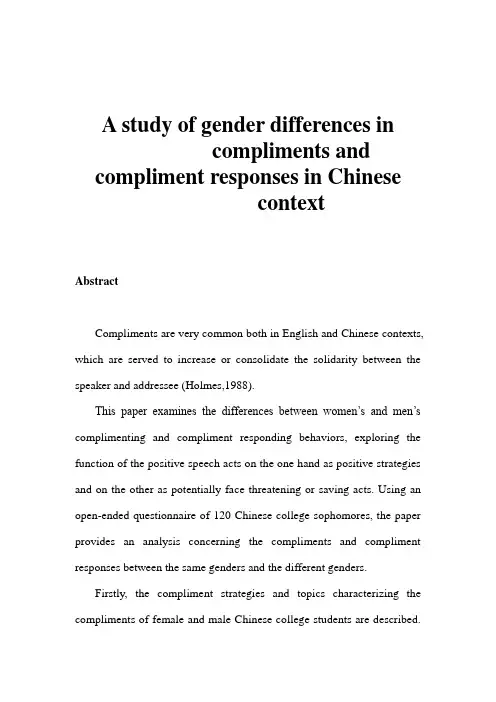
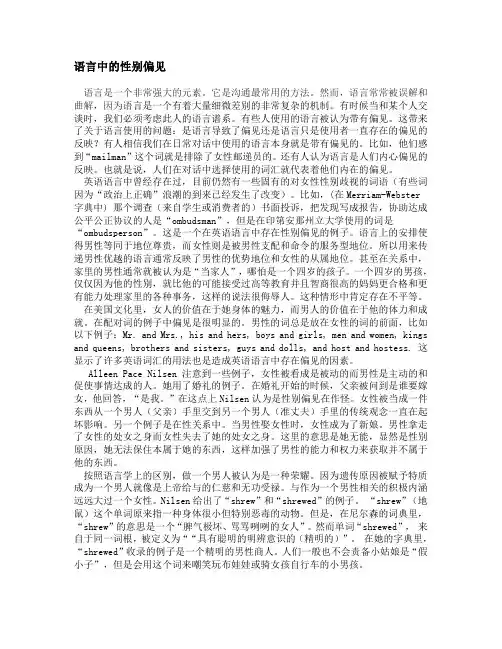
《英语语言学实用教程》教学提示Unit 1 Some Preliminaries about Language[Check your understanding]State whether each of the following statements is True or False.(1) There is universal agreement about the origin of language. F(2) Pet dogs can speak human languages. F(3) All human infants can speak some language. FNote: All normal human infants can learn to speak some language.(4) By creativity we mean the creative use of language as often practiced by poets. FNote: By creativity we mean that we can always create and understand new sentences never used before.(5) With different cultures there will be different languages. FNote: Some cultures can share the same language.(6) Not all uses of language are meant to convey new information. TNote: Example: language used for phatic communion is not meant to convey new information.■ In-Class Activities1. ASK:(1) What does ―language‖ mean in each of the context s?a. a natural language; language in particular.b. a human-specific tool for communication; language in general.c. individual style of language use.d. a metaphorical way of referring to bees’ system of communication.(2) Is there any other context in which the use of the word means something else?Yes. Example: language for the computer like C+2. ASK:(1) What if there were no language?Omit.(2) What if there were only one language the world over?Omit.(3) What can we learn from this Bible story?Language is powerful as a tool of human communication.3. ASK:(1) Do you think the two statements are equally probable, and if not, why not?(a) is more likely than (b), because the word as the basic unit of meaning that can occur independently in language is finite in number, whereas the sentence as composed of words, though almost infinite in number, is made possible by our knowledge of vocabulary and grammar. We canalways produce and understand sentences that we never come across before. In that sense, no sentence is really new.(2) In what context do we make the second statement?When we focus our attention on the meaning of a sentence or when we are concerned with the form of a sentence as found in a language class.4. ASK:(1) Are there onomatopoeic words in Chinese?Yes. e.g. “哗啦”、“扑通”、“喀嚓”.(2) Does the existence of onomatopoeic words overthrow the claim that language is arbitrary?No. Onomatopoeic words account for a very limited percentage in the vocabulary of a language.5. ASK:(1) Can one really invent a language of one’s own?No.(2) If not, why?A language comes into being and use by convention or agreement among its speakers.6. ASK:(1) Is there any basic flaw in this experiment?The process is not strictly controlled. There may have been some coincidence. The sample size is too small for the experiment to be valid.(2) Do you think we really can answer the question about the beginning of language?No, at least in the present condition where/when we cannot perform experiments on the human brain, the key organ of speech.7. ASK:(1) Can you identify the most likely order (from least to most advanced) of these samples?C→B→A(2) What features in each child’s utterances can you use as evidence to support your ordering?Child A: good syntax except for improper question form.Child B: visible development of syntax; overgeneralizationChild C: Not much syntax; two-word utterances; telegraphic sentences (sentences that contain only content words but lack function words)8. ASK:(1) It is often assumed that children imitate adults in the course of language acquisition. Canimitation account for the above production on the part of the child?Not wholly. There is counter evidence against the assumption, like the overgeneralization ―go-ed‖ for ―went‖.(2) What distinguishes the child’s production from that of the adult?Overgeneralization of ―-ed‖ for the past tense as shown by ―holded‖.9. ASK:(1) How do adults reinforce the process of children’s acquisition as exemplified here?They use explicit correction.(2) Do children know what they are doing wrongly?Not exactly.(3) Do the adults succeed in their reinforcement?Not always, at least.(4) How should we treat the ―mistakes‖ that children make while acquiring their mother tongue?We may ignore them sometimes, although some amount of reinforcement may turn out to be helpful.10. ASK:(1) Do children learn through structured or simplified input, as suggested?Not always. There is evidence for both sides.(2) Can you offer some examples illustrating, representing the way adults talk to infants?Omit.Note: Motherese is characterized by shorter sentences, higher pitch, exaggerated intonation, higher proportion of content words to function words, simple syntax, more interrogatives and imperatives, more repetitions. Yet it is not syntactically simpler. Rather, it may include syntactically complex sentences such as questions: Do you want your juice now?Embedded sentences: Mommy thinks you should sleep now. Imperatives: Pat the dog gently! Negatives with tag questions: We don‟t want to hurt him, do we?Indeed, it is fortunate that motherese is not syntactically restricted. If it were, children might not have sufficient information to extract the rules of their language.11. ASK(1) What measures do you suggest for protecting dialects as well as languages?Omit.(2) Do you think that someday people all over the world will speak only one language, or somedayno dialect will exist?Omit.12. ASK:Are there any universals that you think all languages share but are not mentioned here?E.g. All languages have internal structures.All languages have numericals.■ ExercisesTask 3: Study Questions1. What do you think is essential to the emergence of language?The existence of social activities; the need to express diverse ideas, emotions, etc.; the need to communicate ideas to distant places; etc.2. Can our pets learn human languages? Why or why not?No. They are genetically not endowed with the capacity.3. What role does body language play in language communication?Omit.4. N aturally occurring ―experiments‖ with so-called ―wolf-children‖, ―bear-children‖,―Mowgli‖or ―monkey-children‖ and other such feral youngsters have been widely reported for hundreds of years. None of these children could speak or understand speech and, indeed, most efforts to teach them language ended in failure. How would you account for the failure?The language acquisition device has to be triggered before a certain age (that of puberty). Sufficient expose to a language environment at the right time is essential to language acquisition.5. The following are some instances of using English for communication. What specific functiondoes each use of English serve in the following pictures?Informative (in the form of commanding)Directive (Advertising in the form of requesting)Directive (Persuading in the form of threatening)Directive (Recruiting)6.Iconicity of language is an aspect of language where form echoes meaning. Onomatopoeia, also known as ―sound symbolism‖, is one type of iconicity. Some researchers have found other evidence of iconicity. For example, words beginning with the sound combination sl- in English often have an unpleasant sense, as in slithering, slimy, slugs. Here are some questions:a. Is the ―unpleasant‖ sense actually true of all, or even most, words beginning with sl- in English? No. e.g. slight.b. Are there any other sounds or sound combinations that you associate with particular meanings? Gliding: slide, slip, slippery;Rolling: tumble, crumble, stumblec. How about the vowel sounds in words that identify near-to-speaker concepts (this, near, here) versus far-from-speaker concepts (that, far, there)? What is the difference? Is it a general pattern distinguishing terms for things that are near versus far in English? What about the case in Chinese?Front vowels for near-speaker concepts; central or back vowels for far-from-speaker concepts. There seems to be a similar kind of pattern in Chinese. C.f. 近jin /远yuan;这zhe /那na7. In many of the world’s languages there are so-called nursery names for parents. In English, for example, corresponding to the word mother is the nursery name mama, and for father one finds dada and papa. There is remarkable similarity across different languages in the form of these nursery names for parents. For example, in Chinese and Navajo ma corresponds to English mama. Why do you think that this is the case?Bilabials are learned and produced first because they are the easiest.8.a. What are some of the changes which appear to have taken place in the child’s ability to useEnglish during that period?Like the basically proper use of interrogatives and the correct use of inflection.b. What do these changes suggest about the order of language acquisition?Complete sentences are acquired later than elliptical ones. Inflection is acquired at a late stage.Unit 2 The Sounds of English[Check your understanding]State whether each of the following statements is True or False.1. [i:] and [i] are allophones of the same phoneme. F2. Not all English phonemes have allophones. TNote: /☠/ and /j/ occur in one single position and therefore do not have allophones.3. The same set of vowels is used in all languages. F4. All syllables must contain at least one vowel. FNote: Some syllables may contain no vowels. They may, instead, employ some syllabic consonant, as in people and muscle.5. The marking of word stress is arbitrary for the most part in English. F6. English is a tone language. FNote: Chinese is a tone language.■ In-Class Activities1. ASK:(1) What is the phonetic environment of [t] in [pit]?[i_#](2) Are the following pairs of words minimal pairs?(a) desk vs. task No.(b) leave vs. Leak Yes. ( li:v vs. li:k )2. ASK:(1) Characterize how the allophones of the phoneme /k/ are complementarily distributed.[k h ] in initial position; [k]after /s/; [k¬] in final position.(2) Is there any other way of charactering the complementary distribution of clear [l] and dark [ł]?[l] before vowels; [ł] elsewhere.3. ASK:(1) What distinctive feature makes /f/ and /v/ different?[voiced](2) Can you specify the distinctive features for the following phonemes?(a) /☞/ [fricative] + [voiceless] + [palatal](b) /k/ [velar]+[voiceless]+[plosive](c) /n/ [nasal]+[voiced] +[alveolar]4. ASK:(1) Are [r] and [l] in complementary distribution? In what environment does each occur?Yes. [r] occurs before vowels; [l] occurs after vowels.(2) Do they occur in any minimal pairs?No.(3) Suppose [r] and [l] are allophones of one phoneme. State the rule that can derive the allophonicforms.[r] is lateralized when it occurs after vowels.5. ASK:(1) Can you give more examples of assimilation?compatriot, sing(2) Can you find any exceptions?input, unbeatable, Canberra(3) What phonetic segments condition this change?The consonant immediately after the vowel.[Note] 2) [tai] should be [tay].6. ASK:(1) Can you give more examples of free variation?advertisement [əd΄və:ti s mənt] [əd΄və:ti z mənt]association [ə səu s i΄ei☞ən] [ə səu☞i΄ei☞ən](2) Why do you think such a phenomenon exists in a language like English?Individual variation is responsible for this phenomenon.7. ASK:(1) Which sound is deleted in ―sign‖, ―design‖, and ―resign‖?[g](2) Can you offer other examples of deletion?paradi g m (atic), condem n(ation)(3) Can you give some words that involve total deletion?plum b, plum b er; clim b, clim b ing(4) Are there any other types of deletion in English?de b t, k now8. ASK:(1) Can you think of a phonetic description of the regular pattern in these expressions?They all start with a front, high vowel and follow up with a mid or low vowel.(2) Can you think of any possible explanation for the observed pattern?[i] involves the least degree of mouth opening while the mid or low vowels necessitate biggeropening. There is an increase of mouth opening in pronouncing the whole word, which is symbolic in meaning.9. ASK:(1) What are likely positive effects of using alliteration? Use one of the poetic examples toillustrate.Coherence, connectedness, smoothness, consistency. Take ―I slip, I slide, I gloom, I glance‖for example. The double alliteration involved helps to create a picture of smooth and coherent dance.(2) Is there a similar use of alliteration in Chinese?Yes, though less often. 花好月圆is a good example.10. ASK:(1) What is the stylistic effect of rhyming?echoing, agreement, correspondence, etc.(2) Can you find more proverbs that involve internal rhyming?First thrive and then wive.Fancy passes beauty.■ ExercisesTask 3: Study Questions1.a. Does the string of sounds mean anything to you?If we want to talk really good, we’ll have to invent vowels.b. What does the picture suggest to you about the role of consonants and vowels in English? Consonants are the backbones of syllables and words.2. Some phonetic transcriptions below are English words, some are not existing words but are possible words or nonsense words, and others are definitely ―foreign‖or impossible because they violate English sequential constraints. Specify each of the a-e cases as illustrated.Word Possible Foreign ReasonExample:[pa:k][tif][lkib]a. [ŋa:f] √[☠] must occur after a vowel.b. [ski:] skic.[knait] √d.[meij] √[ ] must occur initially before avowel.e.[blaft] √3. In English, the /i/ vowel becomes almost as long as /i:/ under certain conditions (written as /i:/ for convenience). Consider the examples listed below:a. List the phonemes that condition the change.voiced consonantsb. State the rule that seems involved.[i] is lengthened before a voiced] consonant.Note: Start with the fact that the /i/ is basic and that short /i/ becomes long /i:/. The change from short /i/ to long /i:/ is phonologically determined; that is, the lengthening takes place in the presence of certain phonemes. A good strategy is to first list the phonemes to the right of long /i:/, then list those to the left. As an answer to (a), then, one would propose that /i/ become /i:/ whenever the phonemes to the right (/d, m, l, b, z, j, ŋ/) occur immediately after that vowel. This hypothesis looks promising because, in fact, the short variant /i/ never occurs before these segments. The next question is, what is it about the phonemes on the right that unify them as a class? One may find that these phonemes are all voiced ([+voice]), and, in fact, the short /i/ never lengthens before voiceless segments. Thus the answer to (b) is that the vowel /i/ is lengthened before (the natural class of) voiced consonants.4. The use of plural–s in English has three different, but very regular, phonological alternatives.a. Can you work out the set of sounds which regularly precedes each of these alternatives?/s/ to words like ship, bat, book and cough;voiceless plosives [voiceless]/z/ to words like cab, lad, cave, rag and thing;after voiced consonants [voiced]/əz/ to words like bus, bush, judge, church and maze.after /s/, /☞/, /d✞/, /z/b. What features does each of these sets have in common?[palatal] or [alveolar]+[fricative]c. Is there any pattern regarding the different pronunciations of the past tense marker?[t] after voiceless consonants except [t]; [d] after voiced consonants except [d]; [id] after [t] or [d].d. Do you think that one of these phonological forms for –ed is more basic, with the others beingderived from it in a regular way? Which, and how?[d] is more basic. [t] after devoicing. [id] after epenthesis (i.e. addition of a sound).5. Below are three columns of words with different patterns of stress:a. How is stress distributed in each column?penultimate for A; last syllable for B; on the last syllable.b. In Column B, what kinds of vowels appear in the last syllable? How does the syllabic structure of Column C differ from A and B?In Column B, long vowels or diphthongs appear in the last syllable.The last syllable of the words in C ends in consonant clusters.[Note] For ―usurp‖, ―r‖ may be pronounced as in /ju(:)΄zə(r)p/.6. The following is a list of words that are spelt in a similar way:fuddy-duddy hocus-pocus namby-pambyfuzzy-wuzzy hurly-burly razzle-dazzlehanky-panky lovey-dovey roly-polyhelter-skelter mumbo-jumbo super-dupera. What similarity can you spot among the words listed?All pairs are the same except the initial consonants.b. What effects may such words have in common when they are put into use?Redundancy, repetitiveness, etc.7. Write the phonetic transcription for each of the following words.Omit.8. Read the following words or phrases and point out the phonological processes that yield assimilation.(a) pat /pæt/ pan /pãn/ sat /sæt/ Sam /sãm/Nasalization rule: [-nasal] →[+nasal] /_____ [+nasal](b) since /sins/ sink /siŋk/ hint /hint/ dink /diŋk/Velarization rule: [-velarl] →[+velar] /_____ [+velar](c) five pits /faifpits/ love to /l∧ftə /Devoicing rule: [+voiced →[-voiceless] /_____ [-voiceless]9.a. Comment on the use of rhyme, alliteration, and assonance(that is, use of syllables with a common vowel, as in ―come‖ - ―love‖) in this poem. How are they used to stress the sense of superficiality and lack of meaning the poet is trying to convey here? (Note especially the role of rhyming pairs of monosyllables and their effect on meter.)assonance: [ri:t☞] [skri:n] [spi:t☞][♈ud] [huk] [buk]The ryhmed words, all monosyllabic and stressed, are semantically unrelated and separated.Alliteration is only sporadically used. Assonance suggests apparent connection but actual disconnectedness.b. Comment more carefully on meter in the first two stanzas. How does it contribute to the meaning? How and where does it work against our expectations?Lack of regularity and thus unpredictability.10. Collect some data to show that English advertisements, newspaper headlines, English songs,and presidential addressee sometimes make use of alliteration and rhyming.Omit.11. What interesting things do speech errors tell us about language and its use? Collect a few casesof slips of tongue from daily conversations.Speech errors are often explainable, often semantically motivated.Unit 3 The Units of English[Check your understanding]State whether each of the following statements is True or False.1. All words in English have a hierarchical structure. FNote: Mon-morphemic words do not.2. Clipping is one of the three most important devices of word-formation in English. FNote: The three most important devices are affixation, compounding (or composition) and conversion (or functional shift).3. Idioms in English are modifiable in some grammatical ways. T4. The presence of constructions is unique to English. F5. Every English sentence has a subject. FNote: Imperative sentences do not have any subject.■ In-Class Activities1.ASK:(1) What is the infix used in the above language data?―-um-―(2) What is the verb form in Bontoc for ―to be poor‖, given that pusi means ―poor‖?―pumusi‖2. ASK:(1) What is the Samoan for: (a) ―they travel‖ (b) ―he sings‖ respectively?(a) savavali (b) pese(2) Formulate a morphological rule regarding how to form the plural verb form from the singularverb form in Samoan.Duplicate the penultimate syllable.3. ASK:(1) Which other affixes are there in English that function as markers of negation?dis-, non-, a-, in-, il-, im-, ir-(2) What pattern underlies the use of un- in the data above?Positive terms can have negative morphemes added to them, as in ―happy-unhappy‖, but semantically negative ones rarely do, because un- is deprecatory as well as negative.(3) Why are ―ungood‖ and ―unbig‖ not found in English, although George Orwell coined―ungood‖in his novel Nineteen Eighty-Four? Do you think they are accidental gaps in the lexicon of English?There already exist words that correspond to ―ungood‖ and ―unbig‖. It is not accidental. This is what is technically called lexical blocking.(4) Read the following extract from Lewis Carroll’s Through the Looking-Glass. How do you think Humpty Dumpty would explain the word ―un-birthday‖ to Alice?―Un-birthday‖ means some day that is not one’s birthday.(5) The fact that un- can be both a verb prefix and an adjective prefix may explain the occurrenceof the ambiguous word ―unlockable‖. Can you imagine two situati ons corresponding to the two senses of the word?? Can you give mo re examples like ―unlockable‖?Imagine you are inside a room and you want some privacy. You would be unhappy to find the door is unlockable–―not able to be locked.‖ Now imagine you are inside a locked room trying to get out. You would be very relieved to find that the door is unlockable–―able to be unlocked.‖ These two meanings correspond to two different structures, as follows:Adjective Adjectiveun- Adjective Verb -ableV erb -able un- V erblock lockIn the first structure the verb ―lock‖ combines with the suffix –able to form the adjective lockable (―able to be locked‖). Then the prefix un-, meaning ―not,‖ combines with the derived adjective to form a new adjective unlockable (―not able to be locked‖). In the second case, the prefix un- combines with the verb lock to form a derived verb, unlock. Then the derived verb combines with the suffix –able to form unlockable, ―able to be unlocked.‖Other examples are unbuttonalbe, unzippable, and unlatchable.4. ASK:(1) How are the verbs in Column A different from those in Column B?Verbs in Column A are transitive while those in Column B are generally intransitive.(2) Can we use ―able to be X-ed‖ to paraphrase ―perishable‖?No. ―Perish‖ is intransitive.(3) A further complication with -able is that in words li ke ―unthinkable‖, the suffix means morethan ―able to be X-ed‖. Why? Can you think of more words of this type?unbreakable,presentable, readable, questionable, payable, washable.(4) Now, let’s l ook at another complication. None of the following words are permitted. What doesthis suggest about the use of the suffix ―-able‖?―-able‖ are not attached to nouns, adjectives, or prepositions.5. ASK:(1) Note the contrast between list A and List B. Can you think of any reason that can explain whythe set of words on List B are impossible words in English?Verbs on List B are intransitive.(2) How are the re- words on List C and List D different from those on List A?Words on List C are made up of re- +adjectives. In the words on List D, ―re-‖ means ―back‖instead of ―again‖.(3) Some re- prefixed words may mean more than the simple addition of the meaning of re- andthe meaning of its base. For example, ―rewrite‖ means ―write something again, especially in a different or improved form‖.Can you give more examples like ―rewrite‖?rebuild, rethink, retry, retell, reorganize, reconsider, reform, etc.6. ASK:(1) Can you give some examples that you consider to be chunks?Omit.(2) Read the following spoken data of a Chinese student. Can you point out the chunks used in it?Can you classify them into some types?It is the most unforgettable birthday um ... that I ... and I can not forget it for forever. Um ... it it was when I was a freshman. It is the first year um ... I left my family and spend my birthday alone. Um ... I remember clearly um ... that day I strode gloomily at campus along for a long time um. And um ... um ... I I felt very ... I I felt ...I felt very gloomy because no one, um no one except my parents um remember my birthday and, and, wan and wanted to um ... and wanted to stay with me for my birthday. Um ... um ... I did, I did not went back I did not go back to the dormitory um ... until um ... until seven o‟clock in the evening. Um ... the light, the lig ht in the dormitory was off. Obviously, um there was no ... there was nobody staying in the dormitory. Um ...but now um ... it may ... it ... it ... seemed um ... it seemed that it doesn‟t matter. Um ... And I open the door um ... and I found except darkness there was nothing. Suddenly a song “Happy birthday to you” sound. I felt, I felt very astonished. Then, the light was turned on. Some familiar faces um ... um full of full of sweet smiles towards me. Um they were my dorm they were my dorm mates ... Yes, they still remembered um ...my birthday, my birthday. And in fact they have ... they indeed prepared for it two years ago. They bought er ... a very beautiful cake for me, and that night um ... we sang, we danced and ... and had that delicious cake. I felt very happy, and and later I (I)made a call to my parents that told them that I has spent a very unforgettable birthday with my roommates.verbal: went/go back; turn(ed) on; prepare for; make a call toadjectival: full ofprepositional: at campus (it should be ―on campus‖, though); for a long time; in the evening; in factclausal: it seemed that ….; it doesn’t matter7. The notion of subject may be classified into three types: grammatical subject(the major nominal part corresponding to the predicate), logical subject (the doer or executor of the action concerned), and psychological subject(the first major component of the sentence, like a nominal phrase, an adverbial phrase, or a prepositional phrase). For instance,a. John(grammatical subject, psychological subject, logical subject) robbed the City Bank last night.b. The City Bank (grammatical subject, psychological subject) was robbed by John (logical subject) last night.c. Last night (psychological subject) John (grammatical subject, logical subject) robbed the City Bank.Analyze the following newspaper headlines from the Washington Post (July 21-24, 2006) in terms of the effect of subject type selection.(a) In Iraq, Military Forgot Lessons of Vietnam (psychological)(b) Evacuation Rules Separate N.Va. Friends (grammatical)(c) Woods Is Closely Followed At British (logical, grammatical)8. ASK:(1) Can you write the public signs in complete forms?You may push the button and wait for the signal of walk.You must use caution when the ground is wet.(2) What rules are there when we write elliptical English newspaper headlines?a. Omit auxiliary or linking verb BE;b. Omit determiners;c. Omit indefinite nouns of person.d. Omit There Be.Task 3: Study Questions1. Point out the word-formation process that applies to each of the following words: Affixation: worsen endearmentConversion: dust (v.) plane (v.)Compounding: laptop airsick daughter-in-lawBack-formation: edit televise peddle swindle (swindler)Shortening: tec (detective) prof (professor) bike (bicycle)Blending: brunch urinalysis (urine + analysis) fantabulous (fantasy + fabulous)Initialism: WTO (World Trade Organization)Acronym: laser (light amplification by stimulated emission of radiation) FIFA (Federation Internationale de Football Association)Coinage (in the forms of invention and eponym—words derived from proper names): Xerox nylon jumbo (name of an elephant brought to the United States by P. T. Barnum)2. How are the open-class words and the closed-class words different from each other?Open-class words:(1)large in number;(2)easy to expand;(3)mainly nouns, verbs, adjectives, and adverbs.Closed-class words:(1) small in number;(2) stable;(3) basically pronouns, prepositions, function words, etc.3. What are the inflectional morphemes in the following phrases?(a) the government‟s policies ’s; -s(b) the latest news -est(c) Isn‟t it snow ing! -ing(d) two frightened cows-ed; -s4. Suppose a speaker of English invents the following italicized English words as a joke: ―they’re always causing a commotion. I tell them not to commote, but they insist on being big commoters.” What process of word creation does this example illustrate, and why? What do the new words mean?It is a process of back-formation. ―Commote‖means the act of causing disorder and ―commoter‖ means someone who causes disorder.。