
牛津九全册· 期中复习专题 chapter 1 body language 短语、词组
- 格式:ppt
- 大小:38.00 KB
- 文档页数:24

Chapter 1 Body Language·Vocabularymunicate·communicate with sb. 与某人交流Parents should always communicate with their children. ·communication 沟通,交流 n.Speech is not the only method of communication.语言不是唯一的沟通方法。
·Ways of communicatingSpoken language:speaking、ringingWriting language:writing、typingBody language:gesturing2.disappointed adj. 失望的She felt a little disappointed.她感到有一点失望。
·disappointing adj. 令人失望的The result was disappointing. 结果令人失望·disappointment n. 失望She left the airport in great disappointment. 她极为失望地离开机场。
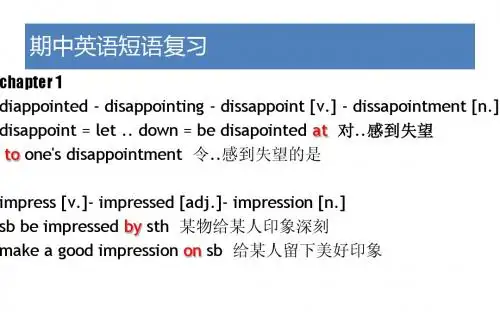
·to one’s disappointment 使某人失望的是to one’s surprise 使某人惊喜的是·disappoint 使(某人)失望, 沮丧v.disappointing 令人失望的, adj.disappointed 感到失望的, adj.·disappoint使(某人)失望, 沮丧v.Don’t disappoint me again.·be disappointed with sb. 对某人失望·make sb. disappointed = let sb. down 让某人失望3、employee n. 职员,雇员The company has 100 employees. 这家公司有100名员工。

wordChapter 1 of Junior 9 Body LanguageLesson PlanTeaching aims and demands:1.Words and expressions:a.Learn how to use 15 words :employee, well-dressed, enter, sigh, senior, prefer, chance, gesture, appearance, impression, hesitation, remind, century, beauty, pronunciation, false, uniform, date, regards, invitationb. Learn to use the following phrases:body language,glance at someone,greet someone cheerfully,rest one’s head on one’s hand ,make a good impression on someone, hold one’s head up,make eye contact with someone, without hesitation,a few moments later, remind someone of somethingtake great care of one’s appearance, use gestures to municatefree of charge, a travel agency ,receive an invitation be in hospitalas a matter of fact2. Be able to skillfully use the usage of zero article.3.Read and prehend the reading in Chapter One4.Understand how to use gestures to municate5. Learn to write a short messagesMain and difficult points:1. Phrases2. Reading prehensionTeaching Methods:1. Listening, speaking and writing.2. Watch and say3. Pair / group workTeaching aids:PPT and tape recorderPeriods needed:10Teaching procedures:Period OneTeaching target1.To know some new words about thereadingpassage.Pronounce the words correctly.2. Memorize the word spellinge the words and phrases to make the sentences.4.To have a warm-up to know about some gestures and expressions.Cartoon talk1Give students some time to look at the cartoon on SB 9, page 1. Tell them to read the sentences carefully.2. Meaning of the cartoon:This cartoon draws attebtion to the topic of the main passage by showing us a strage, frightening man. His appearance and body language make people run away, instead of attracting them to him. Teaching courses:a.Pre-chapter activitiesStep1 Greetings and leading in.1.How many ways do people municatein ?Spoken language,Written language,Body language2.What is Body language?Gestures and expression.Step2 Can you name the expressions shown by the hands below?thumb a ride(You’re out of gasand find yourself stuck on the road. You wave your thumb at the driver.)thumbs up (This symbol means“ok,” or “good,” in the U.S.)thumbs down(You can’t get thesupport you want.)under one’s thumb(ruled byanother or control by him)In the U.S. and other places, it means“all right”; In Japan it means “money”; In France it means“zero,”The symbol is a way to ward off( 守护;防卫 ) bad luck, & theevil (邪恶的, 不幸的)Body language is the most important form of munication!You can express your thoughts and emotions even without speaking a word. The way you stand and sit and the expression on your face and the eyes can give people an impression.b.Look at the pictures on page 2. What feelings does the girl’s body language show? Match the words with the pictures.c. Watch a vedioWatch a vedio and say how much you understand.In the early 1900s, the first films were black and white, and there was no sound. We call themsilent films. Actors and actresses used bodylanguage to tell people what they were actingabout. Charles Chaplinwas the most famoussilent film actor. The following is part of his film named Modern Times. Watch it and tryto understand as much as you can.d. Vocabulary Box.Guess the words according to the English meaning.1.a business that makes its money esp. by bringing people into touch with others---agency2. to give a quick short look---glance3. to wele with words or actions---greet4. happy and lively, in good spirits---cheerful5. to let out a deep breath slowly and with a sound, usu, expressing sadness , tiredness…sigh6. (someone who is ) older ---senior( someone ) of high or higher rank7. a person who is employed---employee8. the act or process of municating---munication9. the use of movement of the body ,esp. of the hands, to express a certain meaning---gesture10. the outside quantity of a person or a thing;the act of appearing ---appearance11. the state of having connection or exchanging information or idea with others---contact12. state / act of hesitating ---hesitation13. to tell or cause someone to remember a fact--- remind14. the office desk or department that receivevictorsto a hotel or an organization---reception15. something suggested---suggestion16. the state of being unhappy at not seeinghopes e true---disappointment17. a planned way of doingsomething---methode. Learn to pronounce the words correctly.f. Conclusiong. Assignments.a. Recite the new words and expressions.(from disappointed to appearance)b. Listen to the tape about the reading passage three times.Period TwoTeaching target1. Review the new words and expressions.2. While-reading.a. Listen to the passage carefully and answer the questionsb. Look through the text and list the body languages between Debbie and Simon.c. Readand think. Then answer somequestions about the reading.d. Read and understand the reading passage further.Teaching courses:a. Review the new words and expressions.Fill in the blanks with the correct words.1.Next year we’ll go to s_______ middleschool.2. I got this job through an employment a____.3. He g________ at his watch and hurried out.4. He g_______us by shouting a friendly “ Hello!”5. The teacher made a g _______ of anger to show that he was not satisfied with our work.6. The closing ceremony of the Beijing Olympic Games was c____________.7. You can tell from her a___________ that shehas been ill.8. I’ve been trying to get in c_______ with himsince he left China.9. When he heard the bad news, he was in greatd__________________.10. The old actress s_______ for her lost youth.11. I’d like to make a s__________ that weshould study harder in the new school year.12. Without a moment’s h__________, heoffered to be volunteers, working day andnight in Wenchuan.13. Athletes from all over the world got a veryfriendly r________ in Beijing during theOlympic Games.14. The bank has introduced a new ________of calculating the interest.15. He applied for a job as an e____________of the pany.16. Body language is one of the mostimportant form of c______________.b.Listen and answer the questions1. Where do Debbie and Simon have part-time jobs?At a travel agency.2. Who did the well-dressed laday prefer?Debbie.3. Does Simon make a good impression on people? Why?No.Because he often rest his head on his hand. He doesn’t look up and never smiles.c.Skim the text and list the bodylanguages between Debbie and Simon.d. To read it further and think. Thenanswer some questions about the reading.1. What is the main topic of the story?2. Where are Debbie and Simon?3. Who gives Simon advice?4. In the photo, which person looks morefriendly, the boy or the girl?5. How does Debbie make the customers feelgood?6. Why does Simon’s body language keep thecustomers away from him?7. What did Simon do to improve his appearance?8. Did Simon Really make a customer preferto him this time?e. Read the whole passage and have a deeper understanding about it.The new words.C1.Read and guess the meanings of some words. Then use them to plete the conversation.1. How do you know she was disappointed atthe news?She ________.2. What does your sister do?She works at the reception desk in a hotel.She takes great care of her _____________.3. Was it difficult to make him agree to yoursuggestion?No. He agreed _____________________.4. Did you read the newspaper this morning?No. I only ______________ the headlines.5. How do people who cannot speak under oneanother?They use __________ to municate.6. Would rather go out or stay at home?I’d ________ to stay at home.C2 Read and find the words in the story that have meanings similar to the following.1. wearing nice clothes---be well-dressed2. e or go into a place---enter3. holding a higher position---senior4. a person who is paid to work for otherpeople---employee5. What is the matter?---What’s up?6. a suitable time when it is possible to dosomething ---chance7. make people think highly of you---make agood impression on people8. help somebody remember something---remindSentencesD Read and plete the questions below according to the answers.1. Who walked over to Debbie?A well-dressed lady.2. How did Debbie greet toher?Cheerfully.3. Whydid the customers always preferDebbie to Simon?Because he doesn’t make a goodimpression on them.4. What did Simon decide todo?To improve his body language.f. Conclusiong. Assignments.1). Recite the new words and expressions.(from rest to false teeth)2). Read the passage after the tape and try to recite paragraph 1- 7.Period ThreeTeaching target1. To read it intensively and fill in the blanksabout the reading.2. To explain the key points about the reading.3. Conclude the key phrases.Teaching courses:a. Revision1. Ask some students to try to recite paragraph 1- 7.2. Have a dictation about the new words.b. Read the story & plete the speech bubble.I s poke to Mr. Young today. He’s one ofthe 1)______ employees at the travel agency.I told him that our customers always preferto talk to 2) _______. He told me the problemmight be the way I 3) ______________. Heexplained to me about 4) ______ language.He said that my body language was notgiving customers a good 5)__________. Sonow I’m trying to 6) __________ my bodylanguage.c. Conclude some important phrases about the reading passage.1 body language2 a travel agency3 a well-dressed lady4 g lance at…5 walk over to someone6 greet someone cheerfully7 a senior employee8 prefer Debbie to me9 the way you municatewith others10 a chance to speak to…11 your gesture and the expression on your face12 give sb. a good impression /make a good impression on sb.13 rest one’s head on one’s hand14 look up; hold one’s head ( up)15 make eye contact with …16 improve his body language17 without hesitation18 remind me that tomorrowis her birthdayd. Importance and Difficulty1.disappointment 失望,沮丧 n.disappoint使(某人)失望, 沮丧v.e.g. To our disappointment, it rained on the day of the piic.Don’t disappoint me again.2.well-dressed 穿着讲究的adje.g. People are well-dressed at the wedding.3.enter 进入,登台 v. entrance 入口 n.e.g. Don’t enter the office without knocking.exit 退出,退场 v. 出口 n.exit visa出境签证fire exit安全出口4.glance at 匆匆一看e.g. glance at the newspapers = read the newspaper quickly浏览报纸5. greeting 问候,欢迎n.e.g. People in Francegreet friends with kissing instead of shaking hands.6.sigh 叹气 v. / n.e.g. How can I lose my weight?’,he sighed.Miss Cat left with a sigh.7.a senior employee一位级别较高的职员senior: holding a higher positionemployee: a person who is paid to work for other people 8.What’s up, Simon?What’s up? = What’s the matter?9.The customers always prefer Debbie to me.prefer A (to B) 选择A(而不选择B)Which would you prefer, tea or coffee?你想喝什么,茶还是咖啡?I prefer tea to coffee.我想喝茶,不想喝咖啡.She prefers walking to cycling.她愿意步行,不愿意骑车.10.It’s the way you municate.municate with sb. 与某人沟通e.g. Parents should always municate with their children.munication沟通,交流 n.e.g. Speech is not the only method of munication.语言并不是唯一的沟通方式.11.I don’t even get a chance to speak tothem.我甚至没有和他们说话的机会.get a chance有机会take a chance冒一冒险, 碰碰运气,by chance偶然, 意外地e.g. I met an old friend by chance.12.What kind of language is that?What kind/sort of…?什么类型…?What kind/sort of shoes would you like?13.You whole appearance municatesthings.你的整体外貌都能传达信息.appearance外观,外貌.出现n.e.g.人.appear 出现 v.e.g. He didn’t appear until 9p m.直到9点他才出现.14.He does not make a good impression on people.make a good imopression on sb.给某人留下好印象15.He rests his head on his hand.rest 被支撑,托v.16.make eye contact with 与某人眼神交流e.g. She is holding her head up.She smiles.She makes eye contact with the customers.contact n.接触;联系 (U)lose contact with 和……失去联系e.g. They lost contact with Jack.make contact with 和……联系Can you make contact with him?keep in contact with保持联络e.g. We still keep in contact with each otherafter leaving school.16.Without hesitation, she went to Simon and gave him a big smile.hesitation 犹豫 n.e.g. She agreed without hesitation.她毫不犹豫地同意了.hesitate犹豫 v.e.g. Don’t hesitate to tell us if you have aproblem.你有问题就直截了当地告诉我们。

Chapter1 body language1.prefer....to......... _____________________顾客喜欢Debbie而不喜欢我。
2.prefer doing sth to doing sth I prefer going out to staying at home3.prefer to do rather than do=would rather do than do1. --- Would you rather ________ to see a film or stay at home?--- I prefer _________ a film to ________ at home.A. to go , seeing, stayB. go , seeing, stayingC. to go, see , stayD. go, seeing , stay2. ---Which sport do you like better, basketball or football?---I prefer ________ basketball ________ football.A.to play, to playB. playing, to playingC. play, than playD.to play, than play.look up :向上看;查阅Look up this word in the dictionary.look out:向外看; 小心Look out. There's a car coming!look after:照顾,照看I can look after myself.look for:寻找 I'm looking for my phone everywhere.look like:看起来像... He looks like your brother.look forward to:期待 We're looking forward to hearing from you.1. If you don't know the word, you can ________ in dictionaryA. look over itB. look it overC. look it upD. look up it2. ---Would you like to go to Beijing for the coming Olympic Game?---Y es, sure. I am looking forward to ________ the opening ceremonyA. attendB. attendingC. attendedD. attendsWhat's up ?What's wrong with you ?What's the matter with you ?What's the trouble with you ?give sb. a good impression ___________________________make a good impression on sb ___________________________make eye contact with ___________________________improve his body language ___________________________without hesitation ___________________________1. --- Debbie, you are so beautiful today!--- Thanks, I want to ________ a good impression ________ the visitors.A. give;onB. make;toC. make;onD. give;for2. --- How's your date , Mary ?--- Great, he really made a first good impression ________ me.A. inB. atC. overD. on3. When I have trouble in learning , he helps me ________ .A. hesitatedB. without hesitationC.no hesitationD. with hesitation.4. --- Was it difficult to persuade your father gives up smoking?--- No, he agreed ________ .A. without hesitationB. with hesitationC. hesitatedD. no hesitationdecide to sth I decide to improve my English.make one's / a decision to do sth I make a decision to improve my English.make up one's mind to do sth I make up my mind to improve my English.---What's your plan for the summer holiday?---I've decided ________ at home and have a good rest first.A. stayB. to stayC. stayedD. staying1. She came to remind me that tomorrow is her birthday and she wanted to have lunch with me. remind 作动词"使想起,提醒" 。
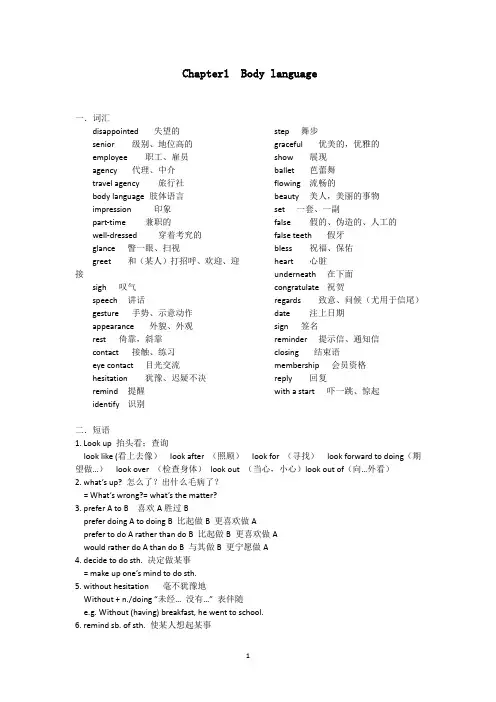
Chapter1 Body language 一.词汇disappointed 失望的senior 级别、地位高的employee 职工、雇员agency 代理、中介travel agency 旅行社body language 肢体语言impression 印象part-time 兼职的well-dressed 穿着考究的glance 瞥一眼、扫视greet 和(某人)打招呼、欢迎、迎接sigh 叹气speech 讲话gesture 手势、示意动作appearance 外貌、外观rest 倚靠,斜靠contact 接触、练习eye contact 目光交流hesitation 犹豫、迟疑不决remind 提醒identify 识别step 舞步graceful 优美的,优雅的show 展现ballet 芭蕾舞flowing 流畅的beauty 美人,美丽的事物set 一套、一副false 假的、伪造的、人工的false teeth 假牙bless 祝福、保佑heart 心脏underneath 在下面congratulate 祝贺regards 致意、问候(尤用于信尾)date 注上日期sign 签名reminder 提示信、通知信closing 结束语membership 会员资格reply 回复with a start 吓一跳、惊起二.短语1. Look up 抬头看;查询look like (看上去像)look after (照顾)look for (寻找)look forward to doing(期望做…)look over (检查身体)look out (当心,小心)look out of(向…外看)2. what’s up? 怎么了?出什么毛病了?= What’s wrong?= what’s the matter?3. prefer A to B 喜欢A胜过Bprefer doing A to doing B 比起做B 更喜欢做Aprefer to do A rather than do B 比起做B 更喜欢做Awould rather do A than do B 与其做B 更宁愿做A4. decide to do sth. 决定做某事= make up one’s mind to do sth.5. without hesitation 毫不犹豫地Without + n./doing “未经…没有…”表伴随e.g. Without (having) breakfast, he went to school.6. remind sb. of sth. 使某人想起某事Remind sb. to do sth. 提醒某人做某事7. in … situation 在某种情况下= on … occasion8. the key to …什么的钥匙/ 关键如:the key to the door; the key to successful communication9. as a matter of fact 事实上= in fact = actually三.语法(一). 零冠词:名词前无冠词(a, an, the)的现象。