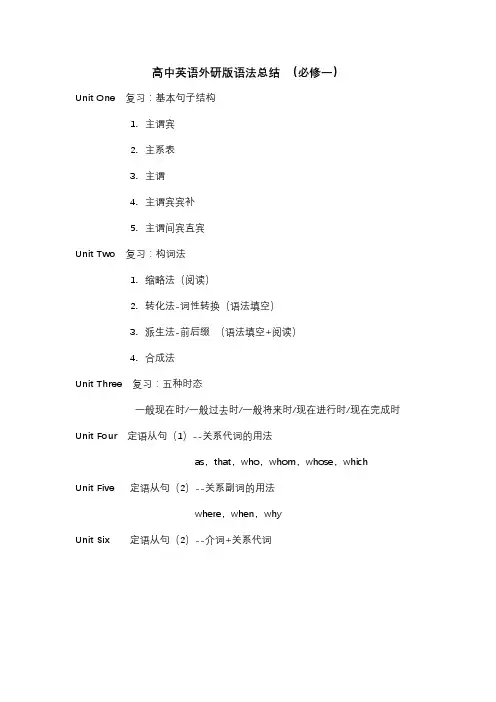
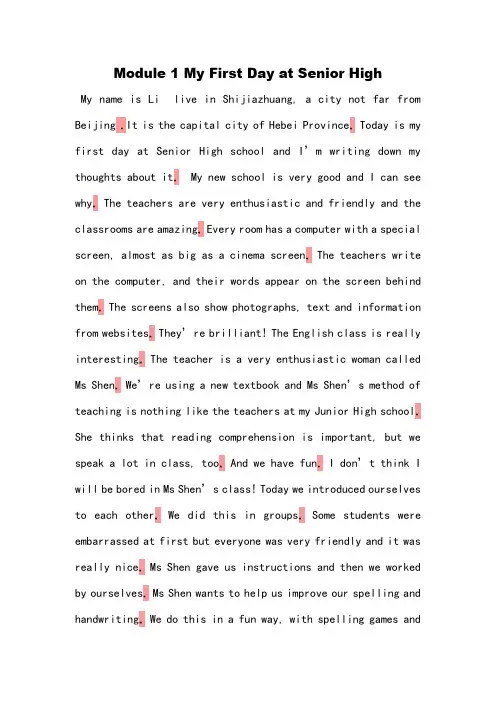
外研版高中英语必修一语法
- 格式:docx
- 大小:21.62 KB
- 文档页数:8
外研版高中英语必修一语法
英语必修一MODULE 1
重要知识点
1、重点词组
换句话说
in other words
期待;盼望
look forward to doing sth.寻找
look for
对…印象深刻
be impressed with 与…不同
be different from 在……开始的时候
at the start of 在……结束的时候
at the end of
被(划)分成
……be divided into
2.语法基础
主语:句子或者句意的主要人物或事物,一般在句首。主语的成分有名词(如boy),主格代词(如you),动词不定式(由to+动词原形构成),动名词(如果一个动词加上了ing变成了名词,那么这个词称动名词)等。
谓语:谓语由动词构成,是英语时态、语态变化的主角,一般在主语之后。及物动词vt.,不及物动词vi.。及物动词可直接接宾语;不及物动词后不能直接接宾语。若要接宾语,必须先在其后添加上某个介词,如in,to,of ,at。
He reached Paris the day before yesterday.
This is the room where I once lived.
Please hand me the book over there.
I went to school yesterday. 宾语:宾语分为直接宾语和间接宾语两大类,其中直接宾语指动作的直接对象,间接宾语说明动作的非直接,但受动作影响的对象。一般而言,及物动词后面最少要有一个宾语,而该宾语通常为直接宾语,有些及物动词要求两个宾语,则这两个宾语通常一个为直接宾语,另一个为间接宾语。例:The boy needs a pen.
I teach him English.
定语:对主语或者宾语的修饰。汉语中常用“……的”表示。主要有形容词此外还有名词、代词、数词、介词短语、动词不定式(短语)、分词、定语从句或相当于形容词的词、短语或句子都可以作定语。The little boy needs a blue pen.
Two boys need two pens.
His boy needs Tom\'s pen.
The boy in blue is Tom.
(in blue为定语,修饰名词boy)/穿蓝色衣服的孩子是汤姆。
The boy needs a ball pen.
(ball为定语,修饰名词pen)/男孩需要一支圆珠笔。
The best boy here is Tom.
(here为定语,修饰名词boy)/这里最棒的男孩是Tom。
There is nothing to do today.
(to do为定语,修饰名词nothing)/今天没有事要做。
The pen bought by her is made in China.
(bought by her 为定语,修饰名词pen)/她买的笔是中国产的。
状语:是句子的重要修饰成分。状语是谓语里的另一个附加成分,状语修饰动词、形容词、副词或全句,说明方式、因果、条件、时间、地点、让步、方向、程度、目的等。状语在句子中的位置很灵活,常见情况为:通常在句子基本结构之后,强调时放在句首。
1.副词一般在句子中做状语.
He speaks English very well.
他英语说得非常好中的very是程度副词,用来修饰well。very
well是修饰speak的程度状语。 2.不定式在句子中可以作目的状语。
I come specially to see you.我专门来看你.
3.介词短语
Ten years ago, She began to live in Dalian.
4.从句作状语
When she was 12 years old, she began to live in Dalian.
If I am not busy tomorrow, I will play football with you.
5.分词作状语
Having had a quarrel with his wife, he left home in a bad
temper.
补语:英语补语的作用对象是主语和宾语,具有鲜明的定语性描写或限制性功能,在句法上是不可或缺的。补语是起补充说明作用的成份。最常见的是宾语补足语。名词、动名词、形容词、副词、不定式、现在分词、过去分词都可以在句子中作宾补。
例一Please don't call me fat.
例二They made the girl cry.
3、重要句式
1.I like Chinese because I enjoy reading stories and poems.
enjoy doing…… 喜欢做
只能接动名词做宾语:enjoy、imagine 、can`t help
喜欢想象禁不住
2.I live in shijiazhuang,a city not far from Beijing.
(1)a city not far from Beijing是shijiazhuang的同位语(2)比较级:far farther—farthest
further—furtherst
I can throw the ball farther than you can.
3.The teachers write on the computer,and their words appear
on the screen behind them.
appear 常用作不及物动词或连系动词,表示“出现,显现”,后接不定式、形容词或从句。 appear做连系动词,表示“似乎,显得”。
It appears that she will win.
4. And we have fun.
(1)have fun玩得开心,快乐
(2)have fun (in) doing sth. 做某事是快乐的
have fun with sb. 和某人在一起是快乐的
5. I'm looking forward to doing it!
look forward to sth./doing sth.期待着某事/做某事”,其中“to”是介词。
动词+介词to构成的常用短语有:
turn to求助于;转向;翻到……pay attention to注意……belong
to属于
6.The teachers are very enthusiastic and friendly and the
classrooms are amazing.
(1) be enthusiastic about sb./ sth. 对…热心/着迷
Mike is enthusiastic about football games.
(2) amazing adj. 令人吃惊的
It is amazing that you can`t swim.
以-ing和-ed结尾的形容词用法:
例She is an ____ (interest) writer, and I`m ____(interest) in the
subjects .
以-ing和-ed的结尾的形容词,常用来表示特征和状态。形式是动词的过去分词和现在分词,但是实际上却是形容词。常见的有:tired/tiring, satisfied/satisfying, interested/interesting,
disappointed/disappointing, pleased/pleasing等。
–ed结尾的形容词,通常用于说明句中主语(人)的情绪变化,对人和物的态度感受,常译为某人感到……的;-ing结尾的形容词,主要用于说明事物,表示事物的性质或特征,若用它们说明人,则表示此人具有此性质或特征。通常译为令人……的。
He is not interested in politics. The book is very interesting.
比较:He is frightened.He is frightening.
7. The teacher is a very enthusiastic woman called Ms Shen.
例The players ________ from the whole country are expected
to bring us honor in this summer game.
A. selecting
B. to select
C. selected
D. having selected
(1)called Ms Shen 过去分词短语作定语,与所修饰的词逻辑关系上存在被动关系,相当于定语从句的who/ that is called
Ms Shen.
We visited the new library built three weeks ago.
(2)过去分词作定语,与所修饰的词逻辑关系上存在被动关系;现在分词作定语,与所修饰的词逻辑关系上存在主动关系。
Do you know the man standing by the door?
Do you know the man locked in the room?
8.Ms Shen’s method of teaching is nothing like the teachers
at my Junior High school.
(1) nothing like 丝毫不像something like 大约,有点像
(2) that 代替前面提到的method
【辨析】one,that,it用法解析
例If you're buying today's paper from the stand, could you
get______ for me?
A. one
B. it
C. this
D. that
one 泛指,代替前面提到过的那类人或物,指代可数名词。复数形式ones前面需要定语修饰。(同名异物)