
《英语句子扩写》课件
- 格式:ppt
- 大小:2.74 MB
- 文档页数:5


英语句子扩写的八大绝招
英语句子扩写的八大绝招包括:
增加修饰成分:可以在名词前增加定语、状语等修饰词,如形容词、介词短语、副词等,以增强句子的描述性和细节。
使用从句:可以在句中增加从句,以增强句子的复杂性和表达力。例如,可以使用if、when、where等引导的从句。
运用被动语态:将句子中的主语和谓语位置互换,并增加适当的主语,以使句子更加客观、具体。
运用疑问句:将陈述句变为疑问句,可以增强句子的语气和吸引力。
使用强调句型:使用强调句型可以突出句子的重点,增强句子的表达力。
运用倒装句:将句子中的部分成分放在句首,可以增强句子的节奏感和表现力。
增加举例说明:可以在句子中增加具体的例子,以增强句子的说服力和清晰度。
使用并列句:将两个或多个简单句组合成一个并列句,可以增强句子的连贯性和表达力。
希望这些绝招可以帮助您扩展英语句子。

高中英语作文句子扩写大全
(中英文实用版)
Expanding Sentences for High School English Essay Composition
A comprehensive guide to enhancing the variety and richness of
expressions in high school English essay writing involves a myriad of
techniques.To begin with, the effective use of synonyms and antonyms
can significantly elevate the sophistication of one"s prose.For instance,
instead of using "happy," students can opt for "elated," "joyful," or
"ecstatic" to convey varying degrees of happiness.
在高中英语作文中,想要提升表达的多样性和丰富性,就需要掌握多种技巧。首先,同义词和反义词的巧妙运用能够大大提高文章的档次。例如,学生可以用“elated”(欣喜的)、“joyful”(快乐的)或“ecstatic”(狂喜的)来替换“happy”,以表达不同程度的快乐。
Furthermore, incorporating vivid adjectives and adverbs can paint a
more vivid picture in the reader"s mind.For example, describing a "swiftly
flowing river" instead of a "fast river" not only adds depth but also creates
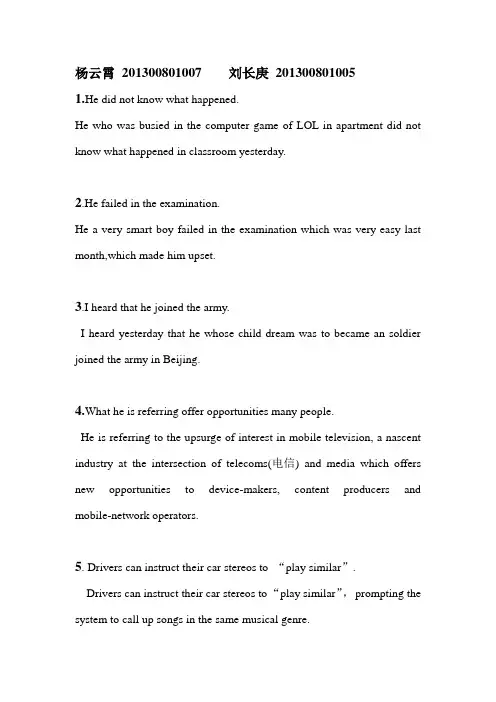
杨云霄 201300801007 刘长庚 201300801005
1.He did not know what happened.
He who was busied in the computer game of LOL in apartment did not
know what happened in classroom yesterday.
2.He failed in the examination.
He a very smart boy failed in the examination which was very easy last
month,which made him upset.
3.I heard that he joined the army.
I heard yesterday that he whose child dream was to became an soldier
joined the army in Beijing.
4.What he is referring offer opportunities many people.
He is referring to the upsurge of interest in mobile television, a nascent
industry at the intersection of telecoms(电信) and media which offers
new opportunities to device-makers, content producers and
mobile-network operators.
5. Drivers can instruct their car stereos to “play similar”.
Drivers can instruct their car stereos to “play similar”, prompting the

初中生英语句子成分划分
句子成分是指构成句子的各个组成部分,即
词或短语在句子中的各个语法意义。
组成句子的各个部分叫句子成分。英语句子成分有主语,谓语,表语,宾语,宾语补足语,定语,状语等。
顺序一般是主语,谓语,宾语,宾语补足语,而表语,定语,状语的位置要根据情况而定。
1、主语
主语表示句子主要说明的人或事物,一般由名词,代词,数词,不定式等充当。
He likes
watching TV.他喜欢看电视。
2、谓语
谓语说明主语的动作,状态或特征。
一般可分为两类
1),简单谓语 由动词(或短语动词)构成。
可以有不同的时态,语态和语气。
We study for the
people.我们为人民学习。
2),复合谓语
情态动词+不定式 I can speak a
little English.我可以说一点英语。
3、表语
表语是谓语的一部分,它位于系动词如be之后,说明主语身份,特征,属性或状态。一般由名词,代词,形容词,副词,不定式,介词短语等充当。
My sister is a
nurse.我姐姐是护士。
4、宾语
宾语表示动作行为的对象,跟在及物动词之后,能作宾语的有名词,代词,数词,动词不定式等。 We like English.我们喜欢英语。
有些及物动词可以带两个宾语,往往一个指人,一个指物,指人的叫间接宾语,指物的叫直接宾语。
He gave me some
ink.他给了我一点墨水。 有些及物动词的宾语后面还需要有一个补足语,意思才完整,宾语和它的补足语构成复合宾语。
We make him our
monitor.我们选他当班长。
5、定语 在句中修饰名词或代词的成分叫定语。
用作定语的主要是形容词,代词,数词,名词,副词,动词不定式,介词短语等。形容词,代词,数词,名词等作定语时,通常放在被修饰的词前面。 He is a new