10年英语真题
- 格式:doc
- 大小:46.00 KB
- 文档页数:10
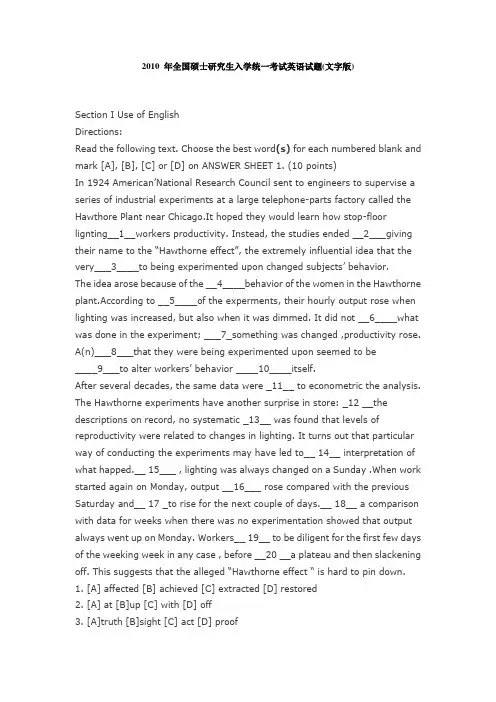
2010 年全国硕士研究生入学统一考试英语试题
Section I Use of English
Directions:
Read the following text. Choose the best word(s) for each numbered blank and mark
[A], [B], [C] or [D] on ANSWER SHEET 1. (10 points)
In 1924 American’National Research Council sent to engineers to supervise a series
of industrial experiments at a large telephone-parts factory called the Hawthore
Plant near Chicago.It hoped they would learn how stop-floor lignting__1__workers
productivity. Instead, the studies ended __2___giving their name to the “Hawthorne
effect”, the extremely influential idea that the very___3____to being experimented
upon changed subjects’ behavior.
The idea arose because of the __4____behavior of the women in the Hawthorne
plant.According to __5____of the experments, their hourly output rose when lighting
was increased, but also when it was dimmed. It did not __6____what was done in the
experiment; ___7_something was changed ,productivity rose. A(n)___8___that they
were being experimented upon seemed to be ____9___to alter workers’ behavior
____10____itself.
After several decades, the same data were _11__ to econometric the analysis. The
Hawthorne experiments have another surprise in store: _12 __the descriptions on
record, no systematic _13__ was found that levels of reproductivity were related
to changes in lighting.
It turns out that particular way of conducting the experiments may have led to__
14__ interpretation of what happed.__ 15___ , lighting was always changed on a
Sunday .When work started again on Monday, output __16___ rose compared with the
previous Saturday and__ 17 _to rise for the next couple of days.__ 18__ a comparison
with data for weeks when there was no experimentation showed that output always went
up on Monday. Workers__ 19__ to be diligent for the first few days of the weeking
week in any case , before __20 __a plateau and then slackening off. This suggests
that the alleged “Hawthorne effect “ is hard to pin down.
1. [A] affected [B] achieved [C] extracted [D] restored
2. [A] at [B]up [C] with [D] off
3. [A]truth [B]sight [C] act [D] proof
4. [A] controversial [B] perplexing [C]mischievous [D] ambiguous
5. [A]requirements [B]explanations [C] accounts [D] assessments
6. [A] conclude [B] matter [C] indicate [D] work
7. [A] as far as [B] for fear that [C] in case that [D] so long so
8. [A] awareness [B] expectation [C] sentiment [D] illusion
9. [A] suitable [B] excessive [C] enough [D] abundant
10. [A] about [B] for [C] on [D] by
11. [A] compared [B]shown [C] subjected [D] conveyed
12. [A] contrary to [B] consistent with [C] parallel with [D] pealliar to
13. [A] evidence [B]guidance [C]implication [D]source
14. [A] disputable [B]enlightening [C]reliable [D]misleading
15. [A] In contrast [B] For example [C] In consequence [D] As usual
16. [A] duly [B]accidentally [C] unpredictably [D] suddenly
17. [A]failed [B]ceased [C]started [D]continued
20. [A]breaking [B]climbing [C]surpassing [D]hitting
Section II Reading Comprehension
Part A
Directions:
Read the following four texts. Answer the questions below each text by choosing [A],
[B], [C] or [D]. Mark your answers on ANSWER SHEET 1. (40 points)
Text 1
Text 2
Over the past decade, thousands of patents have seen granted for what are called
business methods. received one for its “one-click” online payment
system. Merrill Lynch got legal protection for an asset allocation strategy. One
inventor patented a technique for lifting a box.
Now the nation’s top patent court appears completely ready to scale back on
business-method patents, which have been controversial ever since they were first
authorized 10 years ago. In a move that has intellectual-property lawyers abuzz the
U.S. court of Appeals for the federal circuit said it would use a particular case
to conduct a broad review of business-method patents. In re Bilski , as the case
is known , is “a very big deal”, says Dennis’D. Crouch of the University of
Missouri School of law. It “has the potential to eliminate an entire class of
patents.”
Curbs on business-method claims would be a dramatic about-face, because it was the
federal circuit itself that introduced such patents with is 1998 decision in the
so-called state Street Bank case, approving a patent on a way of pooling mutual-fund
assets. That ruling produced an explosion in business-method patent filings,
initially by emerging internet companies trying to stake out exclusive pinhts to
specific types of online transactions. Later, move established companies raced to
add such patents to their files, if only as a defensive move against rivals that
might bent them to the punch. In 2005, IBM noted in a court filing that it had been
issued more than 300 business-method patents despite the fact that it questioned