
Reading(1):Englishanditshistory
- 格式:pptx
- 大小:1.25 MB
- 文档页数:18

Unit 1 Teenage lifeReading and Thinking (1)阅读理解ARoger: Hi, there! It was my 15th birthday last Saturday. Some of my friends and Alan, my cousin, came to celebrate it. Everyone brought me a gift. We had a party. We played games, sang songs and had a big birthday cake. It was really a wonderful day! Did you do anything special last week?Jessica: Yes. My class were on a school field trip last week. First, we went to the University of North Carolina to learn about the history of its basketball team. Many basketball stars were students there! Then we visited a museum. We learned about how the plane was invented and took many pictures there.Sara: Well, I was lucky enough to go to a conference(会议) on charity(慈善) last Wednesday. I was so excited to meet a lot of kind people there. One of them was a boy named Richard. He spoke at the conference about the charity work that he had done in the past few years.Martin: It was a more different week than usual. Last Thursday, my school band went to Atlanta to perform in a competition. I played the violin and we won a prize! On Friday, we went to the Georgia Aquarium and got to see different kinds of sea life from all over the world. It was really cool!1. When did Roger have his birthday party?A. Last Wednesday.B. Last Thursday.C. Last Friday.D. Last Saturday.解析:细节理解题。

Ⅰ.认阅读单词1.heritage n.遗产(指国家或社会长期形成的历史、传统和特色) 2.temple n.庙;寺3.relic n.遗物;遗迹4.clue n.线索;提示5.dam n.水坝;拦河坝6.protest n.抗议v i.&v t.(公开)反对;抗议7.committee n.委员会8.fund n.基金;专款9.document n.文件;公文;(计算机)文档v t.记录;记载(详情) 10.republic n.共和国11.archaeologist n.考古学家12.pyramid n.(古埃及的)金字塔;棱锥体13.sheet n.一张(纸);床单;被单14.parade n.游行;检阅v i.游行庆祝;游行示威15.digital adj.数码的;数字显示的16.cave n.山洞;洞穴17.quote v t.引用18.paraphrase n.,v i.&v t.(用更容易理解的文字)解释Ⅱ.记重点单词1.mount n.山峰v t.爬上;骑上v i.爬;登上2.former adj.以前的;(两者中)前者的3.preserve v t.保存;保护;维持n.保护区4.likely adj.可能的ad v.可能地5.department n.部;司;科6.within prep.&ad v.在(某段时间、距离或范围)之内7.issue n.重要议题;争论的问题v t.宣布;公布8.conduct n.行为;举止;管理方法v t.组织;安排;带领9.attempt n.&v t.企图;试图;尝试10.worthwhile adj.值得做的;值得花时间的11.download v t.下载n.下载;已下载的数据资料12.entrance n.入口;进入13.process n.过程;进程;步骤v t.处理;加工14.overseas adj.海外的ad v.在海外15.exit n.出口;通道v i.&v t.出去;离去16.mirror n.镜子17.roof n.顶部;屋顶18.dragon n.龙19.image n.形象;印象20.throughout prep.各处;遍及;自始至终21.quality n.质量;品质;素质;特征adj.优质的;高质量的22.further ad v.(far的比较级)更远;进一步23.opinion n.意见;想法;看法24.contrast n.对比;对照v t.对比;对照25.forever ad v.永远;长久地Ⅲ.知拓展单词1.creatively ad v.创造性地;有创造力地→creative adj.创造性的;有创造力的;有创意的→create v t.创造→creativity n.创造性;创造力→creation n.作品;创造2.promote v t.促进;提升;推销;晋级→promotion n.提升;推销;晋级3.application n.申请(表);用途;运用;应用(程序)→apply v t.&v i.申请;应用;涂;敷→applicant n.申请人→app n.应用程序;应用软件(application的缩略形式)4.balance n.平衡;均匀v t.使平衡→balanced adj.平衡的;均衡的5.proposal n.提议;建议→propose v t.提议;建议6.establish v t.建立;创立→establishment n.建立;创立7.limit n.限度;限制v t.限制;限定→limited adj.有限的;受限制的→limitless/unlimited adj.无限的;无尽的→limitation n.限制;局限;极限8.prevent v t.阻止;阻碍;阻挠→prevention n.防止;预防→preventive adj.预防性的;防备的9.loss n.丧失;损失→lose v t.丢失→lost adj.迷路的;失去的10.contribution n.捐款;贡献;捐赠→contribute v i.&v t.捐献;捐助11.investigate v i.&v t.调查;研究→investigation n.调查;研究12.donate v t.(尤指向慈善机构)捐赠;赠送;献(血)→donation n.捐赠物;捐赠;赠送→donor n.捐赠者;捐赠人13.disappear v i.消失;灭绝;消亡→disappearance n.消失;灭绝→(反义词)appear v i.出现→appearance n.出现;外表14.professional adj.专业的;职业的n.专业人员;职业选手→profession n.专业;职业→professor n.教授15.forgive v t.&v i.(forgave,forgiven)原谅;宽恕v t.对不起;请原谅→forgiveness n.原谅;宽恕16.tradition n.传统;传统的信仰或风俗→traditional adj.传统的17.historic adj.历史上著名(或重要)的;有史时期的→history n.历史→historian n.历史学家→historical adj.(有关)历史的;历史上的18.comparison n.比较;相比→compare v t.&v i.与……相比较19.identify v t.确认;认出;找到→identity n.身份;个性→identification n.识别;身份证明(文件)1.attendance n.出席人数;出席;参加2.awful adj.可怕的3.bacterium(复bacteria)n.细菌4.baggage n.行李5.banquet n.宴会,盛宴6.bare adj.空的;赤裸的7.bargain n.(经讨价还价之后)成交的商品;廉价货v i.讨价还价8.barrier n.障碍;隔阂Ⅳ.背核心短语1.take part in参与(某事);参加(某活动)2.give way to让步;屈服3.keep balance保持平衡4.lead to导致5.make a proposal提出建议6.turn to向……求助7.prevent...from...阻止;不准8.donate...to...向……捐赠……9.make sure确保;设法保证10.all over the world在世界各地Ⅴ.悟经典句式1.There comes a time when the old must give way to the new,and it is not possible to preserve everything from our past as we move towards the future.(There comes a time when...)新旧更替的时代已经到来,在走向未来的过程中,我们不可能将过去的一切都保存下来。
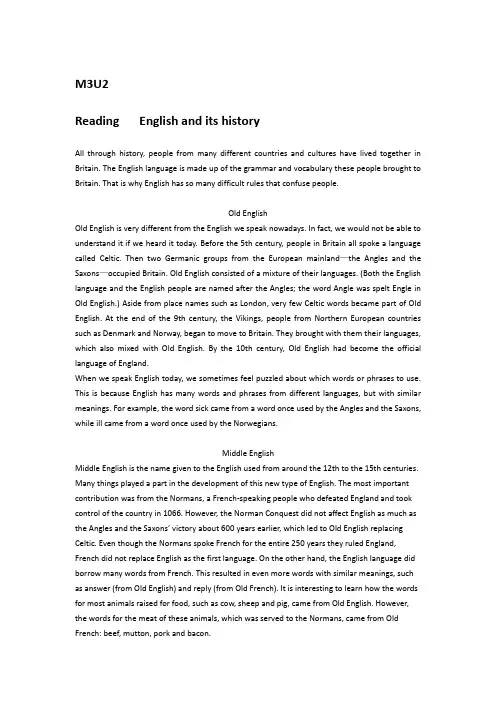
M3U2Reading English and its historyAll through history, people from many different countries and cultures have lived together in Britain. The English language is made up of the grammar and vocabulary these people brought to Britain. That is why English has so many difficult rules that confuse people.Old EnglishOld English is very different from the English we speak nowadays. In fact, we would not be able to understand it if we heard it today. Before the 5th century, people in Britain all spoke a language called Celtic. Then two Germanic groups from the European mainland—the Angles and the Saxons—occupied Britain. Old English consisted of a mixture of their languages. (Both the English language and the English people are named after the Angles; the word Angle was spelt Engle in Old English.) Aside from place names such as London, very few Celtic words became part of Old English. At the end of the 9th century, the Vikings, people from Northern European countries such as Denmark and Norway, began to move to Britain. They brought with them their languages, which also mixed with Old English. By the 10th century, Old English had become the official language of England.When we speak English today, we sometimes feel puzzled about which words or phrases to use. This is because English has many words and phrases from different languages, but with similar meanings. For example, the word sick came from a word once used by the Angles and the Saxons, while ill came from a word once used by the Norwegians.Middle EnglishMiddle English is the name given to the English used from around the 12th to the 15th centuries. Many things played a part in the development of this new type of English. The most important contribution was from the Normans, a French-speaking people who defeated England and took control of the country in 1066. However, the Norman Conquest did not affect English as much as the Angles and the Saxons’ victory about 600 years earlier, which led to Old English replacing Celtic. Even though the Normans spoke French for the entire 250 years they ruled England, French did not replace English as the first language. On the other hand, the English language did borrow many words from French. This resulted in even more words with similar meanings, such as answer (from Old English) and reply (from Old French). It is interesting to learn how the words for most animals raised for food, such as cow, sheep and pig, came from Old English. However, the words for the meat of these animals, which was served to the Normans, came from Old French: beef, mutton, pork and bacon.Old French made other contributions to Middle English as well. In Old English, the Germanic way of making words plural was used. For example, they said housen instead of houses, and shoen instead of shoes. After the Normans took control, they began using the French way of making plurals, adding an -s to house and shoe. Only a few words kept their Germanic plural forms, such as man/men and child/children.After the Norman Conquest, high-class people spoke French while common people spoke English. However, by the latter half of the 14th century, English had come into widespread use among all classes in England. In 1399, Henry Ⅳbecame King of England. His mother tongue was English, and he used English for all official events.Modern EnglishModern English appeared during the Renaissance in the 16th century. Because of this Modern English includes many Latin and Greek words. Pronunciation also went through huge changes during this period. Of course, this was not the end of the changes in the English language. The question of whether English will keep on changing in the future is easy to answer. It is certain that this process will continue, and people will keep inventing new words and new ways of saying things.M3U2Project The development Chinese charactersThe Chinese language differs from Western languages in that, instead of an alphabet, it uses characters which stand for ideas, objects or deeds. Chinese words are formed by putting together different characters. In many cases, a single character can also make up a word. The history of the Chinese language can be examined by looking at how these characters developed.Chinese writing began thousands of years ago. According to an ancient story, a man named Cang Jie invented Chinese writing. One winter day while he was hunting, he saw the tracks of animals in the snow and observed that the appearance of each one was different. Then he had the idea that he could use different shapes to represent different objects. The first Chinese characters were drawings of physical objects. Some characters have been simplified and others have been made more difficult over time. However, as a whole, the characters have developed from drawings into standard forms. The character for a mountain was at first three mountaintops together. This became one mountaintop and three lines, and over time turned into the character used nowadays.Not all characters were developed from drawings of objects. Sometimes to express ideas, some characters were made by combining two or more characters together. For example, 'rest' was made up of the characters for a man and a tree. The character 'prisoner' was formed with a 'man' inside a square. Other characters were developed for directions and numbers. It is easy to distinguish their meanings by looking at them, for example, the characters for 'up' and 'down', which are opposites of each other.Though these kinds of characters indicate meanings, one of their shortcomings is that they do not show how they should be pronounced. Therefore, a method was developed to have one part of a character indicate the meaning and the other suggest the pronunciation. Many Chinese characters used today were made this way.In the 1950s the Chinese government introduced simplified Chinese characters and now they have widespread use in China's mainland.The story of BrailleUsually, when we talk about reading, we think of using our eyes to see letters written in ink on paper. However, this is not always true. For example, blind people cannot see, but they can still read books.The man who introduced blind people to reading was Louis Braille (1809-1852). Braille lost hiseyesight at the age of three as a result of an injury. When he was ten, he went to a school for the blind in Paris. In those days, books for blind people used paper pressed against metal wire to form letters. Since the metal wire was heavy, each book weighed as much as 100 pounds. The whole system was not convenient for use. Indeed, the school library only had fourteen such books in it.In 1821, a soldier visited the school and showed the students a system for passing messages at night during times of battle. His system used paper with small, raised dots that could be felt with the fingers. Each letter of the alphabet was represented by a different pattern which consisted of twelve dots. The soldiers would drag their fingers over the raised dots to read the message. While the students found the soldier's idea interesting, the system was too difficult to be of practical use. However, young Louis Braille took the idea and worked on it. At the age of fifteen, he created a system with patterns of six raised dots representing each letter. 'Braille', the system for reading used today by blind people around the world, was thus born.The blind can easily recognize Braille with the fingers. They can also easily write in Braille with a special typewriter. Today, it is the most common system used by blind people for reading and writing, and nearly every language, including Chinese, has its own version of Braille for its people to use.。

初中所有学科英文一、初中常见学科英文及翻译、解释、用法示例1. 语文- Chinese- 翻译:“语文”的英文是“Chinese”,在这里“Chinese”作为名词,表示“中国人;汉语;中文”等含义。
- 用法解释:当提及与中国的语言、文学、文化等相关的学习内容时使用。
例如在描述语文课上的学习活动,如阅读中国古典文学作品、学习汉字书写等。
- 示例- I like Chinese because I can read many interesting stories.(我喜欢语文,因为我能读到很多有趣的故事。
)- Chinese is our mother tongue.(汉语是我们的母语。
)- We study Chinese poems in Chinese class.(我们在语文课上学习中国诗歌。
)- The Chinese teacher asked us to write an essay.(语文老师要求我们写一篇作文。
)- Chinese includes grammar, vocabulary and reading comprehension.(语文包括语法、词汇和阅读理解。
)- My favorite part in Chinese is ancient prose.(我最喜欢语文中的古文部分。
)- I got a high score in Chinese this time.(我这次语文得了高分。
)- Chinese culture is deeply reflected in our Chinese study.(中国文化在我们的语文学习中有着深刻的反映。
)- We should practice Chinese writing more often.(我们应该更经常地练习语文书写。
)- The difficulty of Chinese lies in its profound connotations.(语文的难点在于其深刻的内涵。